Let’s Decode Warren Buffet Rules of Investing
POSTED BY ON July 8, 2010 COMMENTS (33)
In this article, we discuss two rules of Warren Buffet and understand their essence. A lot of people in the stock market quote these two rules of his, but the majority of them don’t even understand what they mean exactly, and what Warren Buffet actually tried, to communicate with his rules.
He mainly stressed on “Controlling losses” which is the most crucial point, when one deals with Equity. This can be directly investing in the stock market or through Equity mutual funds. Let’s look at them.
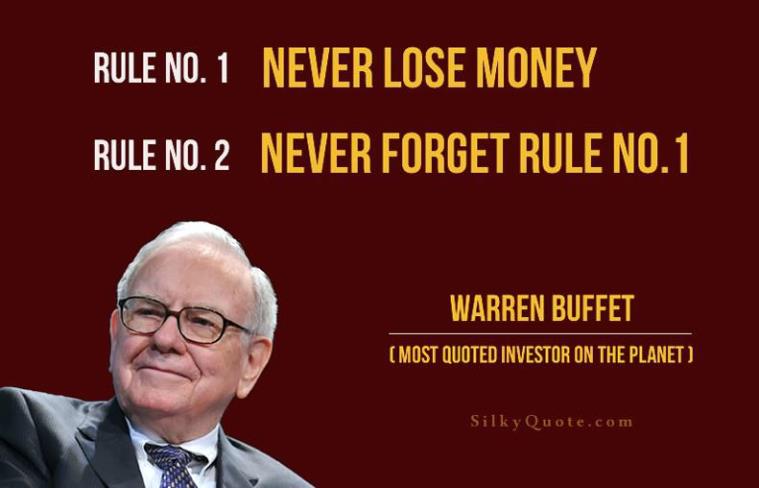
Warren Buffet Rule of Never Lose
Warren Buffet says, there are two rules in the stock market
- Never Lose Money
- Never forget Rule #1
Most investors have heard this and have read it a number of times. But for the most part, they’ve taken these words casually and feel that they are just funny lines. How can one never lose and how can that be the single most important rule in the stock market?
The real meaning of these two rules lies behind those words and if we dig a little deeper, we will understand the real value of those rules.
Let me decode it for you here. Read it with all your concentration & focus. Those two rules, really are, worth everything in the stock market.

What Warren Buffet really means when he says “Never Lose”?
No one in this world, wins all the time. One loses frequently, and this is true in stock markets also. No one can ever trade or invest in such a way that he/she never loses.
What Warren Buffer actually means by “Never Lose” is that every time we lose, it has to be an insignificant loss. The quantum of loss, has to be so limited or small, that It’s not going to affect us psychologically. If we make a profit of 100 every time and lose 20 or 30 every time we lose, we are actually not losing, if that’s your series of trades.
If you win 100 and lose 20, you are actually only winning 40 for every trade in series of 2 trades… But if you are letting your losses mount and never controlling them, then you are really losing and then those losses can impact you in a big way…
What he means when he says “Never forget Rule number 1”?
By this, he wants to emphasize on how important controlling losses are. Another one-liner of his, that in the stock market and in life you don’t need to do a lot of right things as far as you are not doing a lot of wrong things.
So, as far as you remember that controlling your losses is the topmost rule, you just need to be an average investor or trader and the power of compounding will take care of rest for you. I’ll summarize those rules again for you and what you should actually read in them.
Rule 1: Never Lose (Control your losses, cut them soon enough, so that you don’t feel them)
Rule 2: Never forget Rule 1 (Controlling your losses is the topmost priority you should have. As long as you are able to take care of it, other things will take care of themselves).
Let’s take an example – There are two investors, Ajay and Robert, who both make 1000 trades in their entire life, 500 losing trades and 500 winning trades. Ajay makes a profit of 6% on winning trades and a 3% loss on losing trade.
He has $11.9 Billion dollars in the end. On the other hand, Robert concentrates more on controlling his losses (and hence is able to control his losses up to 1% on average per losing trade) and also makes 5% on winning trades. At the end of his career, he would have $25 billion.
Conclusion
Its only controlling losses which made Robert more money than Ajay. Remember this, you need to concentrate more on “not messing it up” rather than making it “rock”.

I think you never research Buffet at all.
Buffet never use stop loss order and Buffet never sell because price fall.
Buffet said: if you can’t hold the stock after stock price fall 50%, you shouldn’t invest in stock market at all.
Go to research Buffett before publishing any article!
The real meaning of never lose money is research the company thoroughly with substantial margin of safety. So you never need to sell it and hold it forever.
I know Warren Buffet didnt say these things . I just used his name to attract readers and tell my stuff !
Stop Loss is a great tool that help to cut losses if things go wrong and every trader should use it as per his risk appetite
Agree 🙂
but setting a stop loss and then following it itself is a biggest challange 🙂
Manish
its almost impossibel to time the market, it might be that the time you ‘stop loss” is the time when the market is about to take a +ve turn, best is to minimise risk as much as possible ie ”control losses”
Manish,
Latest chart for Sensex and Niffty is available in http://www.ichart.in . It is possible to sign up for free.
Nice .. will have a look 🙂
Manish
Dear Manish,
Lets say again this is a good article.
I like to request you one thing. Please post an article “how to predict the best time to buy and sell the fund through an application of some technical analysis”.
caribou,
Technical analysis is an art not science. It depends on person’s time frame and type of trader.
There are various ways to look at charts. The simplest way is using moving averages, support and resistance levels on a chart pattern.
To illustrate buy and sell points using technical analysis in a single post by Manish is nearly impossible.
Praveen
Good concept , however we would require the chart and data for that , do you know good places we can get that ?
Manish
I can write an article on technical analysis with charts if you want to publish on your blog.
Praveen
Manish, we can get the latest chart of Sensex and Niffty from http://www.icharts.in , where you need to sign up for free.
I can view the chart, but analysis and future prediction is difficult for beginners like me.
Please provide a new post for analysis of the sensex chart, and how the buying and selling point can be predicted.
Sorry for late response.
Thanks for the link 🙂
Manish
it says web site under construction 🙁
Try again , works for me : http://www.icharts.in/ . its .in not .com
Manish
Hi Manish,
Sorry, but i dont agree with these rules.
actually, if i dont invest, i follow both the rules. but i dont make any money also. 😛
so actually, following these rules does mean that you are going to make money.
My rule is “Probability of profit is directly proportional to risk”
🙂
Nitin
Should’nt it be “Probability of profit is proportional to risk” , we are not sure if its linearly proportional or through some other way ?
Also the post only tried to say that controlling risk is very very important .
Manish
u are right.
Remember…if you loose 10%, to break even you need to earn back 11.1%
if you loose 20%, to break even you need to earn back 25%
but here is the kicker..if you loose 50%, you need to earn 100%.
how often you can earn 100% on your investments,very rare. unless you trade options.
Take care of downside (losses), upside (profits) will be taken care of automatically
Praveen
Yup , you got the essence of this article , we have to be more considerate with controlling the losses than making the profits
Manish
Hi Manish
I am a big fan of Warren Buffet and as a long term investor I follow his two rules theory. These rules are not for traders i think.
Khalid
Yes , I understand that these rules are not for traders , the example is taken just to show the concept that controlling looses is the main thing and even warren buffet stressed on that with his rules .
Manish
Hi Manish
good follower of yours
but now looks like it is contradicting
well Long term Goals & Trading does not go hand in Hand,except one is having both the side of world (very rare species )
and adding warren with trading 🙂 looks funny
Rohit
The intention is to communicate the importance of controlling losses , its not just about trading , trading example is taken for understanding .
manish
Manish – You have given a trading angle to Buffett’s first two rules. From a trading/speculation perspective , I agree that risk management (Stop losses etc.) and money management (position sizing etc. ) are important.
However when discussing Buffet, you have to wear fundamental cap, and when you mention — taking stop losses is what Buffett meant…. — I will tend to disagree ……..
Buffett’s first rule is primarily based on the concept of value discovery (intrinsic value) of a stock. All Value Experts (Phil Fisher, Ben Graham, Buffett — ). Their funda is to discover fundamentally good stock. Identify it’s intrinsic value. They believe that market is inefficient. If the price of that stock is well below it’s intrinsic value. Then the purchase is Risk Free (And this is what he means by Rule#1). Even if the price were to go below the purchase price, the belief is such that market will bring the price to well above it’s intrinsic value.
Rule#2 is well as is……
And lastly, thanks for such a wonderful website…. You are doing a great job….
– Kapil
Kapil
hmm.. I agree with you , may be a touch of trading has gone there , however all I wanted to communicate the importance of cutting loss 🙂 . thanks for pointing that out 🙂
Manish
Very true. I am also a big fan on “Money Management” and “Risk Management” then actual trading part. Sometimes its even said that if you are good in managing money, you can even make money by randomly picking up stocks (ok thats too much now :-))But rule of thumb, before you can buy/sell stocks, you must have clearly written risk management strategy with you in case stocks turns sour
Harpreet
Yup , Even I am a big fan of money management part . Its true that over a long term one’s skills in how they manage risk and their money is a bigger contributor of what they earn in the final . But traders do not understand it and continue searching for tips and tricks , which does not matter much .
Manish
I agree. Traders often have their biggest lost in Trading due to loss of proper money and risk management strategy coupled with heavy dose of leveraging. Classic examples would be the case of Victor Nieferhoffer and companies like Long Term Capital Management (LTCM)
hi manish,
so by this u mean that if the stock s good and it starts falling do we average to cut the losses or sell and come out of it
Sudhir
It means cutting the loss , one should cut the loss , you should not take it like “If prices fall , we should sell” , There are rules, when you trade you have to define the strategy you will take, how you will sell , under what conditions, whats the max loss you will take and stick to it .
Manish
Sudhir,
When you are saying that “when prices fall, we should sell” will not be a doubt no more once you understand that you need to come up with a clear strategy on when to exit if conditions turn sour. These doubts will always come when you take a plunge without having your “style” in mind. Always have a stragedy before taking a plunge.