How will Budget 2011 affect you ?

How much will you benefit with this budget ? There are some direct and indirect effects on a common man due to this budget which we will look in this article point by point . There has been not a major changes on exemption limits, but there are some changes which aim to simplify the whole process of Income tax.

Budget 2011 India changes

Tax Exemption limit raised

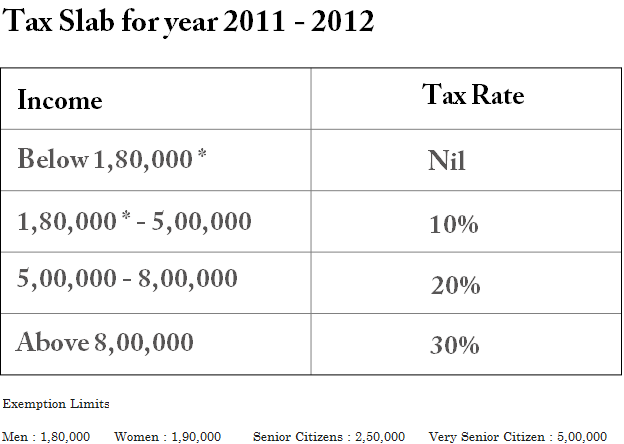
Earlier the limit of exemption was Rs 1,60,000. It has been raised from 1,60,000 to 1,80,000 . Which means roughly Rs 2,000 saving for individuals. For women, the exemption limit is at the same 1,90,000 .

Senior citizen definition and limits

Senior citizen definition is changed. Now any one above age 60 yrs will considered as senior citizen, earlier this was 65 yrs . This is a good move as more and more people will be able to enjoy the benefits of senior citizens. The exemption limit for senior citizens was also raised to 2,50,000 from previous limit of 2,40,000 .

No Tax Return filing if income less than Rs 5 lac

This has been the best point of this budget , from years small tax payers who were having smaller salaries had to go with the cumbersome process of filing tax returns , But from now on tax payers having income of less than Rs 5,00,000 will not have to file their tax returns, if their TDS is cut by their employer.

But incase one has additional income from other sources like dividends, capital gains , interest from Bank deposits or Income from House and Property etc , in that case they will have to file the tax returns or they will have to notify their employer in advance about these additional source of income so that the employer can take these points in consideration and deduct the extra TDS. In this case employees form 16 will be treated as their tax returns. This change can be a bit of blow for tax return filing service providers, a big relief for small tax payers who are purely salaried.

“CBDT will be issuing a notification, which clarifies about the  ‘classes of persons’ exempted from the requirement of furnishing income tax returns. This will be implemented for the year 2011-2012 and will come into effect from June 1, 2011” – said Sudhir Chandra , CBDT chairman .

New category called “Very senior citizen”

There is a new category of senior citizen called “very senior citizen” in this budget. Any one above 80 yrs of age will be under this category and they will not be taxed up to the income Rs 5,00,000 . While this looks a nice addition, the benefits of this move should be very limited, as I wonder how many 80 yrs old will have their personal income more than 5 lacs in our country. But it’s would be a good strategy to gift a big lump sum to very senior citizen and let it be invested on his name and generate income for him.

Infrastructure bonds extended by one more year

We saw the introduction of Infrastructure Bonds last year which can save you additional Rs 20,000 exemption other than sec 80C. In this budget , the this benefit is extended by one more year . Which means that in 2011 – 2012 also you can invest in Infrastructure bonds and save some tax.

Insurance policies other than Term Insurance to get expensive

In this budget, our financial minister has warned all the insurance companies to have a deeper focus on pure risk cover. Service tax net has been widened to insurance policies which have “investment” component, which means ULIP’s , Endowments plans , money back plans and even return of premium term insurance plans will have a higher service tax on the premiums. Earlier there was 1% service tax on the premiums, but now it has been raised to 1.5% . Which means that incase your premium is Rs 50,000 in ULIP , you were paying service tax of Rs 500 earliar, but now it would be Rs 750 , which will be adjusted from the premium itself . So that gives another reason to opt for term insurance now ! .

Medical , Air-travel and hotels becomes Expensive

Healthcare , Air-travel and expensive hotels is set to become more expensive due to some changes in this budget. The changes are

  1. Health check-ups done by hospitals with more than 25 beds or those with air conditioning will now be in the service tax net .
  2. There will be service tax of 5.15% on  hotels where the tariff is more than R1,000 a day or they are air-conditioned restaurant that has a licence to serve liquor.
  3. The service tax on economy class airfare has been increased by R50 to R150 on domestic sectors and by R250 to R750 for international travel.

So you will have to add some more thousands to your bill incase you were planning to go on vacation with your family and it required air travel + hotel stay !

Day to-day basic items to get costlier

There is excise duty of 1% levied on 130 items which includes day-to-day items like tea, coffee, sauces, ketchup, mobile phones , soups and all kinds of food mixes, ready-to-eat packaged foods . This would mean a bit of cost increased on them .

DTC coming in 2012

Financial minister has once again confirmed in his speech that DTC will be implemented from year 2012 . As per this article DTC would affect the NRI definition and it would negatively impact them.

Employer contribution towards NPS goes out of sec 80C

If your employer was contributing towards NPS , his contribution was eligible under 80C , but with this budget while it will still get tax deductions , it would come out of 80C , which means that some space will be left under 80C for people whose employer was contributing in NPS . The person can now invest more in sec 80C because of this .

Tax Slabs India 2011

Comments ?

What you you feel about this budget ? how are you affected ? Do you see as a good budget or as a bad budget ? Download this great ebook by Livemint on Union Budget incase you want to dive deeper .

SBI bonds @9.95% , Who should buy ?

SBI retail bonds or SBI bonds are the latest offers from the State Bank of India. These savings bonds issue will open from 21st Feb 2011 and closes on 28th Feb 2011.

These bonds are offering attractive interest rates to investors which are better than even fixed deposits, however, it does not suit every kind of investor. Only if you are looking at income generation, these bonds will be good for you, but if your aim is capital appreciation, you will benefit by investing in PPF instead of these bonds.

Lets look at the details of these retail bonds . .

SBI retail bonds

Tenure and Interest Rates on SBI bonds

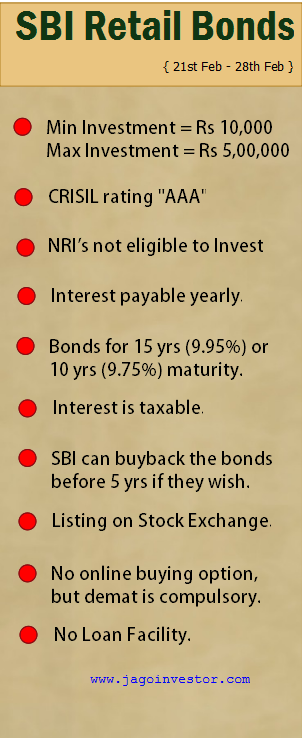
These SBI bonds will come in two variations. The first one is with 15 yrs maturity period offering 9.95% interest and the other option is with 10 yrs maturity period offering a 9.75% interest rate. Note that these interest rates are applicable only if you are investing less than Rs 5 lacs (retail category).

If you invest more than Rs 5 lacs then you will come into the category of non-retail investors for whom the interest rates are 9.30 percent for a 10-year bond and 9.45 percent for 15 years bond. The interest offered by these bonds is a payable yearly, which makes them a great alternative to Bank Fixed Deposits.

Following is an illustration which will clear a bit about how it works.

Ajay invests Rs 1,00,000 in 10 yrs SBI Retail bonds. He is entitled for 9.75% interest each year. So he will get Rs 9,750 per year for next 10 yrs . Note that each year this interest amount of Rs 9,750 will be added to his income and he will pay the tax on it accordingly as per his tax slab.

He can sell off these bonds on stock exchange incase he is getting a good deal . One more thing which can happen is that SBI can force him to sell off the bonds back to them if SBI exercises their “call options” , which we have talked about below ! .

Call option

There is something called “Call Option” in these SBI Bonds. For people who are familiar with “Futures and Options” , they know that a Call option is nothing but “Right to Buy” . So as per this call option, SBI has the right to buy back these bonds from you and terminate the contract with you much earlier than the actual maturity.

If they choose to “exercise” the call option, SBI will pay the principal back to you. For 15 yrs bonds, the call option can be exercised in 10th yr and for 10 yrs bonds, the call option can be exercised in 5th yr. Note once again that it’s the right of SBI, not yours.

For example: If you buy 15 yrs bond in 2011, then if SBI wants to buy back the bonds after 10 yrs which is the year 2021, they can do it. In which case, they will pay back the principle amount to you and close the contract.  But in case they dont want to do it, they will continue the bond and you can’t do anything :).

How to Apply for SBI Retail Bonds


There is no way to apply for these bonds online. You will have to physically go to SBI Bank and get the form from there and fill it up  (See the list of all the designated branches of SBI in PDF and EXCEL format, thanks to Babu for providing the list).

However, these bonds will be issued in Demat form only and therefore you will need to have Demat account for buying these Savings Bonds from State bank of India. So be clear on two points

  • You need to have Demat account to apply for these SBI Bonds
  • For applying you need to go to SBI Bank Branch and fill-up the form , there is no way to apply online

sbi retail bonds summary

Listing on Stock Exchange

One great thing about bonds is that they are listed on a stock exchange so that you can buy and sell them in the secondary market in case you want to exit from it before maturity. SBI retail bonds will also list on the stock exchange after 1 month of the issue, after which you can buy or sell them on the stock exchange.

Last time when SBI came with a similar issue, the buyers benefited a lot because the bonds listed at 5% premium on the first day itself, so there was an instant 5% gains for those who bought these bonds. However, there is no guarantee that it will happen again.

Taxation

The interest which you get from these bonds will be taxable. The interest will be added to your salary and taxed accordingly. Also, these bonds do not give you any tax benefits on investment amount and are not covered under sec 80C. So effective return for these bonds will be much lesser for investors in 20% and 30% bracket post-tax. Watch this video on 7 tips of saving tax

Should you Invest in these bonds?

So the main question anyone will ask is “Should I invest in these bonds?“. It would depend on your goal as an investor. Just by looking at 9.95% you cant say that its the best investment. Note that the interest payout if yearly. It’s not compounded like your PPF or FD’s. This means that the returns do not earn anything on it later, but its paid out to you.

So in case, your goal is to generate yearly income at decent rates, It would be a nice investment. However if your goal is capital appreciation and you are looking at the growth of your investments, these bonds would not be the best option. Note that even PPF would give more money to you at the end.

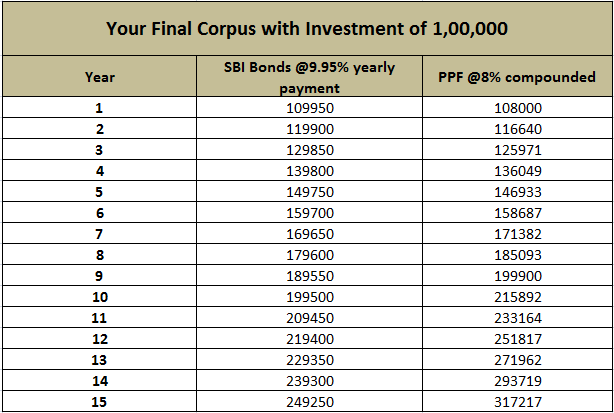
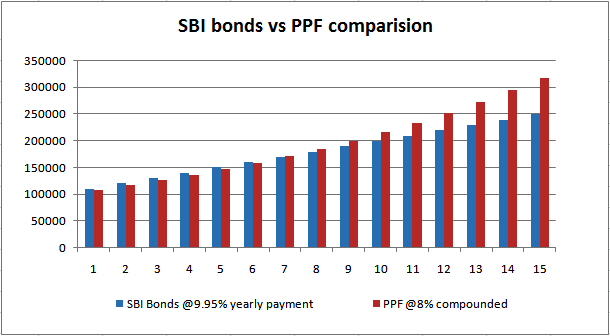
Below is a chart that shows the yearly amount you have got by the end of each year.

SBI bonds vs PPF

SBI bonds vs PPF

You can see that in the case of PPF you are having more money with you even though the interest you get on it is just 8% because of the compounding of money which is happening there .. However, in the case of SBI bonds, it’s not the case.

Here the reinvestment of those yearly payouts is not taken into consideration. So the point here is that if you want yearly income, only then these bonds make sense.

What about interest rates in the future?

But the only suspense is what will be the interest rates in the coming years? What you don’t know is how interest rates will move in the long-term and if interest rates offered by these bonds will look attractive in the future?

SBI might not be too dumb to offer these returns for such a long-term. Here is an except Deepak Shenoy …

“why is SBI doing this? They don’t need to. They’re really smart people. Let me reiterate that. SBI has extremely smart people. If they could have offered a lower rate, they would have. That means this is actually a low rate compared to what they expect rates to go to.

Meaning, there will be more rate hikes, and the 9.95% that looks good now, won’t look so great if you can get, say, 12% outside. (Don’t tell me 12% is out of reach, please. Even 10% was out of reach a couple of years ago) So that’s the risk – the feeling of regret if rates go up to 12% – in fact, you will think of it as a “loss” because the market value of the bonds will be below par, in that case.

But if you have a different view on interest rates or can swallow such regret, go ahead.”Excerpts from Deepak Shenoy on his blog post.

Some Great Advice from Experienced Investor

In case you are going to buy these bonds, you need some real-life tips.  One of the readers Mr. Sundar shares some good and worthy points based on his experience of applying in these SBI bonds in 2o10. Read it below …

1. Apply in retail quota and do it on the first day. It is first to come first depending upon the day. I applied for HNI Quota and failed. Retail gets preference over HNI. Read the offer document carefully.

2. Those who apply for 15-year bonds get first preference over the 10-year bond applicant. Read the offer document carefully. So don’t apply for 10 years if you want to improve your chances of allotment.

3. SBI Bonds are listed on the NSE as N1 and N2. Go to NSE Website and search for SBI equity. You will get SBI, N1, and N2. Trading per day is not that good. 15-year bonds are trading with a premium of 4% (N2)and 10 years (N1)at 2.5% as of yesterday.

4. On the whole this offering is good. But if you are looking for holding it up to maturity you will be shocked to know that the gains will be treated as interest and not as capital gains. So it will be better to sell this bond in the market in which case it will be treated as capital gains on Debt Funds.

Unfortunately, the trading is small and only small lots can be sold on a per-day basis. See the trading pattern on NSE.

Other Features

  • There is no Loan facility on these bonds. You will not be able to pledge these bonds for taking the loan.
  • The minimum investment is Rs 10,000 and the maximum is Rs 5,00,000 for the retail investors.
  • NRI and PIO can’t apply for these bonds
  • CRISIL has assigned a rating of “AAA” to these bonds which comes into the “safe” category.

Comments? Have I missed anything in the article which you want to point out? Are you investing in these bonds?

LIC Bima Account Policy [with Return analysis]

LIC Bima Account is the latest product launched by LIC of India on this festive tax season (generally known as JFM, JAN-FEB-MARCH, Tax saving season). There are mainly two varieties of this insurance plan called LIC Bima Account 1 and LIC Bima account 2, which differ a bit in terms of premiums, tenure, etc. No wonder that it’s the best time to launch the insurance plan as everyone is looking forward to investing in tax-saving, and when something has a tag of “Guaranteed returns” + “LIC” , its an instant favorite :).

LIC Bima account comes under sec 80C, you can save income tax on the amount invested.  A lot of risk-averse investors will be investing in these plans. However, It’s important to know what these plans have to offer in terms of returns and see if it’s as transparent as it looks like. The company claims to pay a 6% return, but will it be 6% by the time it reaches your hand? Let’s look at it.

LIC Bima Account

Did you notice the above picture? It’s very much related to our financial services industry. Every other financial product has a face, which is shown to public, but if you analyze it further and look at  it from the mirror of IRR, you can see its real face which is too horrifying sometimes .. Be it ULIP’s, Endowment plans and even PMS schemes, every other product has some real face which we need to find out . I have tried it find the real face of LIC Bima Account policy here. It’s up to you to decide is it beautiful or not!

Features of LIC Bima Account 1 and LIC Bima Account 2

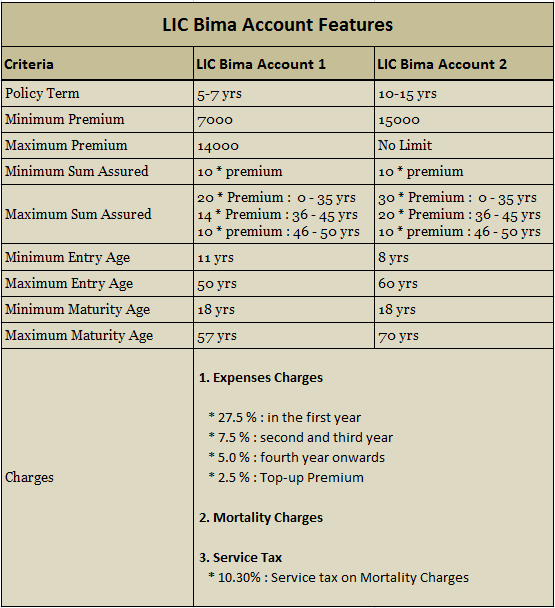
The chart below gives you an idea of both the variants of the policy. While LIC Bima Account 1 is for investors who can pay smaller premiums, Bima 2 is for investors who are looking fo paying higher premiums.

LIC BIMA ACCOUNT INSURANCE PLAN

The lock-in period for these policies is 3 yrs, You can surrender the policy after paying the premium for 1 yr, but you will be paid back only after completion of 3 yrs lock-in period. The common part of both the plans is that you will get 6% returns from these plans if you continue paying the premiums till maturity, but only 5% return if you make it as paid-up policy. There will be a bonus also paid by LIC in these plans, but it would depend on the company experience with the plan and bonus is not guaranteed. Also the bonus will only be applicable for investors who have completed the whole tenure.

Important: Taxation of LIC Bima once DTC is in Force

Another important point worth nothing is taxation of LIC Bima Account policy after the Direct Tax Code is in effect. As per DTC, the tax exemption will be allowed only if the Sum assured is more than 20 times the yearly Premium, however, both LIC Bima Account 1 and LIC Bima Account 2 offers options where a person can choose Sum Assured which is less than 20 times the yearly premium (see the chart above).

In that case, they will be able to claim the tax deductions in this current year and next year also, however there after they won’t be able to claim any deductions on this policy. I am not sure how many investors are looking at this point. The majority of investors in LIC Bima are going to be from small cities, who will definitely have no idea about this taxation point.

Commission for agents in LIC Bima Account 1 & 2

So what is the commission LIC agents will make from selling these policies? Here are the numbers shared by an LIC agent with me over the phone.

  • 16.5% for first year
  • 3.5% for the second and third year
  • 2% for 4th year onwards

What are the returns from LIC Bima plans?

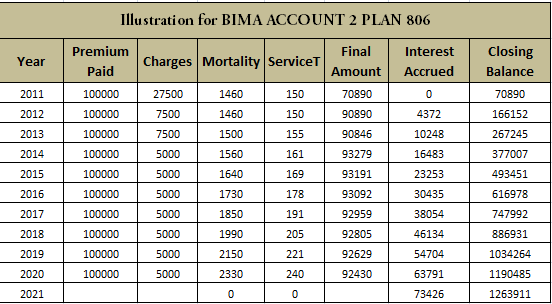
This is where one has to pay attention to. Note that the returns of 6% are offered only in the Net amount invested (Final Amount in the charts below). We will take an example of LIC Bima account 2 Plan 806 below which I got from. Suppose you invest 1,00,000 per year in this plan for tenure of 10 yrs,  then at the end of the tenure you will receive 12,36,911, guess how much actual return does it translate to? So we have to do an IRR analysis for this to find out the actually CAGR return an investor will get. As per IRR analysis, the returns turn out to be 4.217 %. So this is the return an investor would earn in 10 yrs, note that is the return without considering any bonus.  For investors who will make the policy paid up or surrender it, for them the IRR would be drastically low and might be as low as 0% or negative also depending on how early investor makes it paid up.

Look at the chart below which shows you the IRR analysis for LIC Bima Account 2 policy, The numbers below are provided by an LIC agent over email to me.

LIC bima account insurance plan returns

So the main point here is that why is an investor not informed about the actual return which he gets in his hand? Why the returns of 6% are shown in a way that common public will not be able to find it out. One can also show the returns like 9% or 10% and then increase the charges to such a level so that the investors in hand returns are just 4-5 %. These plans are going to generate a lot of attention and crores and crores will be generated. Do you feel it can be called misselling or Mis-use of Public trust, as the returns are in a way misleading? This is a question from you as an investor !.

A trusted source Dhawal Sharma had a talk with LIC Development Officer and here is what he found out –

I met with an LIC DO yesterday and he explained to me that BIMA ACCOUNT is for someone looking for other option than Saving Bank Account and thus the name.. Bank Account gives 3.5% and here it is with Minimum Guarantee of 6%, that too with Insurance Cover and tax benefit.

It’s another LIC stunt of JFM (JAN-FEB-MARCH) Tax saving season..Remember, LIC launched WEALTH PLUS last year on 8th FEB…Crores of policies were sold and crores of premium was raised by LIC in 2 months flat..I am eye-witness to last year’s madness when LIC agents were asking people to come along with FILLED FORMs for WEALTH PLUS and public obliging..and there we were, the KOTAK (or PVT PLAYERs) doing everything for the client but still being made to look second-grade in comparison to LIC..That the NAV of WEALTH PLUS now is Rs 9.63 is a different matter altogether 😉 Just wait and look for a new product from LIC every year in FEB..

Actually its not misselling, its MISSUSE of the TRUST that people have in LIC..”Whatever LIC come up with must be good” according to Indian public and thus the result..

Note that the actual returns from LIC Bima after considering the non-guaranteed bonus will be higher, but still it would hardly be attractive enough.

Comments? Are you buying it? What kind of investors should buy LIC Bima Plan?

Is Stock Market Crash on the way ? [ 4 charts ]

Did you invest in ELSS recently for tax saving? If you have done that with the intention of getting quick great returns in 3 yrs and then liquidate the funds, you might not like this article. Indian stock markets are seeing some serious sell-offs in the last 1-2 months and there are some reasons for it. In this article we will look at some indicators which can help you take further decisions.

Stock Market Crash India

Why Nifty Started Falling from levels of 6300?

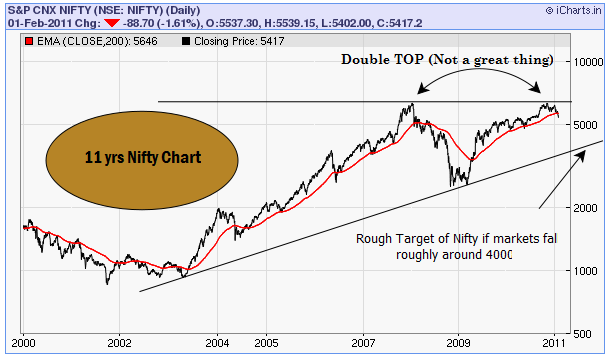
You should ask why shouldn’t it fall? Everyone has bad memories about markets and 6300 in nifty is a level from where we saw one of the biggest crashes in 2008. A lot of investors had a really bad experience at that point, as they were stuck at that point and could not sell-off in 2008. They kept their stocks with them in the hope to sell it off next time when the market reach the same levels. This is what exactly happened when markets reached the levels of 6300 recently, everyone said .. “BOSS. I am now getting out of markets as I have reached my previous levels, No matter what happens next, I am just out !”, which is very natural and well-known phenomena is markets.

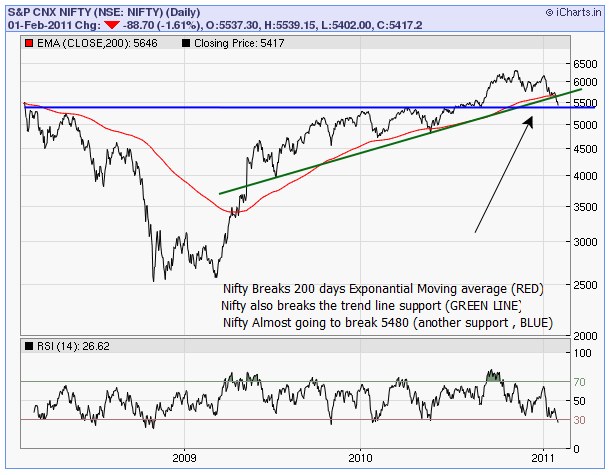
When the majority of people do this,  there is serious sell-off suddenly. In technical terms, this phenomenon is called Resistance and we can see a probable double TOP at the level of 6300, not a very great thing for people looking to BUY :). I say probable double top because it will only be confirmed after markets break the target of 5350 at nifty (got this tip from Nooresh Merani). It would be a bad situation to watch ours for. Look at the last 11 yrs chart of Nifty below.

Stock Market Crash

3 major indicators indicating the fall in Indian Markets

There are some serious events which are worth looking at. Let’s look at them

1. FII’s are selling

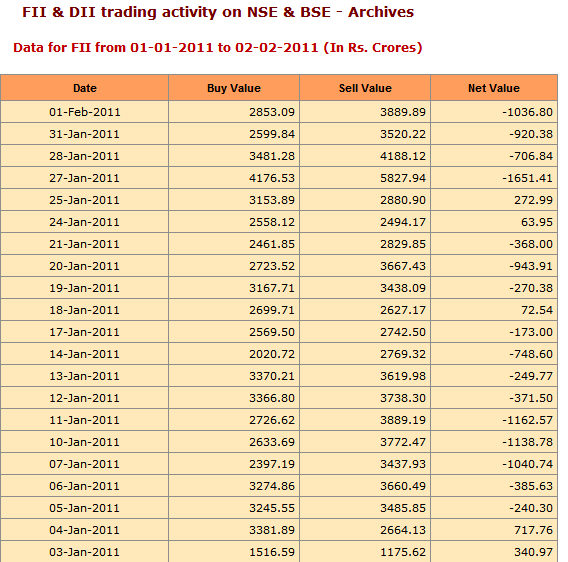
The biggest reason for the current market fall is due to FII (foreign institutional investors) selling off. Suddenly American and European markets are looking better than Indian or Asian Indices. Note that US markets are rising from last some months and Europe has outperformed Indian markets by 20%+ in Jan alone. FII’s have sold a lot of in the last 1 month, below is the data are taken from the NSE website.

FII sold in Indian markets

However, not everyone agrees to this argument. “FII’s have invested around 50,000 crores in Indian markets from the point when Nifty was around 5,400 last time, which was around Aug 2010,  However FII’s have sold taken out just 15% of what they invested, and right now we are at the same levels , so still lot of FII’s money is lying around.

So, the biggest reason for the fall is the fear of rising inflation and interest rates and the way it will affect our markets and economy in coming days”- says Deepak Shenoy of Capitalmind.in .

2. Markets broke its 200 day EMA + important Support points

This is not a small thing to ignore, breaking of 200 EMA is a significant event, and it has happened only twice in last 2 yrs, but it bounced back from that point, However, this time it has broken it again and got below it and not bouncing back. Incase it does not bounce back above it, It’s not a comfortable situation. So if you know GOD personally, please pray.

Look at the 3 yrs chart below which shows the 200 EMA breaking and other trend line breaking. Learn more about Support and Resistance and other important things related to stock markets here, here and here

Should retail Investor Buy right now for the long-term?

I had a talk with Nooresh Merani, a technical analyst at Analyse India, and he feels that the main panic button is still not triggered.

As per him – “The major point comes at 5350 on Nifty which is very crucial, we can not say we are entering a Bear market unless market crashes below the levels of 5350. If that is broken, then there can be further weakness in Indian markets and sell off, However if markets bounce back from these levels of 5350-5400 and go up further, it would be safe to buy only if markets move above 5700 levels , unless then better to be high on cash and not take any action. If markets can move above 5700 again , it would be a great idea to deploy cash and see levels of 6800-6900 on Nifty” – Nooresh Merani (blog)  .

Stock Market Crash

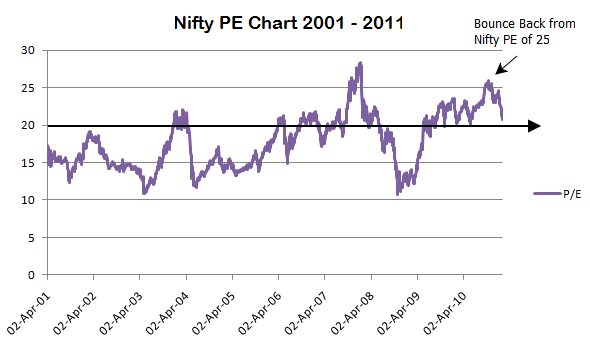
3. Nifty PE touched 25 and now moving down

Please read this post on Nifty PE incase you have no idea what is it. Nifty PE has been a good indicator till now to show the over-bought and over-sold regions and we can expect it to be a good indicator. In the last 10 yrs, It was the second time when Nifty PE went beyond 25, Only in 2007-2008 it was around 27-28 and even body knows what happened after that. Even now Nifty PE touched 25 and now it’s moving towards 20, I would not be very bullish for long-term in this kind of scenario. But there are cases where it has bounced back from 20 again to move higher, so keep it as a possibility. See the chart below which shows you the Nifty PE movement in the last 10 yrs.

NIFTY PE indian stock markets

Conclusion

Technical analysis is an art of reading charts and there are some serious concerns seen in the chart, however, it’s not at all recommended to take the words on rock and believe it blindly. This article and the information here are to facilitate your decision-making process. By no means, this article suggests you sell off anything.

If you are a long-term investor with monthly SIP’s running in Mutual funds, you should better concentrate on what you are good at in life and keep your SIP’s running. Only traders or short-term investors trying to catch the market movements should take decisions based on the information provided. Also if you are going to invest in markets or mutual funds for 1-3 yrs and are a first-time investor, you should understand that there is a possibility that you do not get much out of markets in returns.

Comments please. Give your comments on the charts above and what do you think should be the next move? Let’s not predict, but prepare ourselves for whatever happens next.

Note : Nifty was at 5526 at the time of publishing this article .

Term Insurance Plans – 20 different policies compared with charts !

Which is the best term insurance plan in India ? Which Insurance company has the best claim settlement Ratio? Should you buy online or offline plans ? These are some of the questions which comes in the mind of every insurance buyer! .

So are you looking for Term Insurance comparison at one place ? Do you have all the sufficient information to decide which is the best term plan you can buy? Today I will show you all the data like riders, maximum/minimum tenure, max age till when these plans covers a person and data on the premium, Claim settlement Ratio at one place! .

Best Term Insurance plans in India – A comparison List

There are many term insurance plans in India, but all of them have different premiums and features which confuses a prospective customer to choose the best term plan for him. Below is a table which shows most of the policies name along with their premiums. But before that, make sure you fully understand what is a term insurance plan ? Better read the 9 most asked questions about Term Insurance before you move ahead.

Company Name Policy Name Mode Riders Available Premium
(1 crore SA)
Aegon Religare iTerm Online Yes 7,300
Bharti Axa e-Protect Online No 7,300
Aviva i-Life Online No 7,368
HDFC Life Click2Protect Online No 10600
Kotak e-Preffered Online No 10825
Edelweiss Tokio Life Protection Plan Online Yes 11,500
Metlife Met-Protect Online No 11,600
ING Vyasa My Term Insurance Offline NA 11,891
ICICI Prudential i-Care Online Yes 13000
DLF Pramerica U-Protect Online Yes 13,400
SBI life Smart Shield Offline Yes 16,798
Bajaj Allianz iSecure Online Yes 18400
Max NewYork Platinum Protect Offline Yes 23,500
IDBI Fedral Termassurance Online No 25,350
LIC Amulya Jeevan Offline No 33,600
Future Generali Smart Life Online No NA
Birla Sun Life Protector Plus Offline Yes NA
Tata Aig Maha Raksha NA NA NA
Reliance Term Insurance Offline NA NA
Canara HSBC Life Pure NA NA NA
India First AnyTime Plan Online NA NA
Sahara Life Insurance Kavach NA NA NA
Star-Union Dai-ichi Term Plan NA NA NA

Note : The premiums above are for 30 yrs old non-smoking male, and 30 yrs policy tenure. The premium quoted is for Rs 1 crore sum assured and does not include service tax. The premiums displayed were taken from respective life insurance companies websites and should be treated as indicative premiums.

Brief overview of Riders

Most of the term plans also allow riders along with their plans. Riders are nothing but additional benefits which you can take by paying some extra premium. Lets see some of the riders and what they mean. A term insurance plan might be offering some of the riders mentioned below.

AD (Accidental Death) : The policy pays you additional sum assured in case the death happens due to an accident . Note that even if you don’t take this rider, the sum assured is always paid on death, whether accidental or not !.

CI (Critical Illness) : This rider gives you a lump sum amount if you are diagnosed with an illness which is mentioned in the policy . Generally all the major illnesses are covered in Critical Illness cover.

DR (Accidental Disability Rider) : This rider covers you for disability and pays you Sum assured in 10 installments per year  incase you becomes temporary or permanent disabled person.

WP (Waiver of Premium) : This rider makes sure that incase you are not able to pay future premium due to disability or income loss, the future premiums are waived off , but your policy is still in force like always !

Claim settlement Ratio of Life Insurance Companies

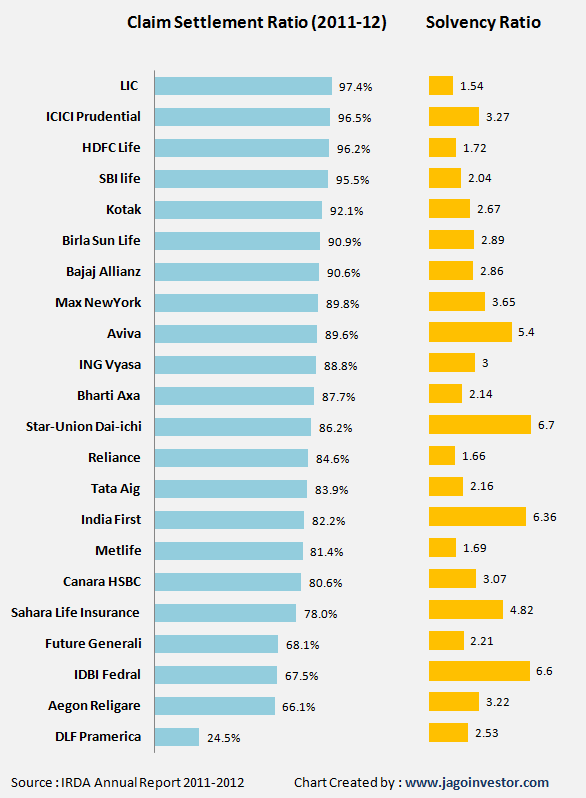
While deciding on a term insurance plan, the biggest point which a person concentrates is the Claim settlement ratio (read this comment) . Claim Settlement ratio of a company tells you that how many policies were settled by paying back the claims in case of death. However note that these numbers are not for pure term plans, but for any kind of policies.

Solvency Ratio of a Life Insurance Company

Another small things to look in a life insurance company is Solvency Ratio. It indicates how solvent a company is, or how prepared it is to meet unforeseen exigencies. It is the extra capital that an insurance company is required to hold to meet all the claims which arise . In other words , Solvency margin refers to the excess amount of asset the insurance company has to maintain over its liabilities. Basically, it is the amount the insurer has to stash away in order to pay the claims during emergency. IRDA requires the insurance companies to maintain a particular level of solvency margin for their smooth functioning

Below is the Table and a Chart showing Claim Settlement Ratio and Solvency Ratio of all the insurance insurance company in India. The data is taken from 2011-2012 IRDA annual Report.

Company Name Claim Settlement Ratio (2011-12) Solvency Ratio
LIC 97.4% 1.54
ICICI Prudential 96.5% 3.27
HDFC Life 96.2% 1.72
SBI life 95.5% 2.04
Kotak 92.1% 2.67
Birla Sun Life 90.9% 2.89
Bajaj Allianz 90.6% 2.86
Max NewYork 89.8% 3.65
Aviva 89.6% 5.4
ING Vyasa 88.8% 3
Bharti Axa 87.7% 2.14
Star-Union Dai-ichi 86.2% 6.7
Reliance 84.6% 1.66
Tata Aig 83.9% 2.16
India First 82.2% 6.36
Metlife 81.4% 1.69
Canara HSBC 80.6% 3.07
Sahara Life Insurance 78.0% 4.82
Future Generali 68.1% 2.21
IDBI Fedral 67.5% 6.6
Aegon Religare 66.1% 3.22
DLF Pramerica 24.5% 2.53
Edelweiss Tokio 100% (Just 1 policy) NA

Claim settlement ratio of Life  insurance companies in india

Term Insurance – Online vs Offline

With online term insurance plans coming in market, two things has happened. First, Customers have really got excited seeing very low premiums which insure them at throw away prices, however low premiums does not appear on the top wish list of customers and what everyone needs is very high claim settlement ratio and excellent customer service. This is where online term policies have disappointed customers, there has been huge disappointment from ICICI iCare and Aegon Religare iTerm Plan in terms of customer service. There have been cases where customers bought an online policy and after that, they had horrifying experiences starting from increase of premium once they bought it, No-response from the company for long duration and Long & frustrating delays in medical tests. This is what pisses off customers most and they get a feel that If situation is bad at the time of buying the policy, then what will be the response when their families for claim settlement .

Another important point which comes to a persons mind is Are private Insurance companies safe ? and what is the claim settlement ratio of the company. From last year IRDA report, we came to know that Aegon Religare did not settle even a single claim out of total 7-8 claims they got . However, this years IRDA report (2009-2010) shows that its better at 48% settlement ratio for Aegon Religare, but Life Insurance is not a maths exam where 90-91% marks will make people happy. We all need 100% or 99% at least !. Because most of the companies are very new, the trust factor is missing from public. Note that not everyone who bought term insurance policies had bad experience, there are many buyers who got very good response and good customer service, but it was a smaller section .

So if you a kind of buyer who understand Insurance very well and how things work in this area and you also have trust in online term plans then you can go for online plans. But if you are not comfortable with it, then you should try the old way of buying insurance through an agent. However it would cost more than online plan, which many are comfortable with! .

If you concentrate on the claim settlement and trust factor then the only option is LIC of India Term Insurance (Jeevan Amulya). However if you are fine with the pvt Insurance, but still want the best features, I personally see Kotak-preferred Plan as a good option. The premium for Kotak-preferred is the lowest in the offline term plans and this plan has good riders along with other good options.

Term insurance plan from LIC is obviously the best option if you do not believe in the pvt companies and insist on high claim ratio, but premium for LIC term policy is too high . So I think you can consider a mix of the LIC term insurance and any one from Pvt insurer. Soon you will also see LIC online term plan

Special Features in Some Term Insurance Policies

There are some policies with very different set of features. Lets have a look at some of the those. These features can help you further in your decision.Term Insurance policy features

Which online term plan do you have currently and incase you planning to have one, which one those the above will you buy ? Will it be LIC Term Insurance or some one else and why ? Also share, If you need any other factor before choosing the term plan ?

Personal Finance doubts and their answers on Forum

Even if you are not participating on discussions at our questions and answers forum, I want to make sure you do not lose out of the valuable things  members are asking and all the valuable learnings which come out by participation of other members.

There has been discussions on variety of topics like Real-Estate , Insurance, Financial-planning, Stocks,  mutual-funds and general finance in day-to-day life. In this post I have just picked a handful of learnings and valuable parts from here and there on forum. Personal Finance doubts

Which small city looks most promising for real estate investment ? (Link)

Members gave some suggestions, but the two cities which were mainly recommended were Ujjain and Gaziabad . Ujjain was recommended because Govt has started Projects of Rs. 1600 Crores due to Next Kumbh after 4 years ) and Ghaziabad (Indirapuram, NH 58 & Vaishali) was recommended as its near to overpriced Delhi & Noida and Metro line will be extended soon. Other suggestions were Indore, Raipur and Hosur .

What is meant by Company’s book value ? (Link)

In simple terms, a company’s book value tells you how much money would be left for shareholders after selling all its assets and pay off all its liabilities at the particular point of time.

Book value = (Total assets-Intangible assets) – Total liabilities

1. Subtract the reported value of the company’s intangible assets from the value of the company’s total assets. Intangible assets are things like trademarks and patents, which are difficult to value. The valuation of intangible assets is highly subjective, so just exclude them from your calculation.

2. Then Subtract the value of the company’s total liabilities from the value of the company’s total assets less intangible assets. The resulting figure is the company’s book value

What is NCD (Non convertible debentures) ? (Link)

“NCD” is “Non Convertible Debenture” issued by corporates. This is fixed income instrument. NCD provides fixed return just like FD interest. Duration of NCD and rate of return are fixed at the time of issuing NCD. Some NCD are secured against assets.

NCDs more or less work like company fixed deposit. One advantage of NCD, at least in theory, is that they are listed on stock exchanges. Hence, provides liquidity to holder. However, there is normally not much volume for NCD. Hence, this advantage mostly remains on paper. For buying NCD, demat account is needed as these NCDs are credited to and debited from Demat account just like shares and no certificate is issued like FD.

When and how much can one withdraw from PPF ? (Link)

One withdrawal, once a year, is allowed from 7th year onwards. You can withdraw an amount not exceeding the lower of:

a) 50% of the balance at the end of the 4th immediately preceding year
b) 50% of the balance at the end of the immediately preceding year

Example: If the account was opened in 2005-06, and first withdrawal can be made during 2011-12. . The amount of withdrawal will be the lower of:

a) 50% of the balance as on March 31, 2008.
b). 50% of the balance as on March 31, 2011.

Facility of Loan: In case of emergency situations before the 7th year, you can take loans from your PPF account. You can take loans between 3rd and 6th year of opening the PPF account.
The maximum loan amount available will be equal to 25% of the balance at the end of the 2nd immediately preceding year.

Example: In your example, if loan is sought in 2010-11, the maximum amount of loan available would be 25% of the balance as on March 31, 2009.

The rate of interest on the loan is usually 2% over and above the rate of interest you receive in the PPF account. This loan has to be repaid within a period of 24 months. Once you repay a loan, another loan can be taken as long as you are within the 3rd and the 6th year of opening the account.

Is there a need of PAN Migration in case of Job Migration ? (Link)

Jayaprakash shares the answer and his personal experience

There is no need for PAN migration in case your residential address is changed. Your Pan card address details are nothing to do with your address given in ITR. Whatever you mention in your ITR is considered for your refunds. The bank and address given in the ITR form will be treated as current for refunds.I’ve submitted my returns in a different IT ward every year since financial year 2007. My address is different in all of those ITR forms.

For 2007 it is Pune, 2008 it is Pune (different ward) and for 2009 it is Hyd. I’ve changed my PAN card address in 2009 but they have not considered that address for refunds of 2007 and 2008 financial years. They have sent cheques to the address given in ITR form (2007, 2008) instead of new address, which I’ve updated with IT department. Now, I’m running behind local ward offices to get my refunds.

Forum Prize Winners for November

For the week of November, Winners for the Forum Monthly Contest are Ramesh Mangal and Shashank Kashettiwar. The first prize goes to Ramesh for answering lots of questions with his knowledge and second prize goes to Shashank for his detailed and amazing insightful/detailed replies . Big thanks to these guys !  .

Do you have any personal finance query which you wanted to clear ? Ask today on Forum !

JagoInvestor/Moneylife helps a customer get his money back

What do you do when you are facing un-ethical practices by some company officials and You are not getting justice anywhere? You should reach out directly at the top of the management somehow because, believe me customer care just does not work ! . This is exactly what I did, when one of the readers complained on our forum that one of his friend is facing issues with India Bulls Real Estate from last some weeks. Here is his complaint

Dear Forum Members,

I’m writting this on behalf of my Friend-Colleague, Ravikumar GovindaNaik, who had a very Bad experience with Indiabulls Home Loan division.

Application Ref no with IndiaBulls – 150625

Name: Ravikumar Lamani GovindaNaik

In August 2010, he initiated the process to buy a 30×40 site near Hosur road, Bangalore. Since the property had only B-Khatha and loan amount was only 10 Lakh, most the major bank representatives denied his enquiries.

Then one Mr. Sivakumar from IndiaBulls Home Loans have appeared as life saver to him an agreed to get him the loan amount approved, with the whatever B-Khatha he have. Every now and then he asked for somany documents copies and it went for almost for a month. In between my friend got an SMS from indiabulls informing that his loan got approved. When he asked about this to Sivakumar he told, Loan is approved by Finance Division but Legal team still have to approve. Also he asked my friend to pay Rs. 5,000/- so that lawyer from Legal division would approve the loan amount. My friend disagreed to pay and asked the contact details of the Lawyer to talk. He refused to gave and tried to divert our attention.

When there was only few days to expire the sale agreement with the Land owner, Sivakumar again appeared and told Loan in COMPLETELY approved and shown photocopy of the cheque favoured the Land Owner. Later Land owner had some dispute on the registration amount and canceled the Land deal.

On October 05, 2010 My friend send a mail to Sivakumar and Indiabulls to cancel the Loan, since he no longer needs it. Nobody responded to mails and phone calls even after repeated attempts, and my friend was scared about the blank cheques he have given.

As he feared, on 13-Oct-10 Rs. 2,216/- was withdrawn from his bank account using the cheque claiming as Pre-EMI, eventhough the Loan Amount cheque was never delivered to him. Immediately my friend contacted Sivakumar and his Manager Praveen enquiring about this, but they suggested to contact customer care. When he contacted the customer care they told him to contact Praveen, The MANAGER. Many e-mail written to Sivakumar, praveen and customer care fell into deaf ears.

On top of that, again on 8-Nov-10  Rs. 20,275/- got withdrawn from my friends bank account using another blank cheque claiming as EMI of the Loan Amount, when the loan amount was never disbursed. Now they have stopped answering my friends calls. Do the Financial Institute have the rights to do like this?

The representative was from Indiabulls that we confirmed, called up the customer care, they also have the application reference number. The cheque’s were in favor of Indiabulls Housing Finance Ltd., only the amount was unfilled. They told that cheques are required for security and to initiate EMI-ECS facility. After the second incident of cash withdrawal, my friend used the “stop payment” facility of his bank. When I searched in Google, I could find lots of complaints against Indiabulls Loan services. In this case they have looted the money on top the processing charge Rs. 5,000, charged earlier.

Yesterday, my friend spoke to the representative Sivakumar again and threaten to send the details to RBI and would file a case, he was least bothered. He just told “Do it!”

What should my friend do now? Anybody knows a Higher official in Indiabulls, who could help? Or writing to RBI about this would help?

Please Help, Thanks, Surabhi R

What action I took ?

I emailed the whole incident as it is to Sucheta Dalal of Moneylife, who  helped in escalating the whole issue directly to Gagan Banga, CEO of the company . Moneylife got the reply directly from CEO within same day that he will look into the issue and by next day itself .

—– Forwarded Message —-
From: Gagan Banga <>
To: Sucheta Dalal
Sent: Sun, 21 November, 2010 1:31:12 PM
Subject: Re: Bad experince with Indiabulls Home Loans

Ma’am, this will be sorted out by tomorrow. Thanks for your feedback and for escalating this issue to me. Regards, Gagan

IndiaBulls had talked to the customer and apologized, they also handed over the refund cheques towards Pre-EMI & EMI the same day. They also dispatched Post dated cheque’s & loan cancellation letter to customer the same day. Here is a reply

From: “Gagan Banga” <>
Date: Mon, 22 Nov 2010 17:09:28 +0530
To: Sucheta Dalal

Subject: Re: Bad experience with Indiabulls Home Loans

Dear Ma’am, Firstly I would like to accept the mistake of my team and our system . We have already apologised to the customer for the inconvenience caused and handed over the refund cheques towards PEMI & EMI today. The remaining PDCs & loan cancellation letter are being dispatched today and should reach him in a day or two. Once again thanks for bringing this to my attention, such feedback will surely help us in improving our processes. Regards, Gagan

This was a reply made from Gagan Banga to Sucheta Dalal of moneylife and she forwarded to me later. Sucheta Dalal has been in journalism from last 25 yrs and its because of this fact that Moneylife has strong ability to reach top management. Moneylife has been helping investors like Ravikumar get justice from many years now and they routinely do grievance redressal with success rate of over 80%.  Moneylife also conducts various Financial literacy initiatives for common public in association with Industry experts .

Customer finally got Justice

After I got an email from Suceta Dalal that finally the issue is resolved, I personally talked to the Ravikumar (customer) on phone. Here is what exactly happened (as per the telephonic conversation)

Ravikumar went to Koramangala IndiaBulls office on Saturday (20th Nov) and the Manager-Praveen was not in office. One gentleman at office connected Ravi to Praveen over the office phone, and Praveen was not happy to talk with Ravi. He told that, today I’m on leave, will be back to office on Monday only, would look into then. There was nothing much to do for Ravi so came back home.

I think after that moneylife sent mail to Indiabulls CEO and he acted on it. On Sunday morning Ravi received a call from Mr. Praveen Pradhan (some other Praveen) , we claimed to the Location head of IndiaBulls in Bangalore. The other manager Praveen reports to this Praveen Pradhan. He might have received the communication from CEO by that time.

This Praveen Pradhan spoke to Ravi for 10-15 minutes, and collected the whole information about the story. He promised to Ravi that, he would receive money on Monday morning without fail. The interaction with Pradhan was pleasing and he apologised for the whole mess.

Monday morning (22nd Nov), Ravi visited Indiabulls office at Koramangala again, and he was directed to finance division. Straight away they have handed over the Refund-Cheque of Rs. 22,491 and as a latest update, while I was drafting this mail, some executive from Indiabulls called up and informed that he is coming down to our office in hour and would deliver the rest of the documents and those blank cheques collected.

– Ravikumar Govindanaik

Problem lies at Bottom level most of the times

This whole incident and what happened opens some questions . Is the problem mainly at lower levels or bottom of the pyramid which involves employees, and managers at lower level ? When we face any issues its never entertained by them or even customer care as they are just not bothered about the company ethics and only interested in their salary and day-to-day activities . However top of the management takes these issues very seriously and acts upon them faster ? What is your opinion on his point ?

Also what are your comments on this whole story ? Do you know some one who has faced these issues ? According to you, what can reduce these kind of frauds or un-professional behavior ?

You also make no mention of the fact that I told you in my email that Moneylife Magazine (www.moneylife.in) routinely does grievance redressal and that our success rate is over 80%.

Its time for Portfolio Rebalancing

Are you thinking of entering the equity markets now? Are you thinking of buying some equity mutual funds? You must have heard by now, how the markets are back in action, reaching highs again.

Today, I am not here to discourage you and say “Don’t enter markets” or “Its time to exit” — because neither I or anybody else can predict it. We are here to take decision based on what we can control; and the market is definitely something, which no one has control over.

Portfolio rebalancing

However we can control our actions, greed or fear! I am here, just to remind you about the last crash and how stupidly we all behaved out of greed or fear. (read my story)

The first thing you should understand clearly, is that it’s not the best time to enter the markets for the long-term, because markets are not back in action from last few weeks. It was back in action 1-1.5 years back when markets started rising from 8000 to current levels of 20,000.

It has already given 150% return on an absolute level or 100% CAGR 🙂 and the retail public is now waking up like always to enter with all its money for “long-term”.

Lets us see in this article some good practices and what you can do at the moment .

We, as investors have to be very cautious and not lose our control. It has been 30 years now, that markets are in existence and these kind of situations have come along loads of times. Let’s make sure, that this time we do not regret like we did before. IPOs have started coming in and we recently saw one of the biggest IPO of Coal-India in the history of Indian markets.

All the news channels are back with all the so-called analysts and discussion on how markets can reach new heights and logical explanations about economy booming, deep valuations and what not.

Good time to Rebalance your Portfolio

Markets are nearing an all time high of 21000! It has come a long way from 8000 to 21000 in last 18 months. For investors who bought equity funds or direct stocks at lowest points, it would be a good idea to book profits or rebalance their portfolios.

Look at your investments in Equity as growing a tree. When you invested 1 yr back, you had started with a plants which over these 1-2 yrs have grown to a tree and now is the time for you to pluck the fruit; at least book the profits partially if you don’t want to sell everything.

Note that it does not mean that markets will fall or should fall. But rather than trying to control what markets are going to do, concentrate on what you can (and should) do at the moment. Don’t loose your sleep over what will happen in markets, reduce your tension by booking your profits partially atleast.

Incase you had bought stocks, mutual funds randomly without any proper study, you should immediately get out of markets.

Two dimensional possibility in markets

Right now, there are two really important influences that can affect your investments. One of those is Market direction and the other is Self-Direction. Market direction is something you can not control and it’s almost impossible to predict.

However, self direction is something you can control. Let’s look at a couple of different scenarios and what they mean!

For simplicity purpose we will assume that following two things can happen in Markets-direction and your Self-direction

Market-Direction

  1. Markets can go DOWN by 50% in next 1 yr
  2. Markets can go UP by 50% in next 1 yr

Self-Direction

  1. Rebalance your portfolio from 100% equity to 50% equity and 50% debt
  2. Leave it 100% equity

Case 1 : Markets go Down by 50% in 1 yr

If your Rebalance :: In case you rebalance right now , you will have 1 lac in equity and 1 lac in debt, The equity component will go down from 1 lac to 50,000 and debt component will rise from 1 lac to 1.08 lacs.  Your total worth would be 50k + 1.08 lac = 1.58 lacs. That would be a 21% loss overall .

If you Dont Rebalance :  If you don’t rebalance right now, you will have 2 lac in equity and it will go down from 2 lac to 1 lacs – a 50% loss overall .

Case 2 : Markets go UP 50% in 1 yr

If your Rebalance : In case you rebalance right now , you will have 1 lac in equity and 1 lac in debt, The equity component will go up from 1 lac to 1.5 lacs and debt component will rise from 1 lac to 1.08 lacs. Your total worth would now will be 1.5 lacs + 1.08 lac = 2.58 lacs, a  29% profit overall.

If you don’t : You will have 2 lacs in equity and it will go up from 2 lac to 3 lacs – 50% profit.

markets flowchart

Results

You can see by this small exercise that in one case you are going to see 50% loss or 50% profit and with another case you can see 21% loss or 29% profit. Now it’s your choice. Which situation are you more comfortable  with? I personally feel, retail investors should concentrate more on limiting their losses.

Where is Nifty PE ?

The Nifty PE has been a good indicator in the past to judge overbought and oversold situations . One problem with Nifty-PE though, is that it can’t give you precise a timeline, for when markets can start rising or falling. Nifty PE right now is somewhere around 25, which has proved to be an overbought situation historically.

In the past Nifty PE has reached this level before markets fell after few months. It happened in 2008 crash. On the other hand, a high Nifty PE also indicates strong momentum and can be seen as an opportunity to make some quick trades by entering on the weaker days.

So it’s your choice on how you want to look at the situation .

Nifty vs Nifty-PE

Note that Nifty PE at the moment is very much near that previous high’s of 25, where markets crashed, but it can still go to 27-28 or even 30 in worst case, which can take another 3-4 months and then market can fall ! severely .

Some views from Market Experts

“This current fall of 1200 points on sensex is an obvious downside which always happen after a spectacular upmove and it is nothing but a pure profit booking correction which has happened in last 1-2 weeks.

There is still 1 leg of major upmove remains in markets and unless Nifty breaks support levels below 5700-5800, instead of panicking its a good time to take some positions for short-term of 3-4 months, markets can break the previous levels and reach upto 25000-25000 levels” – As per Hemen Kapadia, a noted technical analyst (I met him at a seminar in Bangalore).

Another friend of mine and a technical analyst Nooresh Merani shares his similar views “Unless nifty breaks down by another 200-300 points, we can see it as a trend reversal pattern, and it still have steam left for another next few months, there after we have to look at charts again to give views”

So If you are an aggressive investor, don’t sell. Just ride the trend; you can also add some money when market cools off a bit and then ready for the move upwards again.

But anyway, you have to be cautious and make sure you have control on yourself. And you should be selling if there are major indications of markets being weak.

JagoInvestor Completes 3 yrs

JagoInvestor.com recently completed its 3 yrs in Nov 2010 and following is the interview taken by one of the fellow bloggers .

Yet another milestone for Manish Chauhan, founder of JagoInvestor.com. It’s been three years since Manish started blogging and on Nov 5th 2010, JagoInvestor.com celebrated it’s third anniversary. After three years of run up, JagoInvestor.com boasts of a massive 6500 RSS followers which is still growing and a treasure-house of articles where you can find almost anything on personal finance. On this occasion, here are some snippets of a tete-a-tete I had with Manish on his journey over the last three years and his vision for JagoInvestor.

Jagoinvestor completes 3 yrs of blogging

Q1) Which is your best personal finance book and why ?

I have not read any book on personal finance nor I am aware of any pure personal finance book which gives a good idea of everything on personal finance at this point in India. However there is enough material on Internet and loads of good websites and blogs which gives great education on personal finance.

More than knowledge, Personal finance is about attitude and applying common sense in area of personal finance. There are few things which a person has to understand and on top of it he himself can build all the knowledge and analyze things . Incase some one has any idea about personal finance books in India , please give the names in comments section !

Q2) What is your vision for JagoInvestor in the next 5 to 10 years ?

Personal Finance is a huge area with opportunity. I see JagoInvestor being synonymous with “Financial Literacy” and  “Psychology changing website” which along with providing personal finance knowledge also provides counseling in the area of personal finance, I want to build a program which would span over few months or may be 1-2 yrs which if any one who is interested in financial freedom can join and they can totally transform their way of looking at personal finance. The program can turn a novice into a pro in area of personal finance. (Would like to read comments from readers on this point)

Overall JagoInvestor’s main motto is to “change investors relationship with money” over time.

Q3) You did you manage running a personal finance blog despite being from a different background ?

There is Chinese proverb, “start doing what you truly love and you will never have to do any work !”. Common sense has no background and I consider personal finance as pure common sense fueled with a passion to change one’s financial life. As I like number crunching and I consider myself a logical person, I started a blog one fine day without realizing that it would become this big today, readers liked it and it was making difference in their life, which motivated me to work hard and make sure I keep running this movement of financial freedom.

Q4) What would be your top three advice for investors ?

Top 3 advice I can suggest some one is

  1. Start investing time to understand how important personal finance is in one’s life, thats one thing we work for and our quality of life depends on.
  2. Take pain of cross-checking each and every aspect promised by products, like investors in endowment plans should calculate what is the return they are getting and how 1% more return can impact their wealth in long run.
  3. Shift from free advice to paid services and value them, paid does not mean costly, if you get more value than what you pay, thats even cheaper than FREE. This mind set of getting FREE FREE FREE in each and every aspect of life actually turns out to be very costly in long run.

Q5) Top 3 urgent changes required in the personal finance space ?

a) Shift from sales driven attitude to value-based model in selling : When even you get a call about some product, all you hear is how great the product is, how much return it gives and blah blah.. all the focus is on the sales and even the conversation you hear is driven by sales. The biggest change which should happen is the whole model should be based on how the product will help customers in achieving their goals, a client buys a product because it helps them in life, not because its GREAT.

b) Training to agents and IFA’s : There is good number of magazines/portal for investors to help them in taking informed decisions, however I don’t see anything which helps agents and other IFA’s/CFP’s to understand how they should change their strategy in acquiring clients and giving value service to them. We need some services like these.

c) Basic Financial Planning for each Indian : While financial planning is a detailed thing in general, each person should have access to cheap basic planning for their life goals such as child education and retirement at least. There has to be a model which gives them inexpensive plan for their most basic goals in life.

Thanks to all the readers of Jagoinvestor for giving me an opportunity along with them to create this platform for learning personal finance.

Comments

Would like to hear your comments on how do you feel associated with jagoinvestor and what changes has happened in your financial life ?

The Interview was from thewealthwisher.com

Importance of will and some essential points to be considered while making a will

We will learn about creating a WILL in India today, but before that you need to answer this question – “Do you want to leave your wealth and let your loved one’s fight with each other to get their shares (a la the Ambanis!)?” –

I guess not! . If you nominated some one in all the financial products you bought and thought that it will be passed to them legally without any issues, you are living in the world of fantasies (kind of :). It’s a common misconception). You need to create a WILL to distribute your wealth in the manner you want to, and having nominated someone ain’t the answer!

Lets fine out in this article, how to make a will in India ?

importance of will

What is a Will ?

A will can be made by anyone above 21 years of age in India. You can make the will on plain paper in India. It’s not legally necessary to make the will on stamp paper. It is advisable to write your will in your own hand writing, as the same can be verified later in case of any doubts raised by relatives.

It might happen that according to your family structure and your preferences, you want to divide your wealth unequally or make a provision for a close friend or a faithful servant. This isn’t possible if you die without a will.

A lot of us feel that talking about “Making a Will” is pretty morbid, and hence, we don’t look at it with right attitude.

“A will is a sensitive topic to open up to. People are not comfortable discussing a will in India. There is a misconception that if someone tells you to make a will, the person thinks that indirectly you are telling him that his end is near or that you are eyeing his property. However, all apprehensions disappear when I tell them the consequences of not making a will.”

– Says Shankar Pai, who has done some commendable work in area of spreading awareness on making wills.

How to make a WILL in India and its importance ?

A will is so important, that it should be your first step in your financial life. If your family structure is diverse, and you want to leave your wealth to different members of family like you want to, you should prepare your WILL today, not tomorrow, not later.

To wit, if you die without preparing a WILL in India, your wealth will then be distributed as per ‘Hindu Succession Law’ (Government rules, on how wealth should be divided among family members). A common misconception, is to believe that all the estate is automatically passed on to the spouse, because children and sometimes even relatives can stake a claim to the property.

Laws of inheritance and succession, are complicated and diverse in nature, and are different in case of Hindus and Muslims.

Inconvenience for the family members:

Another point you should consider, is the inconvenience caused to your family members because of your laziness, in not making a will for them. In case of a dispute, your family members have to produce the proof about their relationship with and also have to go helter-skelter to lawyers and spent money and energy.

Much better then, to gift them some time of yours, and creating a will! This will save them a lot of headache.

Watch this video to know why it is necessary to get a registered will:

How do you make a Will in India?

A will has several parts, which duly completed, make up a complete Will. Though there is no legal or defined format, there is a template, which has been generally used for ages. It’s simple, it’s very logical and derives from common sense. Let’s look the whole format and some important points while creating a will.

Step 1 : Declaration in the beginning :

In the first paragraph, you have to declare that you are making this will in your full senses and free from any kind of pressure. You have to mention your name, address, age, etc at the time of writing the will so that it confirms that you really are, in your senses 🙂

Step 2 : Details of Property and Documents :

The next step is to provide list of items and their current values, like house, land, bank fixed deposits, postal investments, mutual funds, share certificates owned by you. You must also indicate, where all these documents are stored by you. In all probability, these are in your bank safe deposit box.

Even the will should be stored in there! Make sure, you take the details from the bank manager, about the procedure and rules of releasing your will from the safe deposit after your death. Make sure you communicate it to the executor of the Will or your family members.

I am sure, they’ll be pretty interested in this 🙂

Step 3: Details of ownership :

At the end of the will, you should mention who should own your assets items and in what proportion, after you have gone.  If you are giving your assets to a minor, make sure you appoint a custodian of your assets till the individual you have selected, reaches an adult age. This custodian obviously, has to be a trustworthy person.

Step 4 : Signing the Will :

At the end, once you complete writing your will, you must sign the will very carefully in presence of at least two independent witnesses, who have to sign after your signature, certifying that you have signed the will in their presence. The date and place, also must be indicated clearly at the bottom of the will.

Make sure you and the witnesses sign all the pages of the will. One important point while choosing witness, is that they should be your friends, neighbors, or your colleagues and not the direct beneficiaries in the Will. They only certify, that you yourself have signed the will in their presence and are not a party in making the will in India.

The envelope has to be sealed after completing all the formalities and the seal must bear your signature and the date of sealing. The witnesses need not sign on the seal of the envelope.

sample of WILL in India

See another Template from Department of Stamp and Registration, Karnataka here, thanks to Babu .

Execution of Will in Court ?

When you are dead, there is someone called an “Executor” who will be responsible for dividing your wealth amongst the beneficiaries and he will make sure the whole process is smooth (You must have seen this in Hindi movies). It is not legally required to get the will executed in a court of law in presence of a judicial Magistrate in India.

However, if you wish, the will can be executed in the presence of Magistrate or the public notary, nominated by the government authorities and sealed in their presence.

Changing the WILL in India ?

You can change your will any time you want to. However, make sure that when you make a new will, you mention that this will is the latest and supersedes all earlier wills. If you don’t, it can complicate the situation, cause major confusion, make such matters go to the court of law and take several years before arriving at any final verdict.

Making a Will through Lawyer

Do-it-yourself” wills often do not contain all the necessary components as required by law and many times ruled as invalid by courts (for example no signatures from witness or no witness at all). Many a time,  it can happen that while creating the will, you use such ambiguous language that it results in lengthy legal battles (“My House should go to Sunita.”

Now if both mother and wife are called Sunita, which Sunita ought to get it?. Anyone who might benefit from the ambiguity of the will can jump in to claim a share! And if the courts decide in his/her favour, you wont like that situation 🙂 (not that, you’ll be around!)

What is a Probate and it’s importance?

A probate is nothing but a copy of will, certified under the seal of court. The executor (someone who is responsible to execute the will) has to file a probate petition in the court of law and if all goes well, the probate takes six months to a year. No right as executor or legatee can be established unless a court has granted the probate of the Will.

Probate can be granted only to the executor appointed by the Will. The cost of getting a probate includes legal fees as well as stamp duty on the value of the property being willed. The stamp duty varies from state to state. Probate is very important in case of Real Estate.

As per Sundar, a reader of this blog…

Legal heirs to get possession of the property from the nominees have to go through a legal process called probate. In Maharashtra this means, the will have to be submitted to Registrar and one will have to obtain a probate. The Registrar may ask the claimants to put an advertisement in newspaper to ensure that they will not be contested.

They may even ask the witnesses who have signed the will to come to their office and sign documents. After all this, and some court affidavits, the claimants have to pay the necessary tax to the state govt. which is hefty and based on property value. After Goverments takes its cut, then finally the probate order is given. Only then will the legal heirs get their property.

Note that, probate requirements differ from state to state. Hence even when making a will a Lawyer should be consulted. I know of fights between Nominees and Legal Heirs. Roadblocks put up by Goverment ( some times they ask for Registered Will etc.).

So just writing a will is not the end of the story. Better consult a lawyer before drawing a will.

Further please note especially in case of land or house property, the society will not transfer the flat without a probate and tax paid certificate. Many times, a prospective buyer will not buy a flat or land, if the holding is not clear and if the property had not been cleanly transferred and if there are disputes between nominees and legal heirs.

Flat may still stay in the dead person’s name till their heirs and nominees settle their disputes. Till then, the flat may be used by Nominees or any other person. But Society will not transfer the flat to prospective buyer till the process of probate is settled first. Hence such property cannot be sold easily.

Please proceed with great care in this matter.

Important points while making a Will

  • If possible, have the two witnesses be a doctor and a lawyer. A doctor signing a will, won’t raise any question of you, being of unsound mind. The lawyer, will vet the will and make sure you dont make stupid mistakes at the time of writing and signing it. 🙂
  • The attesting witness and his or her spouse should not be a beneficiary under the terms of your Will. This might create vested interests and some times make your will invalid. Also, make sure the witnesses are younger than you and not very old as your will might be in effect for several years! And you want them to be present in this world 🙂
  • Write your will on good quality thick white paper so it doesn’t get spoiled over a period of time. It should be stored in a plastic envelope in full size, without folds.
  • Note that you should keep just one more copy of will and stored separately from the original will. The will must be stored very safely in your bank, in safe deposit box. You must also inform your next of kin, as to where you have stored your will. Do not make many copies of your will.
  • In case of Hindus, it should be clearly stated if the property is inherited or not, because it makes a huge difference, as no ancestral property can be assigned to any person through a will. All rights on inherited property are acquired by birth. So if you inherited a property from your Father, you cannot say in a will, that you want to assign it to person X only! It will go to all your legal heirs as it is “Inherited”
  • A will must always be dated and if more than one will is made, the one with the latest date will nullify all the previous ones. In fact, there should be a statement in your will, nullifying all other previous wills. The pages should be numbered to avoid fraud.
  • The value of assets often fluctuates, so it is better to mention how much each beneficiary will receive, in percentage terms rather than absolute numbers. Unless it is pure cash.

So what appeals to you more ? Writing a will your self or hiring a lawyer for this and pay to him ? I hope you are clear about the rules and procedure for writing a WILL in India ?