What is mean by Instant Gratification? And how does it affects your Financial Life?

Do you understand the meaning of Instant gratification and its affect on your financial life ? We will learn that today. How did we become a generation that “wants things now!” no matter what?

Think about this – both, our parents generation and ours, save , invest and spend. What then, is the difference between them and us? It’s mainly that they used to first earn money, save & invest that money and then spend it on things they needed.

They got ‘delayed gratification’; this quality of waiting before they are able to buy. However, we have reversed the equation. We first buy, and then pay for it later; without having a clue if we will be able to earn that money in the future or not!

And that’s is where the problem lies — Once we buy something, the deal is done! Then we have to live with it because we can’t change our minds about it later.

Instant Gratification in Personal Finance

We love ‘the thing!’ &  We need ‘the thing!’ . Our life is not complete / not possible without ‘the thing!’ . ‘The thing!’ can be a home (debate on buying ve renting), a car, some household item, the latest gadget  or 3 pairs of jeans from the big Sale!

I’m not talking about the planned and carefully thought out spending we do in life, rather I’m referring to the spending which ‘just happens’, the spending that does not add much value to our lives. Even if it adds any value, it’s mostly short-lived and makes us feel happy for just a while.

This ultimately, weakens our financial life, since we do not concentrate on our major and important financial goals, chasing the smaller and futile wants in life. A lot of this phenomena is result of the impulse called “Instant gratification!” which is what, we will look at in this article.

It’s important to realize, that the more we give in to Instant Gratification, the more we sink into the dal-dal of debt & misery. Sooner or later we’re in upto our neck and it gets too late to fix things. The biggest example of this was the recent sub-prime crisis in the US. “BUY NOW! Pay later” was the attitude!

Let me tell you a short story to give you an idea of what I am talking about.

Two small children Anita and Ramesh, lived in a small village with their parents. Their father gave Rs 5 to each of them to eat a watermelon. Both of them visited a  farm and asked the farm owner for a large watermelon.

“A big one will cost Rs 20 and a small one would cost Rs 5”, said the farm owner pointing to the watermelons in the field. With the irresistible urge of having the sweet and juicy fruit, Ramesh bought the smaller watermelon and started eating it. Anita however, wanted the big watermelon.

“OK, I too will buy a smaller watermelon”, she told the owner. “But can you please leave my watermelon in the field itself, I will be back in a month and take it at that time!” The little girl knew that her patience would be rewarded. By waiting one month, she could have a big, ripe watermelon for the price of a little green one. She got the bigger fruit, because she controlled her “Instant gratification” and waited patiently!

What is Instant Gratification ?
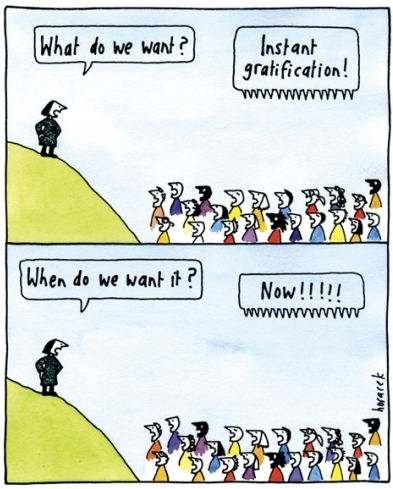
instant gratification

Instant Gratification is the habit, of always wanting to enjoy now, and not having the patience to wait for future benefits (an experiment). Anything which gives us temporary happiness or excitement, but is not actually a good thing for your life, can be put in this category.

For example…

  • When you sleep till late in morning and do not take pain of getting up and exercising.
  • You eat those unlimited sweets in your office cafeteria.
  • When you eat that burger with EXTRA cheese !

These were some examples to just give you an idea about what Instant Gratification is, – mainly concentrating on the immediate result and not thinking about its outcome in future or how it will affect us later in life.

If you can control yourself and concentrate on “delayed gratification” , your life can change! like anything , But we just are not bothered about it and do not have motivation.  Do you know why this is? Let me be straight & blunt! The challenge is that most of us do not have to face life or death situations, or seek food and shelter and defend our territory everyday anymore ! (like these people)

The result, is that we can’t see the impact of our spending in the future. Think about a poor person who struggles daily for food. If he has to spend Rs 100 on something, how will he think? If you offer him a burger, he will instead ask for the same amount in cash, because he knows that the money will help him get food for next 3 days.

He’s not focused on taste in this case.

We however, are privileged, blessed even. If something bad happens once in a while, our next meal or next place to sleep isn’t in danger. Hence some of us have just lost that attitude of looking at things without instant gratification . If you have seen bad times in your life financially, you will know, what I am talking about.

6 Examples of How Instant Gratification affects our Financial Life

Many a time, what we do in our financial life makes our future, dismal and weak, and we have no idea about it. We aren’t even aware!

#1 Not surrendering Endowment/ULIPs

This one is my favorite. “What should I do with my Policy? Should I Surrender it or make it Paid up?”  is one of the top most queries I come across. It feels bad, accepting and acknowledging that you’ve made a mistake, and it hurts psychologically when you lose by not continuing the policy. But what is the effect, long-term?

You still continue paying huge premiums and it earns you very, very little.

So you don’t take any decision on your junk policies, ergo you do not have to face a tough situation! It’s Instant gratification in a way! But for your own good though, you should take action and take that loss now because right now it’s a whole lot smaller than if you stick with the policy and try to quit later!

#2 Keep losing Shares and selling your winners

Have you ever bought a share which gave you instant profits? What was your reaction? Most of the people want to sell it off and take that profit right now, otherwise the profits can vanish! But what happens in most of the cases?

The same stock or portfolio gives huge returns in future if it was left untouched and that feeling of instant happiness is so powerful sometimes that so many can’t control it. It also happens, if one does not have proper understanding of how equity works.

Many people who understand also fall for instant gratification though!

In the same way, you might be holding some stocks which is not performing well, but instead of getting rid of it and investing in better stocks, we keep on holding on to the loser in the hope that some day it will go up! (Read 5 mistakes I did in my first stock investment).

It’s another case of instant gratification as you seek temporary comfort. You  don’t taking the tough decision of selling the loser, because the moment you sell it, it gives you a feeling of loss, but if you just keep it as it is, it’s a case of “I still have some hope !” Don’t do it!

3# Getting into wrong products for Tax saving

When we talk to lot of our paid clients on why they bought the Endowment/Moneyback policies or even ULIPs, the only reason turns out to be “Tax Saving”. Millions of people, get into the wrong products which they don’t need, & don’t understand, has no power to meet their financial goals in future, just to save tax!

I some times feel how much tax saving one does! If one invests with a premium of Rs 50,000 in a ULIP for instance, and if that person is in the 30% tax bracket, he will save 15,000 in tax. But if that was a ULIP with 50% premium allocation charges (as so often happens), 25,000 is lost the moment you sign the documents!

So you save 15k and lose 25k as charges! And yet,these are the same people who say “20k for a financial planner—too costly!” 🙂

#4 Not Paying a Financial Planner or a counselor

Now you know what stops you from paying for advice? Do you immediately get any instant results from advice which you can see? Does your portfolio return suddenly become higher than earlier? Do you immediately see the results which you wanted in your financial life ? No !

And that’s the reason most of the people are not excited about it . But now you would realize that, if years before you had paid some adviser and taken right advice, you could have saved a lot by not getting into wrong products , you might have got better results or same results with lesser risk than what you have got at without right advice!

The benefits of financial planning are always “delayed” as the planning will show the results years later.

We get a lot of inquiries for our paid services from readers who want more personalized service and paid guidance from us. We talk to them and they are very excited when they hear how their financial lives will get transformed working with us, however when we talk about the fee part, some of them just don’t come back!

Price is not a barrier for them as they are well earning, but the problem lies somewhere else which even they are not aware of, and that’s Instant gratification!. They can’t see the immediate results from it and hence they choose to live with their messed up financial lives instead of getting out of it.

I am sure they will lose 10 times more than what they tried to save in fees by not have proper advice over the next couple of years. What do you think ?

#5 Shopping for things you don’t need

How many times, have you bought things which you don’t need? But you still buy it, because it feels good! For example, you might buy another jazzy mobile phone even though your current phone is working well. You buy a nice new shirt – It was on display, which can be your 24th shirt but you actually don’t need it.

Women know very well what I am talking about here and if you are married, even you know what I am saying 🙂

Most of the instant gratification happens at “Sale”. Resist Sales. Sales tend to our minds into buying more than we need. We start justifying to ourselves, that we really do. If the “Sale” decides what you need in your life, then there is a problem!

6# Spending due to Peer Pressure

Suppose there was no one in this world except you and your family, would your life still be same ? I am sure not! People around us affect our mind and make us feel that we are lagging behind. If they buy House or car , we start feeling the need for it. Peer pressure is one of the top reasons why people spend a lot of money.

You are persuaded to join or pay for an activity that your friends are participating in. Whether you are interested or not, you go with the flow because they tell you to. There are occasions where you have to join them and you should!

But not always, and not in everything.

Develop a “Need Mentality” to save your self from Instant Gratification

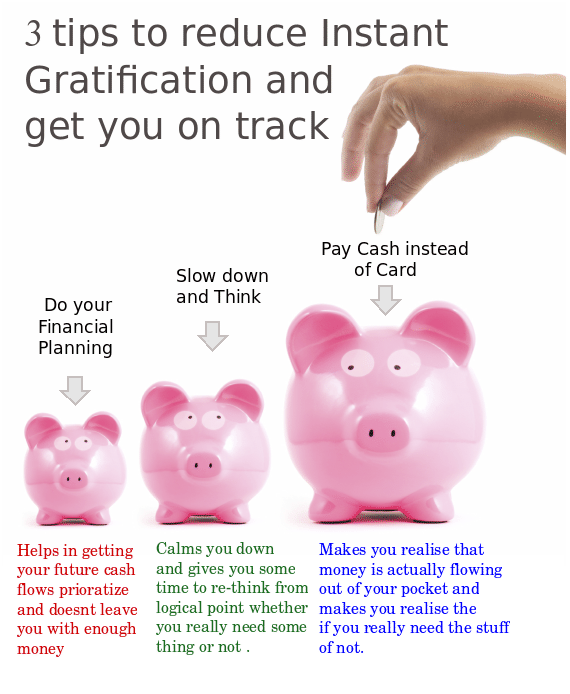
Here are 3 solutions which can help you reduce or avoid instant gratification in your financial life.

Do your Financial Planning :

You should do your financial planning and have a full plan on how you will invest your money for your future financial goals. Once your Insurance, child related goals and retirement are planned, you will have to commit the investment for these goals which are more important in life than other things which come along the way .

You will be more responsible and think twice before you spend on other unimportant things.

Slow down :

Don’t be impulsive, whenever you have to spend your money on anything, call some family member and tell them 4-5 reasons why it’s a good investment and is worth buying for, tell them enough reasons why it makes sense to buy it. If you are able to pass this process, then you can buy it else, reconsider.

What happens when you do this, is that you slow down and take a logical approach in deciding if you really want to want something. Let me give you a personal example. I recently did this for myself, when I wanted to buy a high-end Nokia phone.

I started counted the reasons why I should buy it and how it will add value to my life, I was very convinced that it’s an important and a valid expense for me.

Try to pay cash for your purchases :

When we don’t feel bad about paying, we tend to buy unimportant things and credit card is the main culprit here.  You buy and you swipe your card, you don’t see the cash going out, so at the end you just make a single payment. It don’t hurt much.

Try paying with cash, and when every time you see those cash notes go out, you become more concerned and more logical in thinking about your expenses.
Instant Gratification in Personal Finance

Other area’s in Life which where Instant Gratification affects us

Some other areas in life which we mess up are Education , Marriage and Career .

Education:

If you have seen “3 idiots” and “Tare Zameen Par”, you will understand better what I want to say here.  Lot of people do not carefully plan their education. There are many people who have pursued something which looked easier to complete or seems to be paying well without understanding, if it aligns with their liking or not and thereafter suffer all life.

Marriage :

Marriage is another thing where people mess-up due to instant gratification. There are many couples, who are not happy after few years of marriage, because the whole situation didn’t turn out the way they imagined.

A lot of times people judge their partners within hours or few days of meeting them, where they like them a lot because they are handsome of beautiful , have lot of wealth, things which impress them at first. I am in no way saying that only love marriages are successful because they are NOT !

It’s the same case some times with love marriages too . The only point I am making is that even in marriages , their is this thing called Instant gratification which creates issues for many people.

Career :

Career is directly linked to Education, so if you mess up your education, you’ll certainly botch your career. But even after people do their education correctly, many mess up while choosing their jobs.

When I completed post graduation, many of my friends went for companies while showed the highest CTC, were the best known companies in IT, but they are shedding tears of blood now as they can’t see any growth for themselves after a point or it’s not something they really wanted to do in their jobs.

However some people who controlled their emotions and planned to choose their companies considering the work they will do there are very happy and excelling now. So don’t just see what makes you happy right now, see what will make you happy all life.

Conclusion

The whole point here, is that we don’t think much about long-term aspects of our spending and hence make bad investments and mess up our financial lives.  Instead, we should use Instant gratification in our favor. One way we can do it is start SIP’s for your Financial goals now, and take action. Get a financial Planner and pay him to give you best advice and transform your financial life.

As 2010 is about to end now, dont let this year go waste as you learned a lot of stuff this year . Start your new year with some commitments and resolutions for 2011 which you will honor and not just write down !.

Share your comments if you’re a victim of “Instant gratification” at any point in your life? Also share how we can use this Instant gratification in our favor ?

At the end wishing you all Happy New Year .

The EMI Disease

“A dog held a juicy bone in his jaws, as he crossed a bridge over a brook. When he looked down into the water he saw another dog below with what appeared to be a bigger juicier bone. He jumped into the brook to snatch the bigger bone, letting go, of his own bone. He quickly learned, of course, that the bigger bone was just a reflection, and so he ended up with nothing!”

What do we learn from this short story?

Some thing, really similar to this story is happening in our lives – where the bridge which we are cross is our lives, the bone is our home,(or car or any thing we own) and the “other dog” is none other, than the people around us, our friends at work, neighbors, relatives, etc., who might have a bigger home than us, a better car or a more expensive LCD.

Does that mean that we also need to run towards that bigger bone? Yes? No? There is no harm in fulfilling our needs. As our families grow, and our need for comfort increases, we are bound to buy bigger homes, better cars (read more expensive) et al… And while we are at it, why not buy that much bigger LCD or enjoy that international holiday with the family? The EMI system changes our “wants” into “needs”.

Is Installment system of payment bad?

Definitely NOT! It’s a very convenient way of buying things, but the problem is that the EMI way of buying, gives a lot of people the feeling that they can afford anything which comes their way. And there lies the problem! A sizable chunk of people believe, that they need a bigger bone (when they actually don’t) and the easy availability of everything, in EMIs plays a large role in said belief. The EMI is such a beautiful concept, that even a person with a salary of 30k can buy a helicopter!

Why not? Just 9999 per month, for the next 200 years! Does he need it? Who cares? He can afford it! The problem is not the EMI concept in itself. The problem is us – losing our control on our spending and extending our affordability horizon to such great lengths, that we have everything in our life; but most of it is under debt.

Our home and our car are the two classic examples of this. Let’s talk about home. I don’t have much data, but my instinct says that most of the people who have taken a home loan are living in a much bigger home than they need. As per an in-house study, (through a poll,) I found out that as much as 67% of the readers on this blog or urban net-savvy people are paying at least 1 EMI, which would mostly be a house or car loan EMI. It was astonishing to see that 11% of readers here pay more than 3 EMIs! That’s too much!. Make sure that your EMIs are not more than 50% of your total, in hand (net), salary.

Number of EMI's paid

Affordability of  EMI vs affordability of Loan

If you tell a person, the EMI of a product, chances are that they will believe that he/she can afford it, as compared to when you tell them the actual price of the product. The problem lies in the numbers. The lower the number, the more affordable it becomes! However, this is not true! Actually, the more you reduce the EMI figure, the longer the tenure, and hence the total cost for you over a long period of time increases drastically!

Let’s take some products –

Home Loan

A classic example is the Home Loan. When a person plans for a loan, he makes sure that the EMI figure is affordable to him and does not concentrate much on the final value. For example, consider a person earning 50k per month. The EMI for a home worth 30 lacs @10% will be Rs 39,645. This may look unaffordable to him, so he increases the tenure to 20 yrs instead of 10, and brings down the EMI to 28,951/- Magically, this same home starts looking affordable to him!

What they concentrate upon, is the initial years, and not the big picture. They might not be considering some important points… like what if interest rates increase to 14%? In which case, the EMI will go up to 37000/-! These are young, recently married individuals, who have no idea of where they will be working in next 5 yrs. Will they be in the same job or same Industry? What will be their liabilities then? A close look at Real Estate Returns in India

I am not sure if a 3 BHK is the right choice for a recently married couple who has no one else with them, to live with. The justification can be that in future they may require it, however, if that’s going to happen in the next 15-20 years, a 1 BHK or 2 BHK is a better choice. It’s better to live in a 1 BHK and breathe easy, rather than a 3 BHK and suffocate every day from the burden of the heavy EMI. Here’s a good article on Home Loan EMI calculation.

Calculate your EMI

Car Loan

A lot of people buy a car before a home, as the EMI is affordable and the car adds to their comfort. I know a lot of people who can easily manage their life with a bike or without a vehicle, but have bought a car for reasons only known to them. There are just 2 people in the family, both have company transport, aren’t really outgoing, but they have a car. Not sure why!

A car is a depreciating asset. This means, that when you buy a car on loan, you are paying more money for something, whose value is coming down day by day, unlike your home. So buy a car, only when it’s really important or your comfort gets bigger than your simplicity when commuting is a problem.

The main problem again, is people buy cars that are much bigger and costlier than what they can afford and need. If you are in the starting phase of your career and have no more than 4 people in the family, why take anything beyond a Santro or Zen? You can always buy that dream car when you are more stable in your career and the other important things in life are taken care of.  My views may be biased because I am not a car or vehicle lover, so all car experts might disagree with me here 🙂

Holiday/LCD/Camera/Air Tickets

IRCTC has started giving air tickets on 6 equal EMIs! There is no catch! You can buy a ticket worth 3k today and pay 500 a month over 6 months. The only catch, is that this makes many people feel that they can afford it now. A student who was earlier traveling second class in train or at most, 3rd AC will not just be tempted but will believe that he can afford air travel now, which he couldn’t if he had to shell out 3k in one go.

Just because it’s a smaller chunk, we tend to buy things that we don’t need and can’t afford. The holidays are a perfect example! We Indians, are earning very well in this new decade, thanks to the opening up of our economy and IT sector especially. Our future earnings are more predictable now, compared to the past and this is the reason why most of the products are available on EMI; which makes us buy today and then pay for it for the next couple of years.

Conclusion

There is nothing wrong with buying things on EMI, as long as you know what you are doing, and then only if you really need it. Don’t run after everything you can get on EMI, and don’t drown yourself in so much debt, that it gets tough to come out. Save a good amount for the down payment and take debt only when buying something becomes inevitable. An early Start in Saving today will make your wealth overtime.

Common Mistakes in Personal Finance [Part 1]

Spending more than you should

Sometimes, people spend impulsively, on things which they do not really need. Just because, your plastic card is in your wallet and you “might” need it in future makes you believe that you need to get it right now. A brand new camera, with a 100 megapixel sensor and a 2000 x zoom is available at an EMI of just 1999 per month — and suddenly you’re interested in Photography! An EMI of 2500 a month, for that magical million colour, anorexic Flat Screen TV creates a magical belief in you that your normal TV at home is now really blurry these days (not to mention really fat!)

Is there a need, to splurge on Movies and eat out, every weekend? A regular meal at home, with a movie on tv is also a good weekend, at times. With many people, savings occur, only if they are left with any money at the end of the month. This needs to change – start saving first, then spend on what’s necessary and then spend on your desires – last. Financial planning does not mean compromising your dreams or what you love to splurge on; it’s all about knowing what you need and what you don’t, & knowing it well! . Read : Can you live with 90% of your Salary

No Financial Education to Spouse and Kids

Most people are more comfortable talking about SEX rather than FINANCE to kids (just kidding.) They dont feel the need to tell their children that they have bought life insurance for them (the kids) should they be hit by a bus tomorrow (the parents, not the kids 🙂 ). Once children reach an age of maturity like 16 or 17; when they can understand things & reason well and can take on responsibilities to some extent… Please start telling them about money and finances. Once you are gone, you can’t even regret.

Kids should know what your work is & how much you earn. They should be clear on how you are saving money to fund their education, bike , trips etc. Once they know about life t it, chances are they will be a lot more supportive, would be realistic in their demands & stay well within their limits. Kids don’t know sometimes, how much pain you take in earning money. Most of the times, kids know your salary and your designation at company and assume the family to be a “higher middle class” one. Once you tell them about Home loan EMI, Car Loan, other liabilities, Retirement SavingsEducation Expenses, Marriage expenses and the medical emergencies for which you are saving, they will have a better idea about the current situation and they will act responsibly.

Parents feel a little uncomfortable, telling their kids these things, as they feel children are still young and such information will create unneccessary psychological pressure and they would not talk about their demands and be unhappy. Parents feel that children should start learning about finance and applying that knowledge, once they are in a job and start earning. I say, if your finances and spending habits are messed up today, a big reason could be that, your parents never talked about finance with you openly. The same applies to spouses. Imagine, if you had all the knowledge and best practices you have learned on this blog, 10 years ago; or when you started earning? The situation would have been very different today, wouldn’t it?

Dont let this happen to your kids: Teach them!

Imbalanced Asset Allocation

A lot of people have a tendency to start working and then never look at, or review their finances. Tax Planning is nothing more, than a “signature” on some form for them. Initiatives from their side are limited to just calling an “agent” and nothing more. When they finally look back at their finances, they find that they have 40 Lacs in FD’s and 25  lacs lying in Bank. This happens a lot with NRI’s working outside the country. These are 35 yrs old who have 90% in debt or Cash, and 3-4 mutual funds and shares bought in recent years just for “trying”. This category misses a huge amount of returns which they could have made with just 4-5 hours of planning or hiring a proper investment consultant.

On the other hand, there are investors who have no PPF, no FD, no Debt Funds, no bonds; they just do share trading, buy direct stocks, invest in just Mutual funds (pure equity). Their imbalanced Asset allocation is responsible for the huge ups and downs their portfolio takes. One year the worth of their portfolio will be 10 lacs, the next year it will be 7, then suddenly it will be 14 lacs the next year. The numbers dance with huge fluctuations, but at the end of let’s say, a decade, they look back & find they are nowhere better than their “High debt Instrument” kind of Investor brothers .

Buying products from Close One’s

Will you sell a junk product to yourself if there’s a 35% commission and it will be a burden to you all your life ? I don’t think so, but if you had to sell it to your friend, colleague, brother-in-law, sister-in-law, father’s friend etc, you’d consider it, wouldn’t you? That’s what happens in real life too.

Most times, the “Best plan” comes from one of your relatives or some one known. STOP IT PLEASE! A simple NO might hurt your relations with said person, but it will save you, your hard-earned money, rather than waste it on idiotic products, which you’ll regret for life 🙂 It’s just common sense that there are better advisors and consultants than your relatives or a close ones, unless they themselves are known and respected in the field (of finance). Read : “Papa Kehte Hain” problem in Personal Finance

Most of the readers here, have shared their bitter personal experiences, where they bought products because it came from their relatives, Uncle’s et al. This happens a lot with young guys yet to start working, and their fathers have bought policies for them and then delegated the premium paying responsibility to them once they start earning, it’s a real “burden of legacy” .

Read Part 2 of Common Mistakes in Personal Finance

Comments please , Any other mistakes you can think of ?

Do not Invest just for Tax Saving

“Tax saving should be result of your Investment planning and not vice versa” . Understand this very well . For most of the people, saving tax is such a big thing , that they forget the primary rule of Financial Planning and concentrate all their energy into Tax Saving .

I see most of the people are trapped in idiotic products because of their obsession with Tax Saving . Most of the people today are invested in products which does not suit them, which they dont need, Which they do not understand .

All because of their idiotic decision of “Investing for Tax Saving !!”  .

tax saving joke


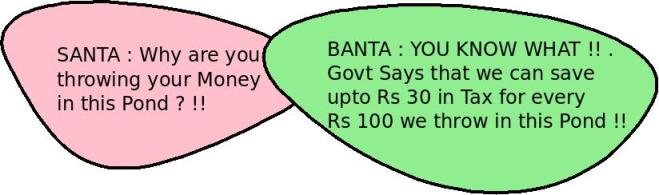
For some people the Products they buy for Tax savings are like This Pond , They are not sure what they will get from buying it , but they are happy about the fact that they are saving some money in Tax . Which is idiotic .

Typical Scenario

Most of the people dont do their Tax Planning in the start of the year . They just neglect The Tax Planning part. Somewhere at the end of the Year around Feb, They recieve a letter from their company that they need to submit their Documents for Tax savings so that they can avail the benefit of 80C and other Tax saving benefits like HRA , LTA ,  Medical Reimbursements , etc .

Even then they dont budge and most of the people wait till the deadline date to come very near .

Then finally comes the deadline date and now “Giving The proofs of Investment” is much more important than “Making Sensible Financial Decisions” . Its too late to Plan for things . ULIP agents , Insurance agents and Mutual funds agents are ready to take the charge and they will brain wash you with all their nice words , They themselves dont understand the product a lot of times .

You have no choice but to invest so that you save tax now . You cant even imagine a scenario where you dont invest your money and pay the tax . It feels like the most idiotic Decision ever . Which I feel can be a good decision sometimes .

Top Reasons for Investing

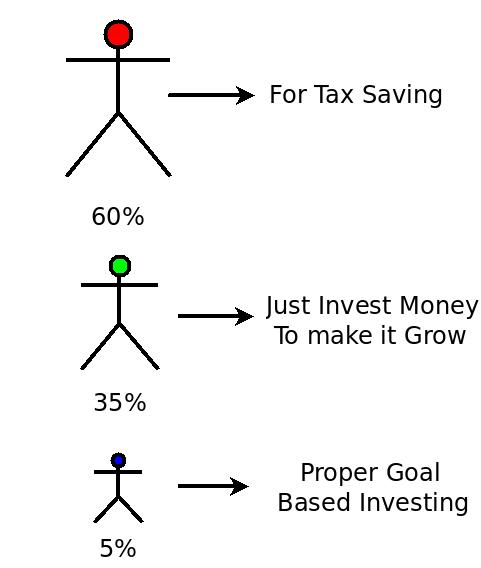
Below is a small diagram which tries to show how what are the biggest reasons people invest their money . Please Note that this is based on my understand and experience with so many investors over the years . And this is what I feel depicts the scenario closest to actual .
Investing Pattern for Tax Saving in India

Problems arising Due to This

  1. The worst Sufferers are those who invest in LIC and other companies Endowment Polices and Money Back Polices  for the primary reason of Tax Savings. These people do not think that even though they are saving tax for this particular year , they are actually getting into commitment for next 15-20 yrs (or Policy Tenure) and Have no Idea how its going to meet their Future Goals . Read a Review on LIC Jeevan Tarang Policy .
  2. Similar problem is with people who take ULIP’s . They Invest for a year to save tax and then next year they have no idea if they would be able to even afford it or not !! . This happens with mostly new joinees in Companies .They have no idea what to ask their ULIP agent at the time of Buying the product .
  3. Next is “Liquidity Problem” . Most of the people do not think about the lock in period and do not take into consideration their Liquidity Requirement for coming Years . They Invest in ELSS and then next year they need money . They Invest in Tax Saving FD’s and then cry for any Expenses which were very obvious to arise down the line .

What we must Learn

Tax Saving is just a benefit provided when you Invest your Money, dont make it as a Primary objective to Invest. What you have to concentrate on is your Investment Planning , and after you have to restructure your Investment planning in such a way so that you also get Tax Benefits from them.

Investment Planning First and Tax planning second .If you are not able to save tax , its fine , Pay taxes . Its always better to avoid getting into messy products which dont suit you and suck your blood out . Tax Planning is Important, But the more Important things is that you don’t get to obsessive about it and do it only if its needed.

Its not a big deal to save tax at the cost of your Finances future . See an article on Gfactor , a decision making tool for Financial Products

I can relate this with “Not using Protection during Sex” and then suffering for a long time because of that small mistake .  This is exactly True with all people who dont not need Crappy Insurance and then one single mistake, Investing in it for Tax saving and then every year , Suffer with it, Paying a huge premium for the Small Insurance not sufficient for you and for the Maturity Amount which is not at all exciting .

Make sure that you invest in some product only if matches these 4 criteria .

So are you one of them who tax Tax saving with High Priority ? Have you invested for Tax saving as primary reasons ? Share with us . We can talk about it and make sure that it does not happen again . Post your Views on this ..

If you liked the Post , then Subscribe to this Blog to get updated .

Search within You ..

I was watching a seminar video on my laptop today which was a trading seminar conducted in US, the speaker was an American.

In the middle of the seminar he presented a small story which was from Hindu Mythology which made me feel good, I am putting it here word by word after finding it from net (so that I don’t have to type all myself).

search within you

There was once a time when all human beings were gods, but they so abused their divinity that Brahma, the chief god, decided to take it away from them and hide it where it could never be found.
Where to hide their divinity was the question.

So Brahma called a council of the gods to help him decide. “Let’s bury it deep in the earth,” said the gods. But Brahma answered, “No, that will not do because humans will dig into the earth and find it.”

Then the gods said, “Let’s sink it in the deepest ocean.” But Brahma said, “No, not there, for they will learn to dive into the ocean and will find it.” Then the gods said, “Let’s take it to the top of the highest mountain and hide it there.” But once again Brahma replied, “No, that will not do either, because they will eventually climb every mountain and once again take up their divinity.”

Then the gods gave up and said, “We do not know where to hide it, because it seems that there is no place on earth or in the sea that human beings will not eventually reach.”

Brahma thought for a long time and then said, “Here is what we will do. We will hide their divinity deep in the center of their own being, for humans will never think to look for it there.”

All the gods agreed that this was the perfect hiding place, and the deed was done. And since that time humans have been going up and down the earth, digging, diving, climbing, and exploring–searching for something already within themselves.

What does this teach us?

In life we have all the power to achieve something we want, we cant get help from some one, we can get tools, we can get support or for that matter any damn thing, but what is needed for success lies with us only, So don’t hunt for things outside, first know yourself.

“Its only you who can change things.”

How do I relate this to Investing and Money Management?

Whatever it takes to grow your money, do better investments or take informed decisions, Its within you, you just need to explore it, You can read stuff on this blog or anywhere else, but the real wisdom lies within you, you have to work hard on it.

I know nothing spacial or advanced things, I know things which any one can learn, The only difference can be my willingness to learn and make the difference and confidence. You can do it to. Just make sure you have the fire to learn and see within you and have confidence.

Just like a good cook doesn’t need great ingredients to make good food, he can make great things out of simple and basic stuff, the same way, we don’t need fancy products for our investments, Even if we have basic products we can utilize them well and create wonders, Only the knowledge and willing to do is required. Its within you, search for it ..

Please leave your comments on the blog, on your view and whether you liked the articles or not. That way I can know atleast that people like my articles or not.

A conversation with friend on avoiding financial responsibility

In this article I’m going to tell my conversation with one of my friend about investment and different investment tools. We have discussed on both advance and traditional investment tools.

Read this chat conversation with one of my old classmate in Graduation.

Avoiding responsibility

“Manish : So where are you going to invest you money this year?

XYZ : May be PPF or Bank FD

Manish : But do you think they would give you good returns? also they would be locked for a long time, don’t you need that money in near future?

XYZ : Not exactly!, actually I can leave that money invested for more than 5 yrs, or may be 7-8 yrs too ..

XYZ : also, But I would like to invest some money in mutual funds … around 20k, May be I need some money to send to my brother for his MBA coaching ….

Manish : hmm.. But I think you should do exactly reverse. Invest this 20k in FD and Rest money in Mutual funds + PPF or only mutual funds.

XYZ : No no, I cant !! I have already lost 50% in mutual funds this time, I cant take risk now, I am fine with less return but a secure one …

Manish : hmm… I told you don’t put all money in lump sum. You never heard !!

XYZ : I invested because I trusted you, I thought you know more than me, but it fell so much … you gave wrong advice at wrong time.

Manish : Don’t you think it was your desire for high returns which made this happen? Equity are risky? I told you this too !!

XYZ : Whatever …

Manish : ok .. np … Consider what I said … good night … 🙂

XYZ : Good night

What is the problem of these people?

First they need high returns, then they cant wait for long term to get that kind of return. They just hear that equity are risky but don’t believe it, they will make you feel that you are responsible for the crash. They just don’t take responsibility for what they did !!

What I actually told her?

I told her that its OK to invest at these high levels but don’t invest in Tax saving mutual funds as they will be locked for 3 years, also invest less and that too through SIP (What is SIP?), so that it can eat up the volatility and insure less losses if things go wrong.

But the only things on her mind was:

  • It will save her tax
  • Will give superb returns like it did during 2002-2007 (these are the people who don’t read “Equity investments are risky and passed performance is not guarantee for future performance”)
  • If she does SIP and markets goes up and up, she will be buying less units.

This is a classic example of “Overestimating Returns and Underestimating Risk”

How should you do your tax planning for the year?

First thing, if you have not done your tax savings yet, its a bad thing. It should be done at the start of the year itself, at least planned.

If you need money for short term goal, don’t invest in Shares or mutual funds !! Put it in some assured investment instruments like FD.

“Return of investment” is more important than “Returns from investments”.

If you have money which you can invest for long term, invest in Shares or Mutual funds (but only for long term). As per your risk taking capability choose combination of Debt and Equity and invest for the long term …

Why Equity?

Do you know that most of the stocks have beaten down so much that they have come down below than the price they deserve, There value has exceeded there price (Read about Value Vs Price).

Unitech : One of the largest and most respected Real Estate companies has fallen down to levels which are unimaginable !! from 532 to 40-50.

Tata Motors : Nano will be manufactured in some months, every thing looks so good, but people just sold it because of Singur tension (It was fine to sell it , but now its oversold).

There are countless examples like this in current market. Things will go fine, but with patience.

Cost of Ignorance and it’s consequences on financial life with some real life experiences

There are two kind of losses

1. Loss of money because of wrong decisions
2. Loss of potential profit because of lack of knowledge or having wrong information (I like to call it loss)

cost of ignorance

I personally feel and realized most of the losses happen to people because of the second point. Today after so much of progress, India Personal Finances still has some very immature characteristics. Indians have one of the highest saving rates in World, but we fail to invest our hard money in the best way.

What happened because of lack of knowledge

– Every insurance agent told that insurance is important, but not the best product for a person which suits him/her. They made Insurance policy synonymous with an Investment product to our average Indian. They packaged those Money back and Endowment policies as must have products for any married person with family.

– People love numbers, they love to get back 30 lacs back by investing just 10 lacs in a 20 years. They were never told about inflation, about decreasing purchasing power of money. Hence they can figure out that 30 lacs after 20 years is less than today’s 10 lacs, so actually they are getting cheated (yes, i like to call that cheated)

– Ask people what is an ETF, FMP, STP or REMF? Its like asking people what is LIC in 1957-58 or asking some one what is Mutual funds in early 90’s. These are important financial products of future, but people are not able to get benefited because of no knowledge.

– People who invest for long term (5-10+ years) still invest in FD’s and bonds, I don’t say that its wrong, but they do it because they don’t know that equity is best for long term, they know there is risk but don’t know that it almost no risk if they are investing in Equity for 10+ years.

When it comes to personal finance, people are almost clue less … Every one wants high returns but without any risk of loss. Everyone has heard about mutual funds giving 40-50% CAGR in 2005-06-07, but not even few know how what role did there excellent management and stock picks played to generate those returns.

Let me tell you what happens when you don’t know a lot of things.

See some of Real life examples :

Example 1 –

One of my classmate has taken ULIP, she pays 25000 per year as premium … She didn’t knew that there are high allocation charges of 18-20% in initial years… She didn’t knew that she can switch her investments in other safe options in ULIP if markets are down …

On the top of that she is given an Insurance of 1.25 lacs (i am not sure how it helps with her insurance needs) …

Example 2 –

One of my friend took LIC policy and pays 60000 per Annam as premium, he heard that it will save him tax … he did a great job in choosing the policy, returns are good … Insurance is fine .. but when asked if he has any financial dependents, he was clueless… I am not sure why the hell he took insurance at all then …

Example 3 –

One of my friend had put 100% of his investments (around 1.4 lacs) in Equity (80% shares and rest in mutual funds in early 2007 … when i asked on what basis he has invested all his money in Equity .. he said he needed good returns because this money will be used for his brother education in another 2 yrs …

I told him that they are risky and more than his risk appetite … he ignored it, saying that his money is almost grown by 70% already and gave him decent returns which he expected …. then came Jan 2008 crash and now his total investments are worth 80,000-90,000, he had invested in small -cap companies which gives nightmares to even great investment guru’s …

Example 4 –

Lot of my friends have invested in Mutual funds in lump sum in Dec 2007 or Jan 2008 and didn’t take SIP instead of my telling them several time that SIP is the the systematic approach and will bring down there average cost … and returns in volatile markets …

All of them have 30-40% loss at the moment, but all those who invested through SIP have loss of around 10-12% only … .

Example 5 –

I know many who earn good money, have good risk appetite and long term financial goals to meet … but they invest in what? NSC and Money back policy of insurance schemes … Any one who is out of his/her mind and is totally insane will invest in NSC or KVP in today time …

They take money back Insurance policy of 3 lacs or 5 lacs for 25 yrs or 30 yrs … I wonder how will that 5 lacs help them in 2035 when average monthly expenses of a medium class family will be around 1 lacs/month … they pay hefty premium of 30k, 40k or 50k in today’s time to get back the kind of money back after 30 yrs which will just pay there 1 yrs expenses …

They do it because they cant see not getting money at the end if they survive for all the money they have paid … they stay away from Term insurance because they don’t get any thing in the last .. So what if for 20 lacs insurance for 25 yrs they just have to pay 4200 total every year … they don’t get anything at last .. so better not to take term insurance .. its not giving anything … that’s what they feel …

Whats the solution?

It takes Rs.30 to buy “Outlook Money” and Rs.20 for “Money Today” (or read online : https://moneytoday.digitaltoday.in/index.php?latn=1 ) and 5-6 hrs to read all of it .

Just Rs.100 and some hrs per month can help anyone save thousands or lacs (depending on there investments), but it takes discipline and regularity