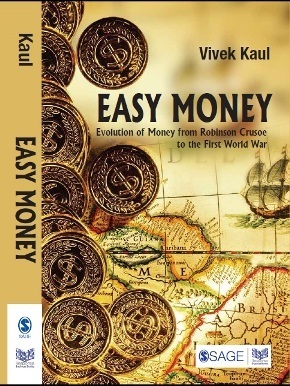
Review of book – “Easy Money – Evolution of Money from Robinson Crusoe to the First World War”

Do you want to learn how money evolved in this world ? How did the concept of money took birth ? Today it might look very easy and intuitive to see and manage money, but it has long history and a very interesting one! . I always used to wonder about these topics, but got to read anything in detail untill some months back when Vivek Kaul sent me his book – “Easy Money – Evolution of Money from Robinson Crusoe to the First world war” (buy the book)

In this book, Vivek has shared how this world was first on the barter system and then slowly and steadily the concept of money was born. He mentions various events in history and examples which will how you how money was not just invented in a day, but it slowly took its shape because it was the need of the hour.

easy money book by vivek kaul

Click Here to Buy the Book

Kaul starts with the history of money from time immemorial and traces the development of money and the financial system till around the time of the end of the First World War. He tells us about the various commodities that have been used as money at various points of time. Other than gold and silver, a whole lot of other metals like copper, iron, platinum, lead, nickel, and tin, have been used as money by various civilizations at various points of time.

Other than metals, agricultural commodities like almonds, cacao beans, rice, wheat, and tobacco have also been used as money. In fact, tobacco was used as money in the United States longer than gold and silver were. Salt has been used as money in large parts of Sahara which are dry.

Here is one example sharing from the book

In the prisoner of war camps during the Second World War cigarettes were used as money. Dog teeth and dolphin teeth have been used as money. And in the island of Yap in the Pacific Ocean even large thick stone wheels called fei have also been used as money.

Gold is valueable because its “Useless”

One of the best things I learned from the book is that Gold is valuable in this world, because its Useless. Yes – you heard it right. From the start of my life, I used to wonder that why people love gold and why its so expensive when it cant be used for anything useful, and in the book I learnt that – its the exact reason why its so valuable . The book shares the reason for this and Here is an excerpt from the book

What also helped gold survive as money is its uselessness. “Despite the fact that it is highly malleable (can be beaten into sheets easily), ductile (can be easily drawn into wires), and the best conductor of electricity, gold does not have many industrial uses like other metals have. This is primarily because there is very little of it go¬ing around. Also, what does not help is the fact that gold is as soft as putty. This softness makes it practically useless for all purposes that need metal,” writes Kaul. “When commodities are used as money they are taken away from their primary use.

So, if rice or wheat is used as money for daily transactions and to preserve wealth, it means a lesser amount of rice and wheat in the market for people to buy and eat. This, in turn, would mean higher prices of grains, which are staple food in large parts of the world. Gold does not have many practical uses. So if people hoard gold, it does not hurt anyone,” he adds. Hence, gold survived as money largely till the start of the First World War. Then paper money took over as various European governments had to print money in order to finance the First World War.

Rise of Paper Money and Banking System

One of the most interesting points of Easy Money is the part where Kaul explains the close link between the rise of paper money and the banking system as it has evolved to this day. In fact, the paper money system was at the heart of the profitability of banks. As Kaul writes “The moral of the story is that the lesser the capital the bank had, the greater money it made, but greater was its chance of going bust as well. As Walter Bagehot, the great editor of The Economist once put it, “the main source of profitableness of established banking is the smallness of requisite capital.”

This is a very fundamental point on how the banks as well as other financial institutions have evolved over the years and is at the heart of things as they are currently. Banks as well as financial institutions over the years have figured out that the lesser the amount of capital they have on their books, the more money they make. But this increases the riskiness of the overall financial system as well.”

Note that the book also talks about some of the heavy topics like financial crisis, financial innovations like securitization, collateralized debt obligations, and credit default swaps, how banks evolved etc

The last chapter of the book tries to link the history to way things are happening currently. This chapter could have been little longer and ends a bit too quickly. Another thing that the author could have done is have had takeaways at the end of each chapter, linking them to the current financial crisis.

My personal take on the book

While I enjoyed the book, and its an an excellent read for anyone looking to understand the current financial crisis from a historical view point in simple jargon free English. Be clear that its not a regular personal finance book teaching you about concepts. Also be ready to read few things which you might not be able to digest in a single read. You should read the book only if you love the topic of money evolution and the whole idea which the book wants to present.

Buy the Book by Clicking Here

About Vivek Kaul

Vivek Kaul has worked at senior positions with the Daily News and Analysis (DNA) and The Economic Times. His writings have appeared across various other publications in India. These include The Times of India, The Times of India (Crest edition), The Hindu, The Hindu Business Line, The Pioneer, Indian Management, Asian Age, Deccan Chronicle, Forbes India, and Wealth Insight. He has also written regularly for www.rediff.com. Currently, he is a regu­lar columnist for www.firstpost.com and a regular contributor to DNA.

Share with us how Jagoinvestor has helped you succeed in your financial life – Click Here

The Shocking story of – How LIC policy was surrendered using Forged Signature

Can someone else surrender your LIC policy and take the money ? I know you have never ever thought this can happen, because this looks so impossible, but I want to share an incident with you all which happened with Muthu (name changed), who is one of our jagoinvestor reader.

insurance fraud surrender

One day, Muthu came to know that 3 of his LIC policies were surrendered by someone else and the money was utilized. He came to know about this only when he got pre-closure letter from LIC for his 3rd policy. Below is the full sharing from Muthu

Hello All,

I was shocked to know that someone has used my identity (signature) to surrender my LIC policies and utilized that money for their benefits.

  • Firstly, my policy # 363934899 was forged and surrendered on 29.01.2013, for which LIC has issued cheque # 926895 dtd 29.01.2013 amounted Rs. 49795/- without my knowledge or consent.
  • Secondly, my policy # 363934900 was forged and surrendered on 29.01.2013, for which LIC has issued cheque # 926894 dtd 29.01.2013 amounted Rs 49795/- without my knowledge or consent.
  • Thirdly, my policy # 364340197 was forged and surrendered on 07.10.2013, for which LIC has issued cheque 959220 amounted to Rs 35645/- without my knowledge or consent.

I came to know about this when I received pre-closure letter from LIC after surrender of my third policy # 364340197. Immediately I raised written complaint to LIC about policies forgery on October 29, 2013. Further to my complaint, LIC recovered forged amount from the concern person and sent a covering letter along with the 4 cheques to me for the forged valve but not specifying the forged person name on the covering letter.

This incident raises some questions which are –

  • When the initial cheques was issued in my name, how the money has been utilized by someone else.
  • Even though requesting, LIC not mentioning forged person name in the covering letter after recovery of the forged amount.
  • Did LIC filed FIR against forged person? If not why?

Who did this Fraud ?

When I came to know about this incident, the first thing which came to my mind was that it was some “insider” from LIC who did this, because its almost impossible to surrender the policy without producing the original policy document, forging the signatures and then redeeming the cheque in your own account. But the truth is that the fraud was not done by anyone from LIC office. Then Who ?

It was his Mother and Younger Brother !

Shocked ! ?

Let me now share in Muthu’s words how his mother and younger brother did this fraud.

The Fraud was done using “re-cycle” procedure

Here is exactly what Muthu shared about the fraud procedure

Dear Manish,

Since the bond was in my mother custody they surrendered that policy with the forged signature (read more about Identity Theft)

When the cheque was issued in my name, LIC agent by name Yeshoda has given a cunning idea to re-submit the cheque received in my name to LIC and another policy to issue for the same value for different name ( This process is called re-cycle procedure).

Finally once the policy has been issued in their name. They can easily surrender that policy and utilized the policy amount.

This is worst ever experience that money can change “ANY ONE”.

Do you have LIC policy ? Are you sure this same fraud can not happen with you ? How will you prevent it ?

Entering ATM PIN is now compulsory when you use Debit Cards

RBI has made it mandatory to punch your PIN number, when you use your debit card on shopping outlets (Big bazaar, Petrol Pumps, Shops) from Dec 1 2013. I realised just few days back that this has already started. I was shopping for household things at a mall nearby and was asked to punch in my Debit card PIN after it was swiped. It was the first time I had to do that in last so may years of my using debit card for shopping. I covered the machine with my hands and entered my PIN and the transaction went through.

mandatory pin on debit card swipe

There are close to 350 million debit card in India right now and you can imagine the quantum of frauds which is possible with so many debit cards in India. Before this rule came into effect, if your debit card was lost – Someone could just take your debit card, go for the shopping and swipe your debit card and would never get caught because the shopkeepers never checked signatures, identity of person etc.

But now with this new rule in place, an additional check of entering PIN number is required and the chances of fraud is lowered to some level

But – there are some Problems due to this

Now from one angle, surely frauds will come down, but then at the same time, this new rule exposes you to some new risks and potential frauds. Like – If you punch your PIN without much thought and others surrounding you are looking at the machine, others can look at the 4 digit PIN number you punched and memorize it.

Forget strangers, but imagine you are with some friend/relative and you punch your PIN, he/she looks at it, memories it and now he can use it later for some online transaction (he still has to find out your Card number and Expiry date, which is clearly mentioned on your card).

Also at some outlets dishonest shopkeepers have skimmers machine which record your data when you swipe the card and they can duplicate your card and use it later to withdraw cash from ATM or do transactions with duplicate cards.

An article from Firstpost also mentions that there is also a possibility of PIN being stored on the Machine after you have punched it.

The next question to ask is can the PIN be stored (knowingly/ unknowingly) on the card reader machine by the retailer? According to this report in the USA, instances have been known where many merchants have incorrectly stored PIN information they should be destroying after customers enter the secret code. While we agree this is a western world report, Indian fraudsters have always been inspired to copy those tricks in the domestic markets. What would stop our fraudsters? And even if your merchant would have stored the PIN inadvertently on his card machine, a hacker can easily access the retailer’s machine to get data about several card holders along with their PINs.

Implementation from Dec 1

The above rule was to be followed by all the terminals from Dec 1, 2013. Anyone not complying is just not following RBI guidelines and breaking the law.

While all the places I have seen has started implementing it, still at some places its not being not followed. Here is one instance which comes from the same first post article comments section, where someone is sharing his experience.

yesterday on 4 Dec, I went to another restaurant and wanted to pay via debit card. While, the merchant was punching into machine, I was waiting for him to hand over the machine. But this is not what happened, I was not asked for the PIN for this restaurant even after the new RBI rule is in effect.

This clearly violates the fact that the new RBI rule is not completely applied for all merchants/banks.

What do you think about this new change ? Are you happy with it, or have some reasons against this change ?

The Journey of 10 part Plan F show (and youtube links)

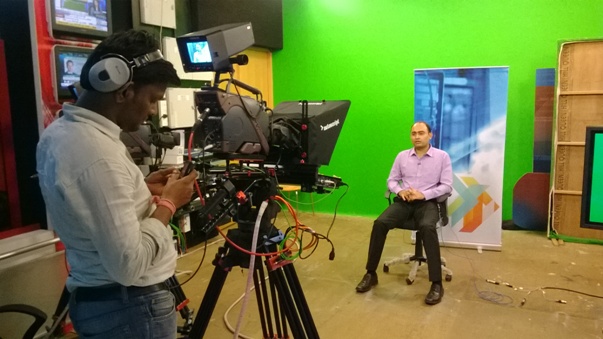
In this post we want to share our great experience till now working with CNBC 18 and DSP BlackRock Mutual Funds team on the show Plan F. We have been involved with the whole process from start. Me and Nandish keep going to CNBC Office every alternate week to shoot for our part which comes at end of each episode.

Shooting of CNBC show plan F

What you can learn from Each Episode ?

All the 10 episodes have been aired and we have got all kind of reviews about them, what was good, what could be improved, which part audience are liking and what they are not liking. I tell all of them that no one episode can fit someone’s expectations, but it surely has deep learnings for everyone. In one way or other one can surely learn from each episode’s. I am not talking about the numbers discussed or their portfolio, but from each episode’s case study financial life journey.

For example – in 5th episode, Mr Subodh Khare shares how he wants to make his daughter financially wise and wants to give them around Rs 50 lacs so that they can shape their life from there in a more powerful way.

In 2nd episode Sreekumari shared how she is operating from Financial Freedom and how she has already taken so many right decisions.

In 3rd episode Ramakumar shares, how all his life, he used 2nd income in family (his spouse income) only and only for saving and now he is almost financially free.

If you look at each episode, write down what is that one learning you can draw from the episode and you can take some actions to improve it. If you listen to IFA’s, they analyse the portfolio and give some 2-3 core insights they can think about. Either Me or Nandish give 3 tips of the week for all investors which you can apply to your financial life.

Episode 1 – Ramesh Jalan

Watch the first episode, where Mr. Ramesh Jalan talks about his investment journey with financial experts Sumeet Vaid (MD, Freedom Wealth Solutions) and Vijay Bhushan (Partner, Bharat Bhushan & Co.)

Episode 2 – Shreekumari Dholakia

Watch the second episode, where Ms. Shreekumari Dholakia talks about her investment journey with financial experts Lovaii Navlakhi (CEO, International Money Matters) and Surya Bhatia (Managing Partner, Assets Managers)

Episode 3 – Ramakumar Poothrikovil

Watch the third episode, where Mr. Ramakumar Poothrikovil talks about his investment journey with financial experts Ramkumar Barchha (Premium Partner, Ramkumar H Barchha) and Ashish Shah (MD, Wealth First Portfolio Managers)

Episode 4 – Himanshu Jain

Watch the fourth episode, where Mr. Himanshu Jain talks about his investment journey with financial experts Suresh Sadagopan (Founder, Ladder 7 Financial Advisories) and Brijesh Dalmia (Director, Dalmia Advisory Services)

Episode 5 – Subodh Khare

Watch the fifth episode, where Dr. Subodh Khare talks about his investment journey with financial experts Ashish Chadha (CEO,Chadha Investment Consultant) and Pallav Bagaria (Proprietor, Brand New Day)

Episode 6 – Sanjeev Singh

Watch the sixth episode, where Mr. Sanjeev Singh talks about his investment journey with financial experts Hari Kamat (Proprietor, Investment Avenue) and Ullas Shah (CEO, Madhuvan Securities)

Episode 7 – Kavita Sharma

Watch the seventh episode, where Ms. Kavita Sharma talks about her investment journey with financial experts Ranjit Dani (Co Founder, Think Consultants) and Krishnakumar Desai (Chief Investment Advisor, Sri Kotyark Investments)

Episode 8 – M Subrahmanyeswara Rao

Watch the eighth episode, where Mr. M Subrahmanyeswara Rao talks about his investment journey with financial experts Gajendra Kothari (MD & CEO, Etica Wealth Management) and N Krishnan (Director, Value Invest Wealth Management)

Episode 9 – Shefali Doshi

Watch the ninth episode, where Ms. Shefali Doshi talks about her investment journey with financial experts Mrin Agarwal (Founder, Mr investment) and Deepak Chhabria (CEO & Director, Axiom Financial Services)

Episode 10 – Cyrus Broacha & Ramesh Damani

In the Plan F finale (10th Episode), watch the key principles of investing that regular investors can implement in their investing strategy, summarized by the renowned market analyst and member of BSE, Ramesh Damani. These principles have been extracted from the many case studies that were featured over the course of the Plan F season. Also, watch the tables turn as Jagoinvestor takes on the role of the inquisitor, interviewing Cyrus Broacha on his personal finance journey.

Share about your views on Plan
Can you share your learnings from various episodes of Plan F ? Which were the points you learned and have started applied in your financial life ?

2nd Batch of Investor’s Boot Camp starts on 25th Nov 2013

Let us remind you again that – Personal finance is not about knowing things, it is about getting things done in your financial life. In other words, It’s all about taking required actions and steps to be in control of your financial life. Now, we know that life throws several responsibilities at you and TIME is the BIGGEST constraint/problem/challenge to complete personal finance pending actions.

To make things doable, we experimented something called Investor’s bootcamp some weeks ago and 33 investors joined our first batch. The boot camp really took all of us with a surprise, we integrated personal finance with social media (yes it happens on your favorite place facebook).

While you hangout on facebook, you will be able to gain key personal finance insights and you will be equipped to complete important personal finance actions in your financial life. Some of the participants had the best personal finance actions days, while they were in the Investors boot camp. It is amazing experience learning from other’s financial life while you are in boot camp. We (Nandish and Manish) will be there throughout the journey guiding you to take actions in each week.

6 weeks investors bootcamp by Jagoinvestor

2nd Batch of Investors Bootcamp from Nov 25, 2013

Today, we are launching 2nd batch of our investor boot camp and we invite those who wants to GIFT a NEW financial future to one self, to those who think it’s high time they get in ACTION, to those who want to expand their actions domain along with knowledge domain when it comes to personal finance.

What is Investors Bootcamp ?

Jagoinvestor Bootcamps is a life changing experience for investors. For 6 weeks, investors who are waiting for doing something concrete in their financial life come together and work on their financial life with help of Jagoinvestor Team on facebook group. Each Week – one area of their financial life is taken and whole group work for the whole week investors work on that area of their financial life. A group structure helps them to learn from each other’s financial life, get accountable to their promises made on bootcamp group. The interactions are rich in nature and deeply meaningful for everyone. If you have been waiting for long time to improve your financial life, its a great way to work on your financial life. Its much powerful than a financial plan because of group structure.

Listen to the audio below to understand what is Bootcamp.

[button link=”#register” color=”#38CFCF” size=”3″ style=”1″ dark=”1″ square=”1″] Register for Bootcamp[/button]

What happens inside Investors Bootcamp ? Here are some Snapshots!

Inside Bootcamp

What Bootcamp Graduate’s Have to Say

“Its going to be a million dollar worth asset for You”

I heard all the 10 audios .Really am speechless when i want to thank you guys for those wonderful audios.If i say your audios are excellent,amazing,marvellous then those words would be the least meant for admiring your words in those audios.I dont think simply you guys are doing your work since we paid.Your words are something beyond that.It shows the real meaning of humanity.It makes me to realise your bond towards the society.

As u said in your audios,you are SERVING us by making ourselves to realise the importance of SLOWNNESS,to be OUTCOME centric,to focus on NETWORTH,to concentrate on what MATTERS,how to CREATE,necessity of COMMITMENT,the vision of BIG game,mindset of playing to WIN,the need of ZERO tolerance I don know how many times am going to hear your audios again and again.I wont stop till i get the complete fruit out of it.Surely i could say these audios are going to be a game changer in my life.I like to thank Nandish and Manish for the quality of their work which helps for the persons like me to grow in their lives.

Friends ,those who got access to these audios ,please dont miss it.Its going to be a million dollar worth asset for u. Thank you.

Sriram Chennaswami

“Not only improve financial life, but also the whole way of your life”

Today I heard all 10 audios! Speachless…. Its not because that all these are superb, yes – it is! , but inspite of all these, these words not only improve financial life but also the whole way of your life. ZINDGI JEENE KA NAZRIYA HI BADAL DETE HAI. I want to start a business after 1 year. For that I wanted use this year to gain more and more knowledge information. Today I learned my first chapter from your audios – ‘PLAY TO WIN ‘ .

Yss – I’ll try my best to follow this principle . ‘Amazing things to realise’ – Thanx to Nandish & Manish..

Dr Minakshi

“It made me look deep into the earnings from the seven years of work life”

Hi Everyone,

First of all, a remembrance to the father of our nation Mr. M. K. Gandhi and to our second prime minister Mr. L. B. Shastri. Whatever their lives and times were, what stands out is that they put the nation in front of their own self. May the message of unity spread by them continue to remind the masses that true happiness lies is helping others grow with us with no boundaries of race, caste, creed, religion, nation or species.

Now to the Week 7 task, Experience till now:

First, I did like to give a look back on how I landed in this forum and then proceed towards the experience of being a member of it. My first encounter with JI was through an email sent by a friend, an article written by Manish on the JI website. One article led to another and before I knew it, I had gained a lot of financial know how on topics I always shyed away from, more like Darsheel Safary in Taree Zameen Par. It truly felt like Aamir Khan teaching the kid in the movie. The simplicity of the language used and the non financial analogies to the concepts made it fun to read and understand. Before long, I had subscribed for email updates on their website and was also following them on the Facebook page. Articles kept coming, I kept reading them and I was beginning to look at Personal Finance in a whole different way. But I must confess, I did not always act upon these articles and most of the time, bookmarked them for later read. By now, I had also hit upon the books written by Manish and Nandish, flipping page after page of immense experience being shared, working through the exercises and relating them to the position I was in and wanted to be at. So, when the mail for registration to this unique Facebook based Bootcamp came up, I knew, this was surely going to help. I did not obviously know the content or the methodology, but I had the confidence. So, I signed up. What followed is explained below.

Wee k0 was thought provoking to say the least. It made me look deep into the earnings from the seven years of work life and arrive at the pros and cons of every financial choice done during those years. If I was a movie producer, I would never accept the script. However, like most things in life, I took the full responsibility to the situation I was in and made a commitment to rework and improve my situation.

Week1 was an eye opener. Thinking is good, especially with past experiences being factual. But if you haven’t written it down, you haven’t done anything. So, if I did not know where my money was flowing, I wouldn’t know which control valve to adjust. So, with all numbers on the excel, I could see why the script of Week0 was so flawed. I knew I had to cut corners, but more importantly I had to make some important lifestyle changes. So, another commitment to look at financial life as an important part of physical life and not as an offshoot.

Week2 was like faith restored. When we start with something new, before even the first step is taken, we are hit by the single most dangerous question of all ‘What if I fail?’. So, security or fall back or whatever we term it can be the only answer. The importance of Life Insurance was well established. But is the investment cost per lakh of insurance justified? Term Insurance was the answer. I went back to correct the traditional policies in-force and then invest in the term policies. Though life was the key asset in focus, importance of personal health insurance policies, over and above the coverage provided through companies we work at and the importance of emergency funds were very well explained. I have since worked on these two aspects as well. Biggest learning which I have never seen highlighted in any other forum was that having insurance is not a license to play with your life. Health is still the biggest wealth. Another commitment, this time to work on health and fitness.

Week3 was Dream Big Week. Dreams, dreams and more dreams, but at a price. So, we had to set targets and work on investing regularly towards these targets. The pit falls of saving up without investing was an eye opener. And the idea of one investment per dream made so much sense. This is when, I felt that current earnings is not enough and I was no where close to making the money work for me. Like any sport, when in doubt, ask the coach and the coach did restore faith. ‘Start small and stay at it’ and ‘You can only try, win or lose is always a chance’. It was also assuring to see that most of us had similar thoughts and were assuring each other with positive feedback. Commitment this time, work on investments as a habit and not when forced to.

Week4 gave another threat. Reminded me of Yuvraj Singh’s ad ( http://www.campaignindia.in/… ), and to quote: ‘Jab tak balla chal raha hai, tab tak thath hai. Jis din balla nahi chalega, us din….’. Although his come back to the game is inspirational, his struggle through cancer is a big warning. Anyways, the point being, money does not grow in trees and most definitely, does not pour with the rain. You got to earn it, and what when you can no longer earn it, among other reasons, for you no longer are capable of competitive work? Retirement Planning should definitely be the most important aspect of anybody’s financial life. But yeah, I could see more investments coming, but could also see that less money is available to invest. What do to? Stick to commitment made in Week2, trying to ensure longer work life while investing whatever was feasible towards this goal. Also, a new commitment to never take a job for granted. Stay competitive in whatever you do, lest everything breaks loose.

Week5 was frankly a breather. With some good habits inculcated at home (like being organised with things under your possession), most documents were in order, neatly filed and stored in an easily accessible, but important place. But wait, like other things, storage has also evolved. So, why not use the Internet to make it ‘access-anywhere’ and also, confide the details in a confidant so that, god forbid, if you cannot access it, somebody else can. Like common sense, simple things, but highly uncommon. No new commitment, but to continually review and update this section.

Week6, I could sense this coming. It had to be something to simplify things further. Technology to the rescue again. Automating the banking tasks was never this easy and in this era where businesses run out of a single laptop or even a tablet/mobile, we had to get smarter too. So, some tasks to work on and I was able to automate most aspects of the financial plan.

Week7, did I see a ‘break’ in the title? But wait, how is it a break if we still have to play competitive and win a book? Feels like school holidays!! No school, but you still have home work

That’s the experience so far and looking back, it’s been a wonderful six weeks. It would be injustice to end this note without thanking our wonderful coaches Manish Chauhan and Nandish Desai! Thank you sirs! None of this would have been possible without your efforts!

Anyways, it is the ‘Joy of Giving Week’ and I hope that along with the tasks in our financial program, we also take some time off and do our bit for the under-privileged and the not-so-privileged.

Nanaiah Bayavanda

“This Bootcamp has made me acutely aware of the pitfalls that I had”

I too started with a lot of apprehensions on this bootcamp. My major question was this – I have already taken personal Financial Coaching/Advice from Nandish and Manish just last year and have gotten significant benefits from that. How will this be better? How will this be any different than what they have done earlier? etc. Eventually, I entered this game for one purpose only and that was to improve the RIGOUR and DISCIPLINE into my Financial life.
I also felt that I can take back the learning that I get here into other areas of my life.

So far, this Bootcamp has made me acutely aware of the pitfalls that I had. The single biggest issue that I have struggled with is to have a proper budget in place, and keeping track of my expenses. All this time, my excuse was “anyway I have a lot of disposable income, so, why should I track where I’m spending”?

This whole thing dramatically shifted after I bought an apartment in Dec 2012, and I had to start paying an EMI of 88k per month! Suddenly, all the values of budgeting came up and hit me pretty hard as I was struggling to meet my expenses for the past 8 months. So, since the past 2 months, I have been tracking expenses on a daily basis. I also convinced my wife to manage the Household expenses, and keep track of all the stuff that we spend. To my horror and shock, I see huge gaping holes that I did not even know existed, and this is something that I’m realizing how TOTALLY BLIND I was!

Another takeaway for me has been the whole experience of Automating… Will share more about this in another post soon.

Venkatesh Kumar


Get FREE BONUS Worth Rs 4,000 with Bootcamp

Bonus #1 – 100 moneyactions Program

100 money actions Program is our flagship program for taking lots of actions in financial life. We given this Rs 1,999 worth of program complementary to all bootcampers!. Listen to the Welcome Message for 100 moneyactions Program below

Bonus #2 – 10 part Audio Program

We also give a 10 part audio program worth Rs 1,999 with this bootcamp which is a life time experience for investors. In these audio’s you will learn how RICH people think and what makes poor investors always poor. Listen to one sample Audio here

Missed 2nd Episode of Plan F – Watch it here !

Did you miss 2nd and 1st episode of the show Plan F – Your Financial Fitness Plan. We have been working from last few months with DSP Blackrock team, to create this personal finance show. Each week one of Jagoinvestor reader features in the show, where Cyrus Broacha talks to them about their financial life to add some fun element and then 2 IFA’s from industry give their expert comments on the case study and finally at the end someone from Jagoinvestor Team (Either Me or Nandish) give 3 insights which others can learn from the case study financial life.

It is the first time some known figure like Cyrus has been introduced to the world of personal finance and it has created quite a stir in the world of mutual funds on what Cyrus is doing in these kind of shows. Personal finance is generally perceived as Boring thing and introducing Cyrus would bring in some fun element to the show. He talks to the participants of the show in his own style and also digs out more about their financial life in his own style.

Shooing for the show in Mumbai

All the IFA’s, Jagoinvestor Team and the case studies travel to Mumbai and we are enjoying a lot together. We have fun talking and it is one of its kind to see how these kind of shows become a reality. We are also happy to meet our readers and have their contributions in making this show a reality.

Two episodes are already aired and we have got some praises and appreciations from readers and other viewers . If you were not able to watch them on CNBC TV 18 due to some issue, not a problem , here are those episodes on youtube. Watch them below

Episode 2 – Case study of Shreekumari Dholakia from Mumbai

You should watch the full episode and look at the views of Shreekumari on how “expenses” are so much part of life from birth to death and her passion towards financial freedom.


Watch on Youtube directly

Episode 1 – Case study of Mr. Ramesh Jalan from Kolkata

If you missed the 1st episode too .. you can watch it here below


Watch on Youtube directly

Watch 3rd Episode 9th Nov (Sat 7 pm)

You should watch the 3rd episode coming on next Sat 7 pm (repeat telecast Sun 8 pm). The 3rd episode is going to feature Mr. Ramkumar who is from Mumbai , a self employed personal. You can watch the promo of 3rd episode below

Download Some Bonus Material

We have created a mutual fund guide which is given as downloadable PDF to everyone, along with 12 financial literacy content in form of PDF’s (created by Jagoinvestor). You can download them by registering at below links

Download Mutual Fund Guide – Click Here
Download 12 investment lessons – Click Here

Register at these links and you can get the PDF’s . Let us know what you think about the show overall.

Plan F – Personal finance TV show on CNBC TV 18 powered by Jagoinvestor

This Diwali is going to be special for us, for our readers and for all investors. It is special because for the next few weeks we will get a chance to step into investor’s living room (with their kind permission of course). From the last couple of months we have been working on a personal finance television show which is all set to roll out from this weekend (Saturday 7 pm and repeat Sunday 8 pm).

We are totally thrilled and excited to share about this new initiative, which we are sure, will light-up lives of many investors. The name of the show is “Plan F” which is an initiative by DSP Blackrock Mutual fund.

Why this show is SPECIAL? (Some highlights)

Here are some of the points we want to highlight.

1. Jagoinvestor Reader gets a chance to make a difference

All the people who are going to feature on the show are going to be readers of jagoinvestor.com. Some weeks back you send a mail to all the jagoinvestor readers (who are on our email list) to apply for appearing on show and fill up a form. We picked some readers who were truly leaders and they wanted to do some real sharing on the show and also met the criteria and profiles required for the show. We are extremely happy with the commitment and enthusiasm of all those who are going to feature.

The case studies are 100% real and from each episode you will find something that you will be able to relate to your financial life. If invite you to little bit rewind or fast forward your financial life so that you can relate to each episode and can draw some key learning’s.

2. This TV Show is powered by Jagoinvestor

We have been involved in the overall design of the show since its inception and the program has a wonderful structure;  It has fun element, powerful advice (from best 20 industry experts) and some jagoinvestor guidelines/insights at the end of each show. You will see either of us (Nandish or Manish) at the end of each show giving some powerful learnings from the episode.

Also the show viewers will get a chance to download some useful material at the end of each show. Here is the 1st Episode Promo to watch out on this Saturday 7:00 PM (26th Oct, 2013). Mr. Ramesh Jalan, a reader of jagoinvestor, who will be appearing on the 1st episode.

If you are not able to see videos on email, please Click here to visit the article on web

3. Personal Finance turns COOL from BORING

A lot of people think personal finance is boring and they tend to avoid watching or reading about personal finance show. This show is going to be a game changer. It has a strong fun element in it. This show has a segment of Cyrus Broacha, who is a TV anchor, theater personality, political satirist, columnist and author. He is best known for his show “MTV Bakra”, he is going to add a whole new dimension to “Plan F” show. After meeting Cyrus, we realized that personal finance can be the coolest thing on this planet. Cyrus is one of the most humorous person to watch and he is going to have ice-breaking conversation with all the show participants. Below is the promo for the show with him

DSP Blackrock Team truly ROCKS

The program “Plan F” is part of visionary Asset Management Company DSP Blackrock Mutual Fund. It has been more than a year we are in touch with this Mutual Fund House and they really want to make real difference in investor’s financial life. We have many friends in DSP Blackrock, who have put in a lot of hard work to make this show a reality. We thank the top management (Someone who is an inspiration) and the entire team of DSP Blackrock for making us part of this initiative. We also thank the creative team of CNBC TV 18 for all their creative inputs and effort. Below is a short promo done by Jagoinvestor Team (Manish & Nandish). Do watch it below

We NEED your support to make this show a grand success?

This show is made with a lot of honesty and effort and we really want it to reach more and more investors. Like a small budget good performance oriented movie, this show also needs your support and love so that more and more people watch the show. You can do your bit by sharing about this show and it’s timing with your close friends and family members with the help of social media, sms or email, whom you think will benefit from this show.

For Continuous Updates about “Plan F”:

We will keep sharing about the show updates with you from time to time but for regular updates you can click here and can be a part of our Jagoinvestor facebook Page. Here we will share some behind the scene pictures and we can also hear your key take-away from each episode.

For more information on Plan F show – Visit www.dspblackrock.com/PlanF.aspx

Lastly, we thank all those who have been directly or indirectly part of this initiative. They say that at Disney even the babies who take birth during the making of any Disney movie are acknowledged at the end of the movie. We want to acknowledge all our readers and their love for making this show a reality and for sharing about the show with more and more people. You can share in the comments section how you intend to help us reach the show to more and more people, also you can be in touch with us on facebook group for regular updates.

Beware of Fake Email Scams asking for password & Critical information – Its a trap !

Some days back one of our readers forwarded an email to me, which he got in the name of SBI Bank and it was about some new scheme or feature launched. All he had to do was login to his account by clicking on the LINK given inside the email. He asked me over the email if this mail was genuine or fake ? You can see the snapshot of the email below.

Fake Email on SBI bank

I looked at the email and instantly sensed that this was some kind of fraud email, just to get hold of the login details of the mail receiver. In this article I want to cover few points which will teach you more about these kind of fake emails and some important points, so that you are not duped in future and are alert.

3 common things you will notice in Fake Emails

There are few common traits of most of the fake fruad emails you will recieve, you should notive these 3 points in those emails.

1. The email id used looks authentic, but it’s NOT

One of the most common trick used in fake emails, is that the email id used by them looks very authentic, but if you enquire a bit about it, you will find out that they are fake and just gives an impression of being authentic. For example , if you get an email from SBI Bank and the email id is “[email protected]”, at first you might get fooled that the email is really form SBI bank, but if you go to google and and search for SBI Bank website, you will come to know that its sbi.co.in or onlinesbi.com, but the email has come from a different place. You should check the website of the fake email id (in this case – sbi-bank.com) and you will come to know that either it does not exist or looking at the website, you will figure out that its Fake.

I can share a real life example of this. My brother faced this fake email some months back. He was searching for a job and he got an email from Larson & Toubro company, that his resume was shortlisted and he has to attend an interview, but he had to give a security deposit of some amount (around Rs 8,000) which he will be refunded back after the interview.

The moment I heard this, I knew this is some fake email, because no company asks anything like that. I asked him to search for larson & toubro website and  it we landed on www.larsentoubro.com/‎ . However the email came from profile@larsentoubroltd.com/‎ (extra ltd word in email), when we went to that website (the fake one) it did’nt exist. When we searched on internet about it, we got so many threads about about it and how they lost money.

Given our country has so much of unemployment, and so many people are looking for jobs, its easy to dupe them and run this kind of rackets. Infact people make millions through these kind of fake emails. Below is the email which my brother got for interview, you can notice how unprofessional the email sounds.

Fake email for Job Offer india

Note – Many times, you will also receive emails coming from the original sites and web-address, but even there is a trick for that, if you use 3rd party email sending software’s, you can fake your email id. You will notive in your email that the mail came “via” another server.

2. The target website link inside the email does not look authentic

A lot of times, inside the fake email you have a link to click, it takes you to some target website and you have to fill some personal details. In reality, the website is a fake one, which looks real visually, but on the backend its a fake one. This is called as PHISHING Trick, which steals your important login details and misuse later. So always make sure that you have all the important links written down or saved as bookmarks in your browsers.

3. The mail asks for PASSWORD or some critical information

If you see all the fake emails, one common thing you will notice is that these emails scare on some point and create some kind of emergency. It can be regarding some new change, new scheme, last date for something, It might say that the server was compromised and they are just asking for proof and things like those.

Always remember that banks or institutions do not ask for these kind of things over email. Passwords are never asked by anyone over email for sure. At times fake emails use name of RBI and Income Tax department so that people take it seriously because there is some kind of fear attached with it (ohh …. its email from Tax department, better I take it seriously). Checkout the Video below which explains about the RBI Email Scam !

Common Traits of the Fake Emails and the Websites

If you look at the fake emails and their websites (the link inside the email). You will notice that they have very bad grammar, no professional look and they ask for some stupid thing to be done which does not look natural. Like some of your friend in Hawaii, who is robbed and now needs $400 to come back to India and will give back your money later, such kind of emails come from hacked emails of some of your friends.

Also check – FAKE Calls on name of IRDA

When do Fake Emails Arrive ?

These fake emails can come anytime to you, but note that the frequency of mails increases, when some important event is nearby like income tax season, or income tax filing season or when some major law has changed, so that people can relate to fake emails.

What’s your thought on this matter and have you ever got an email asking you to click on a link and provide some critical information? And what did you do in that case ? Can you share ?

5 major changes in life insurance policies from Jan 1, 2014 – How it affects you ?

Some major changes are going to happen in life insurance industry from Jan 1, 2014, especially in traditional policies like Endowment Plans, money-back plans and even ULIP’s. You will surely have a LIC policy or any other private sector traditional plans or might buy them in coming times. Here are 5 major changes which you should be aware about and they will come  into effect from Jan 1, 2014.

1. Service Tax introduced in LIC Policy Premium

Till now LIC was not charging the service tax of 3% from the customers and paying it to govt from the pool of money collected itself, but now the service tax will have to be charged separately from policy holders. Which means that if your LIC premium was Rs 50,000 per annum, now it will be 3.09% higher in first year, which is Rs 51,500  and after 1st year, it will be 1.545% as per moneylife article.

While customers see it as additional burden, note that its not the case exactly, Earlier – LIC was paying the service tax from the pool of money collected from investors only, which reduced the bonus amount given back to them. But now because it will not be taken out from the funds, that means the bonus declared each year will go up by that much margin and will come back to investors only. Note that Pvt companies were charging the service tax already, so nothing changes on their side. Only LIC was not charging it separately, which they will have to do from Jan 1, 2014 deadline.

2. Increase in Surrender Value

One of the major changes which has happened, is the change in surrender value for policy holders. The rules of surrender value depends on the premium paying term of the policy. If the premium paying term for policy is less than 10 yrs. Then the policy will acquire the surrender value after paying premium for 2 yrs (earliar it was 3 yrs), however if the premium paying tenure is more than 10 yrs , then the surrender value will be acquired only after paying 3 yrs premium.

In both the cases, the minimum surrender value would be 30% of the premiums paid without excluding the first year premium. Note that earlier, if you used to surrender after paying 3 premiums, you got 30% of premiums paid MINUS first year premium, but now as per new rules, the first year premium will not be deducted. Learn everything about LIC policies working before Oct 1

Another good change is that, from 4th-7th year, the minimum surrender value would be 50% of the premiums paid, and has to reach 90% of premiums paid in last 2 yrs of policy paying tenure.

3. Possible Decrease in Premium on LIC Policies

There is a great possibility that the premiums on LIC policies will come down by some margin, because the mortality rates will now be revised by LIC in calculating the premiums.

Mortality rates are the rates at which the insurance company deducts the fees for insuring you based on your age. LIC had been using old mortality rates till now, but now they will have to use new mortality rates . Just to give you an idea on reduction of premium, when I check the mortality rate for a 40 yrs old person in old table, its 0.001803 . But in new rates its 0.002053 . Which is approx 10% better. Lets not go into detailed calculation at the moment, but your risk premium part should go down by 10% (not the full premium, because only some part of whole premium in traditional policies are risk premium and rest is investment part) .

4. Higher Death Benefit

If the policy holder is above 45 yrs of age, then the Sum Assured has to be more than 10 times the annual premium, and for those who are less than 45 yrs old, it can be minimum 7 times the premiums. Note that for claiming the tax exemptions, your sum assured has to be 10 times the base yearly premium. So when you buy the policy in-case, you need to keep it in mind. BasuNivesh has done a great point by point notes on each aspect of regulation, in-case you want to go into details.

5. Agents’ incentives have now been linked to the premium paying term

Now agents commissions is linked to the premium paying tenure. Earlier a lot of agents used to sell the policies which had higher maturity tenure, but limited premium paying tenure (like 30 yrs policy with 10 yrs premium payment) . Here is the new commission structure taken from Moneylife article 

In case of regular premium insurance policies, a policy with a premium paying term (PPT) of five years will not pay more than 15% in the first year. Products with PPT of 12 years or more will have first year commissions up to 35% in case the company has completed 10 years of existence and 40% for the company in business for less than 10 years.

The funny aspect is that a lot of LIC agents tried to mislead many new investors by projecting date Jan 1, as the deadline when a lot of LIC products will stop giving good features using the official notification. LiveMint has even captured it in this image.

misleading ads by LIC agents

What should you do ?

The insurers have to refile all their products to IRDA and already lots of products have been approved and many are still waiting for approvals. So if you have a insurance policy, then you will get the communication from your insurer about any changes if any. Right now, for sure the traditional plans have got better, compared to their past avatars.

If you are adamant on buying endowment plan, better wait for some time and let things get more clear. Let me know about your thoughts on this change ?

Merchants can’t charge 2% extra on Debit Card Payments – Says RBI

Have you ever faced this situation, when you were making payment through your debit card or credit card?

“Sir How are you making payment ?

Debit Card or Cash ?”

“Card”

“Sir, There will be 2% extra charges if you pay by Debit Card ? ”

“Why extra charges ? I use it at every place and no one charges any thing extra ? ”

“Sorry Sir, this is our Policy. You can take out the CASH from the nearby ATM if you want to save that extra charges”

“Huh ! .. &^#$^&*J#^&&#%$&*N”

You often face the above situation, when you buy things like jewelry, Laptops, Mobile phones etc. I faced this 2-3 times myself, but could argue well with the shopkeeper, because I knew this is just a tactic used by shopkeepers to save on the charges they need to pay from their own pocket. Hence I never paid that extra 2% or just left the shop.

Merchants Cant charge extra on debit card payments

Merchants cant charge any extra charges on Debit Card Payment – say RBI

Now yesterday, RBI has openly cracked down on this unfair trade practice and issued a notification saying that Shop Merchants can not charge any extra charges from customers, if payment is done through Debit Card. Below is the exact wordings from RBI Notification

4. Levying fees on debit card transactions by merchants – There are instances where merchant establishments levy fee as a percentage of the transaction value as charges on customers who are making payments for purchase of goods and services through debit cards. Such fee are not justifiable and are not permissible as per the bilateral agreement between the acquiring bank and the merchants and therefore calls for termination of the relationship of the bank with such establishments.

Why Shopkeepers Charge extra 2% on Debit Card payments ?

When you swipe your debit/credit card  for purchasing some item, the merchant has to pay some fees (1%-2%) to the Bank or the rental fees for the swipe machine. The charges goes out of their own pocket, as the cost of running the business and convenience of taking the payments (more customers will come, if card payment is there). If its a small payment like Rs 500 or Rs 1000, then its a charge of Rs 10 or Rs 20, which is fine. But when it becomes a payment of lets say Rs 30,000 (imagine buying laptop or iPad), then its around Rs 300-600 and to save that big charges, they discourage debit/credit card payment.

They often ask customers to pay by CASH and point them to nearby ATM. Almost always, customers could not refuse, because they have already made the buying decision, and dont want to argue for the small charge, and a lot of times, they finally believe that may be its not illegal, and finally give the CASH even if they do not want, or just allow the merchants to charge additional 2% charges.

But, as per RBI, its not a fair practice, because merchants already have agreed in the agreement with the card swiping machine bank that they will not charge anything extra from the customers. Here is one example of asking for 2% extra fees by some Geeta Ramani on rediff website

My worst experience was when I intended to purchase a Tata Sky card worth Rs 1000. The shopkeeper said 2.5% = 25 rupees extra. I told him — you give 10, I will give 15 rupees. He spoke quite roughly — hum kyon den? I told him it was because he was supposed to pay the bank, not I, and that I was doing him a favour and not the other way round. He said he did not earn anything from the transaction. Anyway, I did not give in. I didn’t purchase from him and purchased the same from Indiaplaza instead online without any transaction fee

What you should do, if Shopkeeper does not agree ?

RBI has clearly asked all the banks to break their relationship with those merchants who are practicing this. So, when any merchant asks you for extra 2% charges and even after the debate they do not agree, you can complain to the RBI about this and also complain to the bank. Each Bank has a “Merchant Services” section on their website and when you mail them or complain in personal to their branch, mention that you want to complain about Merchant Services. Example for ICICI bank is here and Axis Bank is here. But

When you take this step, at-least some merchants might fear the consequences and oblige!, but now the problem is how many people will go to this extra mile . It would require some time and effort from your end.

So next time you are asked to pay extra 2% on debit card payment, you can clearly tell them about this RBI notification. If required better take the print out of the notification and keep it with you in your wallet or as an image in your smartphone.

Have you ever faced a situation where you were asked to pay extra 2% charges on debit card payments and were pointed to a near by ATM, and what did you do in that situation, please share !