How do Highest NAV Guarantee Plans work ?

March 17, 2010 · 398 comments

Now a days, we are seeing a new “Innovative” product in the market. They’re called Highest NAV Guaranteed Plans .These products have come in, after the recent crash in the market, and companies are taking advantage of the fact that Investors are looking for some kind of a safe investment equity product. Hence, they’ve launched these Highest NAV Return ULIP’s which confuse investors and make them (the investors :) ), believe that they are going to get the highest return from the Stock market in long run – generally the tenure is 7 yrs, for these plans .

In this article, we look at how Highest NAV Guarantee ULIP’s work, and you will understand, how any Guarantee product can be created by simple methods . The simple catch, here is that these schemes, are structured in such a manner, that the collected funds can be invested either in equities, debt instruments or in money-market instruments in proportions varying from zero to 100%

How Highest NAV Guarantee Policy Works ?

These plans use strategies like Dynamic Hedging and CPPI (Constant proportion portfolio insurance), which are advanced strategies used in Derivatives world. But, let me explain a simplified version of the whole process.

Supposing a policy starts today and is guaranteed to give highest NAV in next 7 yrs  and we can control how money moves to debt and equity, its pretty simple.

In the beginning, let’s assume a NAV of Rs 10, and the Asset allocation is 100% in equity and 0% in debt . Now suppose, the market moves up and NAV goes upto Rs 15 by the end of the first year, at this point, try to understand what Insurance company has to provide – they have to make sure, that they provide at least Rs 15 as the return after 6 yrs . Now in order to achieve this, all they have to do is keep X amount in debt instruments which will mature in next 6 years and provide Rs 15 at the end of 6 yrs, so assuming the debt return at 7%, they need to put around Rs 10 in Bonds , so that the maturity of the bond is Rs 15 at the end of 6 yrs .

=>  10 * (1.07)^6
=>  15.007

They can now invest the rest Rs 5 in Equity as Rs 10 is allocated to Debt . So, now they’ve made sure that whatever happens to the market, they get Rs 15 for sure at the end of 6 yrs. Now, there are two possibilities

Case 1 : Market Goes down : If market goes down, the NAV will go down correspondingly, but as per the strategy, the maturity value will be at least Rs 15.

Case 2 : Market Goes up again : If market goes up at this point and the NAV rises above 15, for example say to Rs. 18, now again they will pull out money from Equity and allocate such an amount to debt, that the maturity at the end of total 7 yrs would be Rs 18 and so on…

Note :

  • These highest guaranteed schemes do not provide wide range of product categories, such as equity-oriented growth funds, balance funds and debt funds.
  • Guarantee on highest NAV is available only if you survive the term. If you die during the term, your nominees will get the prevailing value of the fund. This is inferior to even a regular debt product because of the high cost structure involved.

Following is a pictorial description of how the Guaranteed NAV plan works with assumption of a 7 year tenure.
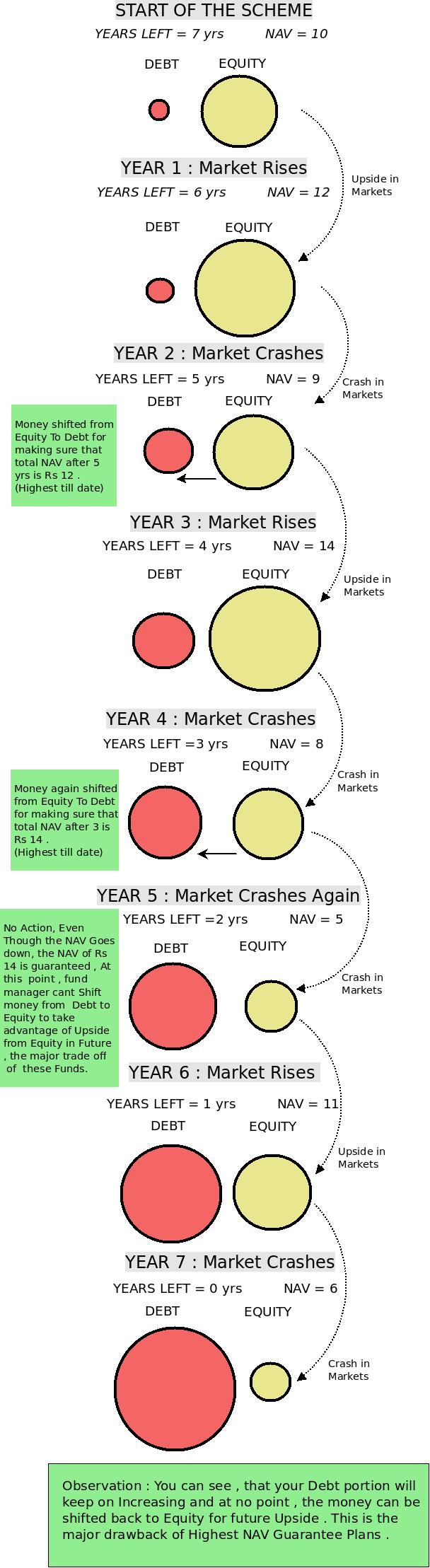
How does a Highest NAV guarantee plan works

How Investors get Confused

You have to read in between the lines; Investors need to understand that these schemes guarantee the “Highest NAV”,  READ AGAIN! , it’s Highest NAV and not “Highest Returns” .  Normal Investors don’t give much thought before buying these products and normally assume that the returns will be linked to the Equity Markets .

Do you Know , you can Now Subscribe to All the Comments on JagoInvestor !! (You can Unsubscribe Later)

Returns from Highest NAV Guarantee Plans

So, what are the return expectations of these funds? We know, that long-term equity returns, are normally in the 12-15% range while, debt returns turn out to be 6-7%. So, considering the fact, that these products will shift most of their money to debt, by the end of the tenure , we can expect the returns to be in range of 9-10%. We do get some equity upside in these products, but that will be limited. After a point, this product will turn into a debt oriented fund with a major portion in debt . Also if you factor in costs, like premium allocation charges , fund management charges and other yearly charges, the returns will not be what you actually expect.

You will be amazed to know, that the returns expected from these schemes, may be lower than the returns offered by equity-oriented Ulips. The reason being, that the basic objective of protecting the previous high NAV of the fund, may constrain the fund manager’s ability to take risks while allocating funds. So if the market has fallen down, the fund manager can’t take the risk of shifting the money from Debt to Equity to gain from the potential upsides in future , because they have to provide the “Guarantee.”

Read : Important Questions you should Ask an ULIP Agent ?
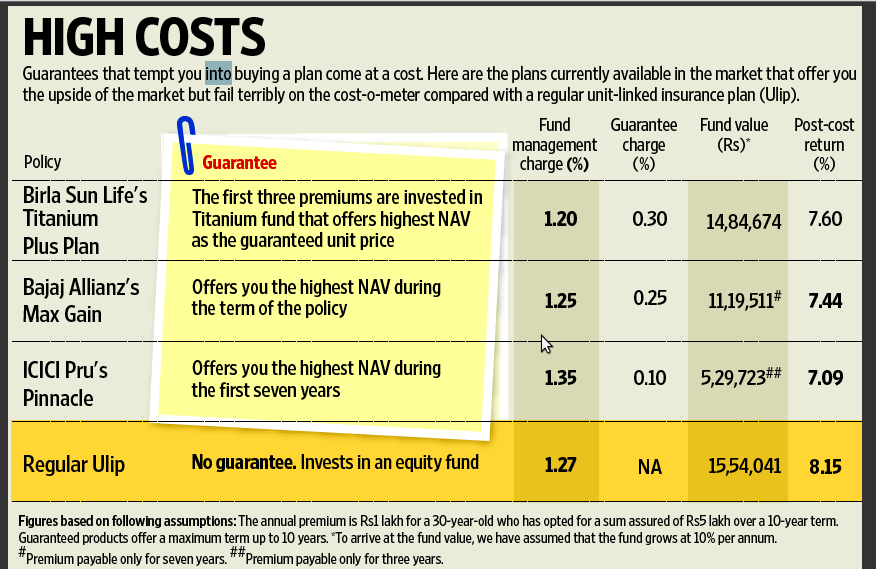
Source :  LiveMint Research

Current Products in Market with Highest NAV Guarantee

  • ICICI’s Pinnacle
  • Birla Sun Life Platinum Plus-III
  • Bajaj Allianz Max Gain
  • SBI Life Smart Ulip
  • Tata AIG Apex Invest Assure
  • LIC Wealth Plus
  • Reliance Highest NAV Guarantee Plan.
  • AEGON Religare Wealth Protect Plan

Controlling your emotions with these products

Let’s talk about mistakes from the investors point of view. We, as investors, don’t think with inquisitive, susceptive minds. Getting good returns from stock markets is anyways a tough thing in itself. So when these companies come up with plans like these, which say “highest NAV in 7 yrs”, we have to ask, “How is this possible?” . Dont say it’s not possible at all, just ask how? How do they achieve it? Stop seeing dreams of getting high returns without looking at the risk involved, and try to find out – what is the strategy they’re using , Is there something in between the lines ?

We all want to get great returns, but we have to shed this belief that, companies come up with plans specially for us. All the companies out there exist to earn money, and their motive behind every product is to make money, & generate profits for their companies, so that they keep their shareholders happy. So next time a product like this comes up , you have to control your emotions before getting in and first investigate. The worst part of this whole business, (of guaranteed highest NAV products) is the timing and how it gives naive investors, high illusions about the product. Products like these, take major advantage of psychology of the ordinary saver. Many Investors in smaller towns have broken their Fixed Deposits and taken some loan to invest in products like these, especially SBI Life Smart Ulip and LIC Wealth Plus because of the trust factor with LIC and SBI . See How Agents are Misselling LIC Wealth Plus

Why you should be “Pissed off” At these Insurance Companies

  • Do you Know that, The Securities & Exchange Board of India (SEBI) , the stock market and mutual fund regulator, does not allow mutual funds to guarantee returns. Therefore Mutual funds can not provide guaranteed products which are related to stock markets, but IRDA can approve things like these and all these insurance companies come under the ambit of Insurance Regulatory and Development Authority of India (IRDA). So any Insurance Company can come up with a new Plan , link it with market and start providing “Guaranteed products” . You have to understand that “equity markets” and “guarantees” are a very risky idea together , so please stay away.
  • Do you observe when do all these “Innovative” products come up in Market ? The answer is around end of the year, which is a premier Tax Investment time (Jan , Feb , Mar) . Is innovation in Finance space limited to End of the year ? Why dont these products come through out the year? Why ? The answer is simple , if it comes after anytime other than last 4-5 months of the Financial Year (ie Dec , Jan , Feb , Mar) , no body will bother to invest in these, because no body is bothered to “invest” at all . Companies very well understand investors psychology and their helpless ness at the end of the year because they have to provide investment proofs for Tax exemption as soon as possible . This is not just limited to these products , its true for NFO’s , IPO’s in booming markets , More Sales calls at the end of the year, and other new products .
  • The so-called “Guarantee” is a marketing gimmick and is implicitly a result of the way the investment is structured . what it means is that the strategy they use itself is such that it will provide you the highest NAV , even we can create our own Plan and do what they are doing . But they make sure that Investors  feel like they have done years of research and came up with these amazing plans .
  • You have to understand that there is nothing “Innovative” in this product , the fact that 7 companies have come up with the same product proves that its not “innovation” because Innovation is unique . Aegon Religare has gone ahead in this stupidity and introduced their Guaranteed Plan which guaranteed 80% of the Highest NAV , Looks like they think that it makes them look different from others .

Who should Invest in These Products ?

If you are looking for modest returns, like 8-10%, you can invest in these policies. The return of these policies may be high in the beginning, if market does well; but when market starts performing badly, the returns can take a hit and then be in a tight range. Your NAV will be protected for sure, but the returns wont be, since over time the CAGR return will go down. Remember, if your NAV is 10 today and you highest NAV is 20, for a 2 year period, the return is a good enough 41%, but by the 4th year it’s just 18.9% and by the end of 7th year it’s a measly 10.4%. So what you really need, is protection of returns, not the NAV which is just a fixed number.

[ad#big-banner]

Comment on this Article and Subscribe to JagoInvestor and 1 Lucky Winner will Win

  • TShirt OR Coffee MUG (Customised with your Picture or PunchLine)
  • Prize will be give to “Best Comment” (Decided by Voting System)
  • Valid Till 25th March , 2010

POLL


Subscribe via RSS or Email:

{ 396 comments… read them below or add one }

1 rajivahuja March 17, 2010 at 9:13 pm

What a scam by the insurance cos.I am glad u came out with the truth behind the plan.

Reply

2 Mohan March 17, 2010 at 11:16 pm

Absolutely! I second that. It is just the investors who blindly go by the deceiving ads by these companies and get fooled. Very good article indeed Manish!

Reply

3 Manish Chauhan March 18, 2010 at 12:37 am

Mohan

I think the issue bigger than the ads is that investors believe and assume things, like when they say “Highest NAV” , the investors will think that NAV means normal NAV and it is calculated the same way as other ULIP’s . they have no idea that company can control the NAV fully .. they never look the policy document for 100% clarity .

What do you think about Regulations ? Should’nt there be explicit rules in investors interest on this ? So if you meet IRDA chairman somewhere in next few days , what would you tell him ?

Manish

Reply

4 raja March 21, 2010 at 8:00 am

hi manish,

i feel that a longterm bull run has started.can u name some 4/5 star rated funds in equity diversified largecap and some midcaps which give the option to swap or transfer to any other defensive(debt based) in the same fund house (like hdfc top200offers) in case of some thing worse happens (like another recession in west and wars).

can u please tip of such mfs.iam planning to take part very agressively say3-5 years.iam eagerly waiting for ur reply.

thankyou
raja

Reply

5 Manish Chauhan March 21, 2010 at 4:16 pm

Raja

Have a look at

Manish

Reply

6 Neel Patel May 7, 2010 at 11:16 pm

Awesome post Manish..!!
Now I get that returns from highest NAV guarantee plans are due to well combination of investing in Debt & Equity
I like to share it with other people it & tweet about it…

Reply

7 Manish Chauhan May 8, 2010 at 12:17 am

Neel

Thanks A lot :)

Manish

Reply

8 Ravi Shankar S November 22, 2010 at 11:16 am

Manish

Nice article… I did the same kind of research, when an HDFC guy contacted me with a similar plan with guarenteed 15Rs return for 10 Rs investment irrespective of the NAV reaches 15 or not… I showed him the power of compounding in a simple debt instrument and he had no answer to my points.. Also I thought him what a term insurance can do and investment in SIP can return…. Thanks to your insights…

Regards
Ravi

Reply

9 Manish Chauhan November 22, 2010 at 11:48 am

Ravi

Nice to hear that :) . please keep sharing your insights with other readers here :)

Manish

Reply

10 Prashat September 24, 2011 at 3:50 pm

Hi Manish,

Today I also got same plan from HDFC guy… I had same thought,,,but I dont have much knowldge @ NAV he explaind me its %…so I dident belive in hi,….Thanks :)

Reply

11 Jayavardhan November 13, 2011 at 9:56 pm

Ravi, can you please suggest me some good Term insurance policies.. thanks in advance.. Jay!

Reply

12 Dr Minesh Vadsmiya March 18, 2010 at 12:52 am

I disagree..
Well..these companies are here to earn money and they are coming with such ideas every year.. They have to come with such plans to “loot” people..
However investor should be well aware and rather not to be greedy..
There is a proverb in gujarati …”Lobhiya hoy tya dhutara bhuke na mare”

And thanks manish for such great articles..

Reply

13 Manish Chauhan March 18, 2010 at 1:23 am

Minesh

Thanks , well I would say a big part is played by Investors greediness :) . If we control our greediness and go logically , a lot of damage can be controlled, but the problem is a big number of people in india are not on internet and cant read stuff like these .

Manish

Reply

14 Girish March 18, 2010 at 10:12 pm

All such companies are trying to make fool of the investors

Girish

Reply

15 Manish Chauhan March 19, 2010 at 11:25 am

Girish

Thanks for your comment

Manish

Reply

16 Chandra March 29, 2010 at 2:52 pm

You are 100% correct, all these compnies eating peoples money.
Wise people always dont invent in this tipe of cheating
better to invest in Lands & Gold
Chandra

Reply

17 Manish Chauhan March 29, 2010 at 2:56 pm

Thanks for comment

Reply

18 Manish Chauhan March 18, 2010 at 12:23 am

Rajiv

Thanks for the comment , So at first you thought that those plans are really offering “Highest returns” ? Do you think IRDA should ban guaranteed products based on markets ?

Manish

Reply

19 Amol M March 23, 2010 at 8:26 am

LIC collected Rs. 3000 crore under Wealth Plus….

http://www.business-standard.com/india/storypage.php?autono=389410

Reply

20 Manish Chauhan March 23, 2010 at 3:47 pm

Amol

People will obviously buy it .. 99.99% people dont have reach to this blog . Only a handful of readers come to know about the actual picture .

manish

Reply

21 Arpan November 1, 2010 at 3:16 pm

Hi Manish,

It seems government of India i.e. Ministry of Finance is okey with the changes in regulation for the insurance industry. Please take a note here that LIC of India, whom we trust the most has looted India more than the others. Still we have strong notions about LIC.

Reply

22 Manish Chauhan November 1, 2010 at 3:49 pm

Arpan

I have the same view about LIC and its tough to change this mentality of people , they are so obsessed with “security” and “Assurity” , that they dont concentrate on “Value”

Manish

Reply

23 dr. kishan March 17, 2010 at 9:21 pm

excellent article manish. very well and simply explained. now i understand that because of the guarantee the money in debt is fixed and not usable for the upswing in market and thus the return is lower than investing in plain diversified mutual funds. once again u prove that investing in mutual funds with adequate diversification and their continuous supervison is better than these plans. thanks for such a nice presentation.

Reply

24 Manish Chauhan March 18, 2010 at 12:42 am

Dr Kishan

Definately , Always understand that mutual funds are the simplest way to invest in Stock market for a layman investor , any thing which is build on that with extra advantage means it will be more costly and more complicated . There might be little work involved with mutual funds , but thats the best way to invest .

What do you feel about Regulators ? Should they not interfere in between ? Do you think its some where a big institutional scam where no one says to the companies who come up with these products ? Looking for your views ?

Manish

Reply

25 dr. kishan March 24, 2010 at 9:03 pm

i think there should be transparency in such policies, which should be ensured by regulators. the basic scheme of the investment should be known to all the agents and should be made known to the consumer. i think rather than banning these products the reality should be made understandable to the general public and thean let the public decide.
dr kishan

Reply

26 Manish Chauhan March 24, 2010 at 11:26 pm

Dr Kishan

I agree with you totally .. But the thing is its tough to train the agents given their understanding levels . they can answer back smart questions smartly :)

Manish

Reply

27 Avinash Josyula March 17, 2010 at 9:41 pm

Very clear insight on the article. Especially the explanation involved with the market surges.

Reply

28 Manish Chauhan March 18, 2010 at 12:47 am

Avinash

Thanks for comments , Do you think they should have adopted some better strategy on “market going up” .. looks like they dont use market upmoves atall ?

Do you think that there is a better way ?

Manish

Reply

29 Hemant Beniwal March 17, 2010 at 9:53 pm

@ Manish

Talk to some security agency, you need it badly. :(

अभी lic वालों से पीछा छूटा भी नहीं था अब तुम ने बाकी सब से भी पंगा ले लिया.

To Whosoever it may concern

“ I don’t know Manish Chauhan” :)

Hemant

Reply

30 Ajay March 17, 2010 at 10:12 pm

@Hemant… Good one… I just finished reading one of the comments that says our author has “may be hidden association with private insurance companies.” and could not stop laughing after reading your comment :)

Reply

31 Manish Chauhan March 18, 2010 at 12:50 am

Hemant

वो LIC वाला article तो आप ने ही लिखा है .. मेरे से कोई LIC का अगेंट पुछा तो मैं तो आपका और आशीष का पता दे दूंगा !!

Manish

Reply

32 Ganesh March 17, 2010 at 9:56 pm

It’s like a rubber ball, isn’t it? You try to shoo away such “plans” and the insurance companies come back with vengeance introducing a new plan! So many people have fallen prey to these “guaranteed plans”, and insurance companies knew that the first line of resistance of hapless investors (are are they insurestors? ;-) ) is market volatility. So danggg.. they come up with guaranteed NAVs and fancy graphs and all that crap!! Jago investor, jagoo..

I wrote a short post on this some time back. It’s perhaps too simplified, but here is the link: http://www.mygraffitipage.in/2010/02/truth-behind-nav-guaranteed-policies.html

Reply

33 Manish Chauhan March 18, 2010 at 1:02 am

Ganesh

Ya , in a way you can say its rubber ball :) . Good analogy

As I said its more of like a planned scam , where they take advantage of things like bad markets , hence traslating to fear in public, also they know its tax time, they they make it complex enough . everything is related .

What do you feel about these plans betterment , If these companies have to really come up with some good product how should they design the product , can you suggest some changes in these products which will improve their performance ans still keep the risk low ? Lets be creative!!

manish

Reply

34 Ganesh March 20, 2010 at 9:26 pm

“Scam” would be an understatement. Really. They definitely leverage the fear in investors.. if the risks involved in equities is the fear, they come up with fancy debt oriented funds and guaranteed NAVs!! For me it is nothing but “wolf in sheep’s clothing”. If they are debt oriented, they should really call a spade a spade. Confusing the hell out of poor investors is unethical (if i can say so).

I am so glad that at least people who follow Jago Inestor can counter these insurance companies (i am not against agents, who are making a living out of selling insurance policies) and their fancy “plans”.

Reply

35 Ajay March 17, 2010 at 10:08 pm

Excellent and detailed explanation Manish….
I liked the Why you should be pissed off section….

Is innovation in Finance space limited to End of the year ? Why dont these products come through out the year? Why ? The answer is simple… Thorughout the year they are busy coming up with such plans to grab all the money they can and close their year with fat profits :)

This article helps for individuals to decide if they want to go for or not go for such “schemes” and the funniest part is that google ad sense displays the Reliance Highest NAV plan in the same page :)

Keep up the good work Manish.

Reply

36 Hemant Beniwal March 17, 2010 at 10:14 pm

@ Ajay

Google Ad sense knows that something on Highest NAV is written here but who will tell them that Manish is tearing their clothes.

Check this Reliance Ad. “All is Well”

But it’s not at all well.

Reply

37 Manish Chauhan March 18, 2010 at 1:10 am

Ajay

Yeah .. google adsense just puts ads based on keywords , they cant figure out if the article is positive or negative for them :) .. hehe ..

What do you feel about regulators role in this whole thing ? Do you feel IRDA should be blamed for all this ?

Manish

Reply

38 reena January 27, 2011 at 9:34 pm

Hi Manish,

I m working as insurance advisor & read your articles regularly. They help us a lot. But sometimes I feel you write lot of in favour of private insurance comapnies. The highest NAV plan were launched by these people first.Why only chir phad of Wealth plus & not ICICI or othres.
At least LIC people work for all. A private company advisor always look for high premium & cream customer. Be open to all. The plan is good for people who don’t know MF or Equities & sold by all of us showing fact. If agent is not listening carefully in meeting it’s his mistake. We follow training & use our own logic.

One more help needed Why LIC term plan premium is higher as compared to all private players?

Reply

39 Manish Chauhan January 27, 2011 at 9:47 pm

Reena

Its not against LIC , even pvt companies come with it , but i took Wealth plus as example as it reaches maximum people .

Term plan premium for LIC is higher because of thier underwriting process , their mortality tables is old , and hence the charges also

Manish

Reply

40 sowmini March 17, 2010 at 10:24 pm

Manish

That was an excellent blog…as u said whenever i visit SBI the first thing the people in the counters ask me is ..mam can you pls not invest in Smart ulip than PPF…this is such a waste of investment…ulip is for young people like you…dont stick on to Old stuff like ppf…..i now know why they stress so much on this Ulip….

regards
sowmini

Reply

41 Manish Chauhan March 18, 2010 at 1:15 am

Sowmini

I am glad you didnt fall into trap :) . Ask them next time about a CPPI strategy and why the whole allocation can move to debt at certain point , why the return from these funds can be in range of 8-11% . I am sure they will process your PPF investments facter than speed of light :)

What do you think ? Do you feel the reason why they ask you to invest in Smart ULIP is their igonorance or they want to trap people in the product ?

Manish
Manish

Reply

42 sowmini March 18, 2010 at 4:57 pm

I feel they are also under sales pressure..so everyone they meet in the bank they start selling them this product and if at all they understand that you are an NRI or in the higher income bracket then thats it….they convince you that 50k investment per year is nothing for us !!!

regards
sowmini

Reply

43 Manish Chauhan March 18, 2010 at 5:01 pm

Sowmini

Yes , they must be under sales pressure for sure . every where in the country the sales pressure is so high that misselling is rampant .

Any ways .. good to have your views here , it adds value

Manish

Reply

44 Rakesh March 17, 2010 at 10:36 pm

Excellent post. Very well explained, an eye opener. A very nice marketing gimmick by these companies.

Rakesh

Reply

45 Manish Chauhan March 18, 2010 at 1:16 am

Rakesh

Thanks , what do you feel about IRDA role in all this ? To what extent should they be blamed ?

Manish

Reply

46 Nikhil March 17, 2010 at 11:15 pm

Dear Manish

Wow..Excellent post…Very Clear thought..
Can you prepare this Calculation in excel sheet..

Nikhil

Reply

47 Manish Chauhan March 18, 2010 at 1:26 am

Nikhil

Is that a question or request ? Which calculation ? Why ?

Manish

Reply

48 ronak March 17, 2010 at 11:28 pm

East or west .. .. Manish is the best…

Excellent post…

Reply

49 Manish Chauhan March 18, 2010 at 12:28 am

Ronak

Thansk , what are your views on companies attitude towards Investors money growth , do you think companies think about actually bringing some good plans for Customers rather than their own benefit ?

Manish

Reply

50 ronak March 18, 2010 at 9:29 am

All company want 2 b superior one form other .. Goal is 2 attract more costumer … agent miss guide the costumer .. They convince like they are well wisher for them .. At last
Highest NAV Guaranteed Plans
Are taken because agent miss guide them …
and customer does not use there brain how it works . They image they do best ..

regards,
ronak

Reply

51 Manish Chauhan March 18, 2010 at 5:24 pm

thanks for your comments :)

Manish

Reply

52 Karsudha March 17, 2010 at 11:55 pm

Excellent post. The moment I saw the advertisements about the Highest NAV I know that they are going to use the Debt route but am not aware of the “innovation” behind the scenes. Thanks for the clear explanation.

Reply

53 Manish Chauhan March 18, 2010 at 1:29 am

Karsudha

Great that you got a feel that they are going to use Debt somewhere , the very basic fact that they are guaranteeing the NAV means less risk , less risk means compromise with returns , which in turn means use of Debt at some point :)

Manish

Reply

54 krish March 18, 2010 at 3:08 am

Nice detailed article Manish…
In particular, I liked the point “any Insurance Company can come up with a new Plan , link it with market and start providing “Guaranteed products” . You have to understand that “equity markets” and “guarantees” are a very risky idea together , so please stay away”.

Moving forward, I will be more careful if I see the word “Guaranteed Returns” from any Agent or in Ads.

Thanks 2 you !!!

Reply

55 Manish Chauhan March 18, 2010 at 5:25 pm

Krish

Ya .. Stock market and guarantee are two opposite words :) . What are your views about Guaranteed products returns , how much returns do you think will excite retail customers ? 10% , 11% ?

Manish

Reply

56 C M Vyas March 18, 2010 at 7:53 am

Dear Manish,

Good to read your article. But I have certain points to make.

Indians tend to invest during the Jan- Mar period to save tax: That is because they have “declared” they will invest in tax saving schemes and now don’t know what to do. They do not want to pay tax now! The solution to this crisis is to have a planned approach to ALL investment options. Take a straw poll and you will find 90% people don’t bother to PLAN THEIR INVESTMENTS! My advice No 1: make investment a talking point as a matter of routine with someone you trust and who will advise you.

All insurance schemes have their strong and weak points, good and bad points, advantages and disadvantages. You have to select the one best suited to your investment needs. You need to assess them. So follow my advice no 1. I do not mean advisers of specific Insurance Cos but people who do financial planning diligently. Not just CFPs. Again trust plays an important part here. The easiest way to identify such people are those who give a lot of time to you and who do not push you towards specific products. Secondly, they will explain the schemes fully. Advice no 2: Give importance to learning about investments. You will be able to understand who is a good adviser.

Personally, I feel that the highest NAV is just a marketing terminology, but the underlying benefits should not be lost sight of. Let us not assume it is a scam! If you want insurance, with least medical hassles, which gives better than inflation and better than Fixed interest returns(12-15%pa), safety of capital, which does not require you to invest directly in the stock market and lose your shirt and gets you your Sec 80C benefits for three years in one shot, you should go in for this. The only other investment that can “guarantee” high returns and can be safe is to buy land!! Would you want to? Advice No 3: Don’t expect every product to meet you every need.

Disclaimer:: I am an investment adviser for the salaried persons only. I do have an interest in creating a sense of trust among people who have to and want to invest. Insurance, Shares, FDs, MFs etc.

Reply

57 Manish Chauhan March 18, 2010 at 5:29 pm

C M Vyas

Nice points .. you said “The only other investment that can “guarantee” high returns and can be safe is to buy land” .. I guess you meant this for long term , If you are talking about short term , then its not true .. for long term , Equity is also one option :)

What do you say ?

Manish

Reply

58 C M Vyas March 19, 2010 at 1:50 pm

Yes Manish, I do mean land for a long term only. I compared Guarantee NAV product with land purchase only due to the long term. Otherwise, the point of difference is the heavy amount required for land investment. So it is not comparable.

As far as Equity is concerned, it requires a lot of time and dedication to get good returns and I don’t think it is comparable with Insurance when we are recommending investment options for salaried people. If some trustworthy and knowledgeable person is there, then why not?

My argument in favor of these schemes is that it gives a 30% return by way of tax savings for 3 years almost immediately on payment (tax saving season!), or Rs 15000 X 3 years =Rs 45000 in all for a Pru ICICI Pinnacle with Rs 50000 pa premium amount for 3 years. In addition even if it returns an average of 12-15 % for the next 7 years, it is OK.

Seven years later, after the highest NAV is determined from the first 7 year performance, the Co can change the investment style from safety (for guaranteeing highest NAV) to a more aggressive investment style ( say full equity) depending upon the market conditions obtaining then. So at the end of 10 years, when the repayment is due, the Guarantee NAV acts as the minimum base return and the aggressive investment style of years 8 to 10 act as “higher return” period.

Pru ICICI Pinnacle will most likely be investing in protector/ preserver versions of investment for first 7 years and which has returned 12-15% since inception as I indicated in my mail.

Just think about that. I don’t see anything wrong in that.

Reply

59 Manish Chauhan March 20, 2010 at 8:49 pm

C M Vyas

You should not be putting the tax saving part of 30% , as its available on ELSS (tax mutual funds) also . So the tax point goes away . lets discuss the other points.

Next thing is 12-15% return is not expected from these guaranteed funds over 7 yrs term, the returns should be much lesser like 9-10% , now even if you say these are ok returns , the point is COST !! .

You can get the same 9-10% return from a debt oriented funds or MIP’s with much lesser cost , the mutual funds are free now days .. why pay for ULIP;s cost ?

You said Pinnacle will be investing in protector/preserver version of investment , how ever all the guaranteed funds like these do not offer different type of funds , the choice of investment is solely with them .. check once to make sure .. let me know .

Manish

Reply

60 sukumaran March 23, 2010 at 4:51 pm

you should read subra’s view on rent vs. buy on his site http://www.subramoney.com
and then decide on real estate. According to subra real estate in one location gives about 5-9% p.a. returns. This means it keeps pace with inflation, THAT is all and real returns are ZERO.

Reply

61 Manish Chauhan March 23, 2010 at 6:25 pm

sukumaran

I have read Subra .. His views are correct from long term view in mind and I agree to it . However In short term and given current situation real estate can give good returns in medium to short term , however that would be with risk .

Manish

Reply

62 Arpan November 1, 2010 at 3:22 pm

Any given point of time the mantra should me the TIME – IN and not Timing :)

Reply

63 Manish Chauhan November 1, 2010 at 3:47 pm

Good point

Reply

64 sriram March 18, 2010 at 9:00 am

Manish

Thanks for the great explanation. I have a question. Won’t this be a decent mutual fund product (non-insurance)? I would never buy a ULIP but if a pure mutual fund product were to offer this strategy, I would consider it. Yes, the returns may pale in comparison to a pure equity product but there is an aspect of “securing the gains” (if any) here. What do you think? Am I mis-informed?

Thanks
sriram

Reply

65 Manish Chauhan March 18, 2010 at 5:31 pm

Sriram

As I explained in the article , you can match this product with debt oriented mutual funds with some part in equity , but then if you want to buy this one , why not go with simple Mutual funds which is more simpler and less costly . choose from http://www.jagoinvestor.com/2009/11/list-of-best-debt-oriented-mutual-funds-for-2009-2010.html

Do you feel these funds are more supirior to Debt oriented mutual funds in other ways ?

Manish

Reply

66 Hemant Beniwal March 19, 2010 at 8:58 pm

@sriram

“INFORMATION RISK”

You have raised a very important point. “Am I mis-informed?”

Very few people know that there is a term called “Information Risk” in investment Market. People think that there is just one risk in investment market & that is “Equities are risky”. :(

Information risk is the risk that the information on a particular investment may not be accurate (this may be brought about by deliberate misstatements by those promoting the product of just a plain bias).

And we know that who is creating this risk in case of Highest NAV Gurantee Plans.

It’s an institutional Fraud.

Reply

67 Manish Chauhan March 20, 2010 at 8:56 pm

Hemant

So I would say whole of India is under “Information Risk” .. from Insurance , Investments , Direct Investing , credti card everyting .. So now I can coin a term called

“IGNORANCE RISK” which is also a big issue in India .. Mostly people mess up with things and still believe that they are in great situation because of “Ignorance Risk” :) .. have a look at 40-50k per month earners and sitting on Insurance of 15-20 lacs max ..

What do others think ?

Manish

Reply

68 Hemant Beniwal March 21, 2010 at 10:11 am

@ Manish

Take copywrite of term “Ignorance Risk”.

I think a complete book can be written on “Ignorance Risk in Investment World”.

If not book why not an article. :)

Reply

69 Manish Chauhan March 21, 2010 at 4:20 pm

Hemant

Yes , I will write on it :)

Manish

Reply

70 srinivasu May 2, 2010 at 4:05 pm

.dear all !
welcome
customers ignorance is agents (sellers) profit.
if sebi vs irda legal issue becomes more and more public debate
in print and electronic media, then only innocent clients can understand what is really happening in ULIPS ?
thanks

Reply

71 Anoop March 18, 2010 at 9:04 am

Well I could not understand the reason behind 7 years highest NAV given by most of the plans. What is the reason behind that? Like LIC the plan is 10 years but the highest NAV is guaranteed only for 7 years. Why the full term of the plan…

Does any one have answer to this question??

Regards,
Anoop

Reply

72 NPR March 18, 2010 at 9:08 am

Anoop, the purpose of this article is — to give you details as how these plans work — and why you should stay away from it. LIC plan could be a slight variation (as Religare plan which Guarantees 80% NAV) — but the point is “stay away”. Ignore All kinds of ULIPs (including the Garanteed Plans). Go for “Term Plans” and with the rest of the money, invest in “Mutual Funds” (this very blog has good MF recommendations). That’s the lesson.

Reply

73 Manish Chauhan March 18, 2010 at 5:38 pm

Anoop

This is an interesting question .. First I thought that they took this number “7″ randomly to make investors think “Why 7″ and discuss about it and in way market it :)

But after some thought I think I know why :) .. The stock markets in India has been running in a 8 yrs cycle from last some decades … so after this recent crash , another big crash is expect to be after 7-8 yrs now , so they want to make sure they are giving investors “highest NAV in 7 yrs” which will be the maximum point in coming 10-11 yrs assuming markets do crash after 7-8 yr and then stay below that point for some years .

Read some things on this below

——-

8 Year cycle Trend: The Sensex is following an eight year cycle trend. The break of the channel lines in 1992 saw the index correcting over 53%. After eight years in 2000, the index once again fell into the grip of bearish cycle and corrected over 57%.

In 2008, the faced the similar fate. Breaking the long term rising channel, the index once again echoed the similar trend and has shed more than 63.7% of its weights from the top

——-

http://www.valuenotes.com/nirav/nirav_market_01Jun09.asp?ArtCd=145963&Cat=T&Id=780
http://notestomyself.wordpress.com/category/sensex/

Reply

74 NPR March 18, 2010 at 9:06 am

Good Article. Lucidly explained the concepts. I was wondering, how can this be possible.. especially on Market based products. Thanks for taking time and putting down your thoughts in this blog.

Reply

75 Manish Chauhan March 18, 2010 at 5:48 pm

NPR

Thanks for your comment , I have given my views on Anoop’s comment on why the tenure is 7 yrs .

What do you feel should be IRDA role in all this ? Do you feel they are doing their job in a right way ?

Manish

Reply

76 NPR March 19, 2010 at 9:01 am

I think IRDA is playing a role similar to FICCI or CII or Assocham for its member companies (a.k.a. insurance companies). It is less of a regulator and more of a spokesman. Whereas SEBI is doing the opposite.

And your comments on why 7-year , looks a well thought out one. Though I am too sure, this is the reason for the 7-year itch :( - You know, I am less certain of giving that benefit of doubt – that they had put their brains to work and came out with a well thought out plan — before designing these policies.

Reply

77 NKanani March 20, 2010 at 6:01 pm

Looking in the FAQ section of IRDA website, we will find only one section – on ULIP – dated 22-Oct-07. The FAQ if read carefully mentions that ULIPs can have hidden charges/costs which people should verify before taking them.

I would suggest IRDA should add more such FAQ sections for Term Insurance / Endowment Policies / Pension Plans / etc.

Reply

78 Manish Chauhan March 20, 2010 at 9:03 pm

NPR

IRDA is made for regulations .. just acting like a spokesperson is not enough .. however i think they are doing some work on regulation part too.. they tried to control the costs for ULIP’s in recent times .
You are right that companies came up with those plans after putting in lot of thought and efforts . they are reaping the benefits too .. already LIC Wealth plus has collected 2000+ crores..

Manish

Reply

79 Marshal March 18, 2010 at 9:07 am

good cracking manish, very simply to understand, at least online community will learn from this, am just worried about others.

Reply

80 Manish Chauhan March 18, 2010 at 5:50 pm

Marshal

Yes , the online community can read about this but even that is limited, as this blog has reach to just 40,000 unique visitors per month , rest of the readers on web do not know about this , now its responsibility of readers like you to spread the word :)

regarding the offline community , what do you think we should do ? Any ideas ?

Do you have any idea how things can be published in Hindi ?

Manish

Reply

81 Marshal March 21, 2010 at 1:16 pm

manish,
i have forwarded to all my friends, and they all thanked it. sorry am taking partial credit :)
for hindi publication you need some close friends in media.. unfortunately i don’t have :(

Cheers
Marshal

Reply

82 Manish Chauhan March 21, 2010 at 4:21 pm

Marshal

Thanks for that .. Let some time pass , and we will get some coverage in media soon ..

Manish

Reply

83 allthecrap March 18, 2010 at 9:26 am

Correct me if I am wrong. But how can you (and what can you) shift to debt when market crashes? In previous cases market was up so you shifted to debt but in reduced NAV there is no surplus to shift, right?

And as it all hypothetical, lets try this, what if market goes down for say first 4 years. you cant exactly shift to debt(as no surplus) if you shift you reduce the exposure in equity and don’t gain when market goes up. And in next 3 years you have to pay the highest NAV. Please explain.

And as always nice write-up. Keep it going.

Reply

84 shithappens March 18, 2010 at 9:50 am

If market goes down for first 4 years, you don’t move to debt. Just ride it out hoping it will pick up later. The NAV is down shit creek anyway. Also, nobody has promised that highest NAV would be more than 10! :-)

Reply

85 Manish Chauhan March 20, 2010 at 9:27 pm

Shithappens

In these funds you dont control where you money goes, you dont have choices , fund manger moves the money from equity to debt .

Manish

Reply

86 Hemant Beniwal March 18, 2010 at 9:50 am

@allthecrap & other readers

I was waiting for this question. :)

Yessssssssssss – CPPI Model(Highest NAV Guarantee Plans ) work this way only when market rises they buy more equity & when market falls they sell equity (Against the of Investment Rule – basic rule says buy when prices are down & sell when prices are high)

Wait for a single day 10-15% Market fall & that will be your highest NAV. (If it comes in earlier days it’s your bad luck you can’t blame fund manager or company)

LIC Website for wealth plus plan
“Guaranteed NAV: In this product there is a guarantee of the highest NAV recorded on a daily basis, in the first 7 years of the policy, subject to a minimum of Rs. 10. “ :(

Getting NAV of Rs 10 means you may not even get your investment amount back.(As there are long list of expenses)

Jai ho insurance cos ki.

Reply

87 Manish Chauhan March 18, 2010 at 6:01 pm

Hemant

Yes , this is a very good point. Guaranteeing the minimum of Rs 10 has no benefit .. over 7-8 yrs, if a person invests 10 and gets 10 , what is the point . even though the growth is 0 mathematically ,the real growth is negative .. the purchasing power is almost halved . so what is the point ..

manish

Reply

88 Manish Chauhan March 18, 2010 at 5:55 pm

Allthecrap

This is a valid question .. the thing is if market falls just after the policy goes live , then your NAV will drop from 10 to how much ? 8 ? or 7 ? In the worst case they will put that 7 or 8 in bonds and now you will get minimum of Rs 10 on maturity :) . The policy document clearly mentions that if NAV falls below 10 , they can put all the money in debt . So on any given date , how much a market can fall ? not more than 20% :) .

Did you understand ? Or I am answering some other question ?

manish

Reply

89 allthecrap March 19, 2010 at 12:54 pm

Kind of getting the idea but how long a manager can resist a booty in debt? wont he go out and try to gain from equity market? I don’t think any fund manager will do that.

@hemant
are you saying that manager will sell if market is in red? and buy when market is in green? just to keep NAV arnd market price? hard to get that logic.
your answer was more tacky then conditions of this ULIP plan. I am an engineer dude, simplify. :)

Reply

90 Hemant Beniwal March 19, 2010 at 8:25 pm

@ allthecrap

Oh my mistake I said Fund Manager.

Let me complicate it and explain it in engineering language. Fund Manager will have no role in when to buy & when to sell in this Product (They can select only securities). CPPI(Highest NAV Guarantee Plans) model are complicated mathematical algorithms, decisions are made by computers & not humans. Let me tell you computers have no brain to time the market (even human don’t have). Who will you blame HP or Microsoft for your spoiled future.

In Simple language “इससे दूर रहो कर्रेंट लग जायेगा”

Reply

91 Manish Chauhan March 20, 2010 at 9:30 pm

Allthecrap

Dude .. I am an engineer too :) .

So fund manger has to stick with debt once he gets into that , because as per the Strategy (CPPI), they cant move from debt to equity , because they have to provide the guarantee .. just imagine after they more from debt to equity , and market crashes beyond recovery .. how will they guarantee returns .. oops .. oouchh .. I mean NAV (not returns)

Manish

Reply

92 Devil March 19, 2010 at 7:49 pm

Guys the answer is right in front of us – Birla Sunlife Platinum Plus II. The launch date was 8th Sept 2008 on which NAV was 10. It went down all the way to 7.7 on 10th March 2009 and went upto 15.6 on 6th Jan 2010. Right now the NAV is around 15.2. The only reason why they are giving this Guarantee is because they have your funds for 7+3 years which is a long period. Markets will not go down for 10 years in an emerging market like India. At the end i will say only if you believe in your contry’s potential then you should invest in equity( if you ask me – in next 40 years we will see so much growth that all of us will say when we are older that yessss we were part of that golden era in which we saw India becoming a developed country from a third world country). Spare me for my emotions.

Reply

93 Hemant Beniwal March 19, 2010 at 7:59 pm

@ Devil

Don’t take it otherwise but do you really no how CPPI Model Works? If yes please share.

Reply

94 Devil March 19, 2010 at 8:08 pm

no buddy…i’ll pass

Reply

95 Hemant Beniwal March 19, 2010 at 9:33 pm

@Devil

I don’t want to disturb your beautiful dream of 10-11% returns from ICICI Pinnacle.

Let me share it with others:
“These products were too complex for the lay investor. Sebi has expressed its discomfiture with schemes that are based on equity-linked debentures (ELD) and constant proportion portfolio insurance (CPPI). A P Kurian, Sebi consciously does not approve a fund if it is too complicated for Indian investors.” March 2009

Earlier there was a similar product by one of the mutual funds on CPPI model. This was 3 year product & matured in 2006 or 2007(one of the best times in Indian Equity Markets).

Guess what they returned after 3 years????

Rs10 Only.

So don’t be surprised if you just get Rs 10 Only at the end of period.

All insurance companies are saying “Guaranteed NAV: In this product there is a guarantee of the highest NAV recorded on a daily basis, in the first 7 years of the policy, subject to a minimum of Rs. 10.”

Reply

96 Devil March 19, 2010 at 10:57 pm

Hemant,

How much annualised return do you think will a product like Pinnacle generate over 10 years?

Reply

97 Hemant Beniwal March 20, 2010 at 9:17 am

@ Devil & all readers

I don’t want to predict returns but I will try to explain this product in my language. (Give me a day’s time as I am busy in one important project)

But I would like to share why these product are 7 to 10 Years. (Many readers have raised this query)

Simple “on July 23, the Insurance Regulatory and Development Authority (Irda) came out with a regulation requiring unit linked insurance plans (Ulips) to cap the difference between gross and net yields at 3% for policies of terms 10 years or less, and at 2.25% for terms over that.”

http://www.jagoinvestor.com/2009/07/ulip-charges-restricted-to-3-by-irda.html

So lower tenure means more charges on investors :( & more commission for Agent :) .

So even if NAV rises by 10% in this period you will only get 7%. So now you know how smart these Insurance companies are. :)

तो आपने क्या सोचा वोह आपके भले के लिए ये पोलिस लायें हैं.

Reply

98 Manish Chauhan March 20, 2010 at 9:40 pm

Devil

I have clearly talking about the returns part in the article itself .. you can expect them to be in range to 9-12% . after a good crash , these funds should be as good as debt oriented funds and after one more crash a pure debt one ..

Even in a pure rising markets , you wont get pure equity returns the money will get shifted from equity to debt because of the fear of markets crashing :)

Manish

Reply

99 vikas March 30, 2010 at 3:44 pm

but isnt return from such schemes is tax free, thus returns r better than fd/debt funds.

Reply

100 Manish Chauhan March 30, 2010 at 3:51 pm

Vikas

There are many angles to it .. One thing is even after factoring in taxes , these funds wont be too beneficial , and Its not recommended that you put all your money in dect as alternate , better would be equity funds or atleast break into debt + equity , so equity part would be tax free ..

Another thing is New tax code , if it comes next year then ULIP or mutual funds , all returns are taxable ..

Manish

101 Manish Chauhan March 20, 2010 at 9:33 pm

Hemant

please share those mutual funds names and some more info if you can ?

Manish

Reply

102 rishabh parakh March 18, 2010 at 9:59 am

Dear All Readers,

“Highest Comments-Guaranteed Prize”

(Highest Comments From Your Side—Guaranteed Prize From Manish’s Side)

No hidden cost or conditions apply, lets go for it:):):)

what an idea sirji

Reply

103 Hemant Beniwal March 18, 2010 at 10:14 am

@ Dear All Readers

BEWARE RISHABH is misselling :) the gift idea; he is saying HIGHEST Comments & Manish has said “Best Comment”.

Misselling is every where. :(

I think Miselling will the maximum used word of 2010. :)

“Comment on this Article and Subscribe to JagoInvestor and 1 Lucky Winner will Win

* TShirt OR Coffee MUG (Customised with your Picture or PunchLine)
* Prize will be give to “Best Comment” (Decided by Me)
* Valid Till 25th March , 2010″

Reply

104 rishabh parakh March 18, 2010 at 9:23 pm

Hemant,

it was not the mis selling but just promoting the good work of Manish by using the words genereally used by insurance cos to MISS sell their products i have tried to use those words to promote some good work,

Hemant dont be to bsessed with the words generally all things cannot be read between the lines:)

Reply

105 Manish Chauhan March 18, 2010 at 6:03 pm

Rishabh

I have changed the mode of choosing a winner , Now the winner would be choosen by a user poll .. some good comments can be choosen first and then a user poll can be added to choose the best comment .

Manish

Reply

106 rishabh parakh March 18, 2010 at 9:19 pm

thanks for accepting my idea

Reply

107 vishal punatar March 18, 2010 at 10:49 am

to mr. manish chauchan,

a good article on highest NAV, can u also comment on the bond markets and investments in debt products at times when one is not interested in equity. How investments will do and their advantage in investing in debt products and bonds.

Reply

108 Manish Chauhan March 18, 2010 at 6:04 pm

Vishal

Thanks for your comments, i would say you should subscribe to this blog and you will be reading about the topics of your interest in future, i will write some thing on bonds too .

Do you have any specific bond product in mind ?

Manish

Reply

109 Sunil S Bhagat March 18, 2010 at 10:59 am

Well explained and highlighted!

Reply

110 Manish Chauhan March 18, 2010 at 6:19 pm

Sunil

thanks for your comment , would love to hear your comments on what do you feel about investors who have already fallen in the trap , what should they do ?

Manish

Reply

111 srinivasu March 18, 2010 at 11:25 am

dear all !
happy to be here once again.
1.when customers lost their money in ulip polices last 2 years,there is NO option left for the sales/insurance co. to bring such guaranteed products.
2.agents say now sir/madam ! your principle amount is safe.
3.clients (!) believe lic gives guarantee bonus,so similar wording is needed for sales talk.
4.policy holders never asked how much is the risk cover/charges,only ask how much in 3 years !
5. this is a very busy tax saving ! month,less advt. for elss and too much for ulips by big perosanalities
6.more sales incentives drive to find innocent rich, busy, financial illiterates.
7.we have enough time/money for cellphones,vehicles, home loans, movies, but no home work for life insurance polices.
8. most of the buyers take polices due to obligation only.
9. very few can understand how mis selling goes in all banks.
10.persons above 6o years taking pension polices read as GOLDEN YEARS ,fixed deposites as SINGLE PREMIUM policies.Even chief general manager of a big bank came all the way to close a non medical policy for a 70 year hni client.
11. IRDA has limited man power to monitor or understand the complex ulips.
thanks
ch.srinivas

Reply

112 Manish Chauhan March 18, 2010 at 6:21 pm

srinivasu

Thanks for your comments :)

By 8th points , do you mean obligation in a sense , that people take policies because of pressure from relatives ?

Manish

Reply

113 Manish Jain March 18, 2010 at 12:43 pm

Manish,

Very well explained. I do have one question, say the NAV is as follows:

Day 300 – 12.00
Day 301 – 12.10
Day 302 – 12.20
Day 303 – 12.05

How do they guarantee that you will get their highest NAV which was on day 302?

Reply

114 Manish Chauhan March 18, 2010 at 6:24 pm

Manish

I am not sure on that , but looks like they are looking at a little wider window , the differnce between the NAV;s are so less that I feel they do not need to be that accurate. Also What will be the probability that the highest NAV falls in the top 5% tenure or say last 2-3 months . I am sure the top NAV will be somewhere in between , there is good chance that its well managable .

Are you with me ?

Manish

Reply

115 Manish Jain March 22, 2010 at 1:59 pm

right, makes sense.

Reply

116 PK March 18, 2010 at 12:59 pm

Manish, I am naive to financial planning and so little confuse here. Please help me understand it correctly. If NAV goes from 10 to 17 they have to redeem all my accumulated units @17 (which souns good to me till now) but are you saying that

1) I will accumulate less units in case market was high (nornally how SIP works)
2) In case market is low, since some of my premium amount had already been invested in debt I will not get the benefits of buying more units in low market. So whatever percentage has bene allocated for Equity investment I will get proportionate units.

So in over all effect due to lesser number of accumulated units the plan will yield moderate returns.

Thank you so much for the valuable contribution you are making for us (Investors).

Reply

117 Manish Chauhan March 18, 2010 at 6:27 pm

PK

So the main point here is that even though your NAV has gone from 10 to 17 , the things is thats not the best deal you are getting .. your NAV would be better if you go for pure mutual funds (equity) or regualr ULIP’s .

I am not sure about how things will be taken care when people put money in these ULIP’s in between .

Anyone has any ideas?

Manish

Reply

118 Rajesh March 18, 2010 at 1:06 pm

I have been receiving a number of calls during last 2-3 months from so-called insurance agents to discuss about these plans. My first question to them is: “Why did not the insurance companies introduce these products during the 2008-2009 when the entire financial market was facing deep trouble?”. They don’t have any answer:-)

You would have noticed these products don’t have the regular funds as in the existing products. Instead they have introduced a new fund (e.g. Pinnacle fund for ICICI Pru, Wealth Plus fund for LIC, NAV protector fund for Aegon Religare and similar). I asked why they have introduced a new fund category for these products and can’t they give highest NAV guarantee for the existing funds (equity, balanced or debt categories). They are clueless. I told them to get answer to my questions from their supervisors or development managers and then call me. Interestingly, I never received the follow up call from any of them.

They invest upto 85-90% of available amount in bond market and debt instruments and try to make false sense of guarantee of highest NAV of equity funds to the customers.

They also try to fool people that such products are available for limited time period. If one misses this opportunity, it would a great loss to the customer:-)

After a conversation, an agent told me it seems I am working in the insurance industry and I know in(s) and out(s) of their business:-)

Reply

119 Manish Chauhan March 18, 2010 at 6:33 pm

Rajesh

Wow .. that was a compliment for all the readers :) , you seem to be doing a great job :)

Yes , the basic question which you asked is a critical one, why a new fund comes out of their company with every other event ? let us know when you get some call again from them :)

What do you feel about agents attitude misselling towards the products, there are good agents who dont want to missell , but the situation dont allow them :)

manish

Reply

120 Rajesh March 19, 2010 at 4:15 pm

Manish,

I have not received any follow-up calls from any of the agent. I don’t think they will call me again. They have to face my not-so-comfortable set of questions again:)

I see a number of agents trying to mis-sell insurance products in the name of investment for short term. I have also come across some good agents, but very few. You are right, the good agents don’t want to mis-sell, but they also don’t want to keep themselves far behind in the group of agents bringing high premiums for the insurance companies.

Keep up the good work!!!

-Rajesh

Reply

121 Manish Chauhan March 20, 2010 at 9:49 pm

Rajesh

There has to be some way of seperating good agents from good agents .. wondering how this industry is making so much money on the fact that honest and responsible agents wont be profitable but a dishonest one will be

Manish

Reply

122 Ashish Garg March 18, 2010 at 1:48 pm

Well written article at the most relevant time.

Kudos to Manish!

Reply

123 Manish Chauhan March 18, 2010 at 2:22 pm

Ashish

Thanks .. I am glad it was well time for you .. but many investors have fallen in trap :( . What do you think IRDA should do about all this ?

Manish

Reply

124 yogesh March 18, 2010 at 2:15 pm

Hi manish,

I think in such plans companies may not take care of our money at all.becuase that is not there worry/objective.They will get there profit from premium allocation charges ..for them its more important rather than investor.
As u mentioned thy can easily give highest nav which never means highest returns.

Regards
Yogesh

Reply

125 Manish Chauhan March 18, 2010 at 6:43 pm

Yogesh

They also take Fund management charges which is used to run the management and other expenses .. premium allocation charges are mainly used for paying agents and for marketing costs :)

Do you feel these products should be recommended to low risk investors , obviously the returns would be less , but it can suit them .. what are your views ?

Manish
Manish

Reply

126 yogesh March 19, 2010 at 7:18 am

Hi Manish,

I think there is no harm in suggesting such product to low risk investor if 9-10% returns are
on over all money invested amount.My below reponse is completely based on assumption
tht returns of 9-10% are on over all money.

I think this product is atleast better than endorsement plans(6-7%) & fixed deposit (8%)as returns are more.
In current condition if u can get 9-10% returms with low risk then its ok.
We can have mix products in our protofolio some with 14%-15% & some with 9-10%.

If some one have good amt with him to invest then he can go for these product as taking lot of MF are also not useful.

Moreover I have obeserve that when market is going down & we shift money to debt then still NAV will increase.In crash market its best to have money in debt as in such cases debt keep increasing & not equity.

Recently I Came to know abt one ULIP which has very low charges.I will share with all.

Regards
Yogesh

Reply

127 Manish Chauhan March 20, 2010 at 10:36 pm

Yogesh

The point is you can get same returns with lesser cost . why pay to ULIP such high cost which you can get in Debt oriteted MF or MIP .

Manish

Reply

128 Jitendra Solanki March 18, 2010 at 2:20 pm

@Manish

It seems you are going to be the Hitler fo rinsurance industry now.

Don’T worry you have supporters from MFs too.Here is one of them.He is just against ULIPs right form birth.
………………..

Can Promises of Highest NAV Guarantee Deliver?
Insurance companies have launched a spate of funds promising investors a guarantee of the highest NAV achieved. Can these schemes deliver what they are promising?Over the last few months, one after another, a number of insurance companies have launched ULIPs which promise to repay the investor on the basis of the highest NAV that the fund has achieved. The pitch is that these funds’ NAV effectively does not drop. Once a level is achieved, then the investor is assured of getting at least as much, no matter what happens to the market. It’s certainly a very attractive idea. From the way insurance companies are stampeding into launching such products, I’m sure investors must be putting down their money in good numbers-in just a couple of months, six insurance companies have launched such products. Any investor who is told of this concept will immediately start salivating at the thought. Imagine how rich you could have been had you been invested over the last ten years and had been able to lock your investments at the magical value that the markets achieved on the day when the Sensex touched 20,873!Any investor thinking about this product would say, “What a wonderful idea!” Why don’t all investment schemes-whether mutual funds or ULIPs or even portfolio management schemes offer this kind of a protection on all their products anyway. The answer to this obvious question is simple. There is no free lunch. These products don’t actually offer what you think they are offering. That is, they do not offer equity returns that never fall. Instead, they offer an investment system with a very long lock-in (seven to ten years) in which protection is achieved by progressively putting your gains in a fixed income assets which will give returns far more slowly than a pure equity option. The lock-in and the non-equity assets make this a very different kind of investment than the equity-gains-without-losses dream that these funds’ advertising seems to imply.However, even that’s not the real reason that these funds are useless. The real reason is that if you are willing to lock-in for seven to ten years, then practically any equity mutual fund would deliver this dream of equity-gains-without-losses. Seven years is a very long time. Over such a period practically any equity portfolio into which any kind of thought has gone would capture substantial gains. This is not mere conjecture. Since at least 1997 the minimum total return that the Sensex has generated over its worst seven is 12 per cent, which was over the seven year period from 6th July 1997 to 5th July 2004. The truth is that in a growing economy like India’s it’s extremely hard to lose money over a long period like seven years. If you are willing to lock in your money for seven years, then for all practical purposes, you have a guarantee of making a profit.Of course, this is not a guarantee that is signed in a contract and legally enforceable, but it’s the kind of guarantee that any thoughtful investor would be willing to believe in. Mind you, this is also not a guarantee that you will get the highest NAV achieved but again, that’s the kind of thing that can’t be attained if you want the gains of pure equity anyway.The most instructive thing in this whole business of guaranteed highest NAV products is the contrast between the illusions spun by those peddling complex financial products and the reality of simple, straightforward investing. It just reinforces one’s belief that financial products are being designed whose goal is nothing more than to create a marketing hype which can manipulate the psychology of the ordinary saver.– Dhirendra Kumar

Reply

129 Manish Chauhan March 18, 2010 at 6:45 pm

Jitendra

Thanks for the writeup . Dhirendra Kumar is one good writer I would recommend everyone .

WHat are your views on the products ,do you think low risk profile investors can invest in this funds ? or they have better alternatives like Debt oriented mutual funds and MIP’s ?

manish

Reply

130 Jitendra Solanki March 20, 2010 at 11:54 am

Manish,

My view is- avoid such product.

One they are too complicated to understand and thus too complicated to give an estimate of any kind of returns.
Second if equity is an option to invest then i should have choice to do an allocation.A good ULIP plan with Fund options will be a far better choice then Highest NAV Product.Alternatively yes Debt MF or MIPs are better option.
Atleast samajh me to aata hai.

Reply

131 Manish Chauhan March 20, 2010 at 10:46 pm

Jitendra

you know what .. after this whole “Highest NAV” thing, suddenly I feel how simple , great and wonderful “normal ULIP” are ..

Manish

Reply

132 Jitendra Gupta March 24, 2010 at 11:39 am

Thanks for thje information. I was about to invest 5 Lacs in this.

Reply

133 S S March 18, 2010 at 2:27 pm

Why everyone is so obsessed with 7? Two of the advetisements I noticed gurantee high NAV for 7 yrs, whats different about it?

Reply

134 Manish Chauhan March 18, 2010 at 8:18 pm

SS

You should look at this comment : http://www.jagoinvestor.com/2010/03/how-do-highest-nav-guarantee-plans-work.html#comment-6636

Let me know what are you views about the reasoning given by me ?

Manish

Reply

135 S S March 29, 2010 at 9:04 pm

Somebody pointed out the charges levied by the companies, less time more charges for the customers to bear with (forgot whose comment it was), that seems logical.

Reply

136 Ramanji March 18, 2010 at 2:29 pm

thanks manish,
very well explained about this all nonsense Highest NAV plans,
so now on who ever seeing this article is be aware of this plan,and educated, so they won’t go into any trap.

Reply

137 Manish Chauhan March 18, 2010 at 8:20 pm

Ramanji

Yea .. also help in spreading the word , please forward the link to all the friends .. I am sure you have ?

What are your views on Alternatives of these funds ? Do you think these funds should be called as equity instruments or Debt funds ?

manish

Reply

138 Ramanji March 19, 2010 at 5:37 pm

yes manish,
i am forwarding links to my friends,

after seeing the articles, and motivation 4 of my friends started SIP ,for both purpose of the tax saving and discipline investment , (some are not started savings yet, some are already started but doing LIC endowment policies,ULIPs,now they understand what the wrong happen)

for such long 7 years of term , in any rated mutual fund will get money more than guaranteed returns, i think more or less it is as equal as debt funds.

no i don’t have taken this fund,just by seeing ads that time i am wondering how they will provide this, but now i know what the logic behind this, with the help of u :)

thanks

Reply

139 Manish Chauhan March 20, 2010 at 10:48 pm

Ramanji

Mutual funds will not provide the guarantee , but over long term of 7 yrs, mutual funds will outperform these funds with very very high probability .

Manish

Reply

140 Vipin March 18, 2010 at 5:23 pm

Since when i saw these adds of HIghest NAV i knew that some thing was fishy…. but now i know how are they making the money safe (Debt) … so as usual trying to play with emotions of Mango People(aam aadmi).

IRDA should have stricter norms for the companies and should not be allowed to play with the emotions of Mango people.

Regards,
Vipin Rathi

Reply

141 Manish Chauhan March 18, 2010 at 5:43 pm

Vipin

Yes , what do you think are the top reasons investors fall in trap of these products ? greed ? fear of loosing great product ? Belief in companies (SBI or LIC) ?

Manish

Reply

142 khalid March 18, 2010 at 5:57 pm

Nicely explained the inner things and the tricks a company use to attract investors. Thanks for eye opening article. Keep doing that, its a great service to aam investor.

Reply

143 Manish Chauhan March 18, 2010 at 8:22 pm

Khalid

thanks for your comment .. Can you give your views on what can be the reason that all the 6-7 companies come with the same kind of product at the same time ?

manish

Reply

144 NKanani March 20, 2010 at 5:39 pm

Well, not much do I know of the reason – a wild guess: One company did the ‘Innovation’ of first launch… All other companies’ big shots were pressurized to ‘DESIGN’ and launch their own ‘Unique’ products which are more lucrative than the other ‘Innovation’s… Tax saving time you know, can’t allow single company to loot all the customers!

Reply

145 Manish Chauhan March 21, 2010 at 12:38 am

NKanani

Hmm.. makes sense :)

Manish

Reply

146 Investor March 18, 2010 at 6:45 pm

Manish what will happen if the NAV goes to say 20 just before the completion of the 7th year.

Reply

147 Manish Chauhan March 18, 2010 at 6:49 pm

Investor

In that case your NAV is 20 only , you will get money as per 20 .. Why is this confusion there ?

Manish

Reply

148 satish March 18, 2010 at 9:10 pm

Mr. Manish u r g8………..

and i like yor article on NAV plans. So now manish plz help me about a ulip plan (bajaj allianz assured gain & kotak super advantage plan ) i want to take it some one say it`s not good for long term bt noe tell me what will i do so plz send me a mail about it and also tell me all minus points about these ulip plans

tnxxxxxxxxxxx

Regards
satish….

Reply

149 Manish Chauhan March 18, 2010 at 9:16 pm

Satish

I didnt understand your requirement !! .. tell in points what you want ?

Manish

Reply

150 satish March 21, 2010 at 9:59 am

hai Mr. Manish

i want to invest money 25 to 30 year(in regular mode) in a good plan dat’s y i m intersted in ulip(1. kotak super advantage plan and 2. bajaj assured gain ) but whoes plan i select fron in this two.

Reply

151 Manish Chauhan March 21, 2010 at 4:18 pm

Satish

Have a look at :

Manish

Reply

152 Girish March 18, 2010 at 10:10 pm

All the plans for highest NAV etc. are making use of the market conditions and making false promises to the investors

Girish

Reply

153 Manish Chauhan March 21, 2010 at 12:39 am

Girish

Yes .. thats exactly what they are doing :) .. what are your views on IRDA role in all this ?

Manish

Reply

154 kavita kamat March 18, 2010 at 11:10 pm

Hi Manish,

superb article, all the people will be really benefitted by this, as all this schemes have started to come 1 after other. As for the Lic agents, as they mostly go to their relatives residence to get their LIC Policy; they again go there for selling such schemes. And Bechara Relatives can say anything nor he can ask him questions. as he is their RELATIVE AND NT AGENT OF LIC.

thks so much

hoping for more such good articles from u.

kavita

Reply

155 Manish Chauhan March 21, 2010 at 12:44 am

Kavita

This is a big problem in India .. people give relations so much importance that they take bad decisions for themselves .. this is un acceptable from financial planning point .. one has to understand that money is one big reason for bad relations , and doing favors to relatives will end up with bad relations

What do you think ? I feel ladies in the family think a lot about relations then men ;)

Manish

Reply

156 Devil March 19, 2010 at 2:40 pm

Insurance companies have launched a spate of funds promising investors a guarantee of the highest NAV achieved. Can these schemes deliver what they are promising?
Over the last few months, one after another, a number of insurance companies have launched ULIPs which promise to repay the investor on the basis of the highest NAV that the fund has achieved. The pitch is that these funds’ NAV effectively does not drop. Once a level is achieved, then the investor is assured of getting at least as much, no matter what happens to the market. It’s certainly a very attractive idea. From the way insurance companies are stampeding into launching such products, I’m sure investors must be putting down their money in good numbers-in just a couple of months, six insurance companies have launched such products. Any investor who is told of this concept will immediately start salivating at the thought. Imagine how rich you could have been had you been invested over the last ten years and had been able to lock your investments at the magical value that the markets achieved on the day when the Sensex touched 20,873!
Any investor thinking about this product would say, “What a wonderful idea!” Why don’t all investment schemes-whether mutual funds or ULIPs or even portfolio management schemes offer this kind of a protection on all their products anyway. The answer to this obvious question is simple. There is no free lunch. These products don’t actually offer what you think they are offering. That is, they do not offer equity returns that never fall. Instead, they offer an investment system with a very long lock-in (seven to ten years) in which protection is achieved by progressively putting your gains in a fixed income assets which will give returns far more slowly than a pure equity option. The lock-in and the non-equity assets make this a very different kind of investment than the equity-gains-without-losses dream that these funds’ advertising seems to imply.
However, even that’s not the real reason that these funds are useless. The real reason is that if you are willing to lock-in for seven to ten years, then practically any equity mutual fund would deliver this dream of equity-gains-without-losses. Seven years is a very long time. Over such a period practically any equity portfolio into which any kind of thought has gone would capture substantial gains. This is not mere conjecture. Since at least 1997 the minimum total return that the Sensex has generated over its worst seven is 12 per cent, which was over the seven year period from 6th July 1997 to 5th July 2004. The truth is that in a growing economy like India’s it’s extremely hard to lose money over a long period like seven years. If you are willing to lock in your money for seven years, then for all practical purposes, you have a guarantee of making a profit.
Of course, this is not a guarantee that is signed in a contract and legally enforceable, but it’s the kind of guarantee that any thoughtful investor would be willing to believe in. Mind you, this is also not a guarantee that you will get the highest NAV achieved but again, that’s the kind of thing that can’t be attained if you want the gains of pure equity anyway.
The most instructive thing in this whole business of guaranteed highest NAV products is the contrast between the illusions spun by those peddling complex financial products and the reality of simple, straightforward investing. It just reinforces one’s belief that financial products are being designed whose goal is nothing more than to create a marketing hype which can manipulate the psychology of the ordinary saver.

Reply

157 Manish Chauhan March 19, 2010 at 3:34 pm

Devil

Hi , thanks for this .. I remember that this was an article by Dhirendra Kumar ? NO ?

manish

Reply

158 Devil March 19, 2010 at 7:30 pm

Very Much Manish…I myself bought ICICI Pinnacle and don’t think it was a bad decision as i am inclined to believe that this one should give a return of 10 to 11%. Hence this is a good product for people with low risk appetite or for people like me who already have most of savings in high risk Midcap funds and real estate. In a way this balances my portfolio (although to a very very small extent but it does anyways).

But i agree that best strategy is Term Paln+ELSS.

In Long Term assets must be diversified into:-

Mutual Funds/ELSS (15% CAGR)
Corporate FD’s/only in AAA (12% CAGR)
Real Estate (8% CAGR)
Gold (Manish can take this up)
Cash in hand/Bank (minimum Rs 3 Lacs)

Along with this Term insurance of atleast Rs 1Cr (if annual package is around 10 Lacs/pa) and Health Insurance 5 to 7 Lacs (this amount must be revisited every 5 years depending on inflation in medical services )

Cheerz
Devil

Reply

159 Hemant Beniwal March 19, 2010 at 7:51 pm

@Devil & Manish

I think something is seriously wrong with ICICI Pinnacle. I have read somewhere that they are guaranteeing Rs 20 NAV.

Boucher is also misleading “The highest NAV recorded on a daily basis in the first 7 years of Pinnacle Fund (from 24-Oct-2009 to 24-Oct-2016), subject to a minimum of Rs.10, will be guaranteed on maturity. This is illustrated in the table below.”

Below this it’s showing Rs 20 Guarantee. Am I missing something? ;(

Reply

160 Hemant Beniwal March 19, 2010 at 7:52 pm
161 Manish Chauhan March 19, 2010 at 7:59 pm

Hemant

Its just an illustration .. Its just taking a case to show what an investors gets in different scenario .

It does not say that Rs 20 is the max NAV . Or am I missing something , do you also agree .. have a look once again .

Manish

Reply

162 Hemant Beniwal March 19, 2010 at 9:02 pm

@ Manish

This is Information Risk. :)

Reply

163 dr. kishan March 24, 2010 at 10:23 pm

yes manish u r right. page6 point no 7 clarifies this, doesn’t it
dr kishan

Reply

164 Devil March 19, 2010 at 8:25 pm

Hemant, they do not guatrantee anything above Rs 10. As per IRDA guidelines they can only show illustrations at 6% and 10% annual growth.

Cheerz
Devil

Reply

165 anonymous March 19, 2010 at 10:45 pm

Devil ..
Corporate FD/AAA (12% CAGR) … from where you get this info…
AAA rated FD will be max 8% only by NBFC … as of now …
Don’t forget CRB Capital Scan … (Chain Ram Bhansali) … Probably in 2003-2004 (if my memory is with me)

Reply

166 Hemant Beniwal March 20, 2010 at 8:45 am

@ Anonymous

You have shared a very valid point on corporate FD but why Anonymous. Let me share extracts of recent article by Money Life on corporate FD

Investors lapping up risky corporate fixed deposits :(

Confident that companies are in for a period of calm after the volatility of 2008-09, investors are lapping up risky corporate fixed deposits. Are they underplaying the default risks?

“Corporate fixed deposits (FDs) offer higher interest rate compared to bank deposits. Within that, many FDs offer even higher for higher risk. According to financial advisors, many companies are in the market offering FDs with higher returns which investors are keen to buy—disregarding the higher risk inevitably attached to them. But corporate FDs are unsecured loans and many periodically default, leaving investors in the lurch. There are many instances were companies have defaulted with cheques, delay in receipts payment and non-payment of maturity amount.

Currently TV18, Ansal Properties and Infrastructure, Ind Swift Ltd, Jai Prakash Associates Ltd and Surya Roshni Ltd are offering an interest rate of 12% for a three-year FD, while Avon Corporation Ltd, Sejal Glass, Talbros Automotive Components Ltd and Damodar Threads Ltd are offering even higher rates for the same tenure.

Companies tend to provide a higher commission to brokers in order to push their FDs. Some of this brokerage is shared with investors. For instance, “the FDs of Television18 are getting a good response because it is paying a commission of 3%,” says a distributor.” Cont…

http://www.moneylife.in/article/8/3866.html

Reply

167 anonymous March 20, 2010 at 10:49 am

@Hemant
Anonymous by choice, do want everyone to know my identity/email .. just being skeptic
Regarding FD, you are very true … Unitech is still giving close to 12% … I personally invested close to 2 Lakh during Mar-Sept 09… But as I grow old .. I learn and get new information… So stopping in FD now…
For Investor FD has to be option… then only NBFC as they are managed/certified by RBI.

Reply

168 Manish Chauhan March 21, 2010 at 12:48 am

Hemant @ Anonymous

People have this sense that Corporate FD’s are as secure as Bank FD’s .. they dont understand credit risk and uninsured 1 lac part from RBI .. they feel, “Humare saath to koi problem nahi hoga” .. its like people think “Accidents are not for me” , LOL !!

Manish

Reply

169 Shrikant March 19, 2010 at 5:08 pm

Hi Manish,
Thanks for this eye opening article. I have purchase ICICI Pinnacle few days back and after going thru this article I will cancel it immediately.

Here I would like to mention my experience – the ICIC Agent did not told me about the Admin charges that would be deducted before premium getting invested in the units. This was substantial charge 7.2 % P.a. The agent was smart enough in talking and convincing. And despite I asking him the direct hidden costs involved he did not mentioned anything about this cost. I accidentally came to know this fact when I read the broacher from ICICI site.

Also he failed to explain ‘how’ part i.e. how ICICI will invest in the equity and still conform the guarantee. Which is very well explained in your article.

I was careful this time as I have bunt my both hands (till sholders) in ICICI Lifetime super and Smart Kid. Still the agent created lucrative picture and convinced me. Yes I was fool.

He suggested me to stop paying for my other ULIP Plans – Smart Kid and instead invest in Pinnacle. I do not know whether it is right or wrong. Any guidance on this will be very useful.

From my experience – One thing is sure ‘investor’ should think rationally and should not fail in trap of lucrative looking factors. Sorry for using crude words but investor should apply brain than heart.
Thanks Again.
Shrikant

Reply

170 Manish Chauhan March 19, 2010 at 10:42 pm

Shrikant

You are correct .. You should immediately cancel this policy if you are in free look up period of 15 days . If not .. you can still close it if you have paid 1 quarterly premium , above that , things are damaged beyond repair .

You should have read the brochure before buying the product. Regarding agent didnt tell you about “How” part .. agents dont even know themselves :)
It was not a right decision to stop other ulips and invest in pinnacle, we dont marry some one just to leave them when we think some one else is “Attrative” .. you choose financial products after lot of investigation and for long term .. trust factor should be there , give time for your products to prove their worth .

Manish

Reply

171 Shrikant March 20, 2010 at 9:38 am

Hi,
Fortunately I have opted for Cover Continuance Option for Smart Kid and that was something only good in rest of the bad happened.
Is there any way I can complain the agent especially agent being the ICICI Pru employee ?

Reply

172 Manish Chauhan March 21, 2010 at 12:54 am

Shrikant

I dont that that can be any basis for a complaint .

Manish

Reply

173 anonymous March 19, 2010 at 10:48 pm

Not doing your own homework is SIN… Yes Agent are doing SIN,
But our ignorance allows them to run on our shoes

Reply

174 kshitij March 19, 2010 at 8:20 pm

Excellent article.. mazaa aa gaya pad ke.
Now I am thinking of starting an insurance company with highest NAV guarantee. All I’ll do is collect the money from “investors” and invest it in these highest NAV guarantee schemes. Enjoy life for 7 yrs. After 7 yrs collect the money and distribute it to the investors(but not before charging my own fee ;) ). Hing lage na fitkari rang bhi chocka aaye :D

What do you think why people ignore this simple principle while investing that high returns can’t be generated without high risk? Guarantees and good returns don’t go hand in hand good returns don’t come with guarantees.

Reply

175 Manish Chauhan March 19, 2010 at 10:56 pm

Kshitij

Beta aakhir tune kar hi diya comment itne saalo baad .. i am glad

The answer to your question is simple as per my understanding .. General Investors feel that these companies who hire fund managers , hire CFA’s , research analysts , big acturies .. they have some magic tool which will beat risk free returns , they feel like if they (general investors) can get just 8% risk free from bank and there has to be some thing magical or some hidden knowledge which will give them better returns .

Its like they feel “If they will not come up with these idea’s then who will :) ” . Its overconfidence in the abilities for these funds .. other thing is past perforance , last 4-5 yrs are a big culprit to make this impression that companies can give any kind of return .

Manish

Reply

176 kshitij March 20, 2010 at 1:28 am

Thaks for your warm welcome but it’s my 2nd comment not the 1st :P
Ok I take your 2nd point past performance, but I think more than high returns it’s the fear of repetition of last yr when markets plunged and people lost so much money in stocks. So if someone is shielding me against it by giving guarantee about highest NAV, I being a common stupid man will fall for it.
Now about the 1st point I won’t call someone stupid if they can’t differentiate b/w highest NAV and highest returns, but I’ll call them stupid if they fail to ask how and blindly trust any investment company/scheme.
For example if I want to start a business and ask someone for 20,000 rupees, he’ll ask me 1000s of questions and still decline my request even if I assure him guaranteed high returns. But he’ll happily invest 100,000 rupees(he’ll even take loan for this as you mentioned in the article) in these schemes, without even asking a single question. But he should think before investing that how is it possible for the investment company to give me high returns with guarantee. The company primarily has two options
1. Invest in equity. This can generate the high returns but the guarantee is not there at all, the investing company may lose all it’s money. And by investing in the equity the company is ultimately investing in businesses like mine(for which I asked the money but the investor declined to give any but now he’s indirectly investing his money in my business :D ). I agree that the investment firm will do thorough research(like the investor did initially) about the businesses it wants to invest in but ultimately all the businesses(and hence equity) are risky and so you can’t guarantee any returns.
2. Invest in debt. Now this can guarantee the returns but they won’t be high and the investor himself can invest in debt then what’s the need for these companies for him?
So, people go for the brand name of these companies and fail to ask this simple question HOW? and later they feel cheated because what they had in mind was the highest returns of the equity(the highest NAV) without any fall(the guarantee) but what they get is little better returns than debt.
And you’re doing a great job in making people understand how important is this question HOW. How should I achieve my financial goals, how should I invest, how does mutual funds work, how am I getting cheated by money back policies.
In fact you should have a how forum :D where people will ask these how related question and you’ll answer them. Will that be possible, HOW? :D

Reply

177 Manish Chauhan March 21, 2010 at 12:56 am

Will add it soon :)

Manish

Reply

178 C M Vyas March 20, 2010 at 6:55 am

I am reproducing my comment made earlier as I feel most other commentators are missing point. It is GOOD to comment but BETTER to read before doing so and Best if all points of view are considered. Remember, in addition to the returns you are insured for the entire period!!

C M Vyas March 18, 2010 at 7:53 am

Dear Manish,

Good to read your article. But I have certain points to make.

Indians tend to invest during the Jan- Mar period to save tax: That is because they have “declared” they will invest in tax saving schemes and now don’t know what to do. They do not want to pay tax now! The solution to this crisis is to have a planned approach to ALL investment options. Take a straw poll and you will find 90% people don’t bother to PLAN THEIR INVESTMENTS! My advice No 1: make investment a talking point as a matter of routine with someone you trust and who will advise you.

All insurance schemes have their strong and weak points, good and bad points, advantages and disadvantages. You have to select the one best suited to your investment needs. You need to assess them. So follow my advice no 1. I do not mean advisers of specific Insurance Cos but people who do financial planning diligently. Not just CFPs. Again trust plays an important part here. The easiest way to identify such people are those who give a lot of time to you and who do not push you towards specific products. Secondly, they will explain the schemes fully. Advice no 2: Give importance to learning about investments. You will be able to understand who is a good adviser.

Personally, I feel that the highest NAV is just a marketing terminology, but the underlying benefits should not be lost sight of. Let us not assume it is a scam! If you want insurance, with least medical hassles, which gives better than inflation and better than Fixed interest returns(12-15%pa), safety of capital, which does not require you to invest directly in the stock market and lose your shirt and gets you your Sec 80C benefits for three years in one shot, you should go in for this. The only other investment that can “guarantee” high returns and can be safe is to buy land!! Would you want to? Advice No 3: Don’t expect every product to meet you every need.

Disclaimer:: I am an investment adviser for the salaried persons only. I do have an interest in creating a sense of trust among people who have to and want to invest. Insurance, Shares, FDs, MFs etc.

Reply

38 Manish Chauhan March 18, 2010 at 5:29 pm

C M Vyas

Nice points .. you said “The only other investment that can “guarantee” high returns and can be safe is to buy land” .. I guess you meant this for long term , If you are talking about short term , then its not true .. for long term , Equity is also one option :)

What do you say ?

Manish

Reply

39 C M Vyas March 19, 2010 at 1:50 pm

Yes Manish, I do mean land for a long term only. I compared Guarantee NAV product with land purchase only due to the long term. Otherwise, the point of difference is the heavy amount required for land investment. So it is not comparable.

As far as Equity is concerned, it requires a lot of time and dedication to get good returns and I don’t think it is comparable with Insurance when we are recommending investment options for salaried people. If some trustworthy and knowledgeable person is there, then why not?

My argument in favor of these schemes is that it gives a 30% return by way of tax savings for 3 years almost immediately on payment (tax saving season!), or Rs 15000 X 3 years =Rs 45000 in all for a Pru ICICI Pinnacle with Rs 50000 pa premium amount for 3 years. In addition even if it returns an average of 12-15 % for the next 7 years, it is OK.

Seven years later, after the highest NAV is determined from the first 7 year performance, the Co can change the investment style from safety (for guaranteeing highest NAV) to a more aggressive investment style ( say full equity) depending upon the market conditions obtaining then. So at the end of 10 years, when the repayment is due, the Guarantee NAV acts as the minimum base return and the aggressive investment style of years 8 to 10 act as “higher return” period.

Pru ICICI Pinnacle will most likely be investing in protector/ preserver versions of investment for first 7 years and which has returned 12-15% since inception as I indicated in my mail.

Just think about that. I don’t see anything wrong in that.

Reply

179 Hemant Beniwal March 20, 2010 at 8:34 am

@ CM Vyas

I am sorry but I am not able to comprehend your long message but my eyes stick on this line “in addition to the returns you are insured for the entire period!!”.

Insurance is not free; you have to pay mortality charges for this. Or we can say Insurance is not over & above returns, your units are diluted for mortality charges, guarantee charges (for repair of computer :) ) and other ABC & XYZ charges.

Yesterday I calculated Term Insurance premium for a male (Age 30) for 30 years it comes to Rs 8000 yearly. I don’t know how much you are paying for so called free insurance.

Reply

180 C M Vyas March 20, 2010 at 10:48 am

Hello Hemant,

My message never said Insurance for free! I say despite the various fees and charges, Pru ICICI Protector/ Preserver Investment styles have been giving decent returns despite being heavy on debt. 30% upfront tax saving + even 10% pa (cumulative) return on fund invested for 7 years and a higher %age return during the last three years can give a substantial growth. Definitely not comparable to Equity/ Equity oriented MFs. After all this is a savings protected fund with insurance cover!! During years 8, 9 & 10, after the Highest NAV (during last 7 years) has been determined, what is to prevent Pru ICICI from investing in pure Equity? Remember they pay you only at the end of year 10! Their maximizer style of investment have been returning anything between 25-40 % till now. Why not then?

Reply

181 yogesh March 20, 2010 at 9:34 am

Hi Hemant,Manish & all,

Till now how many corporate FD fraud had happened now ?

Few time back TATA Motor has launched same kind of FD..Is it totally unsafe to
put money or are there any precuation which can be taken while opting for corporate FD?
Can we go for big corporate’s?

Regards
yogesh

Reply

182 Manish Chauhan March 21, 2010 at 12:59 am

Yogesh

One can go for big corporates .. there is nothing wrong in it .. but only after you accept the risks involved .. i would actually enourage if you want .. but do you accept the risks and are ok with it when they happen ?

Manish

Reply

183 sanchit March 20, 2010 at 10:48 am

I really like the diagrammatic explanation, it was very simple and straight forward. Keep up the good work

Reply

184 Manish Chauhan March 20, 2010 at 1:48 pm

Sanchit

Thanks :) . Keep coming

Manish

Reply

185 Best Stock tips March 20, 2010 at 11:56 am

hi…….Keep it up!

Reply

186 Manish Chauhan March 21, 2010 at 1:00 am

Thanks :)

Reply

187 Jitendra Solanki March 20, 2010 at 12:11 pm

CM Vyas

The product is too complicated to understand for layman (Here i am talking on Investment Philosophy-CPPI).I believe more than 80% of the agents will not be aware about this.
Now if such a product is to be launched why not restricted to only a class which can understand this.Just by marketing “Highest NAV Guaranteed in 7 years” companies are trying to genrate business from all segments.

I know these products are being sold very heavily in Rural areas also.Firstly,An agent in rural area -Will he be able to understand the product?What about a villager?

Go to area like Saharanpur in U.P. ULIP is being sold to villagers like a bread from a bakery.Still customer know what is there in bread?And this i know because i happen to open an office for a stock broking company there.

So basic question is why complicated product and if it is there how can you go an market to layman who doesn’t even understand what is equity or debt?Any knowledgable advisor can tell this product is only to gereate more business?

What say Hemant & Manish?

Reply

188 C M Vyas March 20, 2010 at 1:18 pm

Jitendra Solanki

Yes, CPPI provides for safety and reasonable growth. That is the way the schemes are hedged. In fact another version is what I follow for my own investments in ULIPs. I judge the market and within a reasonable range, I shift between high equity and high debt switches as required. I am permitted 4 free switches per year.

In these schemes the fund managers do the switches. In fact in the recent Pru ICICI policies, there is the trigger option which automatically signals a predefined increase in the equity based portfolio and shifts a portion of the surplus to debt based exposure. This further hedges against risk. Yes, it is complicated for the layman to understand, but decent checks and balances have been incorporated in the schemes nowadays. I believe most of these schemes would give 15% average returns along with insurance cover.

Reply

189 Manish Chauhan March 21, 2010 at 1:04 am

C M Vyas

But most of the investors in india are not that savvy like us when it comes to taking fast decisions of swithcing and all .. i am talking about majority .

Also what is your rational or reasoning that these funds will be able to give 15% plus return ? Why ?

Manish

Reply

190 Manish Chauhan March 21, 2010 at 1:09 am

Jitendra

I might have a very different take on this .. Villagers do not understand Equity and mutual funds well and will not invest in it. . the only things they can think of is FD and LIC policies .. so in one way if they buy this .. they will make a better return compared to what they could have made on FD or Endowment .. may be a little level of risk is still there but they can take this ..

what are your views on this ?

Manish

Reply

191 Jitendra March 21, 2010 at 3:09 pm

Manish

I am just making a comparison on complexity of the product.Yes FD and LIC are a good investment becaus ethere investor in villagers understand whts there in th eproduct.How do you explain NAV to them?

Reply

192 Manish Chauhan March 21, 2010 at 4:24 pm

Jitendra

I understand that explaining NAV to them would be tough task , but considering that these policies are sold to them can be a “ok” think , as the returns from these would atleast beat LIC or FD .. Do you agree ?

I understand that customer will not understand it very well , but it will still be beneficial to those category .

Manish

Reply

193 deepak moond March 20, 2010 at 12:30 pm

hi !
when the companies offering highest NAV return and approx. 8-10%
return is expected on maturity then what’s wrong with these policies.
please suggest “ORDINARY INVESTOR KESE SAMJHE”

Reply

194 Manish Chauhan March 20, 2010 at 1:43 pm

Deepak

The thing is that after you have read this post , now you understand that the returns will be 8-10% , but the investors out there do not know this , they feel the returns would be market linked 100% . Also you can get 8-10% with lesser cost , then why pay to ULIP’s

Manish

Reply

195 jagofan March 20, 2010 at 4:10 pm

thanks…..
thanks…………….
thanks…………………………….

Reply

196 Manish Chauhan March 21, 2010 at 1:12 am

Jagofan

Nice screen name :) .. what are your views on this whole thing .. I would love to hear more :)

Manish

Reply

197 Jitendra Solanki March 20, 2010 at 5:40 pm

CM Vyas

I do not question the returns generated by the company OR THEIR INVESTMENT PHILOSOPHY.My question is the way these schemes are marketed and AUM is generated.What benefit it is giving to an investor if he is in a misconception of returns?My personal feeling is these schemEs shoudl not be targeted to retail investors as they are.Either they should be made simple and underlying investment should made in a laymans language or they should be targeted only to class of investors who has understading of the same.
I still do not get an answer of marketing these schemes in areas where even equity is not understandable?WHO WILL UNDERSTAND NAV…………AND if NAV is not understandable then how do you convince them to invest.Will a plain traditional scheme of LIC is not better than this.At least apart from Bonus,Sum Assured and Maturity you don’t have any highfi words for them.

Reply

198 C M Vyas March 20, 2010 at 9:54 pm

Jitendra,

I think you must have missed the whole point of my reproducing my series of comments. I will enumerate the same in short:

Guaranteed returns: Guaranteed for the scheme period only. No mention of equity or debt.
Investment style: high debt, medium debt, high equity. I have mentioned higher proportion of debt rather than equity.
Marketing gimmick: Hah! Its marketing terminology. Highest return? They will give highest return but by taking a safe investment style. Have they said “Only Equity”? Or lottery ticket? Never. So why are you assuming Equity type returns? Especially since you said CPPI. If CPPI assumes safe investment strategy, then your readers already know what to expect. So if the expectation is only limited returns based on your explanation and that of Manish’s and Hemant’s, then why should the readers think anything better? How does that become a scam? That’s because most investors assume super normal returns! And that is the precise point I had reproduced my posts. From a marketing angle it may be “building a dream”. But from a purely investment perspective, as I have outlined, it is certainly not a bad deal. The whole point of this blog (I seriously believe!) is to educate investors on what to expect and not scare them away!! Manish’s post started clearing the doubts about high expectations. Don’t have very high expectations and you will not be disappointed (or feel cheated). That was the essence of Manish’s initial post. I reproduce a portion of my first post below:

Disclaimer:: I am an investment adviser for the salaried persons only. I do have an interest in creating a sense of trust among people who have to and want to invest. Insurance, Shares, FDs, MFs etc.

Reply

199 Manish Chauhan March 20, 2010 at 10:18 pm

CM Vyas

There is some misunderstanding here .. The first point of “Is This product Worthy or not?” .

So every product has some Risk , return , Cost , simplicity , liquidity etc . So product A is worth investment , “if and only if” there is no other product B in market which can beat A in all the factors combined .. now talking about this product , the return expectations are in range with MIP’s and debt oriented funds , Now if that is so .. why to pay So much of Alloocation and other charges in these policies ?

Why not take simple Debt oriented funds directly from MF , that will save cost , this is more simpler , have no liquidity issue , Lets say its same on risk . But return for investors would be larger in pure debt products even though the returns for fund is 9-11% in these funds . let us know your thoughts on this ?

Now issues 2 : No where company says “only Equity” so why people are calling it as “scam” and “If CPPI assumes safe investment strategy, then your readers already know what to expect.”

So in that case , we have to assume there is no “misselling” in the country , because investors can always read the policy document and take informed decisions .. but thats not the case, India is one of the most ill-educated in financial literacy , and corporates , comapanies knows this , investors are not going to read papers or calculate things , if that was the case this country would not have been sitting with average insurance of less than 1 lac per insured person in a county where There is a 50+ yrs old Insurance company , the point is people assume things here , and people selling and designing products know allthis , so they have to act responsibly , but they do not .

What do you think abiout points mentioned in “Why you should be pissed off at these Insurnce companies” section ? Share your views ? NIce discussion .. i am loving it

Manish

Reply

200 Jitendra March 21, 2010 at 3:05 pm

CM Vyas

My question is not on Investment Model or Returns from Equity/Debt.
My question is if you want to have a guarantee on product why through NAV….I repeat NAV.Why not make it simple like a traditional plan.I am raising this question because i m not getting my answer how to make an investor understand NAV when he cannot even understand equity/debt? and NAV is only in equity and debt.
“Guaranteeing Highest NAV in 7 years.”How will you make this understand without talking on equity or debt.
An dmind you if you do not mention equity or debt investment you cannot mention NAV.Then how do you explain the product? Isn’t it complex.Because you will have to give an expectation of returns to investor.
My question is simple-Can you go with such kind of product in tier2 or tier3 cities (Thats what insurance companies are focussing on for their second phase ogf growth) and to rural areas.
By getting premium from customers on such product which even agent don’t understand is “misselliing”.And i am 200 % sure even 5 % of pupulation who has bought thi sproduct will actually be knowing whats their in the product.Sinple reason-maximum contribution is from retail investors.
And If its such a good product why not launch in April to March.

Reply

201 ravii March 21, 2010 at 12:39 am

Thanks for the effort put in coming up with this article, you exposed well the point how ‘Highest NAV’ doesn’t mean ‘Highest Returns’ than what investors get through normal ULIP’s/Equity funds etc..

Actually i was surfing to understand the logic behind these ‘Highest NAV’ funds, its good you saved my time :)

Well, it has been lot discussed and exposed the reality… let me not repeat same!

How ever i would like to mention few points.

1. As the ‘Highest NAV’ applicable for investors only under condition that he doesnt redeem before maturity, its more like ['Close Ended'] NFO which gurantte protection for capital. {Also the way fund manager protects Higher NAV for stipulated time frame is similar with concept of NFOS’} with the only difference here is, ‘Capital Protectio’ is Obligation as well :) [But its dishearting to see insurance companies marketing theseproducts in ugly way with the support of bad regulation from IRDA]

2. Instead of opting with this complicated products [in layman perspective] i would suggest to construct a genuine capital-guaranteed fund himself. Go to the nearest post office and replicate the fund manager’s strategy as explained by manish above in this article.The post office will pay you 7.5 per cent compounded quarterly so for a five year period so you can deposit 69 per cent of initial investment and have 31 per cent left over for equity investment. The equity part can be invested in any good large cap equity fund and that’s that, you have your very own home-made capital-protection fund.

Not just that, this home-made capital protection fund is actually way better than the factory-made ones on three crucial parameters. One, the equity part is liquid. Two, the equity part is exempt from capital gains tax. And three, the capital-protection is genuine, underwritten by the Government of India. Not just that, you can also construct an SIP-style version of this fund by using the post office’s Recurring Deposit scheme instead of its Time Deposit scheme.

3. I hope you dont talk about Insurance benifits from these funds, its just peanuts compared to what you are paying to them. Instead take 2 term policied combing total insurance cover you need, one from religare iterm & another from LIC which covers accident,critical illness cover as well.

4. if one may can leverage his brain, he can take advantage by choosing index funds for the same 10 years period [my favorate 'Benchmark CBX 500'] & stay invest in VIP mode. Surely u will smile at your cubicle mate who signed for ‘Highest NAV fund’ after 10 yars down the line :) [provided 15% CAGR post tax returns, its comparably decent return over so called 'High NAV' funds which probably result around 10-12%]

Manish,
Like to see more of your insights :)

Reply

202 Manish Chauhan March 21, 2010 at 1:38 am

Ravi

2nd is a good point .. i agree. also i would say if the time frame is that high like 7-10 yrs , then pure debt does not make sense , better use equity .. atleast balanced.

3. & 4th Makes sense totally ..

You explained things so well .. does not need much insight :)

Manish

Reply

203 Krishna March 23, 2010 at 11:07 pm

Hi,
Ravi/Manish,
I didnt get what you mean by opening the RD account in PO and investing in Equity. ?Do you mean Post office offer capital protection funds like you mentioned above………Could you explain in detail?.

Reply

204 Tarun January 15, 2011 at 11:08 pm

Ravi,

If you consider this product in totallity. Interest of around 10% + Insurance cover + Tax benefit I think its not bad. Especially for people who would want to put huge chunks of money say 2 lacks+ premiums per year. The main problem with this class of people is tax is 30% . If you put 60% of the portfolio into say FD you would end up paying 30% tax. While there is PF which is also not taxed but its kind of locked money.

While there are allocation charges etc we should see the ROI on total investment. It is saving us our effort as a (one-solution product) from managing differnt FDs + MFs + Taxing for a good amount of time. Overall I would say its not a bad product given that fund managers make sure that atleast I get 10% return overall. Given the fact that Indian markets are on boom atleast for next 10 years I think these funds will return average more than 12% and for the last Pinnacle story (Now there is Pinnacle II avaiable in market) People have got more than 15%.

Reply

205 Aditya March 21, 2010 at 4:03 pm

The last time (Nov 2009) I was on holiday to India, the ICICI fella tried to sell me Pinnacle with the term ‘Highest NAV’ repeating in every sentence. The sheer desparation and agressive selling by the local bank ppl put me off, and neither could they explain, atleast to my layman terms how ICICI are able to ‘guarantee’ such plan. Thankfully I did not opt for it, and for a long time been waiting to read some review about such plans. Manish, you nailed it.

After reading the article i understand if the returns are so meagre, and the plan involves other fund mgmt charges, why cant we simply invest in a debt oriented mf (and i see you have already said that to one of the readers). good work manish, thanks.

Reply

206 Manish Chauhan March 21, 2010 at 4:08 pm

Aditya

I am glad you didnt take it that time , and now you understand how it works and atleast can educate others who dont understand it , please pass this link to everyone you know :) .

Manish

Reply

207 Sanjay Pandey March 21, 2010 at 4:43 pm

Hi Manish,

Superb effort. I really like your sensible approach. If was in UP, I would have sought your FP services.
Meanwhile, I wonder whether you have seen Moneylife magazine. They have been consistently advocating the interest of consumers and investors.
As far back as 2006, they had written about how harmful ULIPs are http://www.moneylife.in/article/76/1912.html

Again, recently they have exposed how banks are misselling insurance
http://www.moneylife.in/article/8/3657.html

I am told insurance companies have decided not to advertise in Moneylife because of their expose.

Reply

208 Manish Chauhan March 21, 2010 at 8:25 pm

Sanjay

I am in Bangalore , I just belong to UP .

Moneylife has taken a good initiative ..

Manish

Reply

209 Hemant Beniwal March 22, 2010 at 9:54 am

@ All Readers

Regulator acts like an industry association; IRDA promotes ULIPs! :(

The insurance regulator has launched an unprecedented advertising campaign, hard-selling ULIPs. Not only is this a bizarre action for a regulator, but the ad is also misleading as it fails to provide any concrete evidence of ULIPs’ superior performance

Can you imagine the Reserve Bank of India (RBI) hard-selling recurring deposit schemes of banks or the Securities and Exchange Board of India (SEBI) bombarding investors with ads asking them to buy infrastructure funds? That is exactly what the Insurance Regulatory and Development Authority (IRDA) is doing. Cont…

http://www.moneylife.in/article/8/4307.html#comment-1077

Reply

210 Manish Chauhan March 23, 2010 at 3:36 am

Hemant

Who are on IRDA board ? Who are these people ? I want to understand how they are selected and what is their qualifications , I am not saying this out of any rage , but i really want to understand , if we general people can understand ULIP’s are not right for retail investors , how come they are not ?

Manish

Reply

211 Jitendra March 22, 2010 at 10:40 am

I too saw the ad and its very dissapointng that a regulator is pushing an investment product.
Might be consequence of war with Mutual Funds-Lagta hai IRDA ne dil pe leya liya.
Who is going to tell them-Yahan dil se nahin dimaag se kamm lena chahiye.:)
Its pity on investors.I am sure many investors will get a misleading message from this ad.

Reply

212 Manish Chauhan March 23, 2010 at 3:37 am

Dil aur Dimaag ki to chodiye janab , yahan Ethics and Logic se kaam lena hai .. But its tough to do I know :)

Manish

Reply

213 Swathi March 22, 2010 at 3:41 pm

Great article is too small a comment to appreciate your work. I remember an agent from TATA AIG who called me and told ” madam we have launched a new plan in which the NAV doesn’t fall !! “. When I asked how is that possible , he said that the company has excellent fund managers and they will see to it that NAV doesn’t fall !!

I asked if their fund managers have magic wands and asked to lend one. :)

Reply

214 Manish Chauhan March 23, 2010 at 3:34 am

Swathi

It was a humorous reply from agent .. They have made fund managers as a GOD . I know how much fund managers know .. I saw Canara Robeco Fund manager recently in Bangalore (I went for a show from CNBC) and that fund manager didnt even know one recent rule about mutual funds which even readers at this blog know about .

So forget that fund managers know very much .. there are good FM no doubt , but taking it for granted is not right .

manish

Reply

215 Neeraj March 22, 2010 at 5:01 pm

Hi, what if the NAV rises so much(say 100% in a year) that too in between the year before they withdraw money from equity market, then the market falls substantially and the value reduces, then they can’t guarantee that much return through debt based schemes even. Say on X date the NAV is 18 during some time in year and at the end of the year the nav is 9 when they will shift money to debt market. So, how will they ensure return at NAV of 18.

Reply

216 Manish Chauhan March 22, 2010 at 5:25 pm

Neeraj

thats a good doubt , So companies are not waiting so long to restructure the asset allocation , we have just given gist of the strategy , it depends on the company how much time they are waiting for shifting the funds . Some companies might do this everyday or 1 month . depends on them .

manish

Reply

217 Hemant Beniwal March 22, 2010 at 6:23 pm

@ Manish

You rightly said every day.

Every trading day at 3.00 PM computer (CPPI Model) will through a number on asset allocation & fund manager will implement it. But any day if market opens with gap down COMPUTER can’t do anything.

Reply

218 Manish Chauhan March 23, 2010 at 3:30 am

Hemant

Thanks , i didnt knew this .. so the rebalancing can happen almost daily , in that case guaranteeing the highest return is almost possible .. we can rule out the cases when markets will open lower for many days and create a situation with guarantee cannot be done .

Manish

Reply

219 Hemant Beniwal March 22, 2010 at 6:26 pm

Is LIC the New Unit Trust ?

“If you sit back and think for just a moment, you’ll realise that there is reasonable outward evidence that the Unit Trust’s history could repeat itself with LIC. It’s true that there’s a lot that is different about the regulatory framework and the nature of LIC’s liabilities. However, the core reasons that led to UTI’s collapse also exist for the LIC today: there is an unapologetic tendency to use the LIC as a bottomless pit of money of which there wasn’t enough accountability. The blatant use of this money to bailout the public sector IPOs is only the most recent and the most visible example-given the lack of public information, it’s not possible to make any assumptions that everything else must be OK with LIC’s investments-just as it wasn’t with the Unit Trust.” Dhirendra Kumar

Reply

220 Manish Chauhan March 23, 2010 at 3:29 am

Hemant

That will be the scariest day of India if LIC goes Bankrupt . Literally millions of people have invested in LIC and have faith in LIC . If things fail , it will be embarassing and a bloodbath day . Riots and chakka Jaam are the least I can expect .

Manish

Reply

221 Jitendra Solanki March 23, 2010 at 10:16 am

@ Hemant

Rightly Said by Dhirendra.

But do you think government will not be aware about this.Or there is no mathematics involved when such decisions are taken.LIC going UTI way looks difficult in thoughts may be not on papers.
LIC is also investing yearly 40000-1000000 crore in equity markets and has been a very big beneficiary of this.
Do you think we should investors should be worried about this.Because LIC losing trust will not have impact on insurance indsutry but also on other sectors too.

Reply

222 NKanani March 23, 2010 at 12:06 pm

I am not authorized to comment on this – but, from figures LIC has been registering profit each year… Still is there a chance of LIC going UTI way?

Reply

223 Neeraj March 22, 2010 at 6:54 pm

Hi, In a hypothetical scenario, say market closes at upper circuit for one day before 3 pm so the NAV is highest but it can’t be encashed and something horrible happens next day and the market closes at 2 lower circuits consecutive for next 2 days so it can’e also be encashed, then the portfolio is down by about 40% instantaneously and it is down by about 40-50% from the highest NAV. So, how can they manage such scenarios as in markets, nothing is impossible.

This is the question I asked from a senior and experienced ICICI representative selling such policy and he was dumb folded and started giving weird explanations that such things can’t happen, Govt or RBI won’t let it happen as markets are controlled by them blah,blah. But, surely if such a thing happens, they will be in big trouble. To me, all ULIP plans till date seem highly cost-intensive and contain lots of charges which will eat good pie of profits even if they are there.

Reply

224 Manish Chauhan March 23, 2010 at 3:26 am

Neeraj

good one .. The situation you have created is a good one and a tricky one . So there is say 7 year long period and lets say companies do the rebalancing every 15 days or 1 month to make sure they give guarantee .. now within 1-2 yrs , they will shift good amount in Debt anyways .. But suppose in the worst case what are the chances that this event which you mentioned occurs ? I think it will be so low , so low that Insurance companies might want to skip it !! and take the risk . Suppose markets move down by 40% , and still there are 6 yrs left . even then those companies will be able to provide the highest NAV ,as they will shift everything to Debt , but if you say if market moves down by 80% before they can take any action .. then thats something one can not cover .

However , I feel in the start only when the policy starts , they might be making sure that they have some part in debt .

What do others feel ?

Manish

Reply

225 Smita March 22, 2010 at 11:08 pm

There are many instances now that Highest NAV Gauranteed products are sold by distributing pamphalets that guarantee high figures sometimes even bearing Company logos.
IRDA does nothing.
And why buy a product that has such a high cost?
SIMPLE-Your AGENT & his company wants to become rich by taking money from your pocket.

Reply

226 Manish Chauhan March 23, 2010 at 12:11 am

Smita

Yup .. you are correct :) ..

Manish

Reply

227 anonymous March 22, 2010 at 11:48 pm

One general question Off the topic …
Banks are also asking for KYC these days for SB A/C holder, is this KYC is the same as “KYC” required for Mutual Fund and done by cvlindia.com …
Banks are asking only for Proof, which I believe will remain with them, they don’t bother about doing KYC for A/C holders…
Any idea about it ? Anyone face in Bank ?

Reply

228 Manish Chauhan March 23, 2010 at 3:21 am

Anonymous

KYC is a concept , its Know your customer , its a kind of form or guideline which an institution has to follow to get information about their customer , I dont think its same as mutual funds or may be .. I am not sure .. any one ?

Manish

Reply

229 Jitendra Solanki March 23, 2010 at 10:30 am

@ Anonymous

The way KYC is done in banks is different form Mutual Funds.Banks KYC is to be done at time of A/c opening only.They just take your documents and the concerned form is attached with A/c opening form.Since you are signing A/c opening form you don’t need to sign KYC form seperately.Thats the reason banks only take your documents for the proof.
Even later also you need to give only the proof.

Reply

230 yogesh March 23, 2010 at 6:51 am

Hi Manish,Hemant & all,

Suppose any orgranization(public or private) gets bankcrupt what happens to investor money?

Will investor gets back there whole invested amount back or its lost & investor can’t do anything?

Regards
Yogesh

Reply

231 SudfromCBE March 23, 2010 at 2:01 pm

Brilliant article… thanks v much for this info

Reply

232 Manish Chauhan March 23, 2010 at 3:40 pm

SudfromCBE

thanks . what are your views on this whole Highest NAV thing . put your views ?

Manish

Reply

233 harashal March 23, 2010 at 9:13 pm

Nice article. Easy to understand. Its important to educate people regarding such adds of financial products.

Reply

234 Manish Chauhan March 25, 2010 at 12:44 pm

harshal

Thanks

Manish

Reply

235 ajay mahajan March 23, 2010 at 9:19 pm

i think invest through sip in mutual fund is best way insurance companies has differnt type of charges which reduces your return today sbi people come to me for highest nav plan i argue them for how can any company invest my fund only in equity

Reply

236 Manish Chauhan March 23, 2010 at 9:23 pm

Ajay

they are actually not investing in only equity .. only equity is the best option .. Ajay Which company was it ? Did they give you unrealistic numbers ?

Manish

Reply

237 ajay mahajan March 23, 2010 at 10:03 pm

in equity fund your return can be 100% but in highest nav plan it is not as equity fund because they will invest your money in debt more for secure retun in pure equity fund more risk more gain in secure fund may be we didnt get any return because of insurance comapines initial expenses so i think we should invesi in mutual fund by sip way is good idea for better returns

Reply

238 Hemant Beniwal March 24, 2010 at 10:15 am

Pensioners kidnap financial advisor – angry about bad advice :(

Yes, this is a true story – a group of pensioners between ages 60 and 79 kidnapped a 56 year old financial advisor, gagged and bound him and kept him in captivity in a remote town. They were furious about huge losses in their investments due to alleged bad advice from this advisor. This bizzare episode happened in Germany.

Reply

239 ashish March 25, 2010 at 6:29 pm

manish in intial para how you can say that after the launch of product and parking maximum corpus in equity will shoot-up the nav by 2-5 rs. that is illogical..if the market got crash immediately after the launch…how they can mange the fall in their nav…plz assume things in a right way…i do resect your other host of articles…but your initial assumptions are wrong…

Reply

240 Manish Chauhan March 25, 2010 at 7:33 pm

Ashish

Some Misunderstanding , Please tell me exact location in the article , where I say something like that , i am not able to find .

from what I understand you said , I meant that to guarantee Rs 10 (start NAV) one has to put most of the things in equity , but in the worst case when markets starts going down , imagine market went down by 20% on day one . then NAV will be close to 8 , now to guarantee Rs 10 , what can they do ?

They have to put somewhere around Rs 5 in the debt and let Rs 3 be in equity . Now in 7-8 yrs, this equity part can perform how much ? I think a good assumption would be around 15% per annum which is close to 9-10 Rs . so total NAV would come out to be 8 . So total NAV would be 17-18 .. so in 7 yrs , the NAV can go upto 17-18 max .. thats not 2-5 .. thats 7-8 Rs .

What is the reason you disagree to this ? What is your argument ?

Manish

Reply

241 ashish March 26, 2010 at 12:21 pm

argument is if market falls continously for 2 year and than it became stable…for an instance think of our market to be like nikkei which didnt show any great movement in last 10 years…than how company will manage that fall in nav…bcoz as per your assumption 100 percent is allocated in equity at initial years….this are some of my doubts which i will be disucussing with country head of icici pru life…and another misselling their branch and unit managers are doing in chattisgarh is by telling distributors that they will be invested in equity(85%)throughout the tenure…i m CFP and involved in imparting training to executives working in banks,mutual fund and insurance sector…

Reply

242 Manish Chauhan March 26, 2010 at 12:30 pm

Ashish

I get your doubt , Talking of ICICI Pinnacle , looking at fine prints tells us that they have said “If the NAV of Pinnacle Fund falls below allowable limits, assets will be completely reallocated to debt” , 5th point , page 6/8 : http://www.iciciprulife.com/public/Brochures/Pinnacle_Brochure_21oct09.pdf

So they start at NAV 10 , and the moment NAV falls below 10 (as per my understanding) , they will move everything to debt . so even if market keeps going down for 2 yrs they are not going to wait for 2 yrs .

What do you say ?

manish

Reply

243 Hemant Beniwal March 26, 2010 at 1:17 pm

Only for Ashish

I think these links will help you to understand CPPI.

http://en.wikipedia.org/wiki/Cppi

Reply

244 Hemant Beniwal March 26, 2010 at 8:46 am

@ All readers

Money Life Article that looks inspired from our article

http://www.jagoinvestor.com/2010/03/review-of-lics-wealth-plus-how-agents-are-miselling-it.html

Money Life: Mis-selling of LIC policies continues

Extract

“Agents are painting a rosy picture and promising guaranteed returns to clueless investors”

“Often, agents show a performance chart to the investor which is invented by themselves and not LIC. The performance chart shows impressive compounded annual growth rate (CAGR) returns of 20%-25% over a period of one year.”

“Numerous misleading advertisements of LIC are being circulated in regional languages carrying a logo of LIC, in smaller towns. These ads promise astronomical returns.

Apparently LIC is not responsible for publishing such misleading claims but it is the agent who takes investors for a ride. Usually the product literature is not on the letterhead of LIC.

“There are umpteen instances where clients are promised exaggerated returns. One of them was promised a return of 35%. This example is just the tip of the iceberg,” adds the source.

Earlier, LIC’s Money Plus—launched in 2007—was also rampantly mis-sold by distributing pamphlets promising unrealistic returns.

The reason for this mis-selling is the high commissions doled out to agents.”
http://www.moneylife.in/article/8/4412.html

I request all readers who are reading this please share below link with your friends, so that we can save many more financial lives. Still we have 20 days (including 15 freelook days of April)

http://www.jagoinvestor.com/2010/03/how-do-highest-nav-guarantee-plans-work.html

Every effort counts.
Your friends need your advice on this mess.
Please help them.

Reply

245 Naresh Kumar March 26, 2010 at 9:56 pm

Great job Manish.
Best article I have ever read. I got perfect answer of my question.

I was about to invest in this type of fund, although I am dealing in equities for last 6 years but still I loose my emotions for guaranteed returns.

Thanks for this great effort.

Reply

246 Manish Chauhan March 27, 2010 at 1:07 am

Naresh

Thanks , Good to know that you are in equities from last 6 yrs, , its rare to see experienced people in equity :) .

Manish

Reply

247 raja March 27, 2010 at 5:11 am

hi manish

i feel that chit business(must be highly trusted one) gives more return s than mfs for shorter term like 1-3 years.chits always gave me atleast 18% cosistently(1.50interest) .i have been in chit group and consistently earned 18%and sometimes24%(re2.00 interst).of course chit doesnot has compounding effect..for long term i feel ppf is better ,what do u think so.

Reply

248 Hemant Beniwal March 27, 2010 at 5:59 am

@ Raja

Will you give me all your savings I will pay you 3% monthly interest? I think answer will be big NO bcoz you don’t know me & there can be risk.

Similarly Chit Funds are risky.

Why someone will pay you 18% or 24% return, when banks are lending at 11-12%? Because his credit profile is risky & bank don’t want to take a chance. But you are taking risk & you are getting higher returns. As you said you are getting similar returns from last 3 years. You may get these returns for 3-5 Years & one day you can lose capital.

Return is not the only thing that matters in investment RISK, tax, inflation & liquidity are also important.

Credit Risk
The higher the perceived credit risk, the higher the rate of interest that investors will demand for lending their capital. Credit risks are calculated based on the borrowers’ overall ability to repay.

Extract Chit Fund Fraud:
“A spurt in the number of chit fund fraud cases reported in the last few months is causing serious concern for the Greater Chennai police.
Though police authorities said they registered only 10 complaints, a senior officer says the police was the last resort for depositors who lost their money in chit fund companies.
Available data with the police reveals that 368 persons had lost money to chit fund companies. The victims lost cash totalling about Rs. 2.77 crore and the police were able to recover about Rs. 1 crore, the officials say.”

Reply

249 Ramesh March 27, 2010 at 3:07 pm

Hi Manish,
Thanks for posting such a wonderful articles and making me literate in finance. I need some suggestion in finance planning. What is the best option to invest a 7 lac rupees to provide some decent results. I just need your opinion only.

Ramesh

Reply

250 Rahul Sadawarte June 23, 2010 at 2:50 am

@Ramesh,
I would suggest to define your decent result first. What kind of expectation you have from this 7 lacs ? What is the time horizon your are looking for investment ? What is the purpose ? I could suggest you somr of the ways through which you can invest this amount but we need to understand the basic information about above queries.

Reply

251 Priyanka March 29, 2010 at 2:00 pm

If you had to invest in the stock markets for seven years, it would definitely give you better returns than any guaranteed product. But I came across the Aegon Religare Wealth Protect plan that gives 80% of highest NAV guarantee even after three years. If you really think of it, as soon as you guarantee 100% of NAV, the risk taken is lower, hence returns would simply come down. But they seemed a little more honest in their product offering. 80% still seems achievable and reasonable!

Reply

252 Manish Chauhan March 29, 2010 at 2:34 pm

Priyanka

hmm.. May be , but still its the same kind of product . I am still not excited :)

manish

Reply

253 Rajat March 30, 2010 at 10:58 am

Nice explaination given here. Making things transparent.

Reply

254 Manish Chauhan March 31, 2010 at 1:18 pm

Rajat

Thanks

Reply

255 Srujani March 30, 2010 at 12:30 pm

Hi Manish

Congratulations on this brilliant article. I googled & gooled to find out exactly how these plans work, but cudn,t come up with much. This article really says it all.

My biggest problem with the insurance space is IRDA’s attitude. The moment they feel that SEBI or any other regulator is trying to enter their turf – they get mighty defensive. What is the point of having a regulator like that? Are you so power hungry that you don’t give a hoot about investors?

Sometimes I genuinely sympathize with mutual funds when they raise objections on the special treatment meted out to insurance companies. You are right – ”equity” & “guarantee” don’t go hand in hand. At the end of the day, we investors are responsible for our own hard earned money.

Reply

256 Manish Chauhan March 30, 2010 at 12:36 pm

Srujani

I agree , thanks for the comment . I am glad you found what you were looking for .

Manish

Reply

257 Shaibal March 31, 2010 at 3:18 pm

Hi Manish,

Its really good one man. Actually I also searching and trying to gain some knowledge in ULIPs(mainly LIC Wealth Plus). Actually I would have never come to know the inner story of these policies. I was just planning to go for this LIC plan. Thanks for this really valuable info.
Actually now m really confused in investing in any ULIPs. Actually all these Type-II ULIPs are somewat like that. I guess ULIP type-I is nt hving any such rubish faulty gurrenties but a bit better from these. Wat u say?

Reply

258 Manish Chauhan March 31, 2010 at 3:26 pm

Shaibal

ULIP’s are generally confusing and not recommended ,just go with plain mutual funds and a term plan , thats all . Read more on the blog and you will find out :)

Manish

Reply

259 rajesh cally April 1, 2010 at 9:05 pm

Grt to read your articles. any thing more on misselling and the pressures the managers handle in life insurance companies which make seeling ulips even worse…

Reply

260 Manish Chauhan April 2, 2010 at 7:57 am

Rajesh

yup , I think pressures from top to sell more and more and Attractive commissions are the two top most things which lead to misselling .

Manish

Reply

261 Karthi April 3, 2010 at 12:02 am

Hi Manish,

Kudos to you for demystifying how these plans work…

I am just adding few more assumptions (though not very sure if these are right!) to complicate the model to bring it close to the reality..
assume that company xyz starts highest nav scheme in 2010, and i enter this scheme in its very first yr of operation… over a period of time definitely capital will keep moving into debt… but that capital is not a constant amount.. AUM keeps growing as many investors join the scheme… there may be several 1000 investors joining every year.. so the new money coming will first hit the equity (this is analogous -> like that year is the first year for me in 2010…)… in this case the scheme is sort of perpetual, and only i exit in year 2017… this will give leeway for the fund manager to have something (actively) in equities at any point of time… thereby there is good chance that nav will rise decently (though not like equity related MF) and deliver higher returns than your projected 9-10%… easily it could be well beyond this…

Reply

262 Manish Chauhan April 3, 2010 at 1:16 pm

Karthi

Thanks , your assumption of “when people buy next year, its will go in equity” is not correct , thats not how it works with ULIPs . So asset allocation is always intact . so if at some point , a ULIP has 50% in Debt and 50% in Equity , so when you buy that ULIP , the NAV you get is just reflection of current situation , the treatment for you will be same .

Manish

Reply

263 Karthi April 6, 2010 at 7:48 am

Manish

Then in this case say after 3 years, people will see the portfolio mix (debt heavy) and figure out things… then who ll buy it after that? so the ppl buying in the first 2 to 3 yrs will feel betrayed… what do you think?

Reply

264 Jignesh April 7, 2010 at 4:15 pm

What will happen when market will crash in the very begining when equity portion is more? Currently market is overvalued, possibility is there. But in long run, they can manage to regain 10 Rs NAV, but what will happen to return to the investor?

Reply

265 Manish Chauhan April 7, 2010 at 4:37 pm

Even if markets go down in begening , they can still shift to debt and regain NAV of 10 , So what ever they said “Highest NAV” is still achieved .

Manish

Reply

266 Hemant Beniwal April 10, 2010 at 9:19 pm

Ban on ULIPs.

:) :) “I’m lovin’ it” :) :)

Reply

267 Dilip April 12, 2010 at 9:46 pm

I am a first time investor and had no idea about NAV plans like this. Thanks for your informative article. As you have mentioned in your About US page, as an ordinary Hindustani I have never gave a thought about investment. But I couldnt hide from it longer. Anyways..keep up the good work. I appreciate your time and energy.

Reply

268 Manish Chauhan April 12, 2010 at 11:45 pm

Dilip

Thanks :) , looking forward to read more comments from your in future .

Manish

Reply

269 ravi April 13, 2010 at 12:46 am

hi manish,

i feel that a longterm bull run has started.can u name some 4/5 star rated funds in equity diversified largecap and some midcaps which give the option to swap or transfer to any other defensive(debt based) in the same fund house (like hdfc top200offers) in case of some thing worse happens (like another recession in west and wars).

can u please tip of such mfs.iam planning to take part very agressively say3-5 years.iam eagerly waiting for ur reply.

thankyou

Reply

270 Manish Chauhan April 13, 2010 at 9:08 pm
271 Rakesh Goyal April 28, 2010 at 12:54 pm

Very good analysis of the plan,

But as every coin has two sides, so is this plan ..good for investors who think for a guaranteed return around 10% …remember it provides a risk cover too…interest is tax free unlike FD…better go for this than FD…! Whut if stock ,market crashes and all ur money is stuck ..this product is comparable to FD only….
Second thought ..u can park ur money to debt or balance option in ulips or MF too…

Reply

272 Manish Chauhan April 28, 2010 at 1:33 pm

Rakesh

one can take tax FD also which have lock in for 5 yrs , in that way you can compare them to those .

Manish

Reply

273 shan May 14, 2010 at 12:52 pm

Thanks for the info……

Reply

274 PRAVEEN May 15, 2010 at 6:26 pm

Dear Sir,

I have taken LIC weath Plus policy from LIC on date 07-05-2010. I want to know LIC has invested the premium collected through Wealth Plus in the Market or not ?
The nav of wealt Plus Fund is showing Rs 10 from date 09-05-2010 t0 14-05-10 on LIC website. NO gain No Losss ……..

Thaks

Reply

275 Manish Chauhan May 15, 2010 at 8:41 pm

Praveen , one reason can be they are not showing the daily NAV ?

Manish

Reply

276 Rahul June 23, 2010 at 3:00 am

Praveen,
The Last date for premium collection might have beyond 14/05/2010. Can you check with your LIC agent and ask for the start of the policy ? The LIC site generaly shows daily NAV.

Reply

277 Vijay Jadhav June 3, 2010 at 1:59 pm

I am not clear about the statement “Your NAV will be protected for sure, but the returns wont be, since over time the CAGR return will go down.” The example provided mentions the reducing returns with guaranteed NAV but what are the underlying calculations that results in low returns? Please explain with calculations/equations for more clarity.

Reply

278 Manish Chauhan June 3, 2010 at 3:20 pm

Vijay

All it means is that the NAV might remain same (implying safety in NAV) but overyears the returns will be lower . Nav from 10-15 in 1 yrs means 50% return , but if NAV remain at 15 only , in 5 yrs the returns would be at 7% .

Manish

Reply

279 Vijay Jadhav June 3, 2010 at 4:21 pm

Got it! Thanks a lot Manish!

Reply

280 PremiumFinance July 28, 2010 at 8:31 am

Hey manish

It’s very interesting these Highest NAV Guarantee Plans and thanks for great detailed explanation.I must do some research in this area of finance but cheers for the head up .

Reply

281 Manish Chauhan July 28, 2010 at 1:06 pm

Thanks :)

Manish

Reply

282 Manikanta August 8, 2010 at 3:35 pm

Yes,

There is nothing like Guarantee Returns in the Money markets, If NAV itself is not going to increase because ot the investment n debt fund, then what is the use of having highest NAV guarenteed…

Mani

Reply

283 Manish Chauhan August 8, 2010 at 4:32 pm

Manikanta

thats the catch , there is no use as such . Thats a marketing gimmick

Manish

Reply

284 Anoop August 13, 2010 at 2:52 pm

The article is well written and posts a balanced view. But, even if the returns are in the range of 8-10%, given that its insurance linked – it would be tax free. Isn’t that better than options like Fixed Deposits, NSC, PO deposits?

Reply

285 Manish Chauhan August 13, 2010 at 4:19 pm

Anoop

True that returns can turn out to be in range of 8-10% , however its not guaranteed, it can be 12% also and can also go upto 5-6% depending on markets, so at the end its market linked only . given that 8-10 yrs of time frame you can generate a better return like 12-15% . Its all about loosing opportunity by investing in these products .

Overall it might be same as Bank FD

Manish

Reply

286 Shiv August 26, 2010 at 1:19 pm

Excellent Article

Reply

287 Manish Chauhan August 26, 2010 at 4:28 pm

Shiv

Thanks :) . Keep commenting

Manish

Reply

288 Raju October 7, 2010 at 8:00 am

Hi Manish,
I don’t agree that it works like this.
Its not as simple as you have shown.

Pl illustrate regular premium paying plan also.

Regards raju

Reply

289 Manish Chauhan October 7, 2010 at 9:09 am

Raju

Can you explain how does it work then ? Also the post is suppose to give a high level idea , yes agreed that there might be some more internal details . but overall idea is the same

Manish

Reply

290 Mani Kumar October 28, 2010 at 11:15 pm

I dont’ agree.

If i go as mentioned in your example, I go on investing every year even the NAV at low (5 or 6 or 7). still i can redeem my units at highest NAV @ Rs.14 at the end of 7th year.

More over, ULIPs always creates the discipline of investing at frequent intervals just like SIPs.

Reply

291 Manish Chauhan October 31, 2010 at 1:58 pm

Mani

What point you dont agree on , I agree with you that you can redeem it at 14 , if thats the highest point ..

Also I agree that ULIP bring discipline , so do endowment plans

Manish

Reply

292 Balaji December 27, 2010 at 12:59 pm

@ Manish,

Excellent article. Recently i went to SBI life and asked details about Term plans. But the manager kept talking about “Highest NAV plan”….Now I know the truth.

It is high time that IRDA should take concrete action against these plans.

Balaji

Reply

293 Manish Chauhan January 13, 2011 at 11:30 pm

Balaji

Yea .. Now you will be able to co-relate with what all he told you :)

Manish

Reply

294 Jags January 17, 2011 at 5:18 pm

Wonderful article…an eyeopener !!

Reply

295 Manish Chauhan January 17, 2011 at 6:04 pm

Jags

Thanks :)

Reply

296 Guru January 21, 2011 at 12:14 pm

Manish,

Recently an agent from SBI had called up to inform about the SBI smart performer plan and he kept on saying about the Highest of Highest NAV. I am new to this finance terminology.

He said that if I invest Rs. 50,000 every year for five years, then we shall be getting Rs. 8Lacs in 11th year. Is this true? How does it work? Appreciate if you could explain taking the amount mentioned as example and reply to my email.

A good article with good number of responses.

Regards,
Guru

Reply

297 Manish Chauhan January 21, 2011 at 1:12 pm

Guru

Avoid it , If its that complex to understand , it not worth the common man . There is nothing like “Highest of Highest NAV” ! . he might be using jargons to impress you !

Manish

Reply

298 OP Poonia January 30, 2011 at 1:10 pm

Dear Manish Jai Hind
Please explain me the following:
You said that returns is in the range of 8%-10% but then how they show the NAV on their official web site to 30-40 they also show the record of past 3-5 years. and suppose I invest 50000 rupees annually for 5 years and in between market goes down and recovers back and this time NAV is 15 and at the ending of 7th year NAV is 30 how much amount I will get. pl clerify.

Reply

299 Sathya February 2, 2011 at 10:36 am

Hello Manish,

What you have explained here is very helpful and illuminating! Without clear knowledge, I have invested on HDFC SL Crest HNAV plan this year. Now, I realize and wish to quit from this. Given the circumstance, I thought I should wait for a year period and then quit this. But I might incur some penalty too. Please guide me, if I’m right and provide your suggestions, to get off this mess.

Reply

300 Manish Chauhan February 2, 2011 at 10:59 am

Sathya

ahh … you have already paid the charges now and it would have the lock in period now .. Can you get into the brochure and find out the detials also .. Can you imagaine we are disucussing this plan in our fourm , I am copy pasting a readers comments below
—-

HDFC SL Crest:-

Fund managers / Agents do not reveal all the charges involved. It’s only after you read the literature about the Fund do you see the “fine print”.

What charges are revealed by them:-
- Premium Allocation charge for 5 years – 4%, 4%, 3%, 2%, 2% of premium.

The “fine print” charges:-
- Fund Management Charge – 1.35% p.a. of fund’s value charged daily
- Policy Administration Charge – 0.31% per month of annual premium !!
- Mortality Charge – Not specified but depends on age & level of cover but is charged monthly !!
- Misc. Charges – If opting for Highest NAV Guarantee then an Investment Guarantee Charge of 0.5% p.a. will be charged daily !!!

Use MS Excel to make a simple calculation based on your annual premium for 5 years. Apply all these charges. For 1 lakh x 5 years (5 lakhs) you will be shelling out almost Rs. 39000/- as charges. Now compare with investing in a normal FD at 7% p.a.(after TDS) – assuming you invest 1 lakh on 1st January every year for the next 5 years – you will get a total interest of Rs. 105000 on 31st Dec of the 5th year. For the Fund to give you the same the NAV has to attain a value of Rs. 19.70. If it stands at Rs.15 (Guaranteed NAV) you will earn lesser than an FD.

Please note that these are the views of a conservative investor ! I am not taking into account the benefits of the insurance part. An unfortunate incident will certainly give anything between Rs. 10 lakhs and Rs. 20 lakhs to the nominee. My main aim was to show readers the “unrevealed charges”.

http://www.jagoinvestor.com/forum/how-is-the-hdfc-sl-crest-investment-plan/1117/

manish

Reply

301 Gary Shah February 2, 2011 at 3:34 pm

SBI smart performer looks great currently as the current NAV as of today for daily protect fund is 9.31 and the highest NAV is 10.73 which was back in November. If I enter today, I am already getting around 15% of return as my NAV will be locked at 10.73 though I enter at 9.32.
In there benefit illustration chart, I am already getting my money at least 4 times in 10 years at 15% after deducting all the charges.
Am I missing anything here?

Reply

302 Arpan M February 2, 2011 at 6:24 pm

I can talk about AEGON Religare which has a single premium plan with a 10 year horizon till maturity. The plan is different in 3 ways vis-a-vis all NAV Guarantee plans available in the market following the CPPI model.

They are:

1. 80% of the highest NAV recorded on any reset day (520 approx) during the whole policy term is guaranteed. If the current NAV is higher than the 80% clause, then the policy holder gets units multiplied by the higher of special NAV or current NAV. Benefit of the 80% guarantee over 100% NAV guarantee plans – A fund manager who has to provide 80% of the highest NAV guarantee can take 20% more exposure in equity. This will result in to comparatively higher returns.

2. AEGON Religare’s NAV Protector Fund is an open ended scheme unlike many other funds which are close ended, thus safeguarding policyholders from a DEBT LOCK scenario.

3. ALL other players who has a NAV guarantee fund does not tell us what happens if the customer decides to quit after 5th year. Obvious terms and conditions are that the NAV guarantee factor goes out of the window. The payout is based on the current NAV. Here the risk factor is that in case the current NAV is lower than the 100% guarantee factor, the customer is not given the NAV Guarantee benefit. BUT in case of AEGON Religare Assure plus, NAV guarantee is applicable at any exit, be it Surrender,Death or maturity.

Reply

303 Manish Chauhan February 2, 2011 at 7:42 pm

Arpan

May be its better than other highest NAV plans, but still not sure what makes it an absolute better plan comapared to other alternatives

Manish

Reply

304 Arpan M February 4, 2011 at 5:01 pm

Manish:

One should not compare an apple with an orange. I can talk about AEGON’s Assure Plus plan. This plan is different in lot of ways as mentioned in my earlier post and provides every kind of flexibility and guarantee one can provide to a policyholder. The mantra for the customers should be to follow Caveat Emptor and to understand whether his/her portfolio requires it or not.

Oh! By the way the company as already given a 19% return on this NAV Guarantee fund since inception (1.5 yrs).

Arpan

Reply

305 Manish Chauhan February 4, 2011 at 5:18 pm

Arpan

Yes I agree one has to find the reasons for having a plan in their portfolio .

Regarding the returns in last 1.5 yrs .. 1.5 yrs has seen markets move 150% up side .. 19% returns look less to me ?

Reply

306 nagess February 15, 2011 at 10:50 am

I prefer HDFC Crest…

One should not forget the ups and downs in market.
let us say market goes with nav 10 , 9, 7, 9, 10 then what happens to my money?

i will get 15 rs for each invested money(15-10,15-9,15-7,15-9,15-10) will be my profit..

in the worst of situations(hypo)…

if market goes up say 13, 15, 17, 18, 20 i have to purchase the units at the highest navs..
then at closing time the nav is down say 14, then it shocks me as an investor (prev experience)

then the guaranteed nav 20 will make me safe(what ever means they invest, either equity or debt)

Even in MF one should keep track of the navs lest we miss out a good opportunity to close..

And today when we contact people, they dont want conventional insurance plans..

Not term insurance(no return input) for middle class people..

That way HDFC 7 year highest NAV(15 nav guaranteed) is my safe proposal.

Charges are more or less the same compared to other highest NAV guaranteed schemes..

Reply

307 Manish Chauhan February 15, 2011 at 5:00 pm

Nagess

How is this plan different from other Highest NAV plans ? Are you not agreeing with the article ?

Manish

Reply

308 srinivasu February 15, 2011 at 8:48 pm

yes, now we all can see the fund performance of such ulips.
thanks for this good work.

Reply

309 Sanjay Dua February 23, 2011 at 3:12 pm

How do the people sell : – I invested in Super Pension Plan of ICICI prudential, & the police was India Infoline where i was asked to invest with 3 yrs locking period for Rs. 18000/- per annum, for 3 years & after that If I want to continue I can if i want to discontinue then i can do that even. IN that case I will get my full money back without any deductions, we people put our money in schemes where we can make profit & not to lose money, here when I contacted ICICI they said that my Fund Value is Rs. 44000/- & 96% of that amount will be paid to you, It means that i am losing Rs. 12000/- & interest of my invested money if I would have invested in bank at least I would have got Interest along with my principal amount. We people feel totally cheated who is responsible for this? All agencies make their money & leave people in Pain, is there any way to get my complete money immediately.

Reply

310 Manish Chauhan February 23, 2011 at 3:26 pm

Sanjay

I would not like to blame anyone but you .

How can you believe some one from a company , if they would say your money would be 10 times in 3 yrs , will you still beleive. Is it not your responsibility to verify what a person on telephone or face to face tells you ?

Its a known fact that you dont get 100% money after 3 yrs , you get around 95% only ,also ULIPs are market linked , so your money will move as per market movement , How come you didnt try to find out what you are buying ? After all we investigate and make sure we are buying good quality fruits and vegitables ,why not a policy ?

Manish

Reply

311 nagess February 25, 2011 at 8:29 pm

HDFC crest closes on 28 th feb.

Premium allocation rate(96% yr 1,2),(97% yr 3),(98% yr 4,5)

That is the amt invested in HDFC(short term fund, income fund, balanced fund, blue chip fund,opportunities fund) MFs.

Two option(Free allocation or Highest NAV)

If highest NAV,(for those who doesnot know fund management like switching at the right time)

then the following applies
extra 0.5% charge
Higher of Rs.15 or highest NAV recorded daily during first 7 years or Nav on date of maturity

Premium should be paid for 5 continuous years(min 50000),
lockin period 5 years. if discontinued within 5 years, then the fund value will be set aside and paid at the end of 5 years(+ 3.5% SI calculated annually).if discontinued after 5 years, the current fund value is paid.

if free allocation chosen,

then u can manage the fund by switching between the given 5 MFs.

This scheme if only for those who cannot keep watch on the shares all the time.

The insurance part is also covered (10 or 20 times annual premium).

After 5 years,
Another possibility is that when u feel that the current NAV is good , then u can close ur scheme right away(only after the lock in period), no guarantee applies then. the insurance will be closed as well. no extra charge applies then.

I think this is the best option compared to other highest NAV schemes.

but it closes on 28th this month.

why this scheme(or ulip) came?
i think
noone cares to take the conventional insurance plans which gives min 6% returns. so it is in the mentality of the people who opt for more return insurance scheme.

When we approach a person with money-back policy, they say what returns it gives, as if insurance is for making money. it is just mutual help in adverse situation. they want to make money in everything possible. so no way for term insurance.

I want to ask a question.

let us say i invest in MF and bought the shares(units) at a high rate.
what happens when it falls. Only person who made money in shares can speak that u can make easy money there.

dont u fix charges on MFs there, for brokerage, switching etc.
how much is the charges?

Reply

312 Manish Chauhan February 26, 2011 at 12:32 pm

Nagees

Please ask brief questions .

Manish

Reply

313 nagess March 1, 2011 at 8:22 pm

HDFC crest closes on March 31st – extended

i want to know the charges in MFs

Reply

314 Manish Chauhan March 4, 2011 at 2:09 pm

Which charges of MF ?

Reply

315 nagess March 7, 2011 at 10:11 am

hdfc crest closes 31st march.

all charges , fund management, switching, etc

Reply

316 DK Bhardwaj March 11, 2011 at 11:50 pm

In my view the article is biased and ill advised. The writer seems pessimistic about the market growth. From 100 points in 1979 it is at nearly 18000 pts today Mar 2011 even with all ups and downs experienced like Harshat Mehta, IT Bubble, Gold secuirty to UK, fall of BJP etc etc. A huge growth of 118times if one had remained invested without any effort from his side. Again have all investors gained from market rise. Answer is NO because all equities have not risen to same levels. Markets have never remained at low ebb for very long and always bounce back. Longest downtrend was in 1929 for about 2 years plus. No company promises the highest of Sensex but highest NAV of their investment strategy. The companies would need to prove their worth by showing better returns than Sensex and competition. One company has shown returns at 27%+ since launch in Jun 2009. Can a normal investor have the knowledge and time to invest and gained values at 27% increase in a short span of 20 months and stay at the level of 27%.. Charges are not high after Sep 2010 IRDA ruling. Companies are bleeding with new regulatory changes to ULIPS as also the agents. The writer is right in that initial exposure to equity is high and very gradually reduces to debt but does not a wise investor revert to debt fund once he has booked profits. Comparing with MFs is rather naive because in any other investment, only the invetsed amount and value of date is payable but in ULIPs even after one premium, a minimum of 10 times of yearly premium equivalent sum is payable should some catastrophy happen to investor. As for these plans being launched only in certain months is a fallacy though Indians by nature wake up only at the time of I.T. returns filing time. Who is to blame the companies or the individuals? In my personal opinion, such plans take away the worries from an investor’s mind and help him/her to be looked after by the insurers. In the end, one can’t have the cake and eat it too. Lastly, pleasae avoid providing one sided and half cooked facts to the readers.

Reply

317 Manish Chauhan March 12, 2011 at 10:51 am

DK Bhardwaj

Which part of article do you disagree with ? Give me the line .

Manish

Reply

318 DK Bhardwaj March 12, 2011 at 8:42 pm

Sir, I addressed your article in entirity, hence a line or two are irrelevant. Let’s accept policy is prepared by Actuaries, accepted by insurance companies and approved by IRDA before launch, hence where is the rationale of mis-representation. Buyer is supposed to read and sign the Illustration but does he/she show inclination and time to learn. Answer is a big NO. Mis-selling is done not of Highest NAV Plans but all products inmarket including in insurance sector because of;
a) Attempt to push products by companies
b) Achievement figures of high targets by sales teams set by companies
c) luring of sales persons( both at agency level and agents level) by offering of incentives though rebating in any form is an offence
d) ULIPs are most transparent product in all aspects

If the Highest NAV policies were so poor in performance how did the insurers garner such heavy premium collections and how do ULIPs account for 75:25 ratio compared to traditional products. Why, because everyone wants higher returns but does not want to accept his / her risk appetite because one can blame the Agent and insurance company. Client wants only higher gains to the extent he/she not shy away from depriving the agent of his rightful earnings despite being conveyed of rebating clause being an offence. It does not effect him and is easily ignored.

I think greater emphasis should be educating the masses against mis-selling, understanding the product, need to buy and overall bringing higher honesty levels and education levels in insurance sector.

Thank you

Reply

319 NKanani March 12, 2011 at 8:47 pm

@DK Bhardwaj

The education of masses against the product mis-selling is what Manish has been doing…

IRDA has been approving for all the policies sold – good or bad… there are many of us here who have burnt hands in ULIPs as well. The charges of initial ULIPs were high and were approved by IRDA – those have come down now – but, I am sure, it was due to such awareness being spread out – not voluntarily by IRDA. Same is the case for highest NAV plans.

Reply

320 Manish Chauhan March 12, 2011 at 8:54 pm

DK Bhardwaj

I take your point. The misselling part is mainly from agents (not all)

Manish

Reply

321 DK Bhardwaj March 12, 2011 at 9:12 pm

Sir, how can anyone blame a particular person in the chain. In Sep 2010, IRDA lowered charges to abysmally low levels, agents commission was reduced in percentage and restricted to mere 3 years but premium paying term increased to 5 years. How does IRDA expect agent to service the client when he is not being paid beyond 3 years. Agent is also being exposed to same inflation levels as anyone in the country. How do insurers/IRDA/ Clients expect a fair deal when survival is at stake. Regulator and agencies have to be realistic. There was a news item in a magazine wherein Chairman IRDA was overheard accepting that Indian agent was poorly paid. Why can’t corrective action be taken through agencies like Jago Investor.

If the efforts of writer are towards educating masses, I am more than willing to partake. Thank you.

Reply

322 sravi March 31, 2011 at 2:05 pm

Hi Manish,
Very useful article. After i have gone through this, i realized that i am the victim of this stupid ulips. Agent sold me 2 ulips SBI Unitplus 3 pension plan and SBI unit plus 3 fixed term. Agent told me to pay 50k for 5 years and after that we can get he pension per month. At the time i was completely unaware of financial planning. so blindly i paid. Please suggest what i can do now.
1. I paid 50k last year june , that was my first premium and in 2 months down the lane i have to pay 2 nd premium. Please suggest me wether i can continue the policy or terminate the policy ..which is good.
Incase of continuation how many years i need to pay the amount and can i surely expect atleast 8% of profit after charges and tax?

Please provide me your valuable insights on thease two ulip policies and suggest me what i can do.
Awaiting your inputs. Thank you in advance.
Cheers,
Sravi

Reply

323 Manish Chauhan April 1, 2011 at 6:48 pm

Sravi

There is a minimum 3 yrs of lock in for you . You would be getting around 8-10% return in long run from these policies .

Manish

Reply

324 AANAND PENDSE April 1, 2011 at 9:46 pm

Extremely useful article. I asked the same question to some of the financial advisors “How?” but fruitless. The only thing that came to my mind was that the entire corpus would be investe in Bonds and Govt Securities and the NAV won’t rise proportionate to the index. Thanks for the elaboration. Now I can ask them to read this article saved by me.

Reply

325 Manish Chauhan April 4, 2011 at 10:29 am

Aanand

Great to know that :) . Let them know this :)

Reply

326 Sushil April 24, 2011 at 7:36 pm

Yaar tum sab log itna time kyon barbaad kar rahe ho ye insurance aur stock ke business pe… yehaan to 200 saloon se public kee lutaayee chal rahee kisi na kisi tarah. Koi health kaa dar bataa ke loot raha hai, koi future kee insucurities bata ke , koi future kaa “RET KA MAHAL- JO KABHEE NAHEE HOGA ” so called 1 crore kaa plan…etc, kul mila ke lutaaee hui, ho rahee hai aur hotee rahegee.
Jio dar gaya woh mar gayaa….
Simple see baat hai ye desh pahle bhee bhagwaan ke bharose thaa abhee bhee hai aur hameshaa rahegaa. Now if you are atheist than why fear , if you are believer than also why worry?
1) Health/accident Insurance – PAhle kal kee chitaa chhodo aur aaj pe dhyaan do achchaa khaao , apane liye time nikalo , kaise sehat kharaab hogee? Agar accident ki chintaa hai to bhee in sabkaa itnaa cover lo kee jaydaa se jyaada 1-2 % anual CTC se jyaada naa ho poore pariwar kaa, else over coverage is begger accident :) .
Say your annual CTC is 3 Lack , so your health insurance expances must not be more than 6000/- else you are over-cautions i feel.
2) Family shielding (to continue financial support, after your death – Jitnee annual income ho uskaa -3-4 % max. Sufficient to support yur family in case of death.
i.e I am earning 5.5 Lack P.A. , my age is 42 years, I need 25 years coverage to help my family in case of death – so approx. 3% = 15,000/- is enough to support 50,00,000 Lakh/- coverage for my family.
In first 2 plan you are paying only to overcome / protect your family in misfortune and get simply nothing for that money if every thing is fine.
So thats why keep it upto 4-6 % of your monthly/annual income.
Now coming to do something which is really rewarding-
i.e. saving /investing.

I feel minimum 10-20 % must be saved for future life when there will be no service / source of income.
3)
Again be very practical-
Save first in your PPF of at least 2 to 5 % whatever you are planning
say 5% in option 1 & 2 and you have 15% to save , so save at least 5% in PPF
So if you annual income 5.5 lakh so at least 2% = 11,000/- or 5 % i.e 27,500/-
Its good amount yearly and safest :) you will be happy to see every 5 years its going steady and up…
Now its time to take risk and earn money from 0 to 25% as per market growth
4) Take help of some good stock market ad visor, be in touch , keep your eys open and invest as per your wish and risk taking capacity you are already safe by first 3 option and have enough money for monthly and daily expanses, and what ever is remaining invest with risk and get/llose be happy

Reply

327 Sushil April 24, 2011 at 7:52 pm

Are yaa, ek baat kahnaa to bhool hee gaya, Agar koi stock market main invest karta hai to , us co. main jiske direct share liye aur woh co. main kisi bande/bandon ne excellent kaam kiyaa jiskaa credit leke teesra/managment ne us co. kaa business and NAAM record height pe le gayaa (just optimistic situation , never happens :) ) to bhee aap ko uskaa kitna fayda hoga I cant guarntee, But surely if outside india some body sneezes and theer are chances your share may get down due to that US/European/outside worlds issues :) .
Aisa hai apna stock market aur top pe kaam karne waale kabil log.

Reply

328 Equity Tips May 3, 2011 at 5:25 pm

Nice always wanted to know abt the NAV structure. thanks buddy

Reply

329 Vivek May 12, 2011 at 5:05 pm

manish sir,

I have already taken this HIGHEST NAV plan from relaince. Is there any way to transfer my money in other plans ?? if it is posible… then which will be better..?? and if it is not posible.. pls help out .. for further. actions..

thanks
Vivek

Reply

330 Manish Chauhan May 13, 2011 at 12:23 am

Vivek

You can only come of those plans (ULIP’s) if it has been less than 15 yrs of taking the policy , else you are trapped now .

Manish

Reply

331 mcx tips May 13, 2011 at 5:15 pm

thanks for giving me a awesome advice dear

Reply

332 mcx tips May 13, 2011 at 5:16 pm

thanks for create a guideline for me.

Reply

333 Ajaya kumar parida May 26, 2011 at 4:18 pm

Dear manish,
Alas, I am already in the trap. I have already invested Rs 1 lakh in two years in Bajaj max gain. Actually for the 2nd Year I was in a dillema wheather to continue or not but I was given idea that if stop I will loose much. Pl. suggest wheather to continue or not.

Reply

334 vishal gupt June 15, 2011 at 3:47 pm

Nice article. Actually i am new in this market and don’t have much more knowledge about where i should invest money . I want to know secure way where i can invest money and will get good return in future and should be tax free. but i don’t want to go with Mutual funds because i don’t have much knowledge about that . I am looking forward for your help .

And can u please provide me some good links about Mutual funds so i can start study on it.
Thanks

Reply

335 Manish Chauhan June 15, 2011 at 3:59 pm

Vishal

You dont need to make it complicated ,the reason you should invest in MF is because you dont have much knowledge :) . Mutual funds are the best way for common man to participate in markets without getting involved > the only thing you have to control is your cool and be disciplined in investing .

Manish

Reply

336 share tips June 15, 2011 at 5:58 pm

good post but any one should have a good financial IQ and should improve ..
inoredr to explore good ways of earning money..

Reply

337 Manish Chauhan June 15, 2011 at 6:52 pm

What is the point you are making ?

Can you elaborate ?

Reply

338 Praveer Kumar August 31, 2011 at 3:36 pm

Hi manish,

thanks for the nice article.
The thing I could not understand is the difference between ‘Highest NAV’ and ‘Highest Return’.
I called up ICICI pru agent for the same policy but I was not convinced how ICICI can pay me 2-3 times of the invested amount (they tried to be over smart).

A simple Question.
suppose I invest 50,000 every year (I know they charge for allocation) and buy some units (say 50000)@10.

now after 2 years NAV reach @18 which is highest in next 7 years.

then where is the ‘hidden’ catch? don’t they return all the purchased usnit @10 per unit?
Please reply. I am confused.

Reply

339 Manish Chauhan September 1, 2011 at 1:57 pm

Praveer

Did you read the full artcile , its mentioned how they calculate the NAV , note that its on them how they can calculate NAV , what if they put all the money to Debt funds ?

Manish

Reply

340 Ajith October 5, 2011 at 2:32 am

Hi Manish,

Need you help badly i just took a HDFC SL CREST ULIP policy with Highest NAV 15 option.I still havent received any documents and bonds.After reading the blog i just wanna come out of it please advise me what to do already i have paid 50k as first year instalment.Whats the procedure to comeout and what will be the penalty?

Also the main reason i took it was to save IT can you suggest some better options and good returns products.

Thanks in advance…

Reply

341 Manish Chauhan October 6, 2011 at 7:30 pm

Ajith

When did you get the policy ? If you have lost the first 15 days ,then you have lost opportunity to give it back , you have to live with it .. read this : http://www.jagoinvestor.com/forum/how-is-the-hdfc-sl-crest-investment-plan/1117/

Reply

342 Suhrud Patel October 11, 2011 at 11:27 am

The tragedy lies exactly when the investor/ buyer dont understand that returns in equity/market linked ULIPS and gaurented NAV have a vast difference. The insurance companies never expalin this fact to the buyer nor do their brochures or policy speak about this . Also IRDA is also not interested , even when notified because they have been heavily bribed by insurance companies

Reply

343 Manish Chauhan October 14, 2011 at 11:45 am

Suhrud

Thansk for your comment ,do you have any personal experience in this ?

Reply

344 sekhar October 23, 2011 at 11:18 am

Dear manish,

I took HDFC SL crest plan one year back, When i check today my fund value , it is arond 16% less to original premium. I would like to stop paying next premium. is it right decision. I need your help.

chandra

Reply

345 Manish Chauhan October 23, 2011 at 12:10 pm

Sekhar

There is some discussion here about that plan : http://www.jagoinvestor.com/forum/hdfc-crest-plan/2095/

Note that you have invested in a equity product and its movement is purely dependent on markets and markets are not doing well from last 1-2 yrs .. so its not your fund , but the markets and relative corelation which is affecting your fund performance , also the costs in your funds are high

Manish

Reply

346 Suhrud Patel October 23, 2011 at 1:31 pm

Dear Manish ,
I bought Tata apex assure highest nav gaurented plan on 30th Mar 2009. I did not recieve any nav statement or any other statements, as I usually recived in other equity linked ulips. When I contacted tata aig i was surprised to know that nav didnot even appreciate by 5% tilll dec 2009 even when market had apprecited in that time by almost 70-80% , surprisingly after deducting the charges the return was -20% . On contacting the higher authorities , I was surprised to find the two facts :
1. the fund was invested in(1st reset date) 30 june 2009 even when I had paid the amount/premium on 30 mar 2009, On further enquiry the senior officials told me that this date was printed on my policy information page (the 1st page of policy document), I told them there was no such information in my policy document, i send them scanned copy, also i visited the local Ahmedabad office of tata-aig and presented my policy document for their perusal . I presented my case and also told them the person who sold me the policy had also told me that 1st reset date or date of investment of my fund was 31st March 2009, I told them this was cheating and they should return back my money.
2. Iam regular equity investor for last 20 years, I had also invested in some equity ulips, with good returns, After one year I discovered that there was big difference between regular equity linked ulips and this gaurented highest nav plans , but this is not reflected anywhere in the policy document, also the person who sold the product also never described this difference , Isnt it surpring that an equity linked product gives -10% return in year Mar2009-Mar2010 when equity market aprreciated by almost 90% . NOW IHAD LONG CORRESPONDENCE AND TELECON WITH TATAAIG OFFICIALS , I DEMANDED CANCELLATION OF POLICYAND FULL REFUND WITH INTEREST AND COMPENSATION, THEN I APPROCHED IRDA , THROUGH IGMS PORTAL BUT SEEMS IT IS OF NO USE , I TRIED TO CONTACT IRDA OFFICE ONE OF THE OFFICIALS OF IRDA TOLD ME THAT TATA, RELIANCE , AVIVA HAVE BRIBED IRDA AND ITS OFFICIALS TO THE EXTENT THAT , NO ACTION WOULD BE TAKEN EVEN IF THEY ARE CAUGHT RED HANDED , NOT ONLY IRDA , TOP OFFICIALS OF FINANCE MINISTRY HAVE ALSO BEEN BRIBED BY THESE BIG COMPANIES.

Reply

347 Manish Chauhan October 23, 2011 at 9:22 pm

Suhrud

Nice to get some good info from you on these issues ..What is the current status of this case and can you also tell us what did the company officials told you ?

Manish

Reply

348 Suhrud Patel October 24, 2011 at 11:22 am

Dear Manish
Company officials are not ready to talk , they just send email indicating , we cannot do anything regarding the matter. I had almost more than 50 email correspondence/ letters and about more than 150 telecon for last 2 years , last few of about 50 I have recorded, which indicates how these white collared mafias like TATA, cheat the people without any fear of law, I would like to publish the whole issue in national daily if possible, ALSO SURPRISINGLY WHEN I WAS VISITING THE OFFICE I FOUND THERE WERE NUMBER OF PEOPLE , LIKE LABORERS, MASONS, CARPENTORS WHO WERE TRAPPED BY THESE COMPANIES AND THEY LOST HUGE AMOUNT , THEY WERE LITERALLY CRYING AND BAGGING FOR HELP TO GET THEIR MONEY BACK. THE MOST SHOCKING ASPECT IS THE CONSUMER COURT, AHMEDABAD (MAGISTRATE MR. SONI) REFUSED TO TAKE ANY COMPLAINT (I HAVE THE PROOF) REGARDING THE MATTER, SAYING THAT THIS COMPLAINT SHOULD BE REGISTERED IN REGULAR COURT, I HAD ARGUED REGULAR COURT WOULD TAKE ALMOST 10-20YEARS TO DELIVER THE VERDICT, AND I ASKED FOR REASON FOR NOT ACCEPTING THE COMPLAINT, FINALLY HE TOLD ME THAT YOU TRY WITH IRDA AND THEN COME IF IT IS NOT RESOLVED , BUT AGAIN IRDA AHMEDABAD OFFICE MAINTAINED THAT THEY ACCEPT COMPLAINTS REGARDING CLAIMS ONLY. AFTER THIS I REGISTERED MY COMPLAINT ONLINE ON IGMS PORTAL, WHICH FUNCTIONS IN TYPICAL GOVERNMENT FASHION.

Reply

349 Manish Chauhan October 24, 2011 at 12:28 pm

Suhrud

I know its a tough time for you , but didnt you find the irregularities in the policy functioning ? I mean did they cut more charges than they told you , did they run the policy in any other way as explained in the policy document ?

Agent might have made a wrong dipiction of the policy , and i am not talking about that .. When you say “fraud” , how do you claim that in policy functioning ..

I am planning to write an article which will highlight this part

Manish

Reply

350 Suhrud Patel October 25, 2011 at 11:19 am

Idid not have look at charges till now , BUT Ifeel it was a fraud because;
1. I was told my funds would go for investment on 31st Mar 2009, 1st reset date(ie as soon as my cheque is cleared, by the tata aig employee who sold me the policy) , Now when the fund didnt perform , they did not send me any statement or any other communication , I follwed up with the company , I came to know that even when sensex appreciated by more than 90% , the fund didnt even appreciate by 5% , INFACT IT DEPRECIATED, I raised my concern strictly and asked the company local office the reason , they made me talk to senior officials and oficers who handled investment , they told me that my fund was invested in month of june2009(ie 1st reset date was in june 2009) and most of appreciation was till june2009 , I was shocked, I told them I would not let my funds be idle for 3 months , Had I known this I would have never invested or returned back the policy within freelook period. The senior officals told me that the 1st reset date was mentioned on policy information page . I told them it was not there , I send them scanned copy, also presented my policy document to local office, BUT TO MY SURPRISE AFTER COUPLE OF DAYS , I RECEIVED A MAIL INDICATING THAT THE DATE WAS MENTIONED ON SIS(SALES ILLUSTRTION SHEET), ONCE AGAIN I CONVEYED THEM : ” IT IS INSCRIBED ON TOP OF SHEET : ONLY FOR SAMPLE ILLUSTRATION , IT IS INSCRIBED ON BOTTOM OF SHEET : THIS IS NOT AN INSURANCE CONTRACT, MORE OVER WHY SUCH IMPORTANT INFORMATION IS GIVEN ON XEROX PAPER WHICH IS HARDLY READABLE AND NOT ON POLICY DOCUMENT/POLICY INFORMATION PAGE AS CONFIRMED AND ACCEPTED BY SENIOR OFFICIALS.
1ST RESET DATE OR DATE OF INVESTMENT IS VERY IMPORTANT ASPECT , THIS SHOULD BE PRESENT IN POLICY DOCUMENT WHERE ALL IMPORTANT INFORMATION IS PRESENT , ALSO THE EMPOLYEE WHO SOLD ME HAD ALSO TOLD ME THAT 1ST RESET DATE WAS ON 31ST MAR/1ST APR. 2009
I FEEL THIS HAS BEEN DONE INTENTIONALLY OR IF THEY ACCEPT THEIR MISTAKE THE COMPANY SHOULD CERTAINLY REFUND MY MONEY

2. Tata aig officials had been calling up for quite a long time may be 6-8 months to sell the product , I was not sure to invest in equity ulips as for past some period the returns were not so good, I am regular equity investor for last 20 years, As a practice of diversifying my investment across different instruments , i decided to go for this product only because of guarenteed highest nav, THE DIFFERENCE BETWEEN REGULAR EQUITY ULIP AND GAURENTED NAV WAS NEVER BROUGHT TO MY KNOWLEDGE BY THE SELLER (HE DID NOT GIVE ME BROCHURE , SAYING THEY WERE BEING PRINTED, THE BROCHURE ALSO DOESNOT CONTAIN THIS INFO) , NOR DID THE POLICY DOCUMENT REFLECT THIS DIFFERENCE.
ANY BUYER , WHO BUYS THIS POLICY AS EQUITY LINKED ULIP AND SENSEX APRECIATES BY 100% IN A YEAR, WHAT SHOULD HE EXPECT FROM THE PRODUCT?
I FEEL IT IS FRAUD BECAUSE THE PRODUCT DEPRECITED EVEN AFTER SENSEX APPRECIATED BY 100% AND COMPANY IS NOT READY TO COMPLY WITH THE INQUIRIES.

Reply

351 Suhrud Patel October 25, 2011 at 11:22 am

I CAN SEND YOU MORE DETAILS VIZ . EMAIL CORRESPONDENCE IF YOU SEND ME YOUR EMAIL ID/ MOBILE NO.

Reply

352 Manish Chauhan October 25, 2011 at 6:19 pm

Suhrud

Send it to me on manish at jagoinvestor dot com

Manish

Reply

353 Manish Chauhan October 25, 2011 at 6:23 pm

Suhrud

I think lets do a story on this .. I will also try to get hold of some one senior in TATA AIG and ask for an explaination .. Please send more info on my mail at manish at jagoinvestor dot com , which some proofs which can make your side more stronger .

Manish

Reply

354 satish October 24, 2011 at 8:28 am

Hello Manish Sir,
The article is very useful. Alas I read it after going for such a plan.
How do Highest NAV guarantee ULIPs fair against FDs?
Consider say 7 year FD with compounded interest calculation with some average interest rate. To be fair, lets not consider tax exemption for premium as we get that even for 5 year FD. Further, I understand that FD returns are taxable, while those for ULIP will not. So we should consider effective interest rate ( i.e – tax) for FD.
What happens if we break in between? For FD we get interest ( with rate corresponding to actual FD period) with some penalty.
Of course if a person is going for FD he is not greedy. He wants safe and guaranteed returns ( mainly to reduce loss due to inflation). In such cases, I see that Private sector banks are recommending Highest NAV guarantee ULIPs against FDs for relatively better returns.
I agree that if objective is insurance then ULIP is a bad choice. What if objective is investment?

Reply

355 Manish Chauhan October 24, 2011 at 10:19 am

Satish

FD investment is purely safe , so there is no risk , with ULIP its risky .. so that way both are different and in a way not comparable :) . Its not just your intention of putting money but also the structure of hte product ..

Reply

356 Satish October 24, 2011 at 10:57 am

Thank you Manish Sir!
I missed to mention some details.
ICICI Pru Pinnacle Super Highest NAV fund B and C gurantee minimum of 11 and 15 respectively, for a NFO of 10.
The returns would be tax free, but at the same time we have charges of 6% for first year , 5 % , 3%, 3%, 3% for following years. ( these are w.r.t annual installment). In addition there is 1.35+0.5% fund management charge, 1.25% policy amc, 0.01% mortality charges. So total deductions are 9.11% for first year , 8.11%, 6.11%, 6.11%, 6.11% for following years.
So in effect, it is equivalent to returns of a savings A/C.
They say that these charges are offset by the 2% loyalty on fund value, but fund value itself has a cap.
So really it is foolish to go for such “investment traps” expecting higher returns than FD.

Reply

357 Manish Chauhan October 24, 2011 at 12:22 pm

Satish

Yes .. you learned it very late

Manish

Reply

358 Ashraf November 14, 2011 at 12:12 pm

Manish,

Well said and i could not agree more. Infact I went to the extent of saying in my blog post that Highest NAV can only ONLY if its a debt fund. I might be wrong, but would to hear your thoughts on my post given your extensive indepth coverage of this topic.

Regards
Ashraf

Reply

359 Ashraf November 14, 2011 at 7:18 pm

Sorry missed out the link to my post for your review [ LINKS ARE NOT ALLOWED LIKE THIS, Please EMAIL ME]
I am not sure if i have summarized all the facts correctly, any correction you could suggest would be helpful.

Regards
Ashraf

Reply

360 Ashraf November 14, 2011 at 9:57 pm

Could yuo share your email ID please? I do not have your email ID and hence couldn’t send it directly.

Reply

361 Manish Chauhan November 16, 2011 at 12:19 am

Ashraf

I have already looked at your site . Truely speaking its very early to comment on the content as there is still more time to come and unless you have 50-100 posts , one can not judge .

You should move to wordpress asap , I made the mistake of being on blogger for 2 yrs , which If I had avoided , I would have been 4 times of what jagoinvestor is today. So if you are serious about blogging , be on wordpress .

Manish

Reply

362 Ashraf November 16, 2011 at 9:42 pm

Manish,

Actually this is my third attempt. I was initially using b2evolution and twice the blog got hacked, and was about to give up. Finally thought will give one last try using blogger as I had not heard good reviews about wordpress.

Given your experience with blogger/wordpress, would surely try to plan the move over to wordpress. For newbies like me, could you help advise what wordpress would give me leverage with as well?

Best Regards
Ashraf

Reply

363 Manish Chauhan November 17, 2011 at 11:14 am

Ashraf

I am not sure if you are first clear about wordpress ,there are two type of wordpress .. one is wordpress.com , where if you make an account , it would be totally FREE and your webaddress looks like just-paisa.wordpress.com , its same as blogger . But all the articles, images and comments are stored at wordpress website (hosting) .

Another thing is wordpress.org , its a software which you install at your own space (hosting) , and then you run your website (Like mine) , this option will require some investment , but its worth , because everything is in your control and the whole blogging experience is very good . You should not be surprised to hear that 90% of the “good” blogs are on wordpress and 90% of the TOP 100 blogs in the world are also on wordpress . Its something which is not worth debating ,so just move !

Manish

Reply

364 Ashraf December 11, 2011 at 6:22 pm

Manish,

Just picked up hosting space and the wordpress software also, hopefully will complete the moving this month.

Thank you for your guidance.

Regards
Ashraf

Reply

365 Manish Chauhan December 13, 2011 at 9:04 pm

Good to hear that . best of luck

Reply

366 commodity November 16, 2011 at 4:24 pm

well i am a learner in this field and keep visiting the site for your updates

Reply

367 Manish Chauhan November 17, 2011 at 11:19 am

Good to heat that .. keep coming

Reply

368 Ameet November 25, 2011 at 8:12 pm

I had read this article before n I am thankful to author bcoz few days ago an agent came to me to sell Highest Return Guaranteed product but he himself did not had actual idea how it works n as i read this i explained the basic concept and then he understood

Reply

369 Manish Chauhan November 29, 2011 at 3:19 pm

Ameet

Great to hear that “:)

Reply

370 ASHU BANSAL December 1, 2011 at 5:44 pm

THANKS FOR SUCH A NICE ARTICLE.
ONE QUESTION ARISES IN MY MIND….
WHAT IF I MAKE AN INVESTMENT AT THE TIME WHEN THE NAV IS AT A LOW…. FOR EXAMPLE….
A FUND STARTS AT A NAV OF RS.10, AND ACHIVES A LEVEL OF RS. 15 AFTER ONE YEAR….. AND AGAIN FALLS DOWN TO RS. 8 .
AND I MAKE AN INVESTMENT @ RS. 8
WILL I BE GUARANTEED TO HAVE RS. 15 AFTER POLICY TENURE.

Reply

371 Manish Chauhan December 4, 2011 at 7:27 pm

Ashu

No , your HIghest NAV is only the one which happens after your investment date :)

Manish

Reply

372 Sam December 10, 2011 at 3:13 am

It seems there is another scheme floating in the market where they are offering guaranteed buy at Lowest NAV as well. SO even if i pay my money today, they will give me the lowest NAV of the year. What is the catch there ?

Reply

373 Manish Chauhan December 13, 2011 at 9:15 pm

Sam

Just liei this high NAV thing it would be working ..

Manish

Reply

374 Nilesh December 10, 2011 at 9:25 pm

Truly Informative Post…! Thanks…!
I have invested in ICICI Prudential Life Stage Wealth II Plan. I have paid premium of 25000 in Dec.2010. My 2nd premium is due now. I am not sure if I should continue with this plan.
I am 27 yrs now & I took this Plan just for Income Tax saving purpose.
Will you guide me please ?

Reply

375 Ashraf December 11, 2011 at 6:12 pm

Nilesh,

Well even before one goes into the merits of the plan you outlined, please note, all these plans have a 3 year lock in period given its tax saving nature and hence if you choose not to pay, you are effectively kissing your 25K good bye.

In general the overall review of this plan has been that its a plan with one of the lowest charges compared to other ULIPs, however in order to give you a more comprehensive comment, could you outline what portfolio strategy have you selected.

I hope this is helpful.

Regards
Ashraf

Reply

376 Manish Chauhan December 11, 2011 at 6:16 pm

Nilesh

mostly this policy can be stopped , but your money will be returned only after lock in period. Whats written in your policy documents ?

Manish

Reply

377 Sam December 12, 2011 at 1:25 am

Did anyone get a chance to research on the lowest NAV schemes. I have been offered one which says; enter at the lowest without timing the market and you are also guaranteed highest NAV in 5/7 years. So does this combination take care of the concerns raised above by others or this is another trap ?

Thanks,
Sam.

Reply

378 Manish Chauhan December 13, 2011 at 2:02 pm

Sam

no , I didnt get any chance on that .. but it should work on similar way

Manish

Reply

379 Umesh December 12, 2011 at 2:42 pm

Hi Manish,

I have invested in SBI Ulip plan two years back with an assurance and i was given a assurance that the returns can be up to 30-32%. After reading this article, i can understand

Reply

380 Umesh December 12, 2011 at 2:43 pm

continuation from the previous comment……

that i have done a sincere mistake beleiving on my insurance agent..

Can u please suggest some of the good mutual funds where we can expect a good return after 5 years or so..

Reply

381 Manish Chauhan December 13, 2011 at 2:04 pm

Umesh

There are good MF like DSPBR Top 100 and HDFC Top 200

Reply

382 PN Rao December 20, 2011 at 2:38 pm

Dear Manish,
I think now i am in water. I have taken insurance for my father in Reliance a policy called RLIC-Highest NAV Advntg (sum assurance 3,50,000/15 yrs term). From last one and half year i am paying premium of Rs. 25,000 /six months. So till now i paid 75,000 but the present fund value is 60,458 Rs only. I am worried whether to continue or exit, if i have to exit suggest me the appropriate way. Please help me with your kind suggestion.

Thankyou,

Sincerly,

PN Rao

Reply

383 Manish Chauhan December 20, 2011 at 5:34 pm

PN Rao

Better not pay any more premium and get out of it

Manish

Reply

384 sonali December 26, 2011 at 1:58 pm

I am offered a plan Pinnacle Super II which will allow me to switch my fund among 9 options. Can anyone suggest me if i should go fot it? all other things are same as Pinnacle plan but switch option is present.
and in case of death , they offer sum assuered and fund value

Reply

385 Manish Chauhan December 26, 2011 at 6:32 pm
386 vijay das January 4, 2012 at 8:40 pm

sir, kindly tell me that should i continue in SBI SMART ULIP ie highest nav garanty plan because i have deposited for two yrs. and agent told me to deposit my last instalment then company will give me highest nav. is there any solotion because i am not in condition to pay it . kindly reply me soon. thanks.

Reply

387 Manish Chauhan January 4, 2012 at 9:31 pm

Vijay

If you cant make further premiums , better you dont .. .mostly you will get the fund value after 3 yrs of lock in , did you look at the policy document ?

Manish

Reply

388 pradeep January 16, 2012 at 4:23 pm

Hi Manish,

I want to try my investment in ULIPs. I want to go with minimum amount per annum and after several reviews I feel ICICI wealth stage II and kotak invest maxima have lowest charges. Can you please give some advice on which to take.

Thanks

Reply

389 Ajay January 18, 2012 at 10:41 pm

Hi,
I have invested last year in HDFC SL ProGrowth Maximiser in which I took an investment option of “Highest NAV Guarantee Fund – offers the Guaranteed NAV applicable at maturity of your policy will be the higher of Rs. 15 or the highest NAV recorded daily during the first 7 years from the launch of the Highest NAV Guarantee Fund.”
My premium was Rs.50,000/- single premium and sigle frequency.
My policy promises assured amount Rs.2,50,000 after 10 years of maturity period.

My concern is Assured means will I get this amount for sure after 10 years or is it linked to anything…

(It also says choose between 1.25 x Single premium or 5 x Single premium ??)

Please can anyone who is aware of this policy give me some clarity…

Thanks
Ajay

Reply

390 Jitendra January 19, 2012 at 12:12 pm

Hi,

I have talked to a person in Birla sunlife and they explained me about the Birla Sunlife Foresight Plan, The plan involve both the Highest NAV return and Lowest NAV (in a year) allocation.

Can anyone gives me more thought on the same?

http://insurance.birlasunlife.com/ProductsSolutions/IndividualSolutions/WealthwithProtectionSolutions/BSLIForesightPlan/tabid/427/Default.aspx

Reply

391 praveen January 20, 2012 at 2:10 am

Yes, please shed some light on the new Birla Sunlife Foresight Plan.

Thanks,
Praveen

Reply

392 Manish Chauhan January 20, 2012 at 10:23 am
393 Krishh February 3, 2012 at 3:29 pm

Manish

I am one of the sufferer of this highest NAV Plan. I had taken this plan last year with annual premium of Rs. 20,000/- . May i stop paying premium and use some other tools for investment. Other than this i have two LIC plan one of them is money back. My aim to make money for my child education. what you will suggest how can i achieve not this goal but make right investment. Pls also tell shall i buy term plan for my husband he is 34 years old.
Pls advice
Thanks

Reply

394 Manish Chauhan February 3, 2012 at 6:46 pm

Krishh

You should make changes in you portfolio. Stop your investments in the the endowment and the highest NAV plan . Better start SIP in mutual funds and I am going to write an article soon on children education plan

Mansih

Reply

395 Krishh February 4, 2012 at 1:55 pm

thanks manish for the quick reply pls write the article as early as possible and also advice me regarding Term plan for my husband and what about Gold etf?
And if you will suggest me for my portfolio. Thanx & regards
Krishh

Reply

396 Krishh February 4, 2012 at 1:58 pm

sorry again disturbing you I am having mediclaim form National insurance it will work or shall i try something else?

Reply

Leave a Comment