
How many Mutual Funds you should have ?

February 24, 2010 · 271 comments

Investment in how many mutual funds is enough? Though it depends on individual needs and situation, we can always arrive at a number or a range which should be optimal for a large chunk of mutual funds  investors. Many a times Investors invest in a large number of mutual funds which does not add any additional value to their portfolio most. They have to understand that investing in every new mutual fund coming into the market will not help them in any ways because after a point they have their investment in most of the companies in stock market. In this article lets see how many mutual funds a common man should invest in general.

Reason we buy mutual funds

Before moving forward, let’s understand why do we buy Mutual funds at the first place? We sometimes neglect the basic reason to invest in mutual funds, the reason is very simple:

We invest in Mutual Fund because we have money to invest but we dont have the expertise to invest in Stock Market. We do not want to spend time to manage the investments directly in different stocks and we want to make sure that we diversify our investment across a number of different companies.

Statistics on Number of Mutual funds in a portfolio

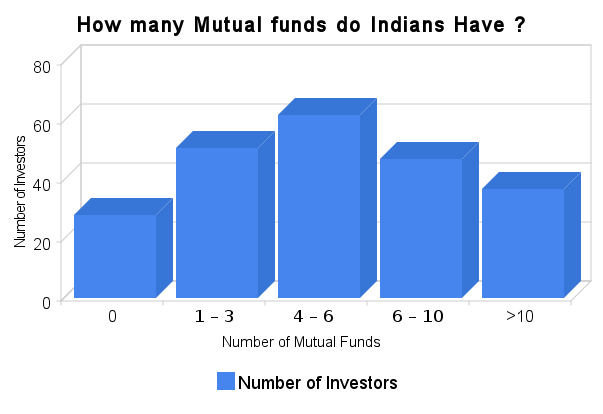
I conducted a Poll on this topic and we have some interesting results .
Facts

  • 63% people invested in less than 6 Mutual funds
  • 84% people invested in less than 10 mutual funds
  • 50% people invested in 1-6 mutual funds
  • The maximum number of investors were in the optimal range of 4-6 .
  • Total Vote : 225
  • Average number of Mutual funds : 5.57

If you look closely the graph results mimic binomial distribtution (Ignore this if you don’t understand), which shows that law of numbers apply even to this phenomenon and somewhere the average number of mutual fund converges to the most logical number by default .

Why it does not add much value when you invest in more mutual funds?

Each mutual fund on an average invest in at least 50-60 companies. If you buy 3-4 mutual funds then you are anyways going to invest in close to 100 companies overall (considering there will be some overlaps). So If you buy any equity diversified mutual funds, your money is going to be invested in some of the best companies probably 50-100 of them. Now when you buy another Equity diversified mutual fund there are high chances that the money is going to be invested in almost same set of companies in some proportion, so you are going to invest in same set of companies again. Buying 2nd mutual fund of same category will obviously increase your reach to some companies which were not part of the 1st mutual fund. But now as and when you add 3rd, 4th or 5th mutual fund, you will actually be invested indirectly to same set of companies. The price movement of these companies share prices will be same for all the mutual funds (most probably).

[ad#big-banner]

So what you have to understand is that after a certain point, adding more mutual funds of the same category is of no much value for the portfolio. Adding more number of mutual funds leads to another problem which is tracking problem if you are a kind of investor who buys a mutual funds and just looks at the NAV to find out if you are in profit or loss then you are not doing right thing. Mutual funds investing is very much close to Share investing where you track the instrument, see how it’s performing, what’s going inside the fund, how is fund manager doing, how are they churning the portfolio etc etc. So if you have too many mutual funds in your portfolio, it will be too tough to track them and your portfolio will be very cluttered.

You have to understand that investment of 1 lac in 20 mutual fund will roughly behave in the same way as investment in 5 mutual funds because finally the investment has happened in shares of top companies (roughly the same number of shares), so the investment value is result of the underlying share prices movement and not the number of mutual funds in the portfolio.

Thumb rules:

You can ask two basic questions to yourself to find out if your portfolio size is too big for yourself:

  1. Can you name all the mutual funds in your portfolio and a 2-3 line explanation about what the fund does?
  2. Can you guess roughly how does the movement in stock market affect your corpus in general? If stock market is going to drop or increase by X%, so you have a rough idea of what will happen to your portfolio at a high level?

Example of a Portfolio of Mutual funds

Let’s create a sample portfolio of mutual funds. We will consider ETF’s as a mutual funds for this example:

  • 2-3 Equity diversified Mutual Fund (Tax + Non-Tax saving): See the List
  • 1-2 Debt Fund: See the List
  • 1-2 ETF’s or Index Funds

Note that 2-3 Equity Diversified Mutual funds will cover almost all the big companies in your portfolio. Some ETF or index fund will give index level exposure and make sure you invest in top companies. Debt funds will add exposure to Debt part and no-correlation with Equity.

Most of the people do not invest in the same old fund they have bought, they feel that buying every other mutual funds in market will some way help them earn extra returns which is far from truth. Consistency in investment and faith in one of the good funds you have chosen is the right way to invest in mutual fund.

How having more than one Mutual fund in portfolio reduces the risk?

You have to understand the concept of standard deviation, it’s nothing but risk and return potential from mutual funds point of view. So a single mutual fund has the highest standard deviation and the risk and return can be very high. Adding more funds will help in reducing the standard deviation of the portfolio. As per Morning Star Research (Many thanks to Hemant Beniwal for sharing this)

After 4 funds, the effect of adding another fund diminished. It’s still noticeable, but not so dramatic. After 7 funds, things have mostly leveled out and after 10 funds, a portfolio’s standard deviation stays nearly the same regardless of how many funds you add. Thus, once you own between 7 and 10 funds, there may be no need for more. In fact, the more funds you own, the more likely you are to own at least a couple that do practically the same thing. That could be a drag on your returns because if you have multiple funds doing the same thing, one is likely to be better than the others. Focus on the superior fund and you’ll get better returns .

How do you Buy Mutual Funds? [POLL]

Comments, Please comment on what do you think is the optimal number of mutual funds?

Subscribe via RSS or Email:

{ 271 comments… read them below or add one }

1 Hemant Beniwal February 24, 2010 at 11:58 am

I met one investor with 62 funds.
Amazing diversification.

Reply

2 Manish Chauhan February 24, 2010 at 12:59 pm

Hemant

Err .. I hope you said “Amazing Diversification” with sarcastic tone :) .

Ask that investor to name it as some other Fund , it will become the best Fund inFund of Fund (FOF) category)

What do you think is the reason for anyone getting into so many mutual funds , What is the average number of mutual funds in your clients portfolio , I think there is a small number of people who take more than 10 mutual funds .

Manish

Reply

3 Hemant Beniwal February 24, 2010 at 3:06 pm

According to Modern portfolio theory (I follow the same) there are 2 type of risk in every portfolio.
Systematic Risk(Market Risk) that cannot be diversified away (within one market) &
Unsystematic Risk(Diversifiable risk) that can be reduced through diversification.

I have added a slide to make your readers understand this
http://www.slideshare.net/hemantbeniwal/diversification-3262806

Now question arises how many funds in a single asset class?
Few of the researches show (incl. morningstar) that after 7th fund you can’t reduce your Unsystematic risk.

I normally suggest 6-7 equity funds(here I am talking about single asset class not asset allocation):
Large-Cap 2-3(40-70%)
Mid-Cap 2(20-40%)
Thematic1-2(10-30%)

To your second question: thanks to Mutual Fund Agents who sold every NFO as best fund, Average comes close to 12-15 equity funds.

Question for everyone: 4-6 horses can pull the cart better or 10-20 horses?

Reply

4 Manish Chauhan February 24, 2010 at 3:20 pm

Hemant

that was nice information . I really liked your analogy of horse cart :) . Really 1-2 horses cant do the best job and either 15-20 will be too congested . the optimal result would come from 5-6 horses .

Same thing applies in general to mutual funds number too . I accept your point on asset class thing , you are right .

But considering general public who has no time to go in deep and wants short cuts , dont you think 5-7 mutual funds in total is good enough :)

Btw , where do we find that morningstar research ? can you send me ? Is it there on their website ? Morningstar.in ?

Manish

Reply

5 Hemant Beniwal February 24, 2010 at 4:20 pm

“After 4 funds, the effect of adding another fund diminished. It’s still noticeable, but not so dramatic. After 7 funds, things have mostly leveled out and after 10 funds, a portfolio’s standard deviation stays nearly the same regardless of how many funds you add. Thus, once you own between 7 and 10 funds, there may be no need for more.” Morningstar Page 70 (Knowing How Many Funds Are Enough)

I will send complete report in evening.

Reply

6 Manish Chauhan February 24, 2010 at 5:49 pm

Hemant

thanks for this one . But arent we more interested in mean of returns than standard deviation . If mean was not increasing by adding more funds , then it would have made sense ? No ?

looks like I am missing some thing .

manish

Reply

7 Hemant Beniwal February 26, 2010 at 5:21 pm

Great! You added it to your post.

I added ½ para from research & you raised a question on mean return.

You added full para & it answered your question.

Wow.

Reply

8 Manish Chauhan February 26, 2010 at 8:41 pm
9 Hemant Beniwal February 27, 2010 at 10:29 am

Manish

I think it’s your smallest comment till date.
Thank god it’s smiling face.

Reply

10 Jitendra Solanki February 25, 2010 at 10:14 am

Hi,

I agree to what you say.

I met an investor a year back (age 63) which has 38 funds in his portfolio.All NFOs.

And add to this-His broker has already earned 5 lakh as commission whereas he is still sitting at a loss after three years without earning a rupee.

Reply

11 Manish Chauhan February 25, 2010 at 6:27 pm

Jitendra

My god !! 38 funds , thats too much , agent earned 5 lacs in commision which was 2.25% of investment, that means the person invested 2.22 crores in total . thats really a big chunk :) . I wish I were the agent ;)

Manish

Reply

12 jitendra solanki February 25, 2010 at 9:58 pm

Manish

Thats true buddy.

Now calculate for an investor who has invested 50 lakh in 40 equity schems and his portfolio is churned four times in three years.Again the agent makes the money and customer is wondering for the day he hired him.

I don’t know where the agents gets the guts to go back to an investor who is already scrwed by him two times.

Reply

13 Manish Chauhan February 25, 2010 at 10:31 pm

Jitendra

Yes .. portfolio churning is one major problem , even mutual funds fund manager also do that a lot to show “action” and may be some “personal” reasons .

regarding “how the agents get the guts to go back” :) . I will call it dedication to make money :)

Manish

Reply

14 मुकेश पंड्या March 15, 2010 at 9:09 pm

म्युचल फंड में निवेश करते समय यह भी ध्यान देना चाहिये कि निवेशक की आय एवं वय (उम्र) क्या है. यदि कोई व्यक्ति मात्र 500/- रू. प्रतिमाह निवेश करना चाहता हि तो उसे केवल Balanced Fund में ही निवेश करना चाहिये. जैसे जैसे निवेश की राशि बढती है फंडों की संख्या बढाई जा सकती है जोकि अधिकतम 10 पर जाकर समाप्त हो सकती है. इससे ज्यादा फंड मात्र संख्या बढाएंगे.

ELSS एक प्रकार के Well Diversified Funds ही है, अत: मेरा सुझाव हैकि सबसे पहले ELSS चुने.
यदि ELSS आपकी आवश्यकता नहीं है तो Balanced Fund से शुरू करे. यदि आप Equity में ही निवेश करना चाहते हैं लेकिन ज्यादा निवेश संभव न हो तो एक अच्छा MultiCap Fund आपको सभी तरह का Diversification देगा.

यदि आपकी बचत ज्यादा है, उम्र कम हैं और वित्तीय जोखिम (Financial Risk) लेने की क्षमता ज्यादा हैतो फिर आगे Large Cap, Mid Cap, Small Cap, सेक्टर फंड जैसे विविध प्लान चुने.

साथ ही यह भी ध्यान दे कि ज्यादातर म्युचल फंड में निवेश (SIP) की राशि न्यूनतम 1000/- प्रतिमाह है. लेकिन कुछ अच्छे फंड 100, 250, 500 में भी उपलब्ध है. अत: अपना पोर्टफोलियो इस प्रकार से बनाऎ कि आप कम से कम प्रतिमाह निवेश में अधिक से अधिक Diversification करले.

Reply

15 Manish Chauhan March 15, 2010 at 10:49 pm

मुकेश

ये कौन से फुन्ड्स है जिसमे १०० , २०० या ५०० रुपये तक का निवेश किया जा सकता है ? कृपया उनके नाम दें !

मनीष

Reply

16 मुकेश पंड्या March 15, 2010 at 11:14 pm

न्यूनतम निवेश SIP फंड हाउस
—————— ————————–
100 Reliance MF (100PM x 60 Months)
250 Sundaram (250 x 20 Months)
500 HDFC, SBI MF, Fidelity, Fortis, LIC, Principal,
UTI (500 x 10 Months)

यह जानकारी फ़रवरी तक अद्यतित (Updated) है. कुछ बदलाव संभव है. लेकिन फ़िर भी हमारा प्रयोजन तो इनमें से कुछ प्लान से हो जाएगा.

Reply

17 Manish Chauhan March 15, 2010 at 11:17 pm

धन्यवाद्

Reply

18 khalid February 24, 2010 at 12:16 pm

I think 10 to 15 mutual funds one should have in his portfolio for covering all benefits of the market. I myself have 10 different schemes in SIP.

Reply

19 Manish Chauhan February 24, 2010 at 1:01 pm

Khalid

If these are diversified in different categories like Equity diversified , Debt , Sectoral etc , then 10 is ok . If all of them are of same category like Equity funds , then I think 10 is on the higher side .

Manish

Reply

20 Mukul February 25, 2010 at 7:18 pm

hi khalid,

what is your list of 10 schemes. Just curious to know.

Reply

21 khalid February 25, 2010 at 11:30 pm

Hi Mukul,
Here is the list for your reference…..

HDFC PRUDENCE FUND – GROWTH PLAN
HDFC TOP 200 FUND – GROWTH PLAN
FRANKLIN INDIA PRIMA PLUS – GROWTH
ICICI PRUDENTIAL DISCOVERY FUND -GROWTH
KOTAK OPPORTUNITIES-GROWTH
RELIANCE GROWTH FUND – GROWTH PLAN – GROWTH OPTION
SBI MAGNUM GLOBAL FUND-GROWTH
SUNDARAM BNP PARIBAS SELECT MIDCAP – GROWTH
RELIANCE TAX SAVER FUND – GROWTH PLAN
FRANKLIN INDIA TAXSHIELD – GROWTH

Reply

22 Manish Chauhan February 26, 2010 at 12:36 am

Khalid

Nice list .. all funds are great . Did you make sure that your equity:debt is fine , it should not happen that you are just into equity upto the neck :)

manish

Reply

23 varun agrawal February 24, 2010 at 12:36 pm

dear manish,
what i trhink a person who want to invest around 10k every month in MF”s
then he shud choose
1) 4 equity diversify funds (6k)
2) 2 balanced funds-equity( 2k)
3) 1 balanced fund-debt( 1k)
4) 1 tax saving (1k)
what is ur views regarding this..?

do some modification needed ..?

Reply

24 Manish Chauhan February 24, 2010 at 1:03 pm

Varun

Overall I think 6-8 funds are ok , though the composition can be different depending on individuals needs . I think if a person wants to invest for long term he should rather buy tax saving funds .

manish

Reply

25 Avinash October 19, 2010 at 11:18 am

Hi,

I’ve started investing in MF a year back
SBI MSFU—Dividend payout—SIP Rs2000
Reliance growth —SIP Rs 1000
HDFC top200 growth—SIP Rs2000

Now i have to invest Rs 10000 more through SIP, please guide.

Thanks in Advance

Reply

26 Manish Chauhan October 19, 2010 at 11:24 am

Avinash

Why dont you continue with HFDC top 200

Manish

Reply

27 Parmod February 25, 2010 at 10:09 am

Khalid ji,
I have one doubt as why should someone have equity funds, Hybrid funds with equity tilt and hybrid funds with debt orientation at the same time. If someone can monitor his asset allocation then equity funds coupled with small savings (for debt) are perfectly OK and for someone who want the fund to control the asset allocation monitoring part, one can opt for hybrid fund or more than one funds and that will take care of it. Like HDFC Prudence, it automatically adjusts equity to debt (in 70:30 ) range thus keeping your asset allocation under check. Remember that overall performance of your portfolio is important (incl PF , PPF and FDs) . Mostly people think only mutual fund portfolio as their portfolio and then try to distribute the same into debt and equity where as one should have a holistic approach towards his finances for asset allocation to work better.
Personally (with due apologies and I welcome a debate on this topic) I believe that Debt funds or Bond funds are not for small investor. Their priicing criterion is not understood by 98% of the retail investors. For small sums of money there are so many avenues of Post Office and bank schemes. So debt component of retail should use these high yield vehicles and MF should be for equity only.
The return of .5% more than bank is good for 1Cr but for 10000 it will not even pay for the petrol that you burn to go to MF office. So leave bond funds for deep pockets and be happy with PPF and Equity MF. What say fellow readers ?

Reply

28 Srinivas February 25, 2010 at 1:36 pm

@Parmod,
Each investment vehicle has a definite objective and usage. debt funds are mostly treated as protecting the capital with minimal appreciation to achieve the near term goal.
Bond funds or debt funds are for every investor to protect the hard earned money from market crash at the end. balanced fund has a allocation range, when market is doing good, manager can use maximum allocation to equity and when he sense long term bear market he can use maximum % of debt to protect the earned capital.
Every body has many short term and long term goals. for long term goal, equity and PPF works fine. But this is 15 year journey.
Assuming one opens equity MF and PPF same day, he cannot book profit in equity MF after 5 years and invest in PPF and lock for 10 years.
One should look and debt/bond or RD/FD whatever to keep capital safe and when goal is approaching.

Reply

29 Parmod February 25, 2010 at 3:25 pm

Srini,
I totally agree with your points. There are two different issues. All I wanted to say was that if there is any logic in investing in a Fund with 70% equity allocation as well as a fund with 20% equity allocation at the same time. These are two different ends of asset allocation. Also PPF as I said is only a metaphor. We can substitute all PO schemes and Banks RD/FD in the umbrella of Debt. What I wanted to say is that post tax returns from bond funds are not that inspiring. BTW How many retail investor know that bond/debt funds and even Gilt funds which invest in Govt security can give negative returns. That is the price of the liberty to move in and out before maturity in a bond. What I say is that retail investor should stay away from debt funds and use other mediums for planning debt side of his portfolio. That is a thought which is based purely on the fact that bond funds can give negative return and this is something that a small investor never tolerate and anticipate. Debt investments are made for safety in the first place.
Need more input from you guys on this issue.

Reply

30 Manish Chauhan February 25, 2010 at 6:41 pm

Pramod

You mean “retail investors with no knowledge” . Why cant we invest some money in debt funds for 1-2 yrs , if we can have a little understanding of things and want to take advantage of that .5-1% part .

Manish

Reply

31 Manish Chauhan February 25, 2010 at 6:38 pm

Srinivas

Dont you think that pure debt funds (which has everything in debt) should be avoided unless the investors has enough understanding of how they can yield more returns by change in interest rates and related ways .

Plain FD’s can also yield similar returns (1 yrs +) but then the simplicity is also there .

I am talking on behalf of common investor who does not have time and motivation to look at his investment .

Manish

Reply

32 Manish Chauhan February 25, 2010 at 6:31 pm

Pramod

Well said , I agree that debt funds for small amount and small duration are no no for small investors . I would recommend debt oriented funds as the last thing an investor should buy in mutual funds in debt front .

What do you think ?

What are your views on PPF after new tax code ?

Manish

Reply

33 sunny March 19, 2010 at 11:31 am

i completely agree that these bond funds are for people with deep pockets.

Reply

34 Chakrawarty February 24, 2010 at 1:12 pm

Manish

I am currently holding 10 Mutual Funds. 3 are now inactive which I stopped because of their performance. (My first investment in MFs where not enough groundwork was done). Of course still holding on to them as I didnot have heart to redeem the same at a loss. Apart from that I hold 1 balanced fund, 2 diversified funds-large cap, 1-mid cap, 1-small cap, 2 sectorial (1 infrastructure and other in banking). I donot intend to add any more to my protfolio. I believe max 4-8 carefully chosen funds are more than enough to manage thru SIP. (depending on how much money is being put in monthly)

Regards
Chakrawarty

Reply

35 Manish Chauhan February 24, 2010 at 2:44 pm

Chakrawarty

Yes 4-8 is a good figure , I would say that even more than that can be ok if you know what you are doing, the problem is the people buy mutual funds one by one as they come in market for the first time ,that is wrong thing .

Why are you holding on to the old funds , even though you are in loss , you can invest the money in better funds and manage it well .

Manish

Reply

36 Chakrawarty February 25, 2010 at 11:57 am

Yup, makes sense to sell the non performing ones..its just that some hope of recovering your initial cpaital keeps one hooked on to these. I know its bad strategy but unfortunately very human..Maybe this can be one of topics you can dwell on sometime..

Reply

37 Chakrawarty February 25, 2010 at 12:10 pm

Manish

One more query,

Any suggestions on tracking the portfolio of funds at one place. Any good tracker or tool.

Chakrawarty

Reply

38 Srinivas February 25, 2010 at 12:20 pm

I am comfortable with moneycontrol.com

Reply

39 Rajesh February 25, 2010 at 3:02 pm

You may like to try . It has excellent features to keep track of funds.

Reply

40 Rajesh February 25, 2010 at 3:03 pm

You may like to try http://www.valueresearchonline.com; it has excellent features to keep track of funds.

Reply

41 Hemant Beniwal February 27, 2010 at 1:01 pm

@ rajesh

Valueresearch tracker is not that good, moneycontrol is better.
Rediff is simplest.

Reply

42 Manish Chauhan February 25, 2010 at 6:49 pm
43 Mukul February 25, 2010 at 7:20 pm

agree on this one. it is ridiculously simple tracker. money.rediff.com and no ads to get the stuff we want.

Reply

44 Manish Chauhan February 25, 2010 at 8:49 pm

Mukul

I was using this one earliar but not using it now :) . No money to invest .. hehe :)

Manish

Reply

45 Debashish February 26, 2010 at 8:59 pm

@Manish – Too bad you say that . With having so much gyan if you do not save money to invest what abt mango people???
(Translate the last 2 words to hindi if you did not understand)

Reply

46 Manish Chauhan February 26, 2010 at 9:15 pm

Debashish

Dont worry man .. I am just out of money this year because of heavy family responsibility . Will take care from this year ;)

I got the hindi part ;) .. come on man .. I know Bhojpuri also . I am from UP :)

Manish

Reply

47 Vidyesh Sabne February 24, 2010 at 1:35 pm

Hi Manish,
You remember me! I met you when you were in Pune. I wish to invest in Gold ETF. I read your article and understood the basic funda about it. But i wan some more information from you regarding, how one can invest in Gold ETF.? Is it like a mutual fund or like trading in shares. In case if i wan to invest in Gold ETF, what procedure shall i follow; like opening DMAT account etc.

Thanks for constantly valuable info,
Vidyesh

Reply

48 Manish Chauhan February 24, 2010 at 2:37 pm

Vidyesh

ETF’s are just traded like shares on stock exchanges , so you would have to open a demat account first , once you have demat account , you can then invest in any ETF (gold etf , index etf) just like shares :)

Hope you got the answer . the procedure is same as buying and selling shares :)

Manish

Reply

49 Srinivas February 24, 2010 at 7:14 pm

In my opinion,
1. Two equity diversified MF (preferably different indices/fund house) via SIP
2. Two Tax saving MF via SIP
3. One balanced debt oriented MF
4. One Liquid Fund/floating rate fund for emergency fund
5. One ETF

(Note: I am not in favour of thematic funds)
Total : 7.
Is that fine? Am I missing something?

Reply

50 Manish Chauhan February 24, 2010 at 7:44 pm

Srinivas

This looks very perfect :) . The point is not actually the number of funds in reality , its about how appropriate your numbers are as per your requirement and profile , if you are a hard core mutual funds investors (or a trader kind of) , then you can even go upto 10-12 .

The biggest worry is that people keep on buying funds after funds without understanding what does it mean and how it helps them . the problem is not understanding what you do , not “what you do” :)

What do you feel ? I am sure its not just limited to mutual funds .

Manish

Reply

51 Srinivas February 25, 2010 at 6:49 am

Yes. you are right.
Though it is difficult to arrive at a number, It depends on individual profile, understanding and risk.
I have many friends who invest in mutual funds with these reasons:
1. SBI magnum tax gain, SBI means returns are guaranteed as it is PSU.
2. Whichever fund declares highest dividend in the month of January, they invest in that for next financial year.

Reply

52 Manish Chauhan February 25, 2010 at 6:51 pm

Srinivas

Reason 1 is really hilarious :) .
Reason 2 is simply because of no knowledge .

Manish

Reply

53 aditya modi February 24, 2010 at 10:21 pm

hey manish,

good work .
my investment
2 small sips in sbi contra nd reliance regular saving 1 sip mid size in hdfc top 200

on my reseach note -I found these are the best in the long run-
reliance growth
hdfc top200
sbi contra and sundaram bnp paribas select midcap

Why dont you capture the last 5 or more odd returns of SIP in these to nail a point-SIP and long term investment really makes sense?
have mailed u some material might be of some help

smiles
aditya

Reply

54 Manish Chauhan February 25, 2010 at 8:52 pm

Aditya

The funds you have mentioned are all good ones :) . have a look at : http://www.jagoinvestor.com/2009/08/list-of-best-equity-diversified-mutual.html to get an idea on long term returns .

Manish

Reply

55 Zamil February 25, 2010 at 12:24 am

Manish,

Another good / informative post. Well, my investment in MF is as under:

1- Two equity diversified Funds (one index tracker/one actively managed) via SIP
2- Two growth oriented funds (via SIP)
3- One liquid fund (one time investment and for emergency)

This is my MF portfolio.
I really appreciate your dedication and hardwork and expect more posts on MF investment.

Zamil

Reply

56 Manish Chauhan February 25, 2010 at 8:55 pm

Zamil

Nice portfolio , can you share what are these “growth oriented funds” , you mean growth option ?

Manish

Reply

57 Kittu February 25, 2010 at 1:56 am

Hey Manish, Nice article. Very insightful.

Let me know what you think of my MF Portfolio. I have the below 10 MFs in which I made one time investment in my initial ivestment saga. I realize this was a mistake but I am thinking that I will keep them even though they are in negative now untill they come up. I am sure they will come up sometime in next 3-5 years. What do you think?

1.IFG ICICI Pru Infrastructure Fund(50k on Jan ’08)
2.Reliance Diversified Power Sector Fund-Growth Plan-G(50k on Jan ’08)
3.36GMagnum Sector Funds Umbrella Contra -G(50k on Jan ’08)
4.U T I(50k on Jan ’08)
5.DSP ML TIGER FUND G (10k on Jan ’08)
6.KOTAK OPPORTUNITIES FUND-G (15k on Mar ’08)
7.RELIANCE GROWTH FUND – G(15k on Feb ’08)
8.BIRLA SUNLIFE FRONTLINE EQUITY FUND(15k on Feb ’08)
9.RELIANCE VISION FUND – G(10k on Feb ’08)
10.RELIANCE DIVERSIFIED POWER SECTOR FUND – G(15k on Feb ’08)

Now that I have some knowledge(thanx to you) I have started SIPs in the following 5 funds for last 6 months. Let me know what you think abt these funds. Should I make any changes? I can invest upto 40k/month.Let me know how best to do that -Thanks.

ICICI PRU INFRASTRUCTURE FUND -GRO-4K
SUNDARAM SELECT FOCUS FUND RETAIL – GROWTH -2K
DSP BLACKROCK Equity Fund – Regular Growth -5K
HDFC TOP 200 FUND GROWTH -5K
IDFC PREMIER EQUITY FUND-GROWTH – PLAN A -4K
RELIANCE REGULAR SAVINGS FUND-EQUITY PLAN-GROWTH OPTION -5K

Reply

58 Manish Chauhan February 25, 2010 at 8:58 pm

Kittu

1 and 3 number funds do not look ok to me .. what are these funds ? Do they suit you ?

Why do you want to keep them even though they are negatives , if they are not performing from long term , then better get rid of , its more of psychological issue :)

The new funds you have started are good. you can look at pruning your portfolio to max 6 funds .there are many duplicates i can see . most of them will behave in same manner :)

Manish

Reply

59 Nitin February 27, 2010 at 3:14 am

The 3rd fund which you are saying not good “36GMagnum Sector Funds Umbrella Contra ” is i guess the Magnum contra fund from SBI right???? Or i am confusing my self…

because in ICICI Diretct they have given name is SBI MAGNUM SECTOR FUNDS UMBRELLA CONTRA -GROWTH…

Reply

60 Hemant Beniwal February 27, 2010 at 10:43 am

@ Nitin
SBI MAGNUM SECTOR FUNDS UMBRELLA CONTRA

Right name is this only, short name is SBI MSFU Contra

Under MSFU they have few sector & thematic funds (Contra,emerging business,FMCG,IT,Pharma,COMMA)

Reply

61 Hemant Beniwal February 26, 2010 at 5:41 pm

@ Kittu

At the time of reviewing your portfolio always ask yourself:

“If funds were in cash today, where would I invest the money?”

If answer is very different your existing portfolio, redeem it after Considering taxation & expenses.

Reply

62 Manish Chauhan February 26, 2010 at 8:53 pm

Yes , I agree to what Hemant says. this is common issue . Investors do not understand that by not getting out of a bad investment , they are going no where , they just want to get out of bad investment and take “loss” . In my previous articles about trading in stock market , I have highlighted this point that psychologically human beings do not want to become “loosers” by taking a loss

so that stay with that loss and will keep in till the moment it comes to “profit” so that they become “Winner who did not loose money” . So there are some people who invest 100 somewhere and then it comes down to 90 . they keep it for next 10 yrs untill it comes back above 100 like 120 or 130 and then they think “they finally didnt loose” :) and they are winners ;)

Manish

Reply

63 Viswa February 25, 2010 at 5:15 am

I agree with you and 6-8 is the right number for mutual funds which one can manage. The kind of mutual funds will differ as per investor’s risk.

Informative article!! Keep up the good work.

Reply

64 Manish Chauhan February 25, 2010 at 8:59 pm

Viswa

How many funds do you have ? Would love to hear your views on Investing in Debt funds vs FD’s ?

Manish

Reply

65 Viswa February 26, 2010 at 3:33 am

I have 5 funds and 1 gold ETF. Out of 5 funds, 3 are Tax savings ELSS and other 2 SIPs were started 3 years back and paid only for 1 year.

After reading your blog and feel the importance of continuious saving/investing.
I don’t know much about debt funds and I will go thru your article on this.

Reply

66 Manish Chauhan February 26, 2010 at 11:08 am

Viswa

Total 6 things look good :) .. You can now try some debt funds if you want to invest for short term like 1-2 yrs , try debt oriented funds with some exposure to equity :)

Look at my post on List of debt funds .

Manish

Reply

67 yogesh February 25, 2010 at 6:48 am

Hi Manish,

Yet to buy mutual fund.Currently No idea.So this is very imp post for me.

But i want to ask few question on MF.

Q1.
If the market drops does fund manager changes investment % in companies in which our money is currently invested ??

Or Investment % in companies will remain unchanged.

Q2.

What is righ time to buy any mutual fund ?
A)When market is low ?
B)Or Any time can buy by doing some analysis on past available data of funds.?

Timming is also very important ..So as per my limited knowledge Option A.

Plz clear my dobuts

Reply

68 Manish Chauhan February 25, 2010 at 9:03 pm

Yogesh

Ans 1 . Yes , fund manger will take active decisions on market movements , thats the reason mutual funds are called “active” funds , if fund manager was just sitting , then we could have bought normal ETF’s or index funds :)

Ans 2
a) Market being low is always the best time without doubt , but how do you know that its down :) . Most of the people do not buy when market is down , so you can understand how tough it is to take logical decisions .

b) If you want to invest for long term , you can anytime start SIP and keep investing without looking at market :)

What is your future strategy ?

Manish

Reply

69 S S February 25, 2010 at 6:52 am

Nice thing about this blog is its simplicity, it helped me understand several things though I still need to learn a lot. Several people tried to teach me but without any suuccess.

Reply

70 Manish Chauhan February 25, 2010 at 9:04 pm

SS

Thanks , its an honour . Comments from people like you motivate me to write more and more and clear doubts , the interaction here teaches me more than anyone , so thanks to you all :)

manish

Reply

71 Srinivas February 25, 2010 at 7:00 am

Answer for Q1: Fund managers certainly take a call how to revise their portfolio during market drops. Fund managers work out short term as well as long term benefits. Based on the past performance you can evaluate how good that fund manager is. Fund performance talks all story.

Answer for Q2: Though the right time to buy a mutual fund is when market is low.
Ask yourself? Who defines low? Now Sensex is 16,200k and it may go down to 11,000 after 4 years. Do you wait 4 years?
You think 13,000 is low and invest and it reaches 12,000 after 2 months. How do you feel?
Any time buying for long term (more than 5 years) is always better.

Remember in Equity, Short term investment is risk and long term risk is investment.

I hope my recent article clear your doubt. Take a look
http://money360.wordpress.com/2010/02/24/invest-and-maximize-your-mutual-fund-returns-sip-by-sip/

Reply

72 Manish Chauhan February 25, 2010 at 9:05 pm

Srinivas

I really liked the line “Remember in Equity, Short term investment is risk and long term risk is investment.” It so true and difficult to understand some time for most of the investors :)

Manish

Reply

73 Rocky February 25, 2010 at 7:46 am

How about investing with ONE FUND HOUSE but across the spectrum. For e.g. investing with HDFC Mutual Fund as follows or alternate…(pls suggest)
HDFC TOP 200- 50% of total monthly investment
HDFC MID-CAP- 25% of total monthly investment
HDFC Prudence- 25% of total monthly investment

Is there any risk associated here?
-rocky

Reply

74 Srinivas February 25, 2010 at 8:18 am

Though it is not a big risk, but still not a intelligent decision because,
1. Fund is managed by same person (HDFC top 200 and HDFC prudence). Same person means same thinking/investment strategy for both funds. most part of the portfolio looks same. if one is going up, other one also would go up and vice versa.
but still if these funds are the top funds in their category against peers, then you can go for it.

2. Each fund house may have different exit load, expense ratio, lock in period.

Reply

75 Parmod February 25, 2010 at 10:27 am

Srinivas ji,
You are right in general yet it is not 100% right. One should opt for the strength of the particular Fund House. HDFC and Fidelity is good in managing conservative and Large cap funds with awesome consistency but their record on mid cap is not inspiring. Sundaram and IDFC have best performing mid and small cap but Large cap funds are below category average. Right now only DSPBR is one fund house which is in top qurtile in each category. Their top 100 , eqity and Small and midcap funds as well as infra fund (TIGER) are all doing well. Anyhow it is the question of good fund house combined with good fund. You can not opt for either in any situation. Fund house is important in terms of process. HDFC, DSP, Sundram, ICICI, Quantum, Fidelity are all good process driven funds but if you see JM, SBI etc. once fund manager gone they are flash in the pan. So look at every aspect.
For your theory of same manager thinks in one way. Look at Sankaran Naren, This gentleman manages ICICI infra a sector fund and ICICI Discovery a value fund and he has not deviated from his mandate in any of the two funds. Discovery was in bottom half in 2007 and Infra in top but he did not templted to buy fancy stocks for discovery as it is avalue fund and in bear market and after, Discovery becomes no. 1 and still his top holding is Bharti , true value buy.
So it is the manager’s integrity to be true to its mandate and the fund house approach and montoring in this regard are important not the fund manager alone.

Reply

76 Srinivas February 25, 2010 at 1:04 pm

Hi Parmod,
Thanks for the thoughts.
Yes. Agreed. Each fund house have a different process and each fund house is good in managing large cap or small cap.
Regarding fund managers we are talking about fund manager investing in equity mutual fund; not about the funds in different categories.
The example you mentioned one is a sector fund and another one is equity diversified, and obviously fund manager should not deviate from the fund objective.
however I also said, if the same fund manager handling fund of same category and still if that could beat peers, it is still a better choice.

Reply

77 Parmod February 25, 2010 at 3:15 pm

I think you have confused it a little. Now we are mentioning that we are comparing the fund manager thing only if the fund is of same theme ie even comparing diversified fund and sectoral fund (Though infra fund by definition that ICICI uses makes it a diversified as investments are limited to 65% in infra sector which by them means anything other than pharma and FMCG.) and there fore comparable. However see the starting comment where this whole discussion started , when you comapred an equity fund with a balanced fund :-) . Anyhow it is the established fact that investor should invest on the mandate of the fund and it is fund house’s job to make sure that it’s manager remain loyal to the mandate and I think this should be the top most criterion for selecting a fund house in the first place. How can one trust one Contra is no more contrarian, Global is not having a single global holding and so on. It is imperative that investor should get what he buys means if I invest in a divesified fund I do not want that the holding in single sector is 40% and also TOP 100 fund should not have the 300th scrip in its portfolio. It is been very good to have a discussion with you srini, keep it up and I hope to interact you with lot more points on lot more topics.

Reply

78 Manish Chauhan February 25, 2010 at 9:13 pm

Pramod

Overall I agree with your thoughts , Can you suggest what should be a strategy to invest in mutual funds considering “fund manager” , “theme” and “asset class” of fund ?

Steps ?

Manish

Reply

79 Rocky February 26, 2010 at 12:54 pm

Thanks Manish.
I need another clarification.
Is it a good idea to make a lump-sum SIP on a fixed date OR to break the monthly investment into say four parts and invest across various dates in the month.
For e.g. is it a good idea to invest say Rs 25ooo on 1st of the month OR is it a good idea to invest Rs5000 on 1st, 5th, 10th , 15th and 25th.
My main aim is to make investments AUTOMATIC from my salary account and make it SIMPLE enough so that I am able to manage it without any advisor/portfolio manager etc.
Thanks for good job u r doing here.
-rocky

Reply

80 Manish Chauhan February 26, 2010 at 2:59 pm

Rocky

It should not make much sense to invest on particular date . there are different level of diversification , first we diversify across asset classes , then AMC’s , then months , now if we do diversification upto this level , it wont matter much I guess.

Havent done any formal study on this , but does not look worth trying to me :)

Forget it :) . Wanna do some small study yourself and share with us . Take data for all the dates and see how the NAV grew and the CAGR return .

manish

Reply

81 Manish Chauhan February 25, 2010 at 9:11 pm

Pramod

I think Srinivas comment on Fund manager was more of general , the example you gave about Sankaran Naren is more of one of the rare examples . Its a general known saying that dont buy same funds from same fund manager unless they are clear enough with their thoughts and have track record of integrity (morningstar)

What do you think ?

manish

Reply

82 Chakrawarty February 25, 2010 at 12:08 pm

Rocky,,

I dont have anything against same fund house funds..as long as you understand the objective of the fund, nature of companies it invests in, risks involved, its performance over 3 to 5 years (keeping in mind that past performance may not be sustained). This portfolio looks ok as Top 200 is large cap diversified fund, Prudence is a balanced fund which also invest some capital into debt instruments(buffers the risk a bit). Mid/small caps are more volatile and can swing wildly with market fluctuations. So depends on ones’ risk apetite.

So bottomline is if there is a fund house which has highly rated funds, no harm in considering them. But its prudent to spread portfolio across different fund houses.

Chakrawarty

Reply

83 Manish Chauhan February 25, 2010 at 9:08 pm

Rocky

As Srinivas suggested . Having 1-2 funds from same AMC and asset category is fine (equity funds) , but above that it wont help much :)

Manish

Reply

84 Sachin February 25, 2010 at 9:00 am

This article reminds me of a book which I read sometime back:
“The Winning Portfolio” – By Paul B. Farrell
It was all about choosing best funds and diversification. Just thought of sharing some conclusions from this book.

Author concluded :
- Fewer than 5 Funds is lack of diversification for a solid portfolio
- More than 12 Funds, no new diversification but increased management problems etc
- Ideally 10 funds in a portfolio leads to good diversification (obviously re-balance when required)
And of course, exceptions exists.

Reply

85 Manish Chauhan February 25, 2010 at 9:15 pm

Sachin

Nice points :)

I liked point ” More than 12 Funds, no new diversification but increased management problems etc”

the management problem mentioned is generally ignored by most of the people , they do not understand that a cluttered portfolio is tough to manage and track and hence its tough to take decisions on buying and selling when right time comes :)

What do you think ?

manish

Reply

86 Sachin February 25, 2010 at 10:31 pm

100% in agreement with you Manish :-)

-Sachin

Reply

87 Raj February 25, 2010 at 9:16 am

I selected 10-13 funds where all the funds are performing well. But I am not able to shorten the list and decrease the portfolio size.

Reply

88 Manish Chauhan February 25, 2010 at 9:17 pm

Raj

To remove the funds from portfolio is much tougher than you think because you can never decide which is better than which . so the best way , beleive me the best way is this , take 13 chits and write the names of each on paper and then pick 6 randomly .

Discard the rest 7 . this is perhaps the best way to remove funds (assuming they are all of same category)

Any other killing Idea ;)

manish

Reply

89 Anand May 10, 2010 at 5:06 pm

Another way is to open an excel sheet, compute the XIRR returns for each fund, sort it so that highest XIRR is at the top and then you can remove the bottom 5 or 6 funds.

I’m sure although all funds are top performing, their XIRR returns will differ slightly.

Reply

90 Parmod February 25, 2010 at 10:35 am

I think if one buy only Nifty and Nifty Junior ETF then there is no need of further diversification. If someone really desperate for diversification then CNX 200 or CNX 500 ETF from Benchmark is best. You will be invested in Top 100 companies (nifty and nifty junior) or top 200 (CNX 200) or top 500 (CNX 500) companies all the time based upon your apetite for diversificcation and opt for one good Large cap (HDFC TOP 200 or DSP top100) and one midcap fund ( Sundaram smile or IDFC Premiere equity) and that is done. You have diversification and active management at the same time without much ado. Thats short and simple. What say ?

Reply

91 Manish Chauhan February 25, 2010 at 9:19 pm

Parmod

I like it . But the problem is awareness , most of the investors still dont know that we have ETF’s for index like CNX 500 and CNX 200 :) .

Parmod , do you think in long term (from now onwards) , ETF’s or index funds return would beat active managed mutual funds (leave aside the risk part)

Manish

Reply

92 Anup Katariya February 25, 2010 at 1:49 pm

Good post :)

Reply

93 Manish Chauhan February 25, 2010 at 5:39 pm

Thanks Anup

How many mutual funds do you hold ?

Manish

Reply

94 Anup Katariya February 25, 2010 at 5:52 pm

Manish,

I just hold few tax saving funds… SBI magnum, Birla Tax relief.

I wish to put more in Equity funds… but there are other priorities in my current life which hopefully will get over soon. Here i had to control my ‘greed’ and resolve some other priorities.

But this is good learning to me for near future.

Thanks,
-Anup

Reply

95 Manish Chauhan February 25, 2010 at 9:21 pm

Anup

Great

take care of Today , leave future right now … If you take care of today well , its the better investment with good returns from mutual funds investing :) .

Even tax saving funds are good enough mutual funds portfolio in isolation , keep it up .

manish

Reply

96 Deepak Gupta February 25, 2010 at 4:48 pm

Hello Manish,

Very informative article and points. So thanks for that. However, I think the analysis that you and some of my friends in their responses have done are based on few assumptions:

1) Every individual has time and knowledge to do research and analysis about MF i.e. knowing who are the fund managers, their past records, expense ratios, etc. I bet you ask what the expense ratio is and most of the MF investors won’t know.

2) All MF investors are internet savvy. I think for non-internet savvy folks, it becomes even more difficult to find out these details. What are the free sources of information other than internet ?

3) People track their investments on regular basis. Many times I have seen that people do investments and forget about it for few months, years. I myself did it for couple of years :) . Agents are the masters in exploiting these points.

So I can easily see that how difficult it is for a layman to do all this research. In the end, most of it especially equity related stuff becomes ‘legalized gambling’ for them. Think about this: I work from 8 to 8 (business/service), have some surplus 1L, but I don’t have time at all to do all this research and I hear all the time that the guy sitting in next cubicle makes money in MF, so I go MF way – NFO, Equity what ever my ‘agent’ suggests. That is why I think trusted CFPs or FPs are so much required these days.

Any way, I have following questions for my own knowledge:

If a MF has given for e.g. 30% return in past 2 yrs. Does that mean one should take money out of it ? I am always confused about exiting. If I stay put then would it mean that the returns will grow and if yes, would they be compounded ? Suppose I take money out since I am happy with the returns but then where should I put that money ? Invest in some other MF or same MF or ??

What about 6-7 Equity funds + 2-3 ELSS + 3-4 Sectoral funds – Infra, Metal, Real Estate, Energy? Should a novice investor go with Sectoral funds ?

Thanks,
-Deepak

Reply

97 Manish Chauhan February 25, 2010 at 9:28 pm

Deepak

A novice investor should not go for sectoral funds ever . the reason novice investor comes to market is some good return and lesser risk , so diversified mutual funds makes sense for any starter .

Answer to your question

Its a good idea to get out of fund if you have got 30% , assuming your return expectation is 15-20% , then you have to look at it this way , “I wanted 15% , but anyways I got 30% , thats my 2 yrs return , so lets get out of this , and even if I get some less returns for next one year of even if I get 0% return I will be on track”

So you have to see that you are on track , this is called true financial planning , if you needed 15% every year on year to reach your financial goal after 10 yrs and you some how get it . that all .. your financial goals are met , what else one needs :)

Now comes the other points you have mentioned :) .

We at this post are dicussing what should ideally happen , true that people dont have time and understanding of things and hence they take wrong decisions , now its our responsibility to share this information , may be this link also :) to others :)

manish

Reply

98 kavita kamat February 25, 2010 at 10:32 pm

hi manish,

very very valued information u share with everyone. also thxs to srinivas as he also shares great information about a scheme named Canara Robecco Floating Rate Short Term. What is this scheme actually and can we invest in the scheme.

kavita

Reply

99 Manish Chauhan February 26, 2010 at 12:40 am

Kavita

Thanks for your comment . So how are you doing now a days .. Did you learn more things from blog , keep posting cooments and ask questions :)

Btw , Canara Robecco Floating fund is a debt fund and has less return potential with safe returns, consider it only for short term if you want , for long term this is not the fund .

Manish

Reply

100 Srinivas February 26, 2010 at 7:08 am

Kavitha,
Thank you for the appreciation.
Though I never said about canara robeco floating rate short term plan specifically anywhere. Debt funds are the last thing to consider.
Floating rate funds work out in rising interest scenario. Now a days, HDFC has come up with RD at quarterly revised interest rate, if the interest rate is rising, you will get the benefit.

Reply

101 Manish Chauhan February 26, 2010 at 11:16 am

Srinivas

Does that mean that we should buy floating rate funds when interest rates are down considering they will go up again later .. here I can understand that taking a call on interest rate is just like trading shares in stock market :) in some way

Correct me If I am wrong ?

manish

Reply

102 Srinivas February 26, 2010 at 1:55 pm

Yes. If the money market is expected to do well and interest rates are set to go high in future, to take that benefits floating rate funds are preferred.
As this is not possible in case of FD, RD because interest rate is fixed for the whole term.

Floating rate funds score well in this case and tax and liquidity.
Take for example, during Nov-Dec 2008 deposits rates are going up, if you had parked your money in floating rate funds, your deposit would take benefit of rates going up.
Considering the previous 5 years data, floating rates have scored well compared to debt funds in 0.5 to 1%.
In next 1-2 years, interest rates are set to increase, so one can take benefit of this.
but as I said, banks are coming up with attractive RD to attract investors.

Reply

103 Manish Chauhan February 26, 2010 at 3:08 pm

Srinivas

Ok great to know this . How is their investments different from debt funds ? Do they put more in bonds ?

manish

Reply

104 Srinivas February 26, 2010 at 3:33 pm

A floating rate mutual fund is a debt fund that invests predominantly in debt securities with a floating rate of interest. And these debt securities peg their coupon or interest rate payable to a market-driven rate such as the Mumbai Interbank Offered Rate (Mibor). Hence, each time the benchmark rate fluctuates; the coupon rate is adjusted accordingly.

The primary advantage of these funds is that they are less volatile than other types of debt funds. This advantage arises due to the inherent structure of the floating rate bonds. In case of fixed rate bonds when interest rates in the economy change, the price of the bond adjusts to make up for the fixed coupon of the bond.

While this happens even in the case of floating rate bonds, the change in the price of the bond is less drastic due to the periodic change in the coupon of the bond. The fall in the price of the floating rate bond will depend upon the reset period. The lesser the gap between the resets, the lower will be the fall in price.

http://www.dnaindia.com/money/report_floating-rate-fund-an-ace-up-investor-sleeve_1273465

Reply

105 Manish Chauhan February 26, 2010 at 8:54 pm

Thanks for the exaplaination :) .. it was a great read :) . I learned about it .

thanks

Manish

Reply

106 kavita kamat February 26, 2010 at 4:08 pm

Srinivas,

can u please explain the Scheme, Canara Robecco Floating Rate Short Term Plan in detail so that i can undertstand it and if suitable invest in it. As i am a housewife , i always read the replies u give alongwith Manish; and i am comfortable with ur simple answers. So please if u don’t mind, can u explain it in detail.

Thk u.
kavita

Reply

107 Manish Chauhan February 26, 2010 at 4:29 pm

Let me take this opportunity to explain as I will also learn :)

So Floating funds are Kind of Debt funds , Normal debt funds invest in safe instruments where return are very much known like corporate bonds , govt securities etc .

On the other hand Floating funds invest more in kind of bonds where the maturity value is linked to Interest rates . So if interest rates go up and down , the returns are also affected .

Is this simple ?

manish

Reply

108 Srinivas February 26, 2010 at 5:47 pm

Kavitha,
Thank you. I am honored. Surely I will write an article with more data and I will make it simple to understand for common investor.
After reading the article, you can tell us how do you feel and we can suggest as per your needs.

@Manish,
Thank you for the appreciation and your gentlemen attitude.

Reply

109 Manish Chauhan February 26, 2010 at 9:02 pm

Anytime ;)

You are one the highest commentator and one of the most knowledgable among all readers . good luck .

manish

Reply

110 kavita kamat February 26, 2010 at 10:18 pm

THANK YOU VERY MUCH BOTH OF U. Manish it is very thoughtful of u to explain it so simply so that every person can understand it. Once again Thks.

kavita

Reply

111 Manish Chauhan February 27, 2010 at 12:11 am

welcome , keep commenting

manish

Reply

112 anonymous February 25, 2010 at 11:23 pm

wonders no one has FT india growth fund, it is one of the best fund available (i dont listen to star/rating) managed by Mark Mobius which sticks to it’s lable …
Even more wonder’s why no one talk about it ?? Agreed that expense ration is on higher side, but how many MF are available with 14+ year history/track record ??

Problem with reliance mf, personal relation comes above investor ( one example. read book by Capt Gopinath, Rel MF was about to buy stake in air deccan in favor for ADAG), recent FAME cinema saga… And find how many AMC houses are holding RCOM ..? “Major is with Only RELIANCE MF and few other’s ”
HDFC/other AMC MF, again personal relation come over, if Parent company stock are free falling, these guys come at rescue ( Same way LIC comes to rescue market/FPO/IPO on FM call, go back in the history), no one care’s about Investor…

Reply

113 Manish Chauhan February 26, 2010 at 12:42 am

@Anonymous

FT India growth fund is a nice one . The reason why no body talks about it is very simple, everyone cant talk about everything , so always there will be some fund or the other which will not be talked about .

Thanks to you that you atleast talked about it :) . nice info

Manish

Reply

114 Krish February 26, 2010 at 2:24 am

Hi,
Manish

I have 2 ELLSS Funds HDFC Tax Saver and Canara Robeco in SIP for 500 each.Which Funds I can buy for long term like for my retirement,Child education etc….
Learnt a lot from your blog about financial planning. Big Thank you to you for providing the excellent information

Reply

115 Manish Chauhan February 26, 2010 at 2:28 am
116 mynameisnotkhan February 26, 2010 at 9:45 pm

hi

is there any mutual fund which mirrors nifty and sensex? i am yet to buy mutual fund. thanks for the article.

Reply

117 Manish Chauhan February 26, 2010 at 11:50 pm

mynameisnotkhan

try index funds and etf’s .. .they mirror index

manish

Reply

118 Manoj February 27, 2010 at 12:37 am

Hi Manish,

Can you please provide your valuable feedback on the following MF portfolio. The objective is to seek 15% plus growth over a period of 10-15 years.

Equity Diversified

Reliance Growth
Sundaram BNP Paribas Select Midcap Reg
Magnum Contra
DSPBR Equity
HDFC Top 200
DSPBR Top 100 Equity Reg

Debt funds

UTI CRTS 81-G
Reliance MIP
HDFC MIP Long-term

Thanks,
Manoj

Reply

119 Manoj February 27, 2010 at 10:29 am

Looks like my earlier message got deleted.

Hi,
I have a created a MF portfolio for a possible return of 15% – 20% over a period of 10-15 years. I am investing in these funds through monthly SIP.

Equity Diversified funds

HDFC Top 200 Fund – Growth
DSP BlackRock Equity Fund – Growth
DSP BlackRock Top 100 Equity Fund – Growth
Reliance Growth Fund – Growth
SBI Magnum Contra
Sundaram BNP Paribas Select Midcap Reg-G

Debt funds

Reliance Monthly Income Plan – Growth
HDFC Monthly Income Plan – Growth
UTI CRTS 81

Members of this forum, your feedback will be really appreciated.

Reply

120 Manish Chauhan February 27, 2010 at 10:47 am

Manoj

Overall good portfolio , but why have you not chosen any ELSS fund ? Most of the equity funds you have chosen are similar in portfolio . you can prune 2 of them I think . Do you needs monthly Income ? Why have you chosen MIP’s ?

Manish

Reply

121 Manoj February 27, 2010 at 11:22 am

Manish, Thank you you very much for the feedback. Can you suggest which of the two equity funds I can prune. While selecting debt funds I went on value research and selected funds which had given the highest return over the last 5 years. I started investing in MF 3 months back, so have limited experience in chosing right MFs. Any suggestions on choosing the right debt MF will be really helpful.

Manoj

Reply

122 Manish Chauhan February 27, 2010 at 12:38 pm

You can remove One of the DSP funds , do you understand contra funds ? Why have you invested in that ?

Manish

Reply

123 Manoj February 27, 2010 at 5:43 pm

Manish, Thank you very much for the reply. Based on the inputs I have come up with the following portfolio :-

Debt

HDFC Floating Rate Income Fund – Long Term Plan (Floating rate)
Fortis Flexi Debt Fund – Regular Plan – (Debt short term)
ICICI Prudential Gilt Fund – Investment Plan – PF Option – (Gilt)
Fortis Money Plus Fund – (Liquid)

Equity Diversified

Reliance Growth Fund
HDFC Top 200 Fund
Sundaram BNP Paribas Select Midcap
DSPBR Equity

Balanced
HDFC Prudence Fund

Any suggestions on index funds will be appreciated.

Reply

124 Manish Chauhan February 27, 2010 at 10:49 pm

Manoj

You can try Benchmark index funds , they are generally known for low FMC , are you looking for Nifty index funds or other indexes like CNX 200 or CNX 500 ?

Manish

Reply

125 Adi Patil February 28, 2010 at 7:42 pm

Dear Manish,
My portfolio is as below.
Sr. No. Fund Invested Value, Rs. Current Value, Rs.
1 Franklin India Prima Plus Fund -Dividend 55,000 45000
2 Birla Sunlife Equity-Growth 20,000 20,261
3 Birla Sunlife Frontline Equity-dividend 10,000 11,513
4 Birla Sunlife Income Plus 20,000 23,414
5 DSP India T.I.G.E.R. Fund – Growth-Regular 20,000 18,718
6 DSP Merrill Lynch Opportunities Fund – Growth – Regular 20,000 20,518
7 DSP BlackRock Top 100 Equity -Dividend Reinvestment 20,000 22,886
8 HDFC Infrastructure Fund-growth 10,000 10,477
9 HDFC Top 200 Fund – Dividend 60,000 54,475
10 HSBC Unique Opportunity Fund -growth 10,000 9,556
11 ICICI Prudential Fusion Fund Series-III- Retail Growth 5,000 5,550
12 PruICICI Infrastructure Fund –Dividend 22,000 13,661
13 ICICI Prudential FMP series 33-Plan A-Retail Cumulative(18M) 50,000 50,746
14 IDFC Premier Equity Fund – Plan A –Growth 25,000 32,543
15 Kotak Opportunities- Growth 20,000 19,046
16 Reliance growth fund-dividend plan – dividend reinvestment 15,000 18,075
17 Reliance Infrastructure 5,000 5,224
18 Reliance Regular Savings Equity fund – growth option 10,000 41,762
19 Reliance Natural Resources Fund – Dividend 10,000 9,470
20 Reliance Vision Fund 55,000 95,370
21 Reliance Diversified Power Sector Fund 22,000 51,396
22 SBI Magnum Global Fund 60,000 54,488
23 Sundaram Select Midcap Fund Dividend 60,000 49,945
24 Sundaram CAPEX – Growth 25,000 25,105
25 Tata Infrastructure Fund-Growth 15,000 13,819
Total, Rs. 6,44,000 6,78,018

After reading your blog, I want to bring down the number of Mutual Funds in my portfolio as below ,

A) Equity – 4~5 nos.
B) Balanced Funds – 2 nos.
C) ELSS – 2 nos.
D) Sector Fund (Power & Infrastructure) – 2 nos. (1 each)
Total – 10 ~ 11 Funds

Please suggest me what to do now? Which MF should I kept for long term say for 10 years horizon. I took these funds before 2~3 years. Can I do Systematic transfer? How to do it?

Thank you,
With Best Regards,
Adi

Reply

126 Manish Chauhan March 1, 2010 at 12:04 am

Adi

Its difficult to comment on each fund , however your idea of keeping 10-11 funds is good . It would be practically and humanlly difficult to prune existing funds list .

Best thing would be to drop off the list and start from scratch .

manish

Reply

127 Srinivas March 1, 2010 at 7:03 pm

Hi Adi,

1 Franklin India Prima Plus Fund -Dividend – Exit
2 Birla Sunlife Equity-Growth - Exit
3 Birla Sunlife Frontline Equity-dividend – Continue
4 Birla Sunlife Income Plus - Exit
5 DSP India T.I.G.E.R. Fund – Growth-Regular – Exit
6 DSP Merrill Lynch Opportunities Fund – Growth – Regular – exit
7 DSP BlackRock Top 100 Equity -Dividend Reinvestment – Continue
8 HDFC Infrastructure Fund-growth – Exit
9 HDFC Top 200 Fund – Dividend – continue
10 HSBC Unique Opportunity Fund -growth – Exit
11 ICICI Prudential Fusion Fund Series-III- Retail Growth – STP
12 PruICICI Infrastructure Fund –Dividend – Exit
13 ICICI Prudential FMP series 33-Plan A-Retail Cumulative(18M) – Contiune till maturity
14 IDFC Premier Equity Fund – Plan A –Growth – Exit
15 Kotak Opportunities- Growth – Exit
16 Reliance growth fund-dividend plan – dividend reinvestment – STP
17 Reliance Infrastructure – Exit
18 Reliance Regular Savings Equity fund – growth option – continue
19 Reliance Natural Resources Fund – Dividend – Exit
20 Reliance Vision Fund – Exit
21 Reliance Diversified Power Sector Fund – Exit
22 SBI Magnum Global Fund – Exit
23 Sundaram Select Midcap Fund Dividend – Continue
24 Sundaram CAPEX – Growth – Exit
25 Tata Infrastructure Fund-Growth – Exit

Total list
3 Birla Sunlife Frontline Equity-dividend – Continue
7 DSP BlackRock Top 100 Equity -Dividend Reinvestment – Continue
9 HDFC Top 200 Fund – Dividend – continue
18 Reliance Regular Savings Equity fund – growth option – continue
23 Sundaram Select Midcap Fund Dividend – Continue

You can see the exposure and diversification and balance it out.
I suggest reduce on DSPBR Top 100 and increase exposure to Sundaram Select Midcap Fund Dividend

Start SIP in one balanced fund preferably HDFC Prudence fund.

I don’t suggest sector fund.

If you do direct trade then buy Nifty junior ETF, if you don’t then invest in index fund.

For Tax ELSS see my blog, http://money360.wordpress.com/2010/02/22/top-3-elss-mutual-funds-for-2010-11/

Reply

128 Debashish March 1, 2010 at 5:53 pm

Currently I have following SIPs

HDFC Top 200 Rs.5000 Monthly
Reliance Growth Rs. 7500 Quarterly
SBI Magnum Contra Rs. 7500 Quarterly

Benchmark Gold ETP Rs.5000 Monthly
-I need to Add 1 more SIP of Rs.7500 Quarterly , and thinking of stopping SIP in Magnum Contra
Funds under consideration for SIP
-DSP BlackRock Equity Fund
-Sundaram BNP Paribas Select Midcap

Any suggestion folks ? Does any one have a strong reason for or Against Magnum Contra ? please give your input
@Manish – sorry I am using ur blog more like a discussion forum
-debashish

Reply

129 Manish Chauhan March 1, 2010 at 5:56 pm

Debashish

Contra funds are not bad .. its just that “do you understand what they are?” and are they suitable to you : http://economictimes.indiatimes.com/features/financial-times/Are-contra-funds-for-you/articleshow/1851990.cms

Manish

Reply

130 Debashish March 1, 2010 at 6:09 pm

I understand what Contra Investment style is . As I am investing for long term (10+yrs) , However now I have doubts how Contra Magnum Contra Fund is (Its top 2 holdings are Reliance and ICICI )

Following is a Value Research analysis (
In its initial years, its contrarian sector moves and concentrated stock allocations made it an awfully bold choice. Its brash allocation to metals and auto in the year 2000, is a case in point. In 2001, when other diversified equity funds were bullish on FMCG, this fund avoided these sectoral stocks. It stayed underweight on healthcare but remained bullish on auto.However, somewhere down the road, it has transformed into a diversified equity offering. It tends to stick more with consensus sectors. )
http://new.valueresearchonline.com/funds/fundanalysis.asp?schemecode=633

Reply

131 Srinivas March 1, 2010 at 6:36 pm

@ Debashish,
Having many funds of same category does not add diversification.
I suggest,
1. HDFC TOp 200 and Reliance growth are better than Magnum contra.
Exit Magnum contra.
2. For the new SIP< i suggest Sundaram BNP Paribas Select Midcap over DSPBR.
Because DSPBR is invests in Top 100 which is again same as HDFC TOp 200 and Reliance growth.
but Sundaram BNP Paribas Select Midcap gives you exposure to midcap companies.
I read some report, Midcap companies are the growth story of the next decade.

Reply

132 Srinivas March 1, 2010 at 7:05 pm

I see you are investing in GOLD ETF every month Rs,5000.
I hope you understand gold ETFs are not preferred for returns instead it is hedge against currency and inflation.

I suggest instead of monthly; make it quarterly

Reply

133 Debashish March 1, 2010 at 8:00 pm

@Srinivas , Thanks for the reply , yes I understand Gold ETF does not give great return , I am using it more for saving for jewelery for my sisters wedding (2-3 yrs ) and not for longterm .

Also I was Talking abt DSP BR Equity ( not DSP BR Top 100 ) which is a diversified fund with more tilted to Midcaps . (http://new.valueresearchonline.com/funds/portfoliovr.asp?schemecode=5243) . Does is make sense to chose 2 Mid caps (DSP BR Equity and Sundaram Select Midcap)

Reply

134 Srinivas March 1, 2010 at 8:11 pm

I just had a look at DSPBR equity and sundaram portfolio details.
DSPBR has 57% for mid and small whereas sundaram 92% for small and midcap.
Sundaram is risk grade is above average.
Considering the you have other funds which have large exposure to large cap. I suggest you can take some risk and go with Sundaram.
Adding DSPBR equity does not make sense.

Reply

135 Debashish March 1, 2010 at 8:17 pm

@Srinivas Thanks
My Idea was to make a monthly SIP of 5K for HDFC Top 200 , and 3 quarterly SIP of 3 diff funds (7.5k each)
1- Reliance Growth
2- Sundaram Select MidCap
should I look for a third fund or its better to divide the amount in above 2 only ?

Reply

136 Srinivas March 2, 2010 at 6:52 am

I suggest better to stay with 2 funds.
Instead of going for quarterly, I suggest go for monthly SIP of 3.75K with different dates.
If your HDFC SIP date is on 5th then Make Reliance growth SIP on 15th and Sundaram on 25th.

Monthly SIP of little amount is better than quarterly huge amount.
See my blog http://money360.wordpress.com/2010/02/24/invest-and-maximize-your-mutual-fund-returns-sip-by-sip/.

Few more questions for you.
1. how are you investing in gold etf? online trading account? or via fund house?
2. Do you know how much brokerage charges, tax you are paying?

Reply

137 Debashish March 2, 2010 at 7:23 am

I am using ICICI direct for ETFs , MFs and direct stocks .
ICICI direct charges Rs.30 per SIP , 0.65% as brokerage and around Rs. 500-600/Annum as other fees.
ICICI direct is more costlier then other brokerage houses but I use it more for a convenience factor.

Reply

138 Srinivas March 2, 2010 at 7:39 am

Though I know, it is not a wise reason for you to invest in gold ETF for 3 years term for your sister marriage. I was just curious to know if any other benefits you worked out before commenting.

With these brokerage charges, you will be under loss.
Let’s say you invest Rs,5000 every month – 35 (let’s take 35 including brokerage + tax)
4965 for 36 months = 1,78,740.

Gold value hardly sees any fluctuation for 3 years term unless something in the world/india market really happens.
If I were you, then I would have opted floating rate funds/RD.
RD of Rs,5000 for 36 months with 7% interest becomes 2,00,686/-

Do you agree with me?

139 Debashish March 2, 2010 at 7:50 am

@Srinivas , Thats an interesting point , I have never considered that . May be i should change my way .
Whats your view on keeping a part of your portfolio in Gold . Should one keep 5-10% of portfolio in Gold .
-debashish

Reply

140 Srinivas March 2, 2010 at 8:01 am

Yes. In my view 5% should be the Max.
I will be writing a detail article in coming days for gold investment.
you can subscribe for the article here: http://money360.wordpress.com/

I would like to do more study and in-depth analysis of each investment vehicle so save single paisa.

In your case, stop gold ETF right away and start RD from ICICI online (if you have other bank account see interest rate and convenience)

Reply

141 Manish Chauhan March 4, 2010 at 12:19 am

Srinivas

Why do you suggest RD instead of Gold ETF ? If you consider Gold ETF from tax point , wont it be better considering Gold returns atleast inflation+ equivalent returns

is there a portfolio related advice here which I missed ?

Manish

Reply

142 Srinivas March 4, 2010 at 10:02 am

Hi Manish,
I am also in favor of investing in gold but only after all types of diversification is done. As you know investing in gold is not for its returns, instead against inflation, currency.
Investing in gold ETF is the best way of investing in gold.

Gold has performed well in bear market (better in recession time). When Rupee appreciates then gold depreciates.
Considering the last 20 years term, gold returns hardly 7%. (cannot beat inflation significantly).

Now recession is over and it’s bull market. See gold ETF returns for last 6 months at 8.5% but for last 3 months at -6.98%.
Considering meager 6% per year best case, with expense ratio, brokerage charges, stamp duty…see the below example of NAV for GoldBeES for last one year.

I have taken March 5th 2009 to Feb 5th 2010, NAV on 5th of every month.
This example is for HDFC brokerages (0.5% brokerages, 10.3% of brokerage as service tax and no STT for gold ETF, stamp duty of 0.01% of turnover).

Average of NAV for 12 months is 1,535/-
Assuming I invest Rs 5000 every month then my final outgo is 5028.075.
per year = 5028.075 * 12 = 60336.9

NAV on Feb 5th = 1569
Total grams accumulated = 39.24

If I sell on Feb 6th then 1569 * 39.24 = 61,573.80
deduct brokerage/tax again = 345.74

At my hand = 61,228.06

Note: Here already I paid 1% expense ratio. for ETF expense ratio are already added in real time NAV. for I would have paid 603.369 towards expense ratio.

returns is 1.477% per year.

Hence I suggested RD in his case because, Guarantee of money, interest is fixed, no brokerage/tax charges,
After completing RD, he can very well purchase gold for marriage.

What is your thoughts on this?

Reply

143 Manish Chauhan March 5, 2010 at 6:51 pm

Srinivas

The Analysis looks good overall , and I accept that gold now can take down turn for short term like 1-2 yrs atleast before resuming its bull run again :) . So if its a short term thing then RD would makes sense as the volatility from GOLD can be high .

What reasons you can think of for Gold not moving forward from this point a lot ? End of recession ? thats all ?

Manish

Reply

144 Manoj March 2, 2010 at 11:27 pm

Hi Manish,
After receiving the valuable suggestions from you and other member of the forum I made some major modifications to my portfolio. Given below is the revised list :-

Debt

LICMF Floating Rate ST (Floating Rate ST)
LIC MF Liquid Fund (Liquid Funds)
Templeton India Short Term Income Fund – Growth (Short Term Bond funds)
Reliance Money Manager – (Liquid plus)

Equity Diversified

Reliance Growth Fund
HDFC Top 200 Fund
Sundaram BNP Paribas Select Midcap
DSPBR Equity

Index fund
ICICI Prudential Index Retail

Your feedback will be really appreciated.

Thanks,
Manoj

Reply

145 Manish Chauhan March 4, 2010 at 12:32 am

Manoj

What is the reason of funds in Debt portfolio ? Can you explain each of them ? Do you understand what they do and how will they help you ?

For index fund why dont you choose a pure nifty fund from benchmark ? Are you not ok with ETF’s ?

Manish

Reply

146 Manoj March 4, 2010 at 7:40 am

Hi Manish,

I am planning to have a 65% :35% fund split between equity and debt funds. Further on debt funds I am planning to have the following split :-

Floating Rate ST – 25%
Liquid Funds – 20%
Liquid Plus – 15%
Short Term Bond funds – 40%

The major reason for investment in these debt funds is for diversification and to generate enough returns which can supersede interest rates provided on fixed deposits along with tax benefits.

I dont have much insight in index funds, so I picked the one that seem to have done better in comparison to other index funds over a five year time frame.

Your feedback will be appreciated.
Thanks,
Manoj

Reply

147 Srinivas March 4, 2010 at 7:47 am

Hi Manoj,
65%:35% is fine. But many debt funds does not add diversification, money market/bonds interest rate is almost same.

I suggest, do Systematic transfer to Floating rate Long term

Reply

148 Manoj March 4, 2010 at 8:32 am

Hi Srinivas,
Thanks for the feedback. I haven’t invested in debt funds as of yet, just trying to build a good portfolio for a 10-15 year time frame. Following are the funds in which I am investing :-

Equity Diversified (Active portfolio)

Reliance Growth Fund
HDFC Top 200 Fund
Sundaram BNP Paribas Select Midcap
DSPBR Equity

Under consideration
Debt fund
ETF/Index fund
ICICI Prudential Index Retail

If I was to add one debt fund and one ETF/index fund will this make a good portfolio for long term.

Regards,
Manoj

Reply

149 Srinivas March 4, 2010 at 8:48 am

Debt fund for long term like 10-15 you mentioned is not good. Instead go for Balanced fund like HDFC Prudence.
1. From the equity funds, see you are exposed sufficiently to large/mid/and small caps. Though all the funds you have mentioned are good. having many does not add diversification. you can think of ignoring reliance growth and go for other 3
2. If you are not comfortable with ETF (direct trading) you can go for index fund with low expense ratio and low tracking error.

Debt fund is only for short term like 1to 2.5 years.

Reply

150 Guha March 5, 2010 at 12:26 pm

Hi Manish,
Many thanks for the insightful article and q/a thereafter. It helps general investors like us get a fairer idea. I am listing my active MF’s and would like comments(Srinivas your inputs would be appreciated too) on what would be good to exit from and which ones are keepers(i get the idea that many does not equal to diversified) and any ideas on how to improve the current portfolio would be very much appreciated. I have no idea about index funds, so a few suggestions would n’t go amiss.
Portfolio of Mutual Funds- (Active)
Reliance Long Term Equity Fund (Growth)
HDFC Pru Fund( Dividend)
ICICI PruTax Plan (Dividend)
Birla Sun Life Tax Relief’96 (Dividend)
Magnum Tax Gain (Dividend)
HDFC Tax Saver( Dividend)
Magnum Sector Fund Umbrella Contra (G)
Fidelity Equity Fund (G)
Reliance Infrastructure Fund (G)
DSP Black Rock Top 100 Equity Fund (G)
Principal Personal Tax Saver (D)
HSBC Tax Saver Equity Fund (D)
Sundaram BP Tax Saver (D)
UTI Infrastructure Advantage (G)

And my wife’s porfolio has

Reliance Long Term Equity Fund(G)
HDFC Pru Fund(D)
Magnum Comma Fund(G)
HSBC Tax Saver Equity Fund(G)
Magnum Sector Fund Unbrella Contra(G)
Reliance Infrastructure Fund(G)
Reliance Equity Linked (D)
DSP Black Rock TIGER Fund(D)
Many thanks.

Reply

151 Manish Chauhan March 5, 2010 at 12:39 pm

Gopal

Looks like you have invested in all the funds which came on your way , this is in general a messy situation and its too difficult to clean up portfolio using “whats good and whats bad” model . the best thing would be too clean up everything and start from scratch . First decide on number

2 tax saving
2 equity funds (non tax)
1 debt
1 Index

Thats all

manish

Reply

152 Srinivas March 5, 2010 at 1:30 pm

@Guha,
Looks like you are in a race to make all mutual funds companies happier as I can see all companies funds in your portfolio.

Ok. no problem, let’s clear up the mess. Receiving dividends in odd time does not serve financial goal. I suggest shift to growth option (redeem all and invest in growth way). My suggestions are:
Reliance Long Term Equity Fund (Growth) – Exit
HDFC Pru Fund( Dividend) – Redeem and invest back in Growth option
ICICI PruTax Plan (Dividend) – Exit if 3 years over
Birla Sun Life Tax Relief’96 (Dividend) – Exit if 3 years over
Magnum Tax Gain (Dividend) – Exit if 3 years over
HDFC Tax Saver( Dividend) – Redeem if 3 years over and invest back in Growth
Magnum Sector Fund Umbrella Contra (G) – Exit
Fidelity Equity Fund (G) – Exit
Reliance Infrastructure Fund (G) – Exit
DSP Black Rock Top 100 Equity Fund (G) – Continue
Principal Personal Tax Saver (D) – Exit if 3 years over
HSBC Tax Saver Equity Fund (D) – Exit if 3 years over
Sundaram BP Tax Saver (D) – Redeem if 3 years over and invest back in Growth
UTI Infrastructure Advantage (G) – Exit

Wife’s portfolio:

Reliance Long Term Equity Fund(G) – exit
HDFC Pru Fund(D) – Redeem and invest back in Growth option
Magnum Comma Fund(G) – Exit
HSBC Tax Saver Equity Fund(G) – Exit if 3 years over
Magnum Sector Fund Unbrella Contra(G) – Exit
Reliance Infrastructure Fund(G) -Exit
Reliance Equity Linked (D) – Exit
DSP Black Rock TIGER Fund(D) – Exit

2 Equity diversified funds
1. DSPBR TOP 100 or HDFC TOP 200
2. Sundaram S.M.I.L.E

2 Tax ELSS
1. Canara robeco
2. HDFC tax saver or Sundaram BP tax saver
Read my blog: http://money360.wordpress.com/2010/02/22/top-3-elss-mutual-funds-for-2010-11/

1 balanced
HDFC Prudence

1 debt (for emergency fund..don’t invest more)
floating rate funds ( See my guest post at http://www.jagoinvestor.com/2010/03/floating-rate-mutual-funds-%e2%80%93-how-when-and-why.html

Reply

153 Raj March 6, 2010 at 1:06 am

Manish

Currently I hold SIP’s in following funds. Want to reduce the size of portfolio for better management. Can you please help in choosing or filtering few of them. I understand same category is repeated in these funds. It could be great if portfolio can be reduced to 6-8 funds.

Manish or Srinivas can help me…. Many thanks…

HDFC Top 200 – G
HDFC Equity – G

Dsp BlackRock Top 100 – G
Dsp BlackRock Equity – G

Birla Sunlife Midcap – G
Birla Sunlife Frontline Equity – G

Reliance Regular Savngs Equity – G
Reliance Growth – G
Rel Power Sector Fund – G

Sundaram SMILE – G
Sundaram Select Midcap – G

SBI Magnum Contra – G
ICICI Discovery – G
IDFC Premier Equity Plan A – G

HDFC Prudence – G

Rel Infra Structure Fund – G (NFO)

Reply

154 Srinivas March 6, 2010 at 5:29 am

@Raj,

most of the funds, you have invested are good, but having different funds which invest in same companies returns same profit (it is just different fund for u but performance is same).
Having minimal number of MFs exposed to large mid small cap is easy for tracking also.

My suggestions are as follows:
HDFC Top 200 – G -Continue
HDFC Equity – G – STP to HDFC top 200

Dsp BlackRock Top 100 – G – Exit
Dsp BlackRock Equity – G – Exit

Birla Sunlife Midcap – G – Exit
Birla Sunlife Frontline Equity – G – Exit

Reliance Regular Savngs Equity – G (If you are not happy with only 2 equity diversified then consider this as third one otherwise exit)
Reliance Growth – G – Exit
Rel Power Sector Fund – G – Exit

Sundaram SMILE – G – STP to Select Midcap
Sundaram Select Midcap – G – Continue

SBI Magnum Contra – G – Exit
ICICI Discovery – G – Exit
IDFC Premier Equity Plan A – G – Exit

HDFC Prudence – G – Continue

Rel Infra Structure Fund – G (NFO) Exit

Let me know your comments

Reply

155 Raj March 6, 2010 at 9:13 am

Srinivas,
But finally you chose only one fund in each category and totally three only. I think we can add 2 to 3 funds more to my portfolio. Currently you have filtered these
HDFC Top 200 – G -Continue
Sundaram Select Midcap – G – Continue
HDFC Prudence – G – Continue

–Raj

Reply

156 Srinivas March 6, 2010 at 9:23 am

You can add 2 ELSS funds.
Read best ELSS funds for this year here. http://money360.wordpress.com/2010/02/22/top-3-elss-mutual-funds-for-2010-11/

Reply

157 Raj March 6, 2010 at 9:27 am

No, I do not want to go for ELSS, I am looking 2 or 3 more funds within my list only.

Reply

158 Srinivas March 6, 2010 at 9:35 am

then you can go for Reliance Regular Savings Equity and DSPBR Equity or Birla SunLife Front line equity Plan A

Reply

159 Raj March 6, 2010 at 9:09 pm

Thanks Srinivas

Reply

160 Manoj March 6, 2010 at 10:25 am

Hi Manish/Srinvias,
After receiving valuable feedback from both of you, following is my current portfolio:-

Equity Diversified
HDFC Top 200 Fund
Sundaram BNP Paribas Select Midcap
DSPBR Equity

Balanced
HDFC Prudence

ETF
Planning to invest in one of the Benchmark funds

Debt
Planning to invest in One floating Rate Long term debt fund

In lot of your posts I have seen ELSS funds being mentioned as a part of the portfolio. I already exceed my 80C limits, will it be beneficial for me to invest in ELSS funds since their required a 3 year lock-in period and may not serve me any tax benefit.

Your feedback on the portfolio will be highly appreciated.

Thanks,
Manoj

Reply

161 Srinivas March 6, 2010 at 10:29 am

If you have already reached 80C limit, then no need to invest in ELSS.
What is your 80C portfolio?

Reply

162 Manoj March 6, 2010 at 10:39 am

Hi Srinivas,
My 80C portfolio is as follows :-

1. 70000 per year in PPF
2. 150,000 per year in ICICI Life Stage assured pension plan

The other funds mentioned in my MF portfolio will they serve to provide decent returns over a 10-15 year time frame.

Thanks,
Manoj

Reply

163 kavita kamat March 8, 2010 at 9:48 pm

hi manish,

i want to invest 3-4 lakhs in Mutual Funds thru SIP for 3 years. which funds u would like to suggest for 2010. Is the market going to rise upto 20,000 level.

Thanks

kavita

Reply

164 Mukul March 10, 2010 at 5:52 pm

thanks to Manish
i am exposed to equities and other nitty gritties of money management which i was totally unaware of earlier.
this is my portfolio
1. hdfc top 200
2. sbi global fund
3. sbi contra
4. SBI gold ETF
I agree when you say that around 4 are enough.4-5 should cover all big companies and investment objective however diverse can also be covered.i agree on the equity MF and ETFs. but i will personally not go for any debt funds.
i may add sundaram bnp paribas select midcap to above list.

Reply

165 Myth March 11, 2010 at 5:09 pm

Hi manish,
i am having 3 MF’s ,
existing-
2-ELSS tax saving
Sundaram tax saver-G
CanaraReboco tax saver-G
1-Diversified non tax saving
Birla Sunlife frontEquity-G
planning –
for long term : PPF ,
for short term : either ETF or Debt fund.
please review this , require your suggestions

Reply

166 Manish Chauhan March 11, 2010 at 6:26 pm

Myth

It looks good in general . but we can say its correct without understanding your risk appetite and long term goals and over all situation . meet a financial planner instead .

manish

Reply

167 yogesh March 11, 2010 at 6:34 pm

Hi Manish & all,

Are there any charges in MF every year in ELSS & Equity Diversified MF?If
yes in general how much are the charges?

Regards
Yogesh

Reply

168 Manish Chauhan March 11, 2010 at 7:49 pm

Yogesh

there are two things

1. Upfront charges : these are charges you pay for buying the funds , this can be paid to agent or to demat account , or it can be NIL if you buy directly from fund house ,.

2. FMC : this is fund management charges which a fund has to incur on salaries and other things which get deducted from the fund NAV itself , so look for low FMC charges .

Manish

Reply

169 ronak kumawat March 12, 2010 at 2:04 am

manish ji,

please provide your valuable feedback on the following MF portfolio:-

uti master share ( D)
reliance regular saving E. share (G)
reliance natural resources (G)

require your suggestions.
Is there any risk associated here?

plz suggest me more funds ..

Reply

170 M Chakrawarty March 12, 2010 at 1:04 pm

Manish,

I have been seeing too many mails from people trying to restructure their portfolios thru the article. Can we please put an end to such practice. There are various other avenues where people can look at information about performance of funds and take their decisions. Its some effort but lot more fruitful to oneself. Otherwise they can always look upto a financial planner.
The purpose of these articles is (my take) to understand and create awareness about investments and investment planning, different aspects of investment, share our insights, and help each other in upgrading our knowledge / understanding. For example, these articles have really changed the way I have started looking at my portfolio and various instruments. An important area is insurance where my viewpoint has drastically changed through all the well meaning portals.

I hope that people will take my suggestion in right spirit.

Regards
Chakrawarty

Reply

171 Manish Chauhan March 15, 2010 at 10:52 pm

M Chakrawarty

Yes , I am trying to keep a check on that now .

Manish

Reply

172 Mark March 19, 2010 at 9:30 am

Hi Manish,
My view of investing into 20 + MFs, is to diversify within the MF companies.
I mean to say if i invest my money in all equity schemes of MF launched by A, B and C :
At the end of year A’s NAV is 15 B’s 12 and C may be 18 . Thats what I observed.
A, B and C claim that majority of amount is invested in banking/tech/infrastructrure companies.
If most of the MFs claim to invest in sectors like banking and tech then why is the diffn in NAV ? For me NAV is what make me profitable, right ?
So, if I’ve to invest into ELSS then I’ll invest in ELSS MF offered by 3 diff companies, since i don’t know what MF will give me better /maxm returns.

What’s your say ? Does it make sense ? ( I find it difficlut to track the funds, though).

Thanks
Mark

Reply

173 Manish Chauhan March 19, 2010 at 11:14 am

Mark

Even though A,B,C claim to invest in same sector , the companies can differ and the proportion too , so the difference in NAV is obvious , also how they churn their portfolio also matters .

3 Different ELSS is ok .. dont go beyond 3

Manish

Reply

174 Daddy Paul March 20, 2010 at 8:54 am

I bet I have at least 25 funds. Yes it is time to do some consolidating.

Reply

175 john varkey March 21, 2010 at 1:11 am

Dear Sir,I have planned a SIP for children education,of Rs.20,000 per month for 12 years and expected a return of 18% and expected to accumulate Rs.1 crores after 12 years against my investment of Rs.24 Lakhs. I have allocated 55% of Large cap (Rs.11K) and 30% Midcap (Rs.6K) and 15% sector fund (Rs.3K). Below are my funds.Large Cap – HDFC Top 200 – Rs.3K, DSP Blackrock Top 200 Rs.3K, Birla sunlife Fronline equity Rs.3K, Reliance regular savings equity Rs.2K,Midcap – Sundaram Select midcap Rs.3K, Kotak Opportunities Rs.1K, Birla midcap Rs.1K, Reliance Growth 1KSector funds – Reliance D Power Rs.1K, Magnum Contra Rs.1K, ICICIPrudential Infrastructure Rs.1KPlease advise this allocation is good? Is these funds good? Will I be able to achieve Rs.1 crores after 12 years.dubai uae, United Arab EmiratesDUBAI UAE, UNITED ARAB EMIRATES  Thanks and Regards 

Reply

176 john varkey March 21, 2010 at 2:41 am

 Dear Sir,I have planned a SIP for children education,of Rs.20,000 per month for 12 years and expected a return of 18% and expected to accumulate Rs.1 crores after 12 years against my investment of Rs.24 Lakhs. I have allocated 55% of Large cap (Rs.11K) and 30% Midcap (Rs.6K) and 15% sector fund (Rs.3K). Below are my funds.Large Cap – HDFC Top 200 – Rs.3K, DSP Blackrock Top 200 Rs.3K, Birla sunlife Fronline equity Rs.3K, Reliance regular savings equity Rs.2K,Midcap – Sundaram Select midcap Rs.3K, Kotak Opportunities Rs.1K, Birla midcap Rs.1K, Reliance Growth 1KSector funds – Reliance D Power Rs.1K, Magnum Contra Rs.1K, ICICIPrudential Infrastructure Rs.1KPlease advise this allocation is good? Is these funds good? Will I be able to achieve Rs.1 crores after 12 years.dubai uae, United Arab EmiratesDUBAI UAE, UNITED ARAB EMIRATES

Reply

177 Anu March 22, 2010 at 11:37 pm

Very interesting post. I currently have 3 SIPs in Equity Divercified Mutual funds 1. HDFC Top 200 2. DSP BR Equity 3. Reliance Vision.

Am planning to re-do my portfolio as below since i am planning to invest more money via SIP. I plan to invest and stay invested for 10-15 yrs or more. Manish, Srinivas and members of this blog, please share your views. Also plan to stop SIP on Reliance Vision. Your valuable inputs are highly appreciated.

50% – Equity Div-Large cap 2 nos
1. HDFC Top 200-G
2. BSL Frontline Equity-G

30% – Equity Div-mid n small cap 2 nos
1. DSP BR Equity-G
2. Sundaram BNP Select Midcap-G

20% – Would like to have two sectoral funds to have exposure to power and infra sector –
1. Reliance Power Divercified-G
2. ICICI Infra-G

Reply

178 Srinivas March 29, 2010 at 1:16 pm

Hi Anu,
HDFC top 200 and BSL frontline invests in BSE 200 index, though you are investing in two different funds, it is not called diversification.

I suggest 2 equity diversified funds (HDFC top 200 and Sundaram BNP Select Midcap-G)
Regarding sectoral funds, they are risky and rewards also more, it suits smart investors who are able to understand the sector, budget and policies, when to exit the fund.
I suggest infra sector over power/banking in next 10 years.

Reply

179 Chetan Parikh March 24, 2010 at 9:39 pm

Dear Manish,
Excellent depth of Knwoledge.
I Have just started SIP in
1.HDFC Equity 25k
2.HDFC Top 200 25k
3.Birla Frontline Equity 25k
4. Reliance Power Div. 10k
5. Reliance Growth 10k
6. ICICI Discovery 10k
7. Birla Midcap 10k
8.Sundaram Select Midcap 10k
9.Uti Div Yield 10k
10FT Dynamic PE 10k
11.Dsp Equity 10k
12.HDFC Tax Saver 2.5 k
13. Icici Pru. Tax Saver 8.5k

Should I Change the Composition /reduce the no of funds
Is it ok for 3-4 year horizon

Chetan Parikh

Reply

180 Manish Chauhan March 24, 2010 at 11:27 pm

Chetan

you should seriously reduce funds to max 5 .

Manish

Reply

181 Chetan Parikh March 25, 2010 at 9:21 pm

Dear Manish
My current sip amounts to 1.66 l.
I intend to reduce my sip by 10 % whenever there is rise of sensex of 1000 points (20% if 2000 point rise) by withdrawing the no of units of single fund of that amount & vice a versa. Is it good idea?

Which should be that single fund for that withdrawal if market rises today ?
Which should be that single fund for that supplement if market falls today ?

Which are the funds you recommend to reduce at present?
which you will recommend to increase at present?
Chetan Parikh

Reply

182 Manish Chauhan March 25, 2010 at 10:47 pm

Chetan

Doing that kind of analysis for you will take too much to time and effort , I would say have a look at the since inception and last 5 yrs return and prune the other funds , This is a good method but not the best .

Dont stop or reduce the SIP amount , because then you are timing the market which is not why you are doing SIP , the reason for SIP itself is to be present in market in all the conditions . At the end its consistency and discipline which will payoff and not reducing and increasing the SIP amount .

Manish

Reply

183 Anu March 26, 2010 at 9:42 pm

I think Mr. chetan is talking about the new investment style VIP Value Investment Plan

check this out on fundsindia.com

Reply

184 Shanil March 29, 2010 at 3:58 pm

Hi Manish,

Congratulations for a brilliant article. I believe the real problem here is that people does not try to understand the Mutual fund schemes and want to make some quick money like in the stock market. They generally confuse NFO with IPOs ( Thanks to the agent) and try buying all the new NFOs expecting a huge return in the short term. This results in having more than 10 MFs in their portfolios. Also when FY year end arrives they try to put their money what ever ELSS the agent suggest. I believe MF scheme also needs to be studied in detail and then make a decision as per your needs. I believe if one has a good appettite for risk he can invest in 2 large cap equity, 1 diversified and 1 small and mid cap. Also you have to look at the Fund house track record. Since Infra is theme for the year one can look to invest in this also. But like you do with your bank account you have to review your portfolio evry 3 months and then modify it if required.

Reply

185 Manish Chauhan March 29, 2010 at 4:40 pm

Shanil

Yes .. thats the right way of thinking :) .. the portfolio mix you suggested looks clean and good .

Manish

Reply

186 Chiradeep April 1, 2010 at 9:03 am

This is the portfolio which I am thinking of going ahead with starting the first week of the current financial year.

Equity Diversified:
HDFC Top 200 – 3k p.m
RSF Equity – 3k p.m

Aggressive(Small & Mid Cap focus)
IDFC Premier Equity – 2.5k

ELSS:
Canara Robecco Tax Saver – 2/2.5k p.m depending how much of the 80C limit is will need to fill using ELSS

Balanced
My wife puts in around 3/4k p.m in HDFC Prudence already.

Debt
Fortis Flexi Debt OR Canara Robecco Income – Mid term funds – 1/1.5 p.m

This is what I have decided so far. Please advise if this looks good or not.

I also wanted to know if it will be interesting to add an element of two things in the diversified portfolio:
1. Dividend Yield funds like UTI Dividend Yield Fund for example(ValueResearch 5 star)
2. Opportunity funds like UTI Opportunities or DWS Opportunities(VR 5 and 4 star)

Please advise so that I can get going right from the start of the year for some good longish period of time.

Chiradeep

Reply

187 Ravikumar S April 1, 2010 at 10:39 pm

Hi Manish,
How to buy mutual funds/SIP with less transaction charge? For e.g. icicidirect charges flat 100 for purchasing mfs and 30 for SIP. But it is very simple, no paperwork, you can buy almost all AMC mfs via this. But, Is there any other way where I can buy with less transaction cost?
I know one way is to directly buy from corresponding AMC. But is it possible practically to visit 4-5 AMCs and buy from them? Is there any other easy way? How you guys are doing?
BTB, I’m staying in Bangalore.

Reply

188 Amol S April 10, 2010 at 1:45 am

Hi Manish,

I am newcomer on your site and its just fantastic and knowledgeable for us. I have one question to ask here.

I have a Demat account with Sharekhan from last one year. To be honest, my interest in buying stocks is very less and I have not really purchase anything(Stock or MF) with online Demat. I bought small amount of mutual funds back in 2006 and that time I bought it using Agent. Now, I can see that one can buy Mutual Funds online I am thinking to buy using my demat account with sharekhan. Do you suggest that?
As per my knowledge currently mutual funds do not have any entry OR exit load(Which is usually 2.25%) and agents normally charge some fees(dont know how much is that). In this case, how that will go if I buy them online using demat account with sharekhan ?
Will they charge any commission in that case…any idea?
In case tomorrow if I close my demat account then what happens with my MF that I bought online using sharekhan demat account ?

Your views will be really appreciated.
And once again thanks in advance

Keep your good work going in helping people in their investment options.

Amol

Reply

189 Manish Chauhan April 10, 2010 at 9:18 am

Amol

Now what ever you invest in Mutual funds goes 100% to your funds, apart from that you have to pay your agent , Sharekhan is also an agent, but they do not charge additional commission for mutual funds , so if you have demat account with them , you dont have to pay anything extra .

These online portals are just agents , you can always transfer your mutual funds from one agent to another with a form , its simple , so if sharekhan goes away tomm , you just have to fill a form which will shift your funds from sharekhan to some one else .

Manish

Reply

190 Amol S April 12, 2010 at 8:13 pm

Manish,

Thanks for quick reply!
I got your point about transferring funds from one agent to another(if required). But is it mandatory to have agent between a customer and MF company?? I think “no” but not sure. Also, if I buy MF online can I specify details such as nominees as we normally do with an agent ? My problem is that currently not in India so looking for a easy and safer way to invest in MF considering a long term future.

Amol

Reply

191 Manish Chauhan April 12, 2010 at 8:19 pm

Amol

No , its not compulsory to have any agent, you can directly buy with AMC also .

If you are out of india , the best thing for you would be either do investment using demat account or through FundsIndia (they support NRI)

Manish

Reply

192 Saurabh Aggarwal April 19, 2010 at 11:52 am

Hi,i have one question how are returns calculated in sip as money is invested on monthly basis , would appreciate if u can explain with an example.Would also like to know your views on my sips started in july 2008:
A.2000 in reliance diversified power sector growth ;
B.1000 in sbi msfu contra growth & 2000 in sbi magnum multiplier plus 93

Reply

193 Manish Chauhan April 21, 2010 at 9:19 pm

Saurabh

You dont know the interest in advance . Your interest is the function of NAV increase and not vice versa . suppose your NAV is 10 today and as per market movement the NAV rised to 144 in 2 yrs , then we will say out of this information that the return turned out to be 12% (10 * (1.2)^2) .

Manish

Reply

194 Saurabh Aggarwal April 22, 2010 at 5:06 pm

Thanks for the reply , and any thoughts regarding my investments .I am planning to start in following sip from next month , would like your comments on that too :
A.Rs.3000 in hdfc prudence growth;
B.Rs.3000 in sbi magnum comma growth;
C.Rs.2000 in relianceregular savings equity growth

Reply

195 Manish Chauhan April 22, 2010 at 11:54 pm

These are good i would say , just make sure they are suitable

Reply

196 Kavita April 23, 2010 at 4:10 pm

Manish,

A superb blog you have here, i am only reading your blog since three to four days, i like the way you interact with people who post comments on yoour blog, Very informative and esy to apply kind of information.

I had put up a query earlier in one of the blogs still waiting for your reply on that one,
My next qs is here
I have recently started SIPs in Mutual funds
Reliance Growth (Dividend)
ICICI Pru Dynamic plan (Divedend)
Now I plan to start 3 more SIPs in these funds, do give me ur feedback

1. HDFC Prudence
2. Reliance Regular savings Fund
3. ICICI Pru discovery
4. One Index fund may be Templeton India

(All in dividend option)

Do give me ur feedback.

Thanks and Regards

Reply

197 Manish Chauhan April 23, 2010 at 4:14 pm

Kavita

How are you choosing funds ? What is your risk appetite and your time horizon ? HDFC Prudence is a balanced fund, RRSF is a very aggresive one , which one is your type ?

What is the reason to choose dividend option , do you want a small share of your money every year ?

Manish

Reply

198 Kavita April 27, 2010 at 11:52 am

Thanks for the reply Manish, My risk appetite is somewhere in the middle, i don’t believe in putting everything in Debt. I do have time in hand to see my portfolio grow and no needs in the immediate future for the money i am investing.
Along with these I also regularly put money in My PPF account.
I have downloaded all your calculators and have used them to understand my requirements and am now planning my investments
My next qs is what are the advantages and disadvantages of Dividend option and growth option.
If you have already dealth with this topic i any earler blogs do send me the link .
Thank you again.
Keep up the good work

Reply

199 Manish Chauhan April 27, 2010 at 12:09 pm
200 Sathish Kumar April 23, 2010 at 8:33 pm

Dear Manish,
Already I have taken the following mutual funds through SIP
1)Sundaram BNP smile – Growth –Rs. 1000 per month
2)Sundaram BNP select midcap – Growth – Rs.1000 per month
3)HDFC TOP 200 Fund – Growth – Rs. 1000 per month
I am investing Rs.10000 per month in VPF so decided not to invest in Debt fund since PF is more secured and giving handsome returns.

Now I want to invest Rs.2000 more per month in any 2 of the following mutual funds each Rs.1000 per month.
1)DSP BR equity fund(G)
2)DSP BR Top100 equity(G)
3)Birla sunlife frontline equity(G)
4)Birla sunlife midcap(G)
5)ICICI pru discovery fund-growth
6)SBI Magnum emerging business(G)
7)Principal large cap(G)
8)Reliance Equity Oppor – RP (G)
Please give me your valuable suggestions. Other than above 8 if any other fund is good for long term(10 years) please mention them
-Sathish

Reply

201 Manish Chauhan April 24, 2010 at 10:33 am

Why dont you continue the same funds ?

Reply

202 Sathish Kumar A April 25, 2010 at 7:07 am

Dear manish,
Thanks for your quick response. I am going to continue the 3 funds which i already have. In addition I need ur suggestion to choose any 2 funds from the list of 8 i have given for further investment. If best fund is not in my list of 8 pls u mention where i should invest.

I think since I have PPF of 10k per month i need not go for ELSS scheme or should I start ELSS?

Thanks in advance.
-sathish

Reply

203 Manish Chauhan April 25, 2010 at 11:04 am

Sathish

You should continue with your 3 funds only , dont take another 2 , just because the average number has come to 6-7 does not mean 3 is not good. put your money in these 3 funds only .

Manish

Reply

204 Sathish Kumar April 26, 2010 at 6:48 pm

Dear manish,
I went through your blog “http://www.jagoinvestor.com/2008/08/creating-weatlh-we-are-going-to-discuss.html”

According to that calculation
1)I have to invest at least Rs.6500 per month for 10 years to create a wealth of around 7.5 crores in 35 years OR
2)I have to invest at least Rs.20000 per month for 2 years to create a wealth of around 9 crores in 35 years

At this point following questions arise from my mind.
1)Should I go for some more funds to increase monthly contribution?
If “yes” name few funds which i should go for?
If “No” then what must be my strategy to build that wealth of say 7.5crore or 9crore in 35 years.

My one more doubt is what must be the proportion of large cap in my portfolio in case if i have to increase my contribution to say (a)6.5k per month or (b)20k per month? In those 2 cases how much money i should allocate to each fund?

Since i am aiming for long term returns i want to select the best of the best fund which will be steadily growing even after 35 years successfully.
Please give me ur suggestions. I am very new to this mutual fund. But willing to take little bit more than average risk. Also having plan of buying house after 5 years. How should I go about now? As of now almost i have zero expenditure since dad is looking after day to day expenditures. So i have to plan accordingly.

sorry for such a long msg. Hope u’ll help me out

-Sathish

Reply

205 Manish Chauhan April 28, 2010 at 10:20 pm

Satish

This will take too much time to answer , I mailed you personally .

Manish

Reply

206 Sathish Kumar April 23, 2010 at 8:39 pm

Further to the above information I am basically from a lower middle class family. Now i’m working in BHEL and My monthly income is 50K and I’ll be single at least for next 4 years.I want to know how can i plan my finance and build my wealth over long term. Pls give me ur suggestion
-Sathish

Reply

207 Manish Chauhan April 24, 2010 at 10:24 am

Satish

You have good money and time in hand , invest in equity (aggresively) : http://www.jagoinvestor.com/2008/08/creating-weatlh-we-are-going-to-discuss.html

Manish

Reply

208 sathish kumar April 27, 2010 at 6:52 pm

Dear manish,
I went through your blog “http://www.jagoinvestor.com/2008/08/creating-weatlh-we-are-going-to-discuss.html”

According to that calculation
1)I have to invest at least Rs.6500 per month for 10 years to create a wealth of around 7.5 crores in 35 years OR
2)I have to invest at least Rs.20000 per month for 2 years to create a wealth of around 9 crores in 35 years

At this point following questions arise from my mind.
1)Should I go for some more funds to increase monthly contribution?
If “yes” name few funds which i should go for?
If “No” then what must be my strategy to build that wealth of say 7.5crore or 9crore in 35 years.

My one more doubt is what must be the proportion of large cap in my portfolio in case if i have to increase my contribution to say (a)6.5k per month or (b)20k per month? In those 2 cases how much money i should allocate to each fund?

Since i am aiming for long term returns i want to select the best of the best fund which will be steadily growing even after 35 years successfully.
Please give me ur suggestions. I am very new to this mutual fund. But willing to take little bit more than average risk. Also having plan of buying house after 5 years. How should I go about now? As of now almost i have zero expenditure since dad is looking after day to day expenditures. So i have to plan accordingly.

sorry for such a long msg. Hope u’ll help me out

-Sathish

Reply

209 Bhalaik April 28, 2010 at 5:14 pm

Sir,
I am retiring this month and intend to invest 15 lacs as under:
1.Bank’s Sr Citizen scheme 4 lacs
2.PO NSC 4 lacs
3.HDFC Top 200 2 lacs
4.HDFC Prudence 1 lac
5.HDFC Tax saver .5 lac
6.Sundram BNP paribas select midcap 1 lac
7.Birla frontline equity Plan A 1 lac
8DSP BR equity 1 lac
UTI Mahila units .5 lac
I seek your valued advice whether I need to change the funds,which please do suggest, or the proposal is o k?

Reply

210 Manish Chauhan April 28, 2010 at 8:04 pm

Bhalaik

Why risky funds ?

Your motive should be to get a decent stable monthly income from your investments . correct ? rather invest in MIP’s mutual funds , Bank’s Sr Citizen scheme 4 lacs (Have more in this) , UTI mahila only women can invest , so if you wife can invest , thats good .

Apart from this have some money in FD’s also , The reason for investing in Equity mutual funds should be becasue you are extra high risk taker at this age or you can afford to loose that money .

If you are not putting money for monthly income , but for pure investments , then it might be ok , better take debt oriented funds or balanced but not pure equity .

Manish

Reply

211 Anand May 10, 2010 at 5:37 pm

I think anybody can invest in UTI Mahila scheme, although it is targeted at women.

Reply

212 Manish Chauhan June 10, 2010 at 10:49 am

Anand

No , its only for women

Manish

Reply

213 arkad May 7, 2010 at 11:44 am

I invested in 7 funds.
2 of them are international eq(35%) funds. You can easily guess their names. because they are only 3 i think).
2 are Exchange Traded Index Funds
1 large cap
1 Diversified eq
1. Fund of funds(Does not invest in its own funds. It only invests in other AMC funds. You can easily guess this too as I think there is only one such fund in indian eq mf industry.)
After buying them I thought, it is better to buy one fund of funds than the other 4 funds. Anyway I am keeping them as of now.

Reply

214 Manish Chauhan May 7, 2010 at 2:23 pm

Arkad

Can you put down the names ?

Manish

Reply

215 arkad May 9, 2010 at 12:14 am

Franklin Asian Equity fund(35% intl eq exposure)
Fidelity international Opportunities Fund(35% intl eq exposure)
Currently international eq is treated as debt may be because of involved currency conversions.
ING Optimix 5 star fund of funds.
ETIFs are niftybees and juniorbees. Other two are very common 5/4 star rated eq mf funds.

Reply

216 Arkad May 7, 2010 at 11:51 am

Manish, Is there any article on International equity funds, international commodity funds and International Real Estate funds(REIT) funds? I found there are very few in india? I know that there is a currency exchange rate risk twice(foreign currency of the stock invested to USD and USD to home currency, that is , India) apart from political risks. Commodity funds are more riskier than general stocks I think. I am unable to decide on long term performance of international eq/commodities/REIT funds. Can you or anybody explain that?

Reply

217 Manish Chauhan May 7, 2010 at 2:24 pm

Arkad

Not much , I wrote one about REIT long back but it was just about the concept and not the names of the REIT .

Manish

Reply

218 arkad May 7, 2010 at 12:05 pm

By the way, I am just a common mf investor. I did all the work to decide on those 7 funds. I am neither an agent nor related to any of the invested funds’ AMC.

Reply

219 the money paradise May 7, 2010 at 5:15 pm

Huge Diversification of mutual funds donot help as these mutual funds are already well diversified. The need of hour is not huge diversification but well and balanced diversification. If an ordinary investor wants to enjoy the maximum benefit he should try to limit to 10 mutual fund schemes at max. it helps in keeping proper tab on them.

Reply

220 Manish Chauhan May 7, 2010 at 6:08 pm

the money paradise

Yup , but even 10 is on higher side, dont you think it should be 3-4 if all are equity funds , 10 makes sense when one has different class of funds .

Manish

Reply

221 Shatrughan May 10, 2010 at 1:34 pm

Hi Manish,

I have recently started five SIP’s plans in last 5- 6 months, these are
1. Birla Sun Life Tax Relief 96 (G) – 1000/- PM
2. Sundaram BNP Paribas Tax Saver (G) – 1000/- PM
3. HDFC Top 200 Fund (G) – 1000/- PM
4. Reliance Vision Fund (G) – 1000/- PM
5. DSP Blackrock Focus 25 (G) – 1000/- PM (NFO)

Can you suggest me if any changes required or ant MF i need to add or remove from my portfolio? right now i am 28 year old & working in private firm as employee…

Regards,
Shatrughan

Reply

222 Manish Chauhan May 26, 2010 at 8:59 pm

Shatrughan

Looks good overall . However more than fund selection , try to stress on discipline and strategy

Manish

Reply

223 Raman May 14, 2010 at 12:41 am

Hi Manish,

I want to invest Rs 10000 every month through SIP in 5 MF for 5 years
i have selected 9 Mutual Fund as mentioned below to invest.
Reliance Equity Oppor – RP (G)
ICICI Pru Discovery Fund (G)
HDFC Top 200 Fund (G)
HDFC Equity Fund (G)
UTI Dividend Yield Fund (G)
Sundaram S.M.I.L.E Fund (G)
UTI Master Value Fund (G)
Birla SL Frontline Equity -A (G)
ICICI Pru Dynamic Plan (G)

Can u guide me which 5 MF should i select and how much amt to invest in each out of 10000.

Regards
Raman

Reply

224 Manish Chauhan May 14, 2010 at 8:42 am

HDFC TOP 200
ICICI Pru discovery

These two funds look good . 5 is too many

Manish

Reply

225 Munavvar May 25, 2010 at 6:12 pm

Hi Mr. Manish.
Have been reading your blog since long. It just happened by mistake that I went to your blog and found it intresting. Hence an intrest of investing into mutual funds has developed in me though very late. I am 42 now with 2 kids and wife. I have opened Demat account and mutual fund account I dont know what it is called will be opened in a week or so. I have studied since 3 months about som funds on the basis of your comparison of SBI & Sundaram funds. Kindly brief me if they are good for a start and for a long term of around 5-7 yrs. I have cash in hand about 3 lakhs to start investing in them.
HDFC prudence growth, birla sunlife buy India growth, ICICI pru discovery fund(G), CanRobecco Equity tax saving fund, DSPBR small & midcap fund. ALL Growth. Should I start investing Rs6000/- in them every month.? Since my Demat account opened I invested Rs. 6000/- in Junior BeES just yesterday
Kindly do guide. Please.
Thankyou
Regards
Munavvar

Reply

226 Manish Chauhan May 26, 2010 at 9:38 am

Munavvar

I think you are putting too much stress in finding the “Best funds” . It does not exist . its ever changing thing . So create a list of some good funds (10 funds) and then choose 2-3 out of them without any consideration . It will not matter much from returns point at the end , even if it does , you cant do anything .

Manish

Reply

227 Munavvar May 26, 2010 at 6:05 pm

Dear Manish,
Thanks for the reply. Kindly suggest if these funds are good to invest in or do you have an other suggestion.
HDFC prudence growth,
birla sunlife buy India growth,
ICICI pru discovery fund(G),
CanRobecco Equity tax saving fund,
DSPBR small & midcap fund.
ALL Growth.
Should I start investing Rs6000/- in them every month.?
Munavvar

Reply

228 Manish Chauhan May 26, 2010 at 8:54 pm

Munnavar

Most of them are good funds . You should see which all suit your requirement and start investment , how did you come at figure of 6k per month ? will it be able to meet your goals ?

Manish

Reply

229 munavvar May 27, 2010 at 1:15 pm

Thats what I can afford around 30 to 36 thousand in total per month. Thats the reason I arrived with 6 thousand per fund. If you have any suggestion please do suggest.
Regards
Munavvar

Reply

230 Manish Chauhan June 4, 2010 at 10:51 pm

looks good

Manish

Reply

231 Manish June 4, 2010 at 3:09 pm

Hi Manish
I have SIP of 5000 in HDFC TOP 200 and reliance growth taken for long term(25 years)

I have also taken SIP of 2 K in HDFC Tax saver and In PPF I’m planning to invest around 50K yearly.

I’m planning to take 3 More SIP of 5K each . Which fund will be better from below list considering my current SIP.or if u can suggest some other fundssss?

HDFC equity
Reliance Regular savings equity
DSP Equity
Sundram Select Midcap

Reply

232 Manish June 4, 2010 at 3:36 pm

The 3 SIP I’m planning to take will be for 10 years…….:-)

Reply

233 Manish Chauhan June 4, 2010 at 10:52 pm

Better continue in existing funds .

Manish

Reply

234 Manish June 7, 2010 at 10:06 am

Actually I had brought HDFC TOP 200 and reliance growth for planning my retiremnt(35 years) .

and other 3 SIP which I’m planning to buy is for diffrent goal dont want to Mix my retirement planning with my Other Goals…….so which other 3 SIP is shld invest in for other goals (10-15Years).

Reply

235 Manish Chauhan June 10, 2010 at 10:31 am

Manish

any of these list is fine .

HDFC equity
Reliance Regular savings equity
DSP Equity
Sundram Select Midcap

Understand that you are stressing too much on selection of funds . Even though it matters , but the main thing is consistency in investmetns and your discipline , these things will be constant , the ever changing thigns will be funds name every year .

Manish

Reply

236 Vivek June 8, 2010 at 6:43 pm

How is SIP insure from reliance ? Can u explain it in detail ? is there any drawbacks any hidden charges for it ?

Reply

237 Manish Chauhan June 10, 2010 at 10:37 am

Vivek

Not recommended , find on net , there is catch of Costs .

Manish

Reply

238 Saurabh Pandey June 16, 2010 at 10:53 am

Hi Manish,
I am looking forward to invest in Reliance Pharma (G) and/or Franklin Pharma (G). But before that i need to know that if it is right time for investment in this sector. I am already having investment in Canera Rebeco Tax saver, SBI Magnum Tax saver, Sundaram tax Saver, SBI Magnum Contra, Sundaram SMILE. Tata Indo Global Infrastructure (negative return). Can you please advise?

Reply

239 Manish Chauhan August 7, 2010 at 2:59 am

Saurabh

Taking a sectoral call is tough job, even for me . Better stick to diversified ones .

Manish

Reply

240 Saurabh Pandey June 24, 2010 at 10:38 pm

Buddy Please Reply.

Reply

241 Gopal July 3, 2010 at 3:10 am

Hi Manish,

Please let me know what you think of this?

1. Each year pick 5 funds (1 Midcap, 1 Large cap and 3 top funds rating based on valueresearchonline and easymf). Do a SIP for 12 months.
2. I run them against mutual fund comparator in http://www.edelweiss.in and see that their correlation is minimal.
3. Keep the fund for three-five years.
4. Plan a SWP and put the money into a PPF. (Now that we can have ppf per person in the family, this is not an issue)

You can even do an STP and get out of a bad performing fund!

Regards,
Gopal.

Reply

242 Manish Chauhan July 3, 2010 at 11:57 am

Gopal

Wont this lead to a clutter of mutual funds in some years . How will you maintain so many mutual funds and track them ?

Manish

Reply

243 Dominic July 9, 2010 at 11:23 am

I am in a similar situation. I have 28 funds and I maintain it using Microsoft Money software that I bought long time back. I can get any of my fund performance details within minutes without visiting any websites. It gives SPI reminders and all I do is just update the SPI unit details every month from the MF statement.

Regards
Dominic

Reply

244 Manish Chauhan July 15, 2010 at 10:29 am

Dominic

I think you should get rid of most of it and only have 6-8 funds max . What is the reason of having so many , you wont get any benefit from return point

Manish

Reply

245 Dominic July 19, 2010 at 3:20 pm

Frankly, I am learning lately :( and started reducing my funds. Thank you and I am learning a lot from your site and blogs.

PS: These CAMS takes about 7 days to redeem a fund. Is it normal?

Regards
Dominic

Reply

246 Manish Awasthi July 10, 2010 at 5:04 pm

Hey How u will Mange it dude ?

Reply

247 Bala September 13, 2010 at 2:49 pm

Hi,

I was refrain from investing in MF or shares for a long time as i didn’t have any clue what it was before and couldn’t understand those terminologies. Atlast decided to invest in MF thorugh SIP and the person in HDFC suggested me these funds below and it has been 2 installments now. Please let me know whether is it the right allocation or not … Please guide/sugges me …

Kotak Opportunities Fund – Growth – 1k
Tata Pure Equity – Growth – 2k
Tata Equity P/E Fund – Growth – 1k
Sundaram BNP Paribas Select Midcap – (G) – 1k

Thanks & Regards,
Bala

Reply

248 Manish Chauhan September 13, 2010 at 3:30 pm

Bala

the funds are all nice once , but higher on mid/small cap . 1k or 2k here and there wont matter much , but you have ask a different question that are you ok with this much of equity ? what is your overall equity/debt ratio and are you ok with it ? Can you take the downturn of 50% in next 2-3 yrs because IT CAN HAPPEN :)

Manish

Reply

249 Kiran September 20, 2010 at 9:35 am

Manish,

You are doing a great job! It helped me immensly to learn about MF’s investments and plan accordingly. I have recommended your site to my friends who wants to plan for their future…Keep it up!

I have invested in the following funds. I’m in a position to take some risk for few more years and hence most MF’s in equity. I have also diversified my investiment in PPF, KVP, real estate and bank FD’s, RD’s to be on the safer side. I know i should have kept my MF investment to 5-6 but majority of my funds (around 70%) are in 5-6 in the below list.

BIRLA SUN LIFE FRONTLINE EQUITY FUND – PLAN A – GROWTH Equity Diversified
DSP BLACKROCK TOP 100 EQUITY FUND – GROWTH Equity Diversified
HDFC TOP 200 FUND – DIVIDEND PLAN Equity Diversified
HDFC TOP 200 FUND – GROWTH PLAN Equity Diversified
ICICI PRUDENTIAL DISCOVERY FUND -GROWTH Equity Diversified
IDFC PREMIER EQUITY FUND-GROWTH – PLAN A Equity Diversified
RELIANCE REGULAR SAVINGS FUND-EQUITY PLAN-GROWTH OPTION Equity Diversified
SBI MAGNUM SECTOR FUNDS UMBRELLA CONTRA -GROWTH Equity Diversified
SUNDARAM BNP PARIBAS S.M.I.L.E FUND – GROWTH Equity Diversified
SUNDARAM BNP PARIBAS SELECT MIDCAP – GROWTH Equity Diversified
CRMF-Equity Tax Saver Dividend Fund $$ Equity Tax Planning

I have also started SIP in the following funds for 5 years.
- HDFC TOP 200 FUND – GROWTH PLAN – 5K / month
- ICICI PRUDENTIAL DISCOVERY FUND -GROWTH – 2.5K / month
- IDFC PREMIER EQUITY FUND-GROWTH – PLAN A – 2.5K / month
- BIRLA SUN LIFE FRONTLINE EQUITY FUND – PLAN A – GROWTH – 5K / month
- RELIANCE REGULAR SAVINGS FUND-EQUITY PLAN-GROWTH OPTION – 5K / month
- DSP BLACKROCK TOP 100 EQUITY FUND – GROWTH – 5K / month

I have invested in stocks before and i have sold most of them as i do not have much time to follow stock market myself.

Let me know what do you think about my investment? Any tips or suggestion to correct my investment.

Thanks in advance,
Kiran

Reply

250 Manish Chauhan September 20, 2010 at 12:07 pm

Kiran

Too many mutual funds , What is solved by so much of funds, you can have just 5 funds and thats all . Most of these look like equity funds , so there is no need of so many , Its like a school hires 10 physics teachers ? 2 are enough .

Manish

Reply

251 Nilesh October 11, 2010 at 8:56 pm

Hi Manish,

Kudos to you for keeping a very highly informative online depository of financial information.
I manage a total of 29 MF’s across all my family members since 2007.
Myself – 13 schemes – Returns – 16.5%
Wife – 4 schemes – Returns – 17.3%
Mother – 11 schemes – Returns – 9.5% (Retired Pensioner)
Sister – 3 schemes Returns – 11.4%
These returns are calculated in excel using simple interest return formula by month. I keep a track of all these funds through money control and also update information as per the actual units received for the MF house.
Some of the schemes do overlap and we also have same MF in dividend re-invest and growth options too. This would be ratified once DTC comes in place.
The funda of mine to keep so many funds is simple, as we have multiple goals it is easy for me to allocate the Funds to those. I also remove some of the non-performing funds if the returns are below 12% for more than 2 years.
The core portfolio consists of
Reliance Diversified Power Sector Fund
HDFC Prudence Fund
SBI Magnum Contra Fund
Reliance Growth Fund
DSP BR Equity Fund
By having multiple funds it is also easy for me to remove the non-performing funds to take care of short term goals.
So I think it is an individuals choice on the number of Mutual Funds to keep if (and only if) the person is able to manage those properly.
And you are perfectly right in stating the 5-7 funds is the number a person should have.

Reply

252 Manish Chauhan October 11, 2010 at 9:05 pm

Nilesh

Great to hear that , what is the CAGR return of those funds ? also you can allocate more than one goal to a single fund, what do you say ?

Manish

Reply

253 Nilesh October 11, 2010 at 10:44 pm

Manish,

The CAGR of the funds in the core portfolio vary from 18% to 21%. This is because I do not follow a pure SIP plan but keep on adding as and when extra cash is available (which has been the case from end 2008 to mid 2009 so I got the benefit of extra averaging) over and above the SIP’s.
My mistake of not mentioning that the core portfolio takes care of the long term goals so you are right here too ;-)
Allocation of more than one goal to a single fund would depend on the value of the goal. If it is long term such as for buying a house or retirement then a mix and match is required.
But for mid-term goals such as down payment for a vehicle, planning for a holiday or for household purchase a single fund is easier to mange.

Reply

254 Manish Chauhan October 14, 2010 at 7:19 pm

Nilesh

Ok , good to hear your way of managing portfolio

Manish

Reply

255 rajeev November 6, 2010 at 5:44 pm

Superb…Manish .. thanks for all the information. We really appreciate your effort and wish you happy deepawali.

Reply

256 Manish Chauhan November 6, 2010 at 5:50 pm

Rajeev

Thanks :)

Manish

Reply

257 anithaveeravendhan November 18, 2010 at 8:28 pm

Manish,
At present our investment is as follows:
HDFC top 200- 1000
Reliance growth-rs.1000
DSPBRtop100eguity-Rs.2000
IDFC premier equityA-Rs.2000
HDFC prudence_Rs.1500
UTImahila-rs.2500
All in growth option. Plan is to continue for atleast 15 years.
We also invest in PPF each month regularly.
Is my portfolio O.K? Is any change necessary?
Please reply
-Anitha

Reply

258 anithaveeravendhan November 18, 2010 at 8:36 pm

Manish,
As we both are 31 our investment are high on equity.We plan to add more debt component in future. At present our investment is as follows:
Large cap fund:
DSPBRtop100eguity-Rs.2000

Large and mid cap oriented:
HDFC top 200- 1000

Mid and small cap oriented:
Reliance growth-rs.1000
IDFC premier equityA-Rs.2000

Balanced with high equity exposure:
HDFC prudence_Rs.1500

for debt component:
UTImahila-rs.2500
All in growth option. Plan is to continue for atleast 15 years.
We also invest in PPF each month regularly.
Is my portfolio O.K? Is any change necessary?
Please reply
-Anitha

Reply

259 Manish Chauhan November 18, 2010 at 10:21 pm

Anitha

Please ask portfolio related questions here : http://www.jagoinvestor.com/forum/

Manish

Reply

260 anitha veeravendhan November 18, 2010 at 11:21 pm

Manish,
I could not login there.
Could you please answer me here.
-Anitha

Reply

261 Manish Chauhan November 18, 2010 at 11:23 pm

Anitha

You have to create a login id at http://www.jagoinvestor.com/forum/ , see “register” at forum and then ask the question .

Manish

Reply

262 anithaveeravendhan November 19, 2010 at 9:43 am

Manish,
I tried and tried but could not register.
It shows”email already exists or wrong email”. I tried in both existing user and tried registering in new user using my id and tried it with my husband’s id.But in vain.
I don’t know what is the problem?
-Anitha

Reply

263 Manish Chauhan November 19, 2010 at 11:20 am

Anitha

I can see your query here http://www.jagoinvestor.com/forum/my-portfolio/630/ , it will be answered soon

Manish

Reply

264 anithaveeravendhan November 19, 2010 at 11:31 am

Thanks manish

Reply

265 Chetan Parikh November 19, 2010 at 1:02 pm

Dear Manish
I have one more reason to keep multiple mutual fundwhen your investment amount is more.
Investment in one mutual fund either in different scheme or SIP, if it is more than 2 lakh /year, it will be reported in annual information report to income tax authority. Reporting in annual information report is criteria for compulsory scrutiny by income tax authority.So total sip of more than 16,000 /month in different scheme of same fund will invite unnecessary scrutiny of your return &consequential harassment.

Reply

266 Manish Chauhan November 19, 2010 at 2:38 pm

Chetan

That was a new information for me , can you give more info or some links to read on this matter ?

Manish

Reply

267 Chetan Parikh November 19, 2010 at 8:36 pm

Dear Manish
item no 3 in link specifies the amt of Rs 2 lakh /annum for AIR
http://taxguru.in/income-tax/air-annual-information-report-detail-in-new-itr-forms.html
For compulsory scrutiny issue
http://itronline.blogspot.com/2009/12/scrutiny-related-issues.html
Below is is relavent paragraph
” The cases are being selected for scrutiny on the basis of AIR information from Assessment Year 2005-06 and it has been seen from experience that large number of cases that have been selected for scrutiny on the basis of AIR information are related mostly to the investment in share and Mutual funds and have resulted in a futile exercise. Though there are instructions from the Board that in such cases of scrutiny on the basis of AIR information, the assessment proceeding should be conducted in such a manner that there should be no harassment of assessee. These guidelines and instructions are being blatantly flouted by the authorities and the assessments are being made as normal scrutiny assessments. Though these instructions are binding on Income Tax Authorities but even the Appellate Authorities are not interfering in cases where the assessments are being made in violation of instructions. It has been held in various judicial pronouncements that these instructions by the board are binding on authorities, subordinate to it and this is the duty of the Court to uphold the sanctity of such instructions in the interest of transparency in administration and public policy. “

Reply

268 Manish Chauhan November 19, 2010 at 10:57 pm

Chetan

Thanks a lot for this , It makes a good post for future .

Manish

Reply

269 JB January 3, 2011 at 8:28 pm

Hi,
Would like your inputs on confusion facing since couple of months. Have identified the following funds and just want to invest them out of the fact that they all are good, still not sure how they will help me touch my goals of good retirement life, kids education and so on:
Already invested::
1. HDFC Top 200
2. HDFC Prudence
3. Sundaram midcap
4. Quantum Long term
5. Reliance RSF Equit
//Stopped SIP in Reliance Growth since its performance didnt seem to have lived upto its hype!

Planning to Invest
1. DSP BR Top 100 (for kid)
2. Birla frontline
3. Birla dividend yield plus
4. Reliance MIP
5. HDFC MIP LT
Absolutely appreciate your inputs on clearing my mind and confusion.

Reply

270 Manoj A January 5, 2011 at 10:56 am

Hi Manish,

I really appreciate your efforts to enlighten people like me. Also, I want to thank all others who have actively participated on the Blog with valuable insight.

Request you guys to please help me in re-balancing my portfolio:

S.No. Scheme Latest Value %
1 Birla SL MIP II-Savings 5 (G) 31575 10.0
2 Birla Sun Life Cash Manager (G) 27752 8.8
3 Can Robeco Dynamic Bond-RP (G) 14805 4.7
4 Can Robeco Emerg-Equities (G) 29300 9.3
5 Can Robeco Income (G) 10579 3.3
6 Can Robeco Liquid (G) 9780 3.1
7 HDFC Prudence Fund (G) 50339 15.9
8 HDFC Top 200 Fund (G) 58942 18.6
9 Reliance RSF – Equity (G) 49045 15.5
10 Nifty JuniorETF 24330 7.7
11 Gold BeES 9960 3.1
Total 316407

Few pointers:

1. I am investing in SIP pattern but at my will every month
2. I want to keep Equity:Debt to 70:30 for MFs (irrespective of my other investments)
3. I understand that Gold BeES would act as Hedge for me
4. I don’t need any monthly income (should I still have MIP or get into other Debt funds?)
5. I also have a small Direct Equity exposure, I don’t want to get into direct equity hence would keep it very small for the long term (only selected Bluechip funds)
6. I am also investing in PPF, LIC, Term Insurance etc. in order to save Tax.
7. I am not interested in TAX Saving MFs as I am saving Tax through other means

I would really appreciate help in this regard.

Reply

271 Manish Chauhan January 5, 2011 at 2:04 pm

Manoj

You can ask your queries at Forum : http://www.jagoinvestor.com/forum/

Manish

Reply

Leave a Comment