
People are confused , really confused …
There are 3 Mutual Funds Options (Growth , dividend , dividend Re-investment) and we will discuss those today. There are lot of misconceptions and myths which add to confusion in the world of mutual funds and agents use it against investors and make them fool …

Different Options in Mutual funds
1. Growth Option
Under this option you get the units at the time of buying and you have same number of units till the end. The NAV keeps changing according to performance
2. Dividend Option
This is the most misunderstood option in mutual fund.
Dividend option in mutual funds means that you will be repaid some amount of your investments every year and it will be called as “dividends” , this helps those people who want some regular returns every year from their investments in mutual funds.
People think that dividend is something extra which they receive other then their investments which is not true
, Dividend is declared per unit basis, if you have 100 units and MF declares dividend Rs 4 per unit , you receive Rs 400 , and you think that your earlier investments have the same worth , where as it decreases by the amount you receive as dividend , because its paid out of your investments only . The NAV of the unit goes down after paying dividend proportionately.
Example : let assume you have Rs 1 lac of units in a mutual fund with NAV of Rs 100 , you will have 1000 units . dividend declared : Rs 20 per unit
How it works : You will get Rs 20,000 and then your remaining worth will be Rs 80,000 and as you have 1000 units , the NAV will go down to 80 . So your actual worth is same as Rs 1 lac . The only advantage to you is that you are getting liquidity with your investments and getting regular cash every year, unlike growth option.
Agents generally lure investors to invest in NFO’s claiming that if company declared dividends, they will get more dividend compared to existing funds as they will have more units, Which is nothing but a idiotic myth
3. Dividend reinvestment
In this option ,the step is as follows
- Re-adjust the NAV assuming that dividend is paid.
- after that buy more units of same MF with that dividend money and allot it. So ultimately the number of units increases and the NAV goes down. In this case dividend money is not given to the investor but re-invested in the same scheme.
Example : let assume you have Rs 1 lac of units in a mutual fund with NAV of Rs 100 , you will have 1000 units . dividend declared : Rs 20 per unit
How it works : Your dividend will be Rs 20,000 , and NAV will come down to Rs 80 like it happened above. Now this 20,000 will be re-invested in same mutual fund and you will get extra 250 units (20000/80).
Your Total units = 1250
NAV = Rs 80
Worth = 1250 * 80 = 1,00,000
Which one is better Dividend or Growth ?
It depends . There is no thumb rule to decide which one is better then the other, it depends on the situation and your needs.
When is Growth Option better ?
If you are a person who earns well and does not need regular money back from your investment and if you are looking at long term investments then growth option is best for you because your investments gets compounded , which does not happen on the dividend part in dividend option as it goes back to investor and its never part of future growth .
When is Dividend Option better ?
If you are a person who need regular money every year from investments for some purpose, It may happen that you have more responsibilities and more dependents and if any small money which you get extra every year is helpful to you , in that case you can go for dividend option.
Conclusion : Different options in mutual funds are for different types of investors , before investing just see what do you want from your investments and take appropriate option.
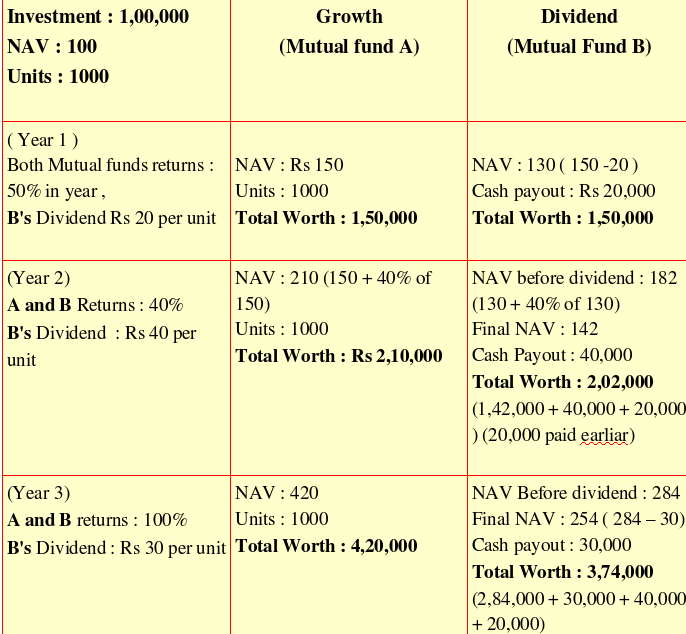
Returns in long term from Dividend and Growth : Below is an example which shows the returns from similar funds with growth and dividend options and there performance over 3 years.
I would be happy to read your comments or disagreement on any topic. Please leave a comment.



{ 80 comments… read them below or add one }
Actually choosing between growth or dividend or dividend reinvestment also has a mathematical reasoning other than the just the investors needs. It is based on the income tax rules and the fund being equity or non-equity and considering long and short term capital gains.
Previously I thought that dividend option is better because mutual fund experts decide when to book profits and give dividends, and it is good to get some amount of my investment back from the risky market. But now I have come to know that it is purely publicity tactis.
In the above mentioned comparision of G and D options,if at the end of 4th year I have to withdraw my money for some need, and market goes down and say,the G option NAV goes down to 80 and D option NAV to 70,I will lose my money in both,but in case of D option,I will have got some money back.But in G option i am at total loss.In G option I will not get the benifit that the NAV once reached 420.
@jitu , yes you are correct . Though i didnt mention , but on the back of mind, i was always talking about Equity mutual funds .
Hi Manish,
I was referring to these scehems..
Do we need to pay any exit load for funds with a lock-in of 3yrs or more??
Thanks,
JC
Hi Manish,
For Mutual funds, we have to either pay an entry load or exit load. However, for some fund houses if we apply directly there is 0% entry load.
The entry load charged goes towards paying up the distributor…
where as for no entry load,Of course, we don’t get any expert advice (like that from distributors in the earlier example) and we have to put money at our own risk…
Which option should we look into… entry load/exit load?
Thanks,
JC
@JC
Only tax savinf funds have lock in period of 3 yrs .. and currently no one has exit load .. Exit load is generally there if you get out within 6 months or 1 yr .. else its not there .
- manish
@JC
You can directly invest through the fund houses to save entry load .. Going through an agent will attract entry load and the advice given by him is most of the time based on 3-5 yrs returns only .. which you can see your self ..
If your long term horizon is more than 5+ yrs , you can invest in any god long term consistent performer …
Manish
Thanks Manish.
I have a SIP of rs.1000 pm, towards Magnum Taxgain. Due to lack of awareness, i made it thru an agent. I am planning to invest rs.6k in this fund.(I have investments in 3funds (ELSS)).Now as every time the investment is charged a 2.25% entry load, can i open another a/c by directly applying to the fund house??
I have started the MF only from Aug’08, so closing this is a worst option… as the charges levied will be more
Can we have two a/c’s with the same fund house, for the same MF ??
Thanks,
JC
@JC
when you invest in a MF , you get a Folio number , its like an account where units are saved .. when you invested in a MF with SBI magnum tax gain , you must have got a folio number … every time you invest in that . the units are added to that folio number … Now if you stop your agent services and want to do it directly from Fund house .. You can do that (and save 2.25% entry load)
Just go to fund house and invest (give them details of your folio number , you can do this online also) …
And the same folio number will be used .
An SIP has to run minimum of 6 months .. even if you have taken an SIP of more than 6 months initialy , you can stop it without any charges ..
Does that answer your question ?
Thanks Manish.
–Just go to fund house and invest (give them details of your folio number , you can do this online also) …
If i go to the fund house/pay online for additional units, the additional amount will not attract any entry load. Is this correct?
The amount for SIP is debited from my a/c every month, so should i have to stop this EC.. and pay directly to avoid the entry load..
Am i making sense??
@JC
You should do following ..
If its already been 6 months from starting of SIP
there are two things you can do
1. Ask yur fundhouse that you dont want to continue the SIP .
OR
2. Dont leave money in your account, so the ECS fails , after it fails .. you SIP will be discontinued .
You should actually stops this SIP . and start a fresh one by filling a different form .
For any further clarification … you can chat with me on manish.pucsd@gmail.com .
thanks
manish
Hi Manish
Good article, Like me most of the people doesn't know that NAV will be adjusted whenever they get dividend.
Is there any chance to get more returns when we choose re-investment option, because we will have more units than rest options.
Please answer.
Yes
you are correct that most people do not understand the working of how divident , growth or dividend reinvestment options work .
I dont see any case when dividend reinvestment options will help in capital appreciation , because its ultimately depends on the growth of investment . The final value for you is still
number of units X NAV .
So if i have 100 units of NAV 100 and you have 80 units of NAV 125 , we both have value of investment as 10,000 . and now if mutual funds investments go up by 50% . the total value of our investments will also go by 5,000 .
The only disadvantage in case of div reinvestmnet is that if its an ELSS fund , your reinvestment money will again be locked in for another 3 yrs and you will have to pay the brokerage for that part .
Hi manish, Again an excellent article.. a big salute to u (in Mitun Da's style from Dance india Dance)
I wish more people read this blog and get educated. I never new the difference between all the 3. Sorry manish again the same topic bcoz i could not understand… I have SIP thru HDFC bank. So for example if i have relinace fund in this case… 1. i will contact relinace fund house 2. will give my folio number 3. ask them to deduct it directly from my HDFC accoutn 4. and initially make a defalt payment with HDFC in order to stop the payment thru them. Pls corrent me if i am wrong. Also my SIPs are 5 months old as of today.
Thanks in advance for ur reply.
Love the new look of ur blog.
@Anu
Nice to hear from you after so many days , I thought i lost on reader because I was not seeing your comments
HDFC Bank is just another agent for mutual funds . If you have a demat account with them . There are two ways for you to buy the mutual fund .
1. Directly from HDFC Bank account (login to your trading account , you must have the option of buying the MF there , I have it in icici direct ), you will have to pay 2.25% here , but it will be too comfortable …
2. Directly go to there AMC (not Bank) and then fill the form yourself and give details of your Bank account .
Hope this will help
manish
1. i will contact relinace fund house 2. will give my folio number 3. ask them to deduct it directly from my HDFC accoutn 4. and initially make a defalt payment with HDFC in order to stop the payment thru them. Pls corrent me if i am wrong. Also my SIPs are 5 months old as of today.
Hi Manish, just needed your opinion to my problem.
I have invested in the dividend plan and dont need any regular income and now would like to switch to the growth plan in the same fund.
Doing so, would there be a reduction in value in my investment ??
Do u recommend that i switch over or just continue the dividend plan ??
Thanks and keep posting, u r doing a fab job.
Btw, do u know any website where i can download in excel format ALL the Nav's ??
@kitt
Its not possible to switch from dividend to growth like that , you will have to sell your mutual funds and then again buy it with growth option .
this will make sense only when you are investing in it for long term , if its just 1-2 yrs , then no point in that .
If you are doing it for long term , this will be a good time , as bear market phase is "almost" over and we may be looking for another bull run .
http://mutualfundsindia.com/nav_home.asp is one place you get all the NAV , i am not sure one place which provides all NAV in list , if you come to know , please let me know
Did i answer you ?
Manish
I m aware that i will have to see and buy the units and i did some calculations which showed that i wouldnt loose any units but just needed your opinion too.
I invested some 3 yrs back on the dividend plan but now after realising that i do not need any income, i now decided to switch to dividend plan.
I agree that the bull is around the corner esp. after the budget but i personally dont see this going for a long term. I believe that the market would continue to rise till next year and then again we are gonna see a major major downturn, Mark my words.
Look fwd to hear from u.
http://www.investmentkit.com/mutualfunds/nav.php
this link provides all the navs on one page but its a tedious process to copy and then paste it in excel.
@kitt
hey .. i have uploaded downloaded all the NAV in excel sheet and put the link on the main blog page , see just above the first title . May be you dont knwo the external link feature of excel sheets , you can just give the url of the link and it will fetch all the data from the url . explore it .
Regarding the bull run , I dont want to comment a lot on it, because its too tough to do that and i want to be honest about it .
Markets are wierd and we have to accept and be with it. the best thing is to be with it .
If it goes up BUY , if it goes down SELL . thats it
Manish
Hello Manish,
Thanks a lot for putting this info in simple manner
Might be very basic, but since I am new to this and willing to invest in my first MF:
How can I contact the fund house to save entry load? I have Sharekhan a/c, but they will charge 2.5%.
If I have already decided which MF to go for, what advice comes into picture from the agent?
What are other factors while going for agent against fund house.
Sorry if its too obvious…
Any comment on Reliance Infra fund?
Thanks again,
-Sachin
@Sachin
Nice to know that you are atleast concerned about this and thinking about this , Nice
Your timing could not be more perfect. Just today SEBI has scraped the entry load charged by mutual funds . So now Mutual funds cant charge entry load , so all your Rs 100 invested with them will get invested .
However , you will have to pay the agents or any other distributor like your ShareKhan as much you like . It means that it will be decided by you .
This means that There will be more competition in the market for distribution for mutual funds and hence low charges accepted by agents .
You can not accept that investing in mutual funds will be free, but unlike 2.25% paid earliar , now you can expect to pay .5 – 1% . Which is a good news
btw, are you my roommate Sachin
Manish
Thanks!
I had just read the news in newspaper and was wondering the same
Any inputs on Reliance Infra?
No, my roommate is not Manish

I am in Pune
@Sachin
You can go through this one first to understand about NFO's . Read more about the fund on some other websites .
http://www.jagoinvestor.com/2009/06/why-to-avoid-investing-in-nfos-beware_10.html
Manish
In growth option there is always risk of market fluctuation where as in divided option the same is not there.
SO we have to plan accordingly
@Anaonymous
I am just wondering what is the basis of your statement . Why do you think so ?
Mutual funds (growth or dividend) are dependent on markets . Marekts fluctuations will affect both in same way . Growth and Dividend option differ only in the way they distribute the returns ,Growth option retains it , while dividend one gives it back to investors . Thats all .
I would love to hear from you on this , may be you have something new for me
Manish
Manish,
You may be right in Div option, but there is one part missing.
After the div is paid, the NAV goes down, BUT when the market appreciates and the NAV goes up you do benefit as now you have more Units because you re-invested the Div or may be you just took the cheque and hence the div yield becomes better.
So after the NAV goes up you DO benefit from Div option.
YOur assumption is that the NAV remains the same. But it doesn't it may go up or down, but in longer term it does go up and you do benefit.
If that was the case then they wouldn't have put that option.
@Anonymous
Thats not true .. Can you give me an example of how one will gain with dividend option , compare it with Growth option ?
Manish
really helpful information and worth knowing technical analysis with layman language
really iam very thankful.
So would you like to read more on mutual funds or other topics
Thanks
Hi Manish,
Is it advisable to buy the MF using my online trading plateform (SBI CAP SEC)?
I may have to pay 0.5% everytime I buy or sell. Does one can buy MF with SIP
using the online trading plateform ?
Thank you,
Balbir
Yes , you can
Buying MF with SIP should be provided by your MF online account . ask them .
You can save your .5% if you go manually for everything .. go to their AMC office .
Manish
Hi manish
I am new to MF and just invested in my first MF – HDFC Tax Saver through my Citibank investment account – a lumpsum amount of Rs 5000. They charged me 2% as transaction fee. Now if I want to buy more units, would they charge me 2% each time I buy a unit ?
If yes, is it worth it? Or should I directly invest through fund house?
Thanks
Nikhil
Nikhil
Yes , they will charge for each payment . its their commision which they will take each time . You can look for direct investing through fund house . that will be free but litle work .
What other funds you like ? Do you invest in direct equity ? BEtter get a good brokerage house like ICICI .
Manish
Thanks Manish for the info. Another question, now since I have my folio no. after investing thro Citibank, can I just use that to direct invest through the fund house? If yes, can I do that online somehow? I tried going to HDFC website but they are also asking for a HPIN along with the Folio no. but I don’t have that? How do I work around it?
I also like ICICI and thinking of Can Robeco.
Also what do you mean by a good brokerage house like ICICI? Does that mean ICICI? Won’t they also charge like citibank?
Nikhil
You should be able to invest online through their website if you have folio number . but i have to figure out how ?
ICICI Direct charges little high brokerage but i like its interface .
Manish
Hi Manish,
This is tarun. I have two days back invested in two equity funds – HDFC tax saver 15,000/ – & Sundaram BP Paridas Tax Saver 10,000 Rs. My age is 25 Yrs. I m confused. Kindly suggest should i go for growth or dividend option. Pl suggest.
Regards,
Tarun.
Tarun
You already know the pros and cons of both options .. you are in a better position to decide compared to me . But the thumb rule is that if its a long term investment and you are mainly not looking for any partial liquidity , better go with growth option .
Manish
Thanks Manish. Please let me know of the way to invest online directly whenever you find it.
Thanks
Nikhil
Why dont you try this yourself . Go to their website and try out things . Ask the company how to do that . I am sure waiting on me is not a good idea because it can delayed a lot .
Manish
Manish,
Documenting it here so others can benefit. HDFC Bank does not charge anything to buy mutual funds online if you have savings account with them. They only charge 100Rs quarterly fees for the investment account. This would be a better option than paying 2% charges with Citibank.
Gowri
Gowri
that 100 rs a quarter is what they are charging
. So in case one is investing more than 10000 in 3 month , it would turn out to be 1% charge for him , which is ok . and this is what an average investor invests .. for someone who is investing a large amount like 10-20k per month , HDFC would be a great choice .. but if someone who is investing a small amount like 1000 per month , HDFC is a bad choice .. in that case ICICI would work better,.
Manish
Hi Manish,
First of thanks for helping investors of today with understanding the different jargon used by financial market to lure them into investment mode. But on this point correct me if I am wrong. I read somewhere SEBI asked fund house to stop collecting entry load where else exit load of 2.25% is applicable along with 2.5% of recurring charges. But as I have seen you mention so many time here in this article exit load is not applicable but entry load of 2.25% will if you go by agent… hmm now I am confuse… is it entry load or exit load which one is applicable and which one is not??
Also one benefits of dividends could be you can reinvest again the amount and claim tax benefits under section 80C.. what your take on that…
Regards,
Akhil
Akhil
This is an old post written before the ban on entry load rule came in , so thats why you are confused
.
Regarding dividend re investing , the problem is very simple , the money will again be locked for 3 yrs from that date .. so its the trade off between getting tax benefit and locking it again for 3 yrs . if one is ok with it , then he should go with it . Not an issue
Manish
Lol you manipulating my future clients with all this disclosure… damn!! :p
Well Yes but if you entered one month before company announce dividend… You won’t mind reinvesting it do you
Akhil
First month just before the dividend is a rare case
. thats granted 
tip: while replying press on “reply” button and then reply , that way the conversation would be threaded and easy to follow
Manish
Hi,
I Understood the difference between Growth and Dividend Re-Invest..
Could you explain which is benificial growth/dividend-R,
how to choose between these two.
Kalyan
You must have got the whole info in the article itself , however the general rule is that if you are investing for long term , you should invest in Growth option . Incase you want to get regular pocket money in form of dividends then buy dividend option . Re-investment option does not makes anysense to me atleast before the new tax code . After it comes into picture it might be beneficial .
Manish
Manish since I have limited knowledge of MF’s…. Please help me understand, How is Growth option is better then divedend?
Correct me if I am wrong… As per the discussion here I understand, Let see if i invest 100 Rs and bought 10 units of Rs 10 in dividend paying fund and company pay out a dividend, say 20%…. it means company will give me 20 Rs… but simultaneously my nav would fall down by same percentage and it will become 8 now….
But Manish Number of units still 10…. how actually its going to affect me… since still number of units intact in my account and if fund performed decently again the nav reach to its original position or may be more… I am still benefited out of that. so dividend which I got earlier is nothing but some kind of bonus for me… which sound good to me…
Please explain what’s the funda in it…
Akhil
So you get dividend of Rs 20 and then your NAV value is Rs 8 . now in some days say the NAV goes back to 10 . You say that this Rs 2 is your extra bonus , but what about the time it took to reach from 8 to 10 . In this case fund has gained 25% to reach from 8 to 10 . total = 2 + 10 = Rs 12 .
Now take case of Growth option . here you wont get dividend , now in comparision with dividend option , during the same time this fund also perfroms equal and goes up by 25% , so in this fund you value would be 12.5 at the end of same period .
total = 12.5 , loss of .5 , which is nothing but the amount of 25% of Rs 2 which did not grow because it was in cash in your hand .
Got it?
Manish
is there a component of dividend distribution tax which the mf pays & which also affects the nav?
Suresh
Yup , DDT is applicable for dividends declared on Debt Mutual funds , so You get less in your hand
Manish
Yeah I got it thanks manish
but divdend option not bad if somebody is not looking looking corpus generation but regular income. what you say…..
Hey one more thing on above illustrated example…I don’t know it’s mistake or what… but if you see second year, In case B (dividend) Net worth is calculated taking into consideration the the Final Nav after adjusting dividend. But in third year Nav before adjustment is taking into consideration for determining Networth why that???
Akhil
Yes , NO option is bad or good , its about situation .
Regarding the problem are you seeing in the example , its a typo , my mistake
Manish
Finaly! gotch ya..
… by the way manish .. which one is mistake… we should consider final nav or nav before adjustment??
Final NAV
Manish
Hi Manish,
If I invest in MIP Growth and apply for SWP does the dividient distribution or any other tax is applicable ?
I have clearly mentioned in the article on MIP : http://www.jagoinvestor.com/2011/01/monthly-income-plans.html
If you use a bit of strategy, you can create a more stable and more tax efficient income by this method. You can choose growth option in MIP and after 1 yr you can start a SWP (systematic withdrawal plan , opposite of SIP) from your MIP to your bank account . What will happen with this option is that you will not have to depend on companies dividend announcement , as its your decision to liquidate a fixed part of your MIP’s, sell it and get the money in you bank account . Also as you are doing it after 1 yr, there wont be any exit load and the profits you get out of it would be Long term capital gains , so you only pay 10% on the profits (assuming you don’t want indexation benefits) , which is 4% lesser than the dividend distribution tax . If you have a large amount of investments in MIPs, then this option can save some tax for you, but if your investments aren’t significant enough, it’s not worth the hassle .
Manish
First, I would like to thank Manish for teaching this very important topic in such a simple language.
Would you suggest to use MIPs (Growth Option) as a long term investment to create a corpus and is it possible to switch to dividend option then, so that this can be used as an alternative to Pension plans ?
Investor
If you are investing for long term , then better use equity mutual funds and not debt oriented mutual funds
Manish
Manish,
In one of your replies you had mentioned that switching to growth option from dividend option is not possible.
Is the reverse possible ? I mean from growth option to dividend option?
NewInvestor
I guess there is an option to switch from growth to dividend and vice versa . http://www.jagoinvestor.com/forum/switch-from-div-reinvest-to-growth-option-of-mf/730/
manish
Hi Manish, thnx for informative details.
As mentioned by you in case of third option i.e. Divident reinvested, divident amount is reinvested to buy additional units.
Normally divident distribution tax (DDT) is paid by MF company for distributed divident. Can you pls clairfy in case of Divident reinvested option -DDT is paid by company and then remaining amount is used to buy additional units or no DDT is appicable in such cases.
Shrenik
Yes ,DDT is paid in dividend reinvestment option just like dividend Payout option ,just that in this case , we dont get it in hand , but its reinvested
Manish
Thanks Manish for the article.
very very informative article..too good.
Manish i want to know..
1) Whether i should go for SWP option in balanced equity mutual funds or leave it as such?
2) Whether Monthly Income Plan is good compared to equity oriented mutual funds?
3) Its easy to buy MFs because agents are available who will help 2 study d fund..but how can we buy stocks for example India bulls Security stock?
Your response is highly regarded…!!
Dr Adhes
1. SWP is just opposite of SIP , so you can use it only if you want the money ? So question boils down to “Do you really need money in coming times” ? . If yes, then go for SWP
2. MIP are debt products , how do you compare it to equity funds ?
3. I am not sure what you want to know here ? You require a demat account to buy stock ,but if you dont have much knowledge and time to track ,better stick to mf only
Manish
Thanks manish,
your answers are so precise..i got all my 3 queries sloved.
*I don’t need money immediate..so i will not opt for SWP.
*Growth in MIP is less as it is debt product.
*I will get Demat account opened.
thank u so much in guiding..as i am yet learning these basics..your advice will go a long way in helping me..
thanks .God bless you.
Hi Manish
Very good article.
I had invested in FI blue chip through an agent during 2007. i got to know now that i will have to pay the entry load.
What is this entry load? when will I need to pay this and how does this get deducted?
Thanks in advance
Kiran B
Kiran
Its deducted from your money and rest is invested ,you dont have to pay it seperately
Manish
Hi Manish,
I have one doubt. I always thinks that dividend payout is better option than growth since in the latter you have to exit at the right time. However, in the former every year you are booking partial profit which can be reinvested if one wants. However, in the growth option if suppose you need sudden cash and market is in bear phase you are trapped. Whats your opinion???
Dipesh
the dividend money is not so huge that you can call it partial withdrawal . Its a very small portion .. also you are looking at one side , what if markets are just going up and up only , in that case growth option would be better .
So dont look at it that way
Manish
While investing in MF I have selected dividend reinvestment option.
Require your comment whether dividend reinvestment option or growth is better?
Brij mohan
Its clear in the article .. What is your doubt
Manish
Very good information explained in simple way so that a layman could understand easily.
thanks a lot
Alka
Good to hear that you liked it
Manish
Hi Manish,
This is my 1st comment on JagoInvestor. Once again very informative article on MF. Being regular reader of your articles from last month, got wealth of info on Personal Finance in layman’s language.
Ur social service in educating commans is much much appreciated..!!
I have a doubt to clear in MF. Since i am new to MF investments this may seem too basic
Can i invest in a MF with Growth option with some amt. as lumpsum (say Rs 50000) & let that amount get appreciated with compunding effect for long term(say 15 yrs or so)?
I saw in valueresearchonline website for DSPBR Top 100 Eqt Reg-G, in ‘Fund Details’ tab under ‘Payout’ heading, Reinvestment as ‘No’. Wht that means?
are they saying tht Dividend Reinvestment option is not available?
Thanks in advance for ur reply.
keep up good work.
DJ
Hi Manish,
many thanks for ur quick reply.
My doubt is not clear for the following, please help..
Can i invest in a MF with Growth option with some amt. as lumpsum (say Rs 50000) only once & let that amount get appreciated with compunding effect for long term(say 15 yrs or so)?
Actually instead of keeping this money in bank FD(i dont need this in near future), i wish to keep it in some good equity MF for long term.
Does MF have any restriction on this or i must invest every year Rs 50000?
DJ
there is no restriction like that. you can invest one time and let it grow
Manish
Hi Manish,
thanks for the reply.
Just to clear a doubt.
In valueresearchonline if u see for ‘DSPBR Top 100 Eqt Reg-G’
in ‘Performance’ tab there r two headings.
Trailing Returns & Annual Returns.
In ‘Trailing returns’ for Fund Return column, for 1 yr it shows -11.89%, 2 yr shows 1.52%.
Does this mean if a person invest in Jan 2010 till dec 2011 now, his overall returns on investment for these 2 yrs r only 1.52%?
& in ‘Annual Returns’ heading for yr 2010 Fund Return is 16.80%.
so 16.80% – 11.89% = 4.91%
it doesn’t match with 1.52% over 2 yrs.
How is tht?
can u plz explain.
many thanks.
DJ
DJ
yearly return means the annual performance from Jan – Dec .. but trailing annual return means 1 yr from NOW , so if today is Nov 6 , 2011 .. the trailing return for 1 yr is exactly 365 days back from today . thats Dec 5 2010 – Dec 5, 2011
Manish