Monthly Income Plans, When you hear it for the first time, you get a feel that it’s some kind of assured and non-risky product which will deliver you uninterrupted monthly income, but it’s not exactly that way. Do you have a lot of cash which you want to park somewhere with expectation of better returns than a Fixed Deposit? Are you looking for some kind of instrument which will give you regular income with decent returns with moderate or low risk? If yes, welcome to the world of Monthly Income Plans, which are also known as MIP’s .

What are Monthly Income Plans ?
An MIP is nothing, but a debt oriented mutual fund which gives you income, in the form of dividends – simple as that. As MIPs are debt oriented mutual funds, they invest heavily in debt instruments like debentures , corporate bonds, government securities etc. It generally has 75-80% of its money in debt and rest in equity and cash . The income you can get from Monthly income plans is not limited to the monthly option. You can also choose to receive income quarterly, half-yearly or annually. Just like any other mutual fund, the MIP too, comes with two options.
1. MIP with Dividend option : Monthly income plans with dividend option provides you an income in form of dividends. There is an option to receive this income monthly, quarterly, half-yearly and yearly. So you have to choose the option at the time of buying the MIP . Note that while the dividend from MIPs are tax-free in the hands of investors, the company has to pay a dividend distribution tax of around 14% on the dividend before it reaches your hand. So your returns reduce by that much.
For example , If company declares a dividend of Rs 3 per unit, they have to pay 42 paisa (14%) as Dividend Distribution Tax and you will only get remaining amount in your hand , on which you don’t have to pay any tax. I hope you know, that the NAV of your MIP will come down by Rs 3 after dividend is declared and given to you. So don’t shout your excitement to all the world when you get dividends, it’s just your own money which you got!
2. MIP with Growth Option : Here, the money is not paid out to you in forms of dividends, instead it keeps growing in the mutual funds. Hence your money is just growing inside the fund itself and you can reap all the benefits at the time of redeeming the funds in future. In this option, you have nothing to do with dividends. Note that you get power of compounding in growth option because your returns also earn in future. Here is an article on difference between dividend vs growth option in mutual funds to give you a better idea of what I am talking about.
Features of Monthly Income Plans
1. Dividends can be declared only from the profits and not from Capital
Regulations demand that dividend can be paid only from surpluses and not from the capital investment. What it actually means is that dividends can be declared from earned income only. If your initial NAV was Rs 10 and after a month the NAV rose to Rs 10.2 , The dividend can only be given out of this 0.2 and not from the initial capital value . This makes sure that Company can not show to the world that they are constantly giving income in case they have not done well.
2. No guarantee of Regular Income
The biggest myth about Monthly income plans is that they provide guaranteed monthly income, which is not true (See this question asked by Krishna on our Forum). While the aim of MIPs is to regularly declare dividends, it might happen at times, that they do not declare any dividends because of bad performance. To top that, there is no regulation or oversight on the MIP’s part to declare regular dividends. So take it on the chin, if you don’t get your income once in a while .
3. MIP’s return are influenced by interest rates and stock market
Just because it’s a debt oriented product, It does not mean that they are “safe” . Even MIPs can give negative return, but in extreme cases. The debt portion is influenced by interest rates. When the interest rate falls, the NAV rises as price of bond increases. When interest rate rises, NAV falls. At such times the equity portion of the fund helps to maintain the return. Here is an article on Interest Rates and how they affect Mutual funds .
4. MIPs are prone to mis-selling because of a high commission structure
MIPs offer lucrative commissions to agents as much as 1-1.5% unlike 0.5-.75% in Equity funds. Due to this it becomes easy to missell MIP’s as they can be labelled as “Safe Funds” and “Monthly Income Plans” which Indians like to hear a lot .
“Look what happened after the abolition of entry load in mutual funds in 2009 . From the last 1 Year, the corpus of MIP schemes have seen a huge inflow all over India. Last year, the total industry AUM was close to Rs. 3700 crore and today it is well over 24500 crore. In this entire period, equity funds AUM have gone down. Now when the intentions itself are not good, needless to say that the outcome will be right. Many investors are not aware that there is an EXIT Load of 1% in almost all MIPs if you were to withdraw before one year & in some cases even 1.5 years.” – says Hemant Beniwal on this Forum post
Taxation of MIP’s
MIP’s are debt funds and hence the taxation is same as debt funds .
Short Term Capital Gains : Any profit before a year would be Short term capital gains and it would be added to your income and taxed at your slab rate. So for investors who are in higher tax slabs it would be wise not to sell their MIP’s (in case they can) before a year, else there will be a good amount of tax on your profits.
Long Term Capital Gains : Any profit you get after 1 yr in MIP would be taxed at 10 per cent without indexation or 20 per cent with indexation, whichever is lower.
Short Term and Long term Capital Loss : The best thing about MIP’s over FD’s or Post office schemes is that incase you have any loss in MIP’s , you can set it off against the capital gains in the same year or in next 8 yrs , which makes sure that even losses can be used for tax saving purpose.
Dividends : All the dividends received from the MIP’s would be tax-free in hands of investors, but note that companies already pay Dividend distribution tax from the MIP’s
Read more on Short term and long term capital gains
MIP’s save money for bad times

Think about ants! They make sure that they save enough food for rainy season, so that they don’t fast in bad times. In the same way MIPs do not declare all the earned income as dividends, instead they declare a part of earned income as dividend and save rest for troubled times in future.
This makes sure that when there are bad days in future and MIPs do not see much growth, they can use the money saved, to declare dividends. For instance, in 2008, despite bad markets, 19 funds skipped only up to four monthly dividends.
However a lot of MIP’s didn’t perform that well and could not save the part of earned income in a proper way. Hence they had to skip all 12 months dividends. Eg., Canara Robeco MIP Mn Div, which skipped all 12 dividends in 2008 and 9 months dividends in year 2009 . See the chart on the right to get more insight on how MIPs missed their dividends . Source : LiveMint
Beware : There is one more option called dividend reinvestment in MIP’s apart from Dividend payout and growth . If the payable dividend is less than Rs 250, then the dividend would be compulsorily reinvested.
Who should Invest in MIP’s ?
1. Investors looking for regular Income
If you are retired/semi-retired or just looking to generate some regular income can look at MIP’s as an option . Note that instead of choosing a monthly option of income, I would rather suggest a quarterly or half-yearly option .
2. Conservative investors looking for better returns
Are you a conservative investor but still looking for better returns than pure debt options like Fixed deposits or Insurance policies ? Well, you can’t get 100% safety with MIP’s , but there are very good change that you would be getting better than FD returns with MIPs.
3. Investors who want to park a big sum of money
A lot of people have questions like “Where to park my lump sum money for medium term with lower risk ?” If your horizon is very less – like 6 months or a year, MIP’s might not be the best option, but if you want to park it for 2-3 yrs with low risk, MIPs with growth option can be a suitable instrument .
MIP vs Fixed Deposits/ Fixed Maturity Plans/ POIMS
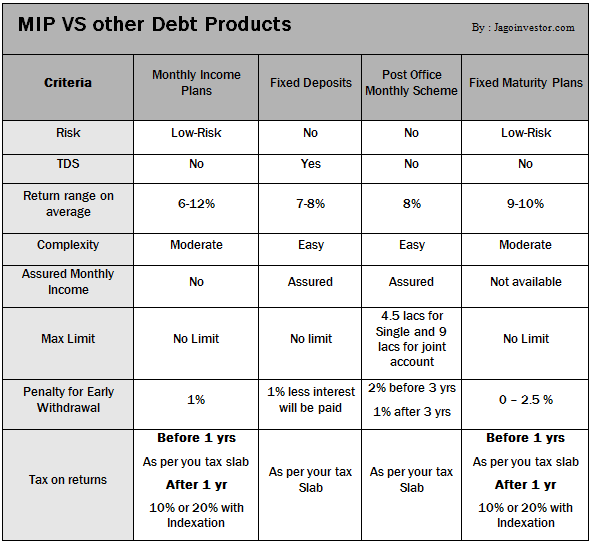
You might get confused between so many debt products and might be wondering how Monthly Income Plans compare to Fixed Deposits (read this post by Deepak Shenoy) , Post Office Monthly Income Plans or Fixed Maturity Plans (FMP) . There are various parameters on which they all differ . Below is the chart which shows you those differences .
Two ways of getting income from an MIP
We will see two different ways of generating monthly/quarterly income through Monthly Income Plans . One is the regular way of choosing dividend option and the option one is starting Systematic Withdrawal Plan from MIP after an year of buying it . Lets look at both and its pros and cons …
1. Choose dividend option
The good point in this option is that you will start getting the income immediately as company starts declaring the dividends, and you don’t have to take care of taxation issues. However the bad side is that eventually 14% dividend distribution tax would be paid by company and the stability of income will depend on how often dividends are declared by company. If they skip the dividend you will not be getting the income for that month/quarter .
2. Choosing growth option and start SWP (Systematic Withdrawal Plan)
If you use a bit of strategy, you can create a more stable and more tax efficient income by this method. You can choose growth option in MIP and after 1 yr you can start a SWP (systematic withdrawal plan , opposite of SIP) from your MIP to your bank account . What will happen with this option is that you will not have to depend on companies dividend announcement , as its your decision to liquidate a fixed part of your MIP’s, sell it and get the money in you bank account . Also as you are doing it after 1 yr, there wont be any exit load and the profits you get out of it would be Long term capital gains , so you only pay 10% on the profits (assuming you don’t want indexation benefits) , which is 4% lesser than the dividend distribution tax . If you have a large amount of investments in MIPs, then this option can save some tax for you, but if your investments aren’t significant enough, it’s not worth the hassle .
Some best performing MIP’s in Market
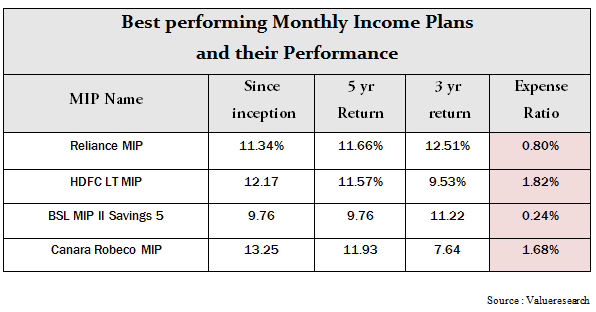
One of the readers Sagar asked his query on our forum : “Which is the best Monthly income plan ?” . While there is no guarantee that the MIP which you choose today will keep performing well always , but I have got a list of MIP’s which have done excellent in past and still look good. You can choose any of these if you are disciplined enough . Once you choose them make sure you concentrate on regularly investing in them without looking at their performance every week or month . Just review them in a year or so . watch out for the expense ratio of the MIP’s, lower the better
Conclusion
So the main takeaway from this article for you should be to understand that MIP’s can be good alternative for you if you have been investing a lot in Fixed Deposits and do not mind taking small amount of risk . Another important point was to look at MIP’s are income generating products with understanding that sometimes they the income can go for a toss in between and you have to comfortable with that .
I would love you hear your comments on monthly income plans and do you feel that it can be helpful in your portfolio , share with us !



{ 177 comments… read them below or add one }
Hi Manish,
Great post, comprehensive information as always!
I liked the information under “MIP vs Other Debt Product” table.I would prefer post office and FD for fixed income investment if ever.Otherwise I am “all stocks or cash” kind of a person.I like “no strings attached” option when it comes to choosing a financial product
Keep up the good work
Cheers
Anuj
I didnt understand your reason for choosing FD or POMIS ? Is it because they guaranteed by govt in some ways ! . If not then is it assurity of income which is the reason ?
Manish
It has to be the safety of investment, else it’s definitely less tax efficient.
Hi Manish and Smart Singh
I would prefer FD or POMIS because it is a “no risk”, easy to understand product.MIPs as you mentioned in the table is a complex one.One has to get her/his timing right when putting money in government securities related products.Like tracking the bond price cycles otherwise months will pass with out getting any income from MIPs
Anuj
Fine .. It might be your internal design which is more inclined towards assurity and safety . Nothing wrong with it .
However MIP’s are that complex , I would say they are little complex than other things . Also in mutual funds there are two levels of decision makings , the first and the bigger level of decision making is already in hands of Fund managers , so things you mentioned with be taken care by them . You dont have to worry about it much .
from your side you can proofcheck the situation . But mostly you dont have to do analysis much , Thats why they are called mutual funds .
Manish
I think Anuj has a great point regarding timing. However, if you keep debt funds for long term asset allocation, the interest rate cycle would even out itself and give you the average FD type return, but much more tax-efficient.
There is one problem with this approach though. The long-term debt funds in India are charging as 2.25% as management fees. This is insane given the fact that their corporate holdings are very low, and they mostly sit on their holdings, as the secondary bond market in India is very weak.
By the way, Anuj, how do you feel about company FDs? Most people feel that these are almost risk-free. Not a lot of companies go totally bankrupt in India.
Hi Manish,
I am new to this financial world so i would like to know what this indexing and non indexing benefits are also in my view i think Fixed Monthly plan would be even more better than MIP. Is FMP linked to debt and equity just like MIP.
Thanks.
Bikram
See this : http://www.jagoinvestor.com/2009/05/how-to-calculate-capital-gains-and-what_7801.html
Manish
Very well compiled as always !
Please can you shed some more light on indexation merits or demerits. Or rather what is indexation.
Thanks
Prasanna
Let me give you an example
Suppose you put 10 lacs in an FD, and earn 8% interest after an year , you will get 80,000 in profits and it will be added to your salary , assuiming you are in 30% bracket, you pay 24,000 as tax . now if its FMP or MIP , and you get same returns ,., like 8% , as it is after 1 yr , your profits are Long term capital gains and your investments are liable to indexation , which means that you can also incorporate inflation to your calcualtion , assuming the inflation was 6% (just an examle).. your actualy investments of 10 lacs becomes 10.6 lacs and your profit now becomes 10.8 – 10.6 lacs and only 20,000 and on top of this you pay only 20% on this , which makes you tax outgo as 4,000 . this is a simple example .
So indexation is using taking into consideration the inflation figures and increasing your COST PRICE and using INDEXED COST PRICE .
For more see : http://www.jagoinvestor.com/2009/05/how-to-calculate-capital-gains-and-what_7801.html
Manish
Manish just wanted to know can FMP give negative returns?
Though i havent gone through the article completely yet.What will you prefer from MIP and FMP.
Also are SIP and MIP on similar line in terms of taxing details?
Sohil
Yes FMP’s can give negative returns and even MIP’s can , but its very rare .. In the crash of 2008 , FMP have given negative returns and thats the reason they are able to provide higher return than FD’s .
What will I prefer would depend on my needs . If I want to park the cash for short term like 3 month or 6 months , FMP can be good .
However for medium term like 1-2 yrs I would prefer MIP
SIP and MIP are different things , MIP is a product . SIP is a techniquie .. you can do SIP in MIP . SIP is nothing but “investing monthly” . so taxation depends on the product , not the technique . I hope you got it . Read what is SIP : http://www.jagoinvestor.com/2008/04/all-about-sip-systematic-investment.html
Ask questions on forum : http://www.jagoinvestor.com/forum/
Manish
Thanks Sorry i misinterpreted it to somewhat monthly investment plan just like recurring deposit.
By the way the valueresearch table showing performance is showing CAGR right or again i am miscalculating .
Thanks for the article as i am really looking for options to park my sisters money .So far fd was the main investment.Company fd was on my radar but seeing so much risk its definitely out plus a regular tab on it needs to be done for interest and if company gets bad than even tougher to get principal (too much risk).
Right now i am comparing figures between fmp and mip.Also any more options.
Also having question with regarding to infra bonds will ask in that thread.
Sohil
I didnt understand your doubt about CAGR thing ?
Manish
FOr e.g Lets take dummy example
.Here we in Reliance Banking fund-growth option last 5 years returns shown is 26.5%.
Does it mean say i invested 10k once 5 years back and at 26.5% its present value to be 32393.11.
IS that cagr return?26.5%?
yes, that’s right.
26.5% return on every year.
The figure 32393.11 is correct.
So 26.5 is not absolute returns; it is annualised returns also called as CAGR.
Ohh thanks Anand.
Actually i too figure it out but not from a dummy example but a investment i made 6 years back while opening an account in bank(last night was digging some old papers).Just saw my portfolio.Had invested 10k in 2005 and right now its worth 28k.Almost 17-18% which too confirms from risk return table.
On contrary investment in dividend option have proved wrong as all investment values the same and i am not in type of the person who waits for dividend money to be used.
Really very helpfull topic cleared lot of my facts and now i fell rather than invested in share market and daily tracking ,experiencing the power of compounding will start SIPs.
Sohil
Yes you should start the SIP’s for your long term goals .. Would you like to get a free 15 min consultation from us on your Mutual funds SIP ?
Let me know we have started it recently ! .
Manish
Sohil
Yes , thats what it means
Manish
Thanks haven’t got any form as mentioned in mail to be filled but noted the number.
Right now not starting sip as i have take care of this financial year planning of mine and mine family members as i belong to business category hence have to make investments by 31st march tough ppf have already taken care of more of it.
Oooooopps I found it here. Sorry for the unwanted comment
http://www.jagoinvestor.com/2009/05/how-to-calculate-capital-gains-and-what_7801.html
Hi Manish,
Thanks for quoting me in your article – actually we wrote a whole post around “Mis-selling of MIP”
Your article is actually a complete guide
Hemant
Yea .. I saw that . I took your quote from the forum as It was a nicely put already in the para by you . Any idea what is the best source to find the information like that on MIP’s ? Like how much their AUM increase from year X to year Y ?
Manish
Hi Manish,
I did that by comparing data of all MIPs(Aug 2009 & Aug 2010) in value research insight magazine.
For a single fund you can use moneycontrol
http://www.moneycontrol.com/mf/aum/display_data.php
In Jul 2009(closing) Reliance MIP AUM was Rs 256 Cr & now it is Rs 8322 Crore.
Great
Thanks for Sharing !
Manish
Great article Manish,
One thing which I would like people to learn is that you don’t really need dividends or interest for meeting your cash flow needs. You can very well sell a small fraction of your investments to make your own Systematic Withdrawal Plan.
I’m not against mental accounting as such, but people should understand that there are other options.
One more thing, I don’t think that even retirees should have more than 70% of their assets in safe assets, because in India, inflation is eating up our FD return and making real rate of return negative.
Smart
Yes , regarding your first point , dividents are not the only way to generate the income , so they have that SWP option .
however regarding your second point , I think its true for majority as they are not “equity guy” .however a lot of people who really have good interest and knowledge and more than anything have “control” can still put more than 30% in equity !
Manish
Another great article. Covers all points of MIP.
Just want your opinion on this strategy. Let’s say I’ve some money which I just park with MIP for a time frame of 5 years. After 1 year, I choose STP of 1% money to equity diversified mutual fund. That will serve as a SIP from the profit of MIP. And after 5 years, I can get my money back from MIP and investments in MF.
What do you think in this kind of strategy?
Gopal
This is strategy A . What are you compare this strategy with ? With what ? Only then there can be come conclusion ! . else not . dont you think so !
Also it would be wise to test this strategy on the old data and see the response !
However it is , at the end it would be limited by risk and return compared to pure SIP in equity funds , that my first guess without any testing !
Manish
Hi Manish
Very good article. I am a lucky guy to find this website Jagoinvestors by just serching “Financial Planning” in Google . But sometime i feel bad that why i didnt come to know about this website before 2-3 years. But its ok now i am getting good knowledge about FP. Thanks for sharing your Views.
But sorry to say, i found a little error in the table HEAD MIP vs other debts products that Penelty in not allowed in PO 6yrs MIP but as much as i know before 1 year not allowed but 2% penelty allowed if withdrawn aftr 1 but before 3 years and 1% allowed after 3 years.
Mukesh
Mukesh
happy to hear that you came here by searching Financial planning
.
Regarding that mistake in chart , I have corrected it . Thanks for pointing it out !
Manish
Hi Manish, your views on lump sum vs sip in MIP, if the amount to be put in is bit in the higher side say 20-30 lakhs.If you think sip then how long should the Sip be.
Pankaj
You should be using STP in this case . Regarding SIP vs lumpsum , systematic investment would be a great thing in long run . Read following articles to clear your doubts
SIP vs Lumpsum : http://www.jagoinvestor.com/2009/03/sip-magic-part-1.html
STP : http://www.jagoinvestor.com/2010/03/what-is-systematic-transfer-plan-stp.html
Hi Manish,
I was about to park 1 Lakh in FD, but after reading this article I have decided to put all money in MIP with growth option.
Sanjay
For what duration , If its more than 1 yr or less than 3 yrs , then good .. You should also be clear with the risk factor !
For more than 3 yrs , I would recommend , Debt oriented mutual funds which are not MIP , or consider balanced funds if you have higher risk appetite
Manish
Good Post Manish with clear details. This will help a lot of folks.
India Investor
Thanks for the appreciation . Keep sharing and reading . What are your thoughts about MIP vs FMP ?
Manish
Good post as usual.
One other great thing with MIP is if you make a STCL (short term Capital Loss) in one year, you can set it off against STCG from Equities or Equity/Debt MF. Very good for tax planning.
Sundar
Yes , thats great point , Let me put it back in the article
Manish
Manish:
May I add a cynical note.
You look upon commission to brokers (being higher than Equity Funds) as a bad thing.
I look upon that as a great thing. Because in India Brokers bring the business. It means that if you invest in MIP, and get out of it and enter equity fund (when the market falls), there will stability in the NAVs of MIPs. Whereas Equity Funds NAVs will fall sharply when investors exit. Thus MIPs also offer a temporary parking place for your investible funds.
What do you think?
Sundar
Agree with your last point ,but I didnt understand why u consider high commissions as good thing , Definately its good for some one who is selling , but how about buyers ?
Manish
Sundar,
Why you are worrying when their is no load on you if you invest directly or through broker and not willing to pay him any brokerage from your part?
Hi Manish,
First of all . Thank you very much for all of your articles.All are really informative.
I am SW Engineer by profession. In my company we have small forum in which we are sending weekly mailers to whole dept. related to Technology,Economics,Communication Skills,Domain specific, etc….Also some Knowledge Sharing Presentations happens on weekly / monthly basis.
In that forum I am playing a role for Economics related mails.
While searching for the articles for the same , I got into this site. After that I am regular reader of your articles.
Your articles are really helping myself and my colleagues in Finacial Life as all of us are from Technical Background.
As part of this forum I had given small Presentation with all grabbed knowledge in last month about Income Tax Structure & Tax Planning .( During Investment declaration time in company )
I would like to share that it helped to save almost 5000-10000 of Tax of 2 of my colleague , also to others for their next financial Planning.
Thanks a lot for your kowledge sharing passion !
Keep it up .
Shashi
Great to hear that
. learning about taxation and giving presentation to the group is an amazing thing . Keep it up , Ask for any support you need .Which City are you in . If required I will be open to come up and give a detailed presentation to the group ! .
Manish
@ Manish
Thanks for reply.
I am in Pune.
Thanks a lot !!!
Hi Manish,
how come same text in this website also. http://www.girdher.com/2011/01/monthly-income-plans-detailed-guide-on.html
He does refer your name but still whats the point in copy pasting? cheers
Mukesh
Well wisher
Mukesh
thanks for telling me this , I have already mailed this guy who is doing it .
Manish
Hi Manish,
Suppose I want to invest 5 lakhs in MIP, On average 1 lakh will be invested in equities. I feel investing 1 lakh in equities at a time is risky.
So how about invest 4 lakhs in FD and remaining 1 lakh into equities by STP.
This is just my idea.
Regards,
Ramesh
Ramesh
In that case you are not comfortable with MIP’s also as its putting 20% in equity , you should go with pure debt funds in that case and a small part in equity .
Manish
Hi Manish,
A good refreshing article!
Regards
Atul
Atul
Thanks
hi manish..
i want 2 invest 1lac in dis couple of days…
as i thinking to go wid FD wid my dad’s name as he comes in a senior citizen so dey are providing me 9.10% intrest for 444 days. . so can u pls tell me ane other option 2 go with better returns… ?????
Hi, Manish
Very gud article.
I have a question for you. Whats the main difference between Investing in PPF and Investing in Post office RD scheme and which is better?
Thru online calculator i found that PORD scheme is far better.
Eg: If i invest Rs 500/- every month for 5 years, at the end of 5 year i’ll get Rs 37,426/- from PORD scheme whereas i;ll be getting Rs 3,168/- only from PPF.
Whether is it possible to invest online to PORD?
Regards,
Pramod
Pramod
Check you PPF numbers again , you have out it at 3168 only ! . The main difference between them is Liquidity , PPF is locked for many years . PORD is locked in for the duration you choose ..
I dont think you can invest in PORD
Manish
Hi Manish and Pramod,
To me investing in PPF is better compare to PORD. Because we dont know after five years they will offer the same interest rate or not. But that risk is not their in PPF as it is long term product. But if investor is looking at short term then I think PORD is better.
Basavaraj
But even in PPF you cant be sure of interest rates , What if tomm it changes to 7% ?
Manish
Manish,
I think like PORD the interest rate what it is at the time of account opening will apply for the whole tenure of that account whatever may be the changes afterwards. Is the same thing applies for PPF or not? I thought in that way and answered.
Basavaraj
No , its not that way . PPF interest and EPF interest rate is declared every year and we get different rates each year . In case of PPF , it was 12% many years ago and from last 3-5 yrs its at 8%. So it can change to any number
Manish
Manish,
Thanks for your information which I misunderstood.
Manish,
What I told regarding PPF interest rate is corrrect. It will be constant throughout the tenure of the account. It will be the same interest rate what it is at the time of account openining. It will not change on yearly basis. What you told about yearly declaration is about EPF which is declared by Govt.
Once upon a time, the rate was 12% and now it is 8%
How do you explain this?
The rate is indeed reset every year. Since in last 3-4 years, it is constant at 8%, it is not a news as such. So no media gave importance to it.
Tomorrow, if it is reduced to 7.5, then it will be big news.
Basavaraj
I am not sure if you have done enough reading on this before saying that , Here is what the official document from govt says
8. Interest – Interest at the rate , notified by the Central Government in
official gazette from time to time, shall be allowed for calendar month on the
lowest balance at credit of an account between the close of the fifth day and
the end of the month and shall be credited to the account at the end of each
year.
Provided that where the interest to be credited contains a part of a rupee.
Then, if such part is fifty paise or more, it shall be increased to one complete
rupee, and if such part is less than fifty paise, it shall be ignored.
Read : 3/7 page of
@manish and others
you have correctly shown the proper document. i think, logically also, when your amount to be deposited over a period is not fixed, nobody, govt. or any institution could bind for fixed % age of interest. banks and companies are giving binding for their fixed deposits over a period. oneway it is contract on both the sides.i don’t know details of all post office schemes, but i am sure whereever the a/m to be invested and period is not fixed, the interest rate will not be fixed.
Manish,
What they are written is correct, what I told is the interest rate is applicable to the whole tenure what it is at the account opening time. It may change yearly but not to the allready existing account holder. Even I confirmed the same with Mam under whom I am taking training, then I posted this comment.
Pramod/Manish
To me investing in PPF is better if the investor is looking for long term like more than 5 years. As we dont know PORD will offer the same interst rate after 5 years.
Basavaraj,
Can you provide any link to support what you say?
“the interest rate is applicable to the whole tenure what it is at the account opening time. It may change yearly but not to the already existing account holder.”
Anand,
If you contact any post office, you will come to know.
Salman
He can invest the money in Senior citizen saving scheme, which would get him 9% return . Thats a better option for him
Manish
Salman,
If you have short term goals then better to invest in secured products like FD. But if you have long term goals then in my view look at some diversified mutual funds which have good returns for longer horizon. That also, my advise is not invest in one shot in one fund, better to diversify your investment in different product under different AMCs. What is your say Manish?
What is short term here ? If its 1-2 yrs , it should be FD only if the investor is very very risk averse . Otherwise FMP’s or Debt funds would be a good idea
Manish
Manish,
Short term means the same years what you mentioned. Just I didnt mentioned the years in this case.
I like your articles and i am regular reader of your articles. I want to invest about about 25,000 per month through SIP route for 3 to 4 years. In comments session I read that debt oriented MF is better than MIP if time horizon is 3-4 years. So may i know what amount of tax is applicable in debt oriented MF or Debt fund ? Can you please seggest me some funds ? Thanks…
Hemant
Any fund which has less than 65% Equity comes under debt fund , So be it pure debt funds or MIP or debt oriented MF, their taxation is same , which is as per tax slab before 1 yr and with indexation after 1 yr .
manish
Hi Manish, I do not like the idea of. MIP because of the taxation issue.Investing 100 Rs. in MIP will put 20 in equity and 80 in debt. you will be paying tax on both equity and debt part even after one year of holding.
On the contrary 20 Rs. invested separately in equity will be tax free after one year of holding and you pay tax only on the 80 Rs. invested in the debt.
For a significant amount that difference can be huge.
Pankaj
I get your point , yes you are correct , but if you are looking for Monthly income through dividends , then MIP can be considered
Manish
Hi, Manish
I’ve been regularly following ur website. Great post. Pl suggest me, that my father is retired(age 58) and he is putting 12000 pm in sip in six equity funds for last six months and plan to do so for one more year. Now he has 14 lacs of sum to be invested. Suggest the best route, POMIS or MIP or FD(since ROI is good now a days) or any other combination. Thanks
Him
Look at what you said , “he is investing in Equity funds and he is retired”. If he is equity expert , then please continue .
If not , its not the time to be in equity for him , as stability is what he needs . For it he should be in debt option . MIP , POMIS or FD anything works , its something which he decides , I have given all info to you .
Manish
Hi Manish,
Very good post as usual….
This article has cleared all my doubts on the MIP. Infact I wish to invest in MIP… but tell me one thing, in the article you have written about “Expense Ratio”, can you please enlighten me about this and in what way it is related to investor….
Mani
Mani
Expense ratio is the changes which company take from us for managing the fund and paying all the salaries and expenses etc . So lower it is , better for us , Its cut from NAV
Manish
Hi Manish,
Just wondering about the difference in MIP and Debt oriented Mutual fund except for the fact that MIPs might declare dividends monthly (as the name suggests).
Sanjay
MIP’s are nothing but a special category of Debt oriented funds , whose aim is to declare periodic dividends . Thats all
Manish
Manish,
I just quite surprised to see so low expense ratios for BSL and Reliance. Especially 0.24% is too good to be true.In today’s Mint Money, the expense ratio for both are higher at around 2%. They have quoted Value Express as their source but I’ve no idea what that is.
So I went back and looked at Value Research. Even they have higher numbers, with Reliance at 1.55% and BSL at 1.38%.
http://www.valueresearchonline.com/funds/h2_typecomp.asp?type=1&objective=25
How did you get these numbers?
Smart Singh
I think I made a mistake in looking at the number , I looked at it in some site , but valueresearch does not confirm it . So I was wrong , thanks for point it out
Manish
I’m always looking for funds with low expense ratios
Anyway I think you should correct the table then, because people like me might make a decision based on the expense ratio. Your blog is quite influential and ‘with great power, come great responsibilities’
Will do
thank you for the article on mip. it could be better if you had discussed/compared the ncd of indian companies getting listed on stock exchanges, and so liquidity is comparable.
Bharat
I would suggest extend the discussion on forum : http://www.jagoinvestor.com/forum/
Hi Manish,
Thanks for the amazing article. I have two questions. I have around Rs 15 lacs to park. I am planning to break it up into MIP, debt fund, balance fund(HDFC Prudence) and some Company Deposit scheme( jaypee associates one).
Please suggest if avenues i choose are correct and also suggest if company deposit scheme is a risky affaire.
Ashish
You should break it into asset classes like equity and debt and decide on your asset allocation , deciding actualy products category comes after that and after that you have to decide on actual investment product names .
You can read about company deposits here : http://www.jagoinvestor.com/2010/04/are-company-fixed-deposit-safe.html
Thanks Manish for quick reply. Actually I want to invest this money in avenues which has least ammount of equity component. With a view to generate monthly income going forward. For equities I am already investing via SIPs.
Would be great if you can share % wise breakup in products in which we should go… for decent monthly return on our money which we have at disposal(around 15 lacs).
Ashish
If you want pure safe option , then Post office monthly saving schemes , Infrastructure bonds with interest payout option and Bank Fd’s with monthly interest options would be be better but then returns would be compromised . For a little more you might want to try MIP’s
Manish
Ashish you can look at POMIS ?(post office schemes)
Manish
Thanks Manish for your help. I invested my kitty in MIPs and bank FDs.
Ashish
Great .. what is your time frame ?
Manish
hi manish
great article once again
some things i wanted to clarify
1) what is the difference between MIP with growth option and debt oriented funds with growth option. am i missing something. if no difference then why two terminologies for the same product
2) it was said that all funds with equity exposure less than 65% are treated as debt funds. where can we get the info regarding a mutual fund whether it falls in debt fund or equity fund. in which category do balanced funds fall? at valueresearchonline there is search method for searching funds according the objectives such “debt” or “equity” or “hybrid”. where do the “hybrid” category fall? is the version of value research final. will the IT department follow the valueresearchonline website when calculating the tax treatment while srutinising the returns. does SEBI(or any other governing body like AMFI) label a fund before it is launched. if yes where can we get that info from
thanks in advance
dr kishan
1) I really have no idea on this , mainly they should be same , but looks like MIP’s portfolio is into more of short term maturity products , otherwise they should be same
2) Any fund with more than 65% equity will be in category of “Equity funds” , balanced funds are also “equity funds” and they come in that category only .
Manish
well explained & educative for a beginner with little or no knowledge of MIPs. thanx dear
Kaushal
Thanks
Manish
Excellent post!
Can you also enlighten us about the taxability of MIP dividend under the new Direct Tax Code (DTC) ? Is it true that DTC implementation will be postponed in the event of Goods and Service Tax (GST) not getting implemented ?
Thanks.
Prabhakar
VRP see this http://taxguru.in/direct-tax-code/dtc-proposes-five-per-cent-dividend-distribution-tax-on-mutual-fund-houses-and-life-insurers.html
Hi Manish,
As read above, I came to know that we can get free consultation from your side. If that is possible, who can I avail that? please let me know..
Thanks,
Niranjan
Niranjan
Its not free for everyone , Its free personalised guidance , if you want to do SIP’s for more than 10k per month through us , We provide the platform through fundsIndia where we also monitor your investments . If you still want the guidance which is personalised for you , you will have to pay the fee for the time we devote for you . Its a one to one call .
Manish
Dear Manish,
Last year one of my friend had invested about Rs. 10.50 lakhs in Reliance MIP with monthly dividend Plan. He was getting regularly monthly dividend of Rs.10,000, 8000, 6000 depending upon the dividend. Last month when we checked up it was found that His capital has deprecited (reduced ) to Rs.10 lakhs , down by about Rs.50,000. How is it possible in MIP.
skumar
Thats not very strange actually, looks like the amount dividents and the tax is getting paid out of the whole corpus and thats pushing the whole corpus downside, but what if the corpus was still 10.5 lacs and dividents were lower ?
Manish
Can you explain how it is possible. If capital itself get depreciated than how MIP is better than FDs where your capital at least is protected.
that means there is no Capital Protection in MIP with Monthly dividend Plan. Please clarify with example
I have experienced this myself when I invested in Reliance MIP.
Note that no mutual fund gives you capital guarantee.
Since 20% is invested in equity, it is possible that if market goes down, then your capital can be eroded.
Just see the IRR out of the scheme you are getting. Don’t worry about capital erosion. My XIRR was 8.35%
Hi Manish
Can NRIs invest in MIPs on a repatriable basis (ofcourse funded through my NRE account).
Also please let me know whats the best possible route to open these invesments.
Regards
Nagendra
Nagendra
MIP is nothing but a mutual funds, so same rule applies : http://www.jagoinvestor.com/2010/06/short-nris-guide-to-banking-insurance-investments.html
Manish
Hi Manish,
Chanced upon this website & must acknowledge that you have compiled a whole lot of info at one place which is hard to come by for a retail investor who is not well verserd with markets & investment vehiles that are available today.
Had one doubt on FD vs MIP/FMP (pardon my ignorance if it sounds dumb!!).
Assume 1 year FD offers 8% pa & MIP too offers the same %(indicative).
Now in FD, lets say, if you break the FD in 6 months you get credited 5.5% (interest rate for 6 months) minus 1% penalty ie 4.5% effectively. How does the calculation work in case you withdraw entire amount from MIP/FMP? Do you still get 8% for 6 months or is it prorated for the period you were invested in the instrument?
Ashu
FD is a secure product where you know the returns you get before hand , FMP or MIP that not know their retunrs, it depends on the underlying products returns they are invested into , so in 6 months you might get 6% , 5% or 7% whatever is the case
Manish
Hi Manish,
Good to read your valuable comments regarding investments.
I had planned to invest 5 lacs in HDFC MIP-Long term- Quarterly Dividend option this month-June 2011. My Banker dissuaded me saying this is not a good time to invest in MIP as lately returns have been flat-due to non-performance in Equity markets. He suggested a FMP option instead. I am looking at a 3 year horizon. Your feedback would be very helpful… Thanks in anticipation… Sandip
Sandip
You need to understand the exposure here , MIP’s or FMP’s , both other them anywyas dont have much exposure in equity , so performance of euqity is not going to greatly influence the returns , I assume that you are investing for mainly income generation purpose , and in that way , MIP’s make sense , just make sure you choose good MIP’s with good dividend track record .
Manish
Do not go by ranking. Invest instead in Reliance MIP (monthly dividend). It gives regular dividend and rarely skips.
You can expect at least 1,000/- as dividend per lakh. This is my personal experience. (I had got 1100)
I have invested Rs.10 lakhs in Reliance MIP monthly dividend last year in May 2010.
Except for the first few months ( 3 months) monthly dividend was around 12000/- . After that till now the monthly dividend is around Rs.5000 to 6000/-.
And also the Initial investement Rs.10 lakhs has eroded to Rs. 9.70lakhs as of today.
I have learnt hard way that is better to invest in Bank FDs where you will get at least 9 to 10 % interest depending upon the bank for 555 days. even if you lost some earning in Tax. If it is hard money than better to invest in FDs as the interest rates are good nowdays.
This is very good examples FD vs Debt product as a lay man understand. thank u.
Hi,
I have a question regarding taxation of MIPs.
I had invested in Reliance MIP and say I have invested 100 Rs, got 10 Rs as dividend and then sold all my units within 1 year and got 95 Rs back.
In total, I got 105, so is that 5 Rs profit (STCG)?
OR if I consider that dividend is tax free (dividend distri tax was already deducted) and omit that then I have loss of 5 Rs ? (STCL)
Which one is correct legally?
ANand
The dividends are tax free . so forget that ..
Now if you got 95 back , then you will have a STCL , you can adjust it with some capital gain or mention it in your return so that you can adjust it in future 8 yrs with some capital gains
Manish
Hi Manish
Your article on MIP is too good, no where I have found a detailed explanation as to what MIP is and how it works, kudos to you.
I invest regularly in stocks (never play intra) and infact I like MF the more and have well diversified MF Portfolio of 10 lac. never bothered to invest in MIP. Now thinking of putting 5-10 lac in MIP or in FD.
I read the entire article with all the discussions and decided to invest in MIP(G) with minimal investment in equity, quickly i scanned all the MIP MFs and almost all the MF barring two showed negative returns for the first two quarter of 2011 and realised they all invested sizeable portion in equity, the two showed positive returns are Birla Sun Life MIP II which has invested just 7% in equity and another is Templeton Low Duration (G) which has zero % investment in equity, instead it has invested 52% in money market.
Now my question is what is money market and how safe are the investments there, as I do not want my capital to get eroded as it happens in case of investment in equities.
Do you consider Templeton a good bet, as said I have more than 15 lackinvested in stocks and mf, I m looking for some safe and zero risk avenues.
rg
Rich Guy
If you are looking for ZERO RISK investments avenues , then MIP are not for you , becasue they have some element of risk , money market instruments are for big players .
Manish
Dear Manish,
I want to park my money(35 lakhs) to a long term MIP.
Please suggest
Thanking you
Regards
surajit singha
Surajit
All the MIP mentioned in this post are good one’s /
Manish
Hello Manish,
Is there any policy in MIP or regular mutual funds that I can invest according my interest?
Like this month I invest Rs 2000/-, next month Rs 3000/-, than Rs 1000/- than I took some money let say Rs 1500/- again I invest Rs 1000/-…..
Anupam
Anupam
There is something called Flexible SIP introduced by some AMC’s , even FundsIndia has that .. You can invest unequal amounts in Mutual funds through it
Manish
Manish,
Thank you for your reply. If possible let me know some company, and how much risk is there for this kind of policy.
Anupam
An excellent article, It is written very well, to the point, clear and simple presentation. I would say “a must read for all who wish to invest in MIP”.
Goodvil
Thanks .. i hope you learned a lot about MIP’s and were looking for it from some time
Manish
hello, i want to invest the sum of 1000-1500 as an investment per month. which was suitable stream for me mutual fund or MIP or SIP n etc . suggest? n which would give me best returns. tax saving benefit is must.
Rashmi
You can then choose Tax saving mutual funds .. nothing else fits your case , but make sure you understand its risk
Hi Manish,
Many thanks for explaining the complete concept of monthly income plan with comparing available tools. Thanks.
Hi Manish,
With NRI deposits being tax free now and a 10year sbi deposit at 9.25% (i.e. 1Lac investment will be 2.49Lacs in 10years) is it not better to invest in it rather than going with a MIP. I am an NRI seek your opinion.
Yes Ajay
you can go for it !
Nice Article. Though I would like to suggest you to mention the date on the article. We need to know if the investments are still good.
Also I would like to know how the MF MIPs compare to insurance company MIPs.
There is nothign like INsurnace company MIP , give more info on what you are reffering to ?
Our financial advisor recently suggested
Max Life Insurance Guaranteed Monthly Income Plan.
I was referring to it.
Ok , thats a kind of policy , generally MIP is reffered to Mutual funds plan
hi manish
this is a great and a comprehensive post. learning for me. thanks.
Abhinav
Thanks Abhinav !
Dear Manish,
Its a graet article and i explored while i was hunting for an article related to MIP. It is quite clear and answers most of the questions, however i have few more doubts on this, i am not sure if you are still responding to this article as after reading the comments i can see that it is more than a year now.
I would like to know-
In current senario which are the MIP one sholud look for as in the article you mentioned few which is now little older.
What will happen to the princlpal amount, will it be safe and can be withdrawn after 2 years or so?
How about TATA AIG MIP which is one of the MIP i come across but honestly not sure about the performance of this.
Awaiting for your reply.
Vaibahv
You are still now clear about MIP in that case , not that its not a DEPOSIT where your PRINCIPLE amount is safe . Its a mutual fund and the unit value will fluctuate as per the market conditions and NAV . However NAV will be mostly consistent as its not into stocks . but your investment value can also move up and down . Out of the increments , mostly the dividends are paid back and thats how the monthly payments happen .
Hi Manish,
Thanks for your reply clarifying the point.
Regards,
Vaibhav
Welcome !
Hi Manish,
How is investing in MIP different from dynamic bond or short term debt funds? They too have dividend options.
MIP is mainly designed for monthly income, they declare dividends on monthly basis so that a monthly payout can happen ! .. On the other hand non-MIP funds are not declaring monthly dividends !
My Father is winding up his business and wants to invest his money in a plan that gives him steady monthly income and at the same time the capital remains safe.
Pls advice what would be a good plan,
Thanks
Here are some good options listed – http://www.jagoinvestor.com/2011/11/10-income-generation-methods-india.html
@manish great work great help
thanks a tonn
Welcome
Dear manish one more doubt
can u suggest a strategy to invest in MIP suppose i have 12 Lakh to invest
is it wise to invest in one go ??
or invest 1 lakh per month over an year
or kindly suggest a methord
thanks in advice
For less risk, better spread !
thankyou bro
Very nice article Manish! I am planning to invest around Rs.20 lakhs in MIP. My need is to generate a monthly income of Rs.15000 – 20,000/-. Would like to know your thoughts on:
1. whether this is a good idea, and
2. Your current list of best fund houses to invest in
3. Ceiling that I should stick to, for investment in an individual fundhouse/MIP.
Thanks for your reply.
SB
It would be little tight to generate 20k per month with 20 lacs .. assuming a very simple example of 10% interest . you will get 2 lacs per year as interest and that means close to 17k per month. Now with MIP anywys you will get volatile income in tight range .. with 5-10% deviation each time .
So I would say look at 10 lacs in FD and 10 lacs in MIP .. so that there is an element of stableness and higher income element also
Thanks for your reply Manish. Any specific MIP fund houses that you could recommend? I ask because the list in your column appears to be dated. Thanks again.
Those MIP’s are still good to go .. Check some which have 4 or 5 ratings on valueresearch !
Manish bhai. Thanx a lot for this article. It made all my concepts clear in one go!
I have a query. I am recently employed and i have saved Rs 300000 which i have recently parked in FD for one year. Since I come in 30% tax slab, i am planning to take out that money frm FD and invest in MIP. Please let me know 2 things:
1. In case of emergency, can if withdraw frm MIP?
2. Since i will be investing in MIP for purely to save tax on 300000 (as compared to 30%+TDS on FD), can i go for growth plan and withdraw total money after 1 year(to save maximum tax) ?
Also, please let me knw wht do u mean by indexation profit whn u are talking abt SWP withdrawl plan? Let me know i should choose indexation profit option or not?
Madhukar
1. Yes.. but there will be delay of few days .. as MIP is just a mutual fund and when you redeem the funds, the money will take some time to come to your account. It depends how you are buying the MIP , is it totally online and do you have facility of redeeming the money online ?
2. How will you save the tax here ?
Manish bhai…thnx for ur reply.
Regarding saving tax,I mean to say that, if i will invest in FD, than i will have to pay 30% tax on interest. But , if i will invest in MIP, i will have to pay less %age of tax on the return profit generated frm MIP. Am i correct?
Yes, because taxation of MIP is different than FD
sir,suppose if i invest 1lakh on feb2013 in mip how much income i will get after 2mnths?your article is very helpful
Depending on the dividend declared, you can expect 1k !
Dear Mr.Manish
Many thanks for providing informative suggessions
Now I am an NRI and my status will change by the end of this year Dec 2013. I would like to park my NRI deposits into MIP schemes. Would it be advisable?
Many thanks in advance
K.Sundaramurthy
Yes, you can do that.. just make sure you are allowed to invest in those AMC which you are thinking about
Dear Mr.Manish
Many thanks for immediate response.
I could not catch your point “you are allowed to invest in those AMC”
say for example 50 lacs planning for Birla sunlife / Canara robaccco
Please advice
Many thanks in advance
I meant to say that some AMC do not allow NRI to invest in their funds . so just check if NRI can invest in those AMC funds or not which you are planning
Thank you very much Mr. Manish
Excellent informative service you are providing
Best regards
K.Sundaramurthy
Dear Mr. Manish,
Thanks for fantastic information, I wish I would read this little earlier, anyways I am earning handsome amount on one of my SIP (ICICI Pru banking & Finance MF) now as this SIP has already given me return around 20%, can I switch entire fund say Rs.86000/- to MIP to protect my growing fund? Is this best option available? Pls guide…
Thanks in advance..
Regards,
Nilesh Mundale
You can do that, but why do you want to do it .. equity is a long term game, and you should not take these kind of short term decisions based on your mood
.. give it a 5-10 yrs time
Dear Manish,
Thanks for sharing this article, it is very nice & informative.
You must be aware that Govt has increased DDT rate from 12.5% to 25%. Now dividend option will become costlier for investor. Their is one more option to get regular income from MIPs that is Auto Encashment Plan (AEP) offered by ICICI Prudential in all its MIP schemes.
Please cover this option also in your article.
thanks.
Regards,
Prakash
Hmm .. I am actually not aware about this . any links ?
Hi, Manish. I have gone through your replies for all the querries and found very interesting. Now, my question is 1) I have 4 lacs in cash and would like to have a monthly income scheme for my self and my spouse at our older age times. Can you please guide us ?
You can make a FD out of it , you should be able to get Rs 35,000 per year at the moment out of it !
Hello Manish,
I am investing in BSL MIP II Savings 5. Although this fund is performing quite well over last 5 years, AUM has quite a hugh variation since inception. It has gone through high/low cycle twice now.
Any idea why? AUM change from thousands’ of crores to few hundred crore is very perplexing.
Where can I get more information regarding this? Obviously bigger companies are pulling out their money based on certain parameters. What are thos?
I think you should not worry about it a lot, NAV movement is the major thing you should look at
Hi manish
This is a great and a comprehensive post. learning for me. thanks.
I want to go for Sip in MIP because it is less risky then other equity fund, is my dicission is correct ? and if yes then plese suggest which fund should i go.
Yes its less risky, but with less risk comes less potential in returns . if thats what you need, then go ahead !
Bharat
Yea .. Other than Bank FD and debentures and Bonds I am not sure what all have fixed interest. PPF is a cheap money for govt , so they would definately not do the mistake of paying a fixed interest all life to someone
Manish