mutual funds performance best bad

How to look beyond short term returns in Mutual Funds

by Manish Chauhan on February 8, 2010

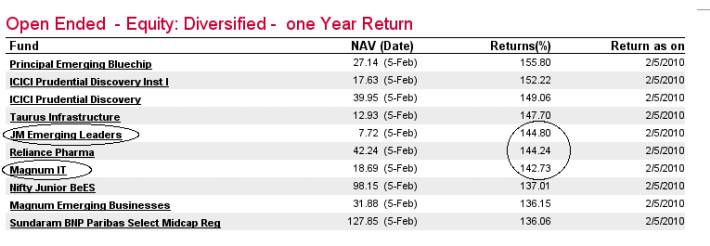
Want to buy a mutual funds which has given 105% return in 2009 ? Go ahead .. How do most of the people choose a mutual fund ? Let us try it ones , Goto Valueresearchonline.com and find Top 10 funds across all the equity funds with 1 yrs performance . Below is the example of the page I got. So all these funds have given more than 100% return over the last 1 yr . Now its pretty simple to choose them, right ? Just pick any of them and you have done your “Investment Planning” !!. Farther from truth. Most of the mutual funds starts advertising their mutual funds “great” performance just after a strong market. They will claim there fund has 1st rank in some blah blah category and they have the unique way of investing and what not. Let us see in this article, how we should look at short-term performing mutual funds and evaluate them on different parameters

best mutual funds in 1 year How to look beyond short term returns in Mutual Funds

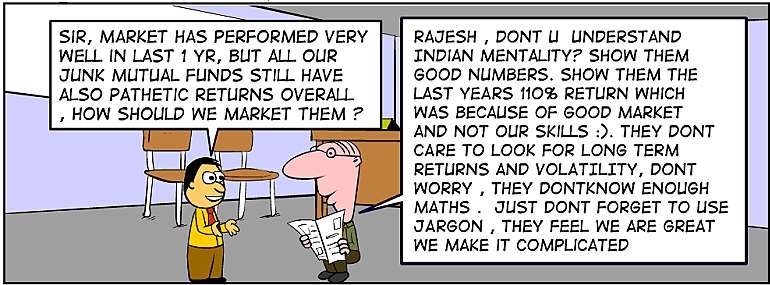
How Mutual Funds are marketed

Let’s take a case of “JM Emerging Leaders” Mutual Fund . Lets try to look at the points which a Mutual funds company can use to attract customers and What is the reason for each of them .

Its one of the 10 funds on the return parameter out of thousands of Mutual funds in this planet. Its 1 yr return is 144% .

True , but what are the reason for this? The fund is extremely risky, risky to the extent you can’t imagine, the fund portfolio looks like this

Mid Cap : 56.18%

Small Cap : 43.82%

(as of Feb 7 , 2010)

Now what else do you expect from a fund which has all 100% of its money in Either Mid cap or Small Cap companies, which moves like crazy after a big bear market. If the fund is so great in 1 yr parameter, what is the reason its overall return since it came in existence is -5% (negative return in last 5 yrs) . The answer is simple, the fund is exposes too much to Risk . In order to get extremely high returns, its exposing itself to so big risk that the returns over long-term will be unstable and probably low .

The fund beats its benchmark and category average returns by huge margin

This happens for the same reasons we talked above. Benchmark is an Index and its returns are not based on some one’s judgement or decisions , but mutual fund returns are !! . Fund manager decides how aggressively they want to invest in, so if today the fund has beaten its benchmark or Category in positive side, tomorrow when there will be disaster, it will beat its benchmark by huge margin on negative side and the performance will be much lower than the benchmark , its called Beta

Mutual funds high returns myth

NAV more than doubled in 1 year

Again an idiotic comment, It’s all about return, the fund has made 105% return in 2009 , but what is NAV value ? Ans : 7.something % . Its 5 yrs in existence now, started from NAV of 10 and still its at 7.something . At one time in 2009 the NAV went down to Rs 2.9 , this 144% year in last 1 yr has helped it come back to 7.something levels now and still the returns are the marketing factors. I am wondering how it manages to get so much of investment (Fund has 262 crores of Net Asset Value as of 31/01/2010) . Who is putting all the money in this ?

What are the Two important factors you can look at and make a quick opinion

Lets talk about two main things

  • Mean
  • Standard Deviation or Volatility

Mean : Mean is nothing but the average of returns over a particular time. It tells us how much can we expect over a period from the mutual fund. It’s important to look at Mean (average) of Mutual funds return so that we have an average expectation . For some period we can get 20% return , for some period , we can get 10% and for some we can get -15% also . But we have to concentrate on the average . Look at a average return from Equity in Long run from Indian Markets

Standard Deviation : Now this is some thing we never see, what is this? Looks like a scary term from our school maths, but dont worry, it’s very easy thing to understand. Its nothing, but how much deviation you can expect from the average. To clear the point , understand that (10,12) and (1,21) , both have average of 11 , but standard deviation of (1,21) is high because both the values are at much distance from their average of 11 . In that same way if we have two mutual funds say Mutual fund A , which has given returns of 20% and 30% in 2 yrs and we have mutual fund B, which has given return of -10% and 60% in 2 yrs,  both of them have average of 25% (simple average) , but the second mutual funds B has higher standard deviation compared to A. What it means is that its more risky , the return range of B is higher . This is directly related to risk/reward . It’s very risky and very rewarding compared to mutual fund A . So it does not suit general investors who need high and consistent returns .

Look at List of Best Equity mutual funds and Debt mutual Funds

What to look at in mutual funds

So over a long term , we have to choose funds which are higher in Return and Lesser in Risk . That mean is there are two Funds X and Y , we have to look which has higher Mean and lower Standard deviation in returns. This is not true for investors who have extremely high risk appetite and want to take extra risk , in that case this will not be very much recommended .

Make sure you dont calculate these things on just 2-3 data points, make sure you have enough (at least 10-12 numbers) so that its more accurate . In the Table Below I have taken two funds which I consider BAD  and 2 Funds which are GOOD and their quarterly returns from Q1 2006 – Q4 2009 (16 quarters) and finally calculated the Standard Deviation and Mean .


Fund Names BAD FUNDS Average of BAD FUNDS Average of GOOD FUNDS GOOD FUNDS
JM Emerging Leaders-G Magnum IT HDFC Top 200-G DSPBR Top 100 Eqt Reg-G
Quarters Return in % for 1 quarter

Return in % for 1 quarter
Q1 2006 16.19 6.99 11.59 21.67 20.35 22.98
Q2 2006 -13.69 -7.53 -10.61 -10.09 -10.83 -9.34
Q3 2006 -0.66 18.43 8.89 16.93 17.5 16.35
Q4 2006 1.15 29.02 15.09 11.01 9 13.01
Q1 2007 -8.98 1.63 -3.68 -4.27 -4.93 -3.61
Q2 2007 22.26 6.41 14.34 16.59 15.15 18.03
Q3 2007 23.4 -10.04 6.68 15.87 16.75 14.99
Q4 2007 41.65 9.3 25.48 23.46 20.86 26.06
Q1 2008 -40.36 -26.34 -33.35 -23.78 -22.53 -25.03
Q2 2008 -13.84 -2.24 -8.04 -11.04 -12.25 -9.83
Q3 2008 -25.45 -20.02 -22.74 0.89 2.89 -1.12
Q4 2008 -48.73 -37.83 -43.28 -20.2 -21.86 -18.53
Q1 2009 -16.26 -10.24 -13.25 0.52 -0.27 1.31
Q2 2009 81.58 58.27 69.93 47.41 55.33 39.49
Q3 2009 24.8 37.61 31.21 19.38 19.48 19.27
Q4 2009 8.39 15.77 12.08 5.08 5.06 5.09
Standard Deviation

32.24 24.38 27.07 18.39 19.57 17.47
Mean 3.22 4.32 3.77 6.84 6.86 6.82

Interpretation of the numbers

So you can see the Standard deviation and mean of returns for 2 Bad Funds and 2 Good funds and their mean return and mean standard deviation in a single quarter . So you can see that Bad funds have given return of around 3.77% per quarter on average (simple average , not compounded one) and the standard deviation is 27.07% , which means that it can deviate up to 27.07% on the upside or downside with 68% chances. (forget the maths , you have to go into probability and normal distribution and all those things , interested people can look for this link to get more insight on this . similarly the good funds would return on an average 6.84% every quarter with deviation of 18.39% on upside or downside with 68% probability.

Conclusion

So the conclusion of this whole exercise is that we should understand that short-term performance of mutual funds is not what we should be attracted to and we should properly evaluate it with different parameters . We should also concentrate on volatility and risk exposed by the mutual fund .

POLL (please vote, It will help me write a new post)

Comments please , Please share your views on how do you feel about Mutual funds with short-term performance ?


To get Free updates in Future, Subscribe to this Blog. Enter your email address

Post Footer automatically generated by Add Post Footer Plugin for wordpress.

{ 1 trackback }

How many Mutual Funds you should have in your portfolio
February 26, 2010 at 6:55 pm

{ 99 comments… read them below or add one }

1 pattu February 8, 2010 at 5:59 am

Manish,
Great article. Lot of effort. Thanks. When one chooses a open ended fund (ELSS or others) what are the options available at the end of the initial tenure (3 or 5 years) if the fund is still a good fund?
That is, can one continue with same no of units and build the corpus? Or should one exit and restart again? If yes to corpus building can one do this for ELSS as well? Does the policy change from fund house to fund house? Other options like switching funds or redemption are easier. This area is not so clear.

Reply

2 Amit Kumar February 8, 2010 at 7:08 am

@ pattu
Hi if you see for 1,3 or 5 year duration the average returns of ELSS is few percentage points less than than the diversified MFs. So it makes sense to switch to a diversified fund once the lockin period of 3 years is over. But on the other hand we also need to take care of capital gains tax and exit load in case we redeem the newly invested fund within next 1 year.

Reply

3 Manish Chauhan February 8, 2010 at 3:42 pm

Amit/Pattu

Forget my first comment, I looked at Tax/Non-tax funds and found that what Amit says is true . Non-tax saving funds have more returns .

For 10 yrs time frame
————————–

5 top non tax saving equity funds have average return of 23.85% (10 yrs time frame)
5 top tax saving equity funds have average return of 19.33% (10 yrs time frame)

I you had invested 1 lac before 10 yrs in these funds , the corpus would be 8.49 lacs and 5.85 lacs , thats huge difference .

For 5 yrs time frame
————————–

5 top non tax saving equity funds have average return of 27.63% (5 yrs time frame)
5 top tax saving equity funds have average return of 24.15% (5 yrs time frame)

I you had invested 1 lac before 5 yrs in these funds , the corpus would be 3.38 lacs and 2.95 lacs , thats huge difference again in 5 yrs .

Amit , good job man .. I am not sure why there is so big difference . because as per logic Tax saving fund mangers have better chance of putting money in undervalued stocks for long term . but anyways .. Looks like I got a new post . Good work

Conclusion , with the small analysis I did at top , seems like it makes sense to put in non-tax saving funds for long term after we have enjoyed the 80C benefit :) .

Pattu/Amit , Any ideas ?

Manish

Reply

4 Hemant Beniwal February 8, 2010 at 6:45 pm

Manish I think this comparison is wrong:

Funds that are ten years old:
ELSS 16
Diversified 37

So in ELSS we are taking Avg. of best 31% funds(5/12)
but in diversified we are taking Avg. of best 13% funds(5/37)

same with 5 years.

My nature is bit of critic, don’t take me otherwise.

Reply

5 Manish Chauhan February 8, 2010 at 8:43 pm

Hemant

But how does that matter much. We are taking top 5 out of both the category and both the category have “enough number” of funds . Enough number of funds is what should matter here and not the exact numbers . Other wise suppose if there are two classes with 1000 children and 100 children and we want to choose 2 best students of each class , then how will we do it . Obvisouly we will filter out the best out of class one and best out of class two and then do the final selection . I accept that it would be differnet when there are 1000 and 5 people .

But when we enough number of people in each category , it should make sense .

So coming back to the mutual funds example , we have enough number of tax saving MF and non tax saving MF , considering we have to choose where to put the money , we will anyways filter out the bad ones from each category and at the end would have hand ful of good MF from each category, So I feel comparision makes sense .

What do others think about this ? Pattu ? Jagbir ? Amit? Ganesh ? Yogesh ?

Hemant, what do you feel about the argument I gave ? You have some other counter argument ? Lets brain storm :)

Manish

Reply

6 Hemant Beniwal February 8, 2010 at 9:36 pm

Let me try.
Compare averages of top 5 funds & all funds in 10 years.

Funds Avg. Top 5 Funds Avg. All Funds
Diversified(37) 23.86% 15.19%
ELSS(16) 19.33% 13.90%
Difference 4.52% 1.29%

Does this say something. Probability!!

Exceptional students in both categories:
Reliance Growth 25.31%
HDFC Tax saver 24.78%

Reply

7 Manish Chauhan February 9, 2010 at 1:44 am

Hemant

Why are we considering total mutual funds , what we are interested is in comparing the top mutual funds because generally investor will be able to filter out the bad funds on the basis of past performance + ratings etc . So what ever number of funds are there in each category , a investor should be able to pick top X funds in both categories .

no ?

Manish

Reply

8 Hemant Beniwal February 9, 2010 at 8:57 am

Mansih
Say question is “Who are healthy Indians or Germans?” & for decision we picked top 5 healthiest Indians & 5 healthiest Germans. And decision came 5 healthiest Indians are winners. So that mean Indians are healthier than Germans. I have my doubts.

When we are comparing 2 categories, we have 2 take Average of all Funds.(I am not saying ELSS is better)

I must recommend you reading “Asset Allocation” by Roger Gibson.

Reply

9 Manish Chauhan February 9, 2010 at 12:52 pm

Hemant

If the question was just “Who are healthy Indians or Germans?” , then yes , your argument holds, but what about the actions on this information . We should ask why are we asking this question ? If a person is asking this answer of “who are healthy Indians or Germans?” for some particular purpose like Spending time with him or doing some medical survey, in that case he is not concerned with the bottom 99% people and he will already have some filtering machanism for unhealthy participants .

In the same way , when we are asking “Tax funds or Non-tax funds? ” question , we have to take an action of choosing the best funds , and there fore we are only concerned with the top 5-6 funds performance and not how the whole of category is doing . Looks like we need more ideas and brainstorming on this topic ;)

I think it would be a good idea to start one discussion on the Linkedin so that other CFP’s can also put their comments .

Coming back to same point , I think when we compare the mutual funds with their particular category , that is also not correct considering the same argument , we should compare a mutual fund only with the top 8-10 funds in the same category.

Incase you have counter argument , please point out the flaw in my argument so that we can be more focused on this healthy argument :) .

Pattu and other readers , join in please .

Manish

Reply

10 Jagbir February 8, 2010 at 9:38 pm

At first glance, Hemant’s point look ok but as you think more deeply.. its not valid.

its like comparing public transport services of Bangalore and Mumbai… obviously Mumbai has much larger fleet of buses than Bangalore.. but does total number of buses matter in assessing quality of transport? of course, not. It will matter if we are comparing a small town against Mumbai (analogy where ELSS has only 10 schemes while Diversified have hundreds of schemes but this is not the case here.)

and moreover, almost every fund house offers both schemes and many fund managers are also handles both ELSS and Diversified funds, so both have equal weight. number of ELSS are less because of lock-in period and only those people who have to save tax are investing in these funds.

just my 2 rupees :)

Reply

11 Jagbir February 8, 2010 at 9:52 pm

sorry hemant, my reply was for Manish’s post.

well, regarding your figures.. My assumption is that few fund houses are fond of new schemes .. every now and then you can see popping up a new schemes there… does all schemes are great to compare here? aren’t there’s more junk diversified funds than ELSS?

-
Jagbir

Reply

12 Hemant Beniwal February 8, 2010 at 10:17 pm

@ Jagbir
I am not mathematics or statistics student but let me try a thing that I read somewhere. Bell curve – binomial distribution (I think so) where we should remove best & worst 5% sample if we are comparing averages of different size of sample.
So in this case I have removed 2 Funds from ELSS & 4 Funds from Diversified.(Approx. 5% from top & 5% from bottom)

Now see the average:
Diversified 15.12%
ELSS 13.85%
Difference 1.27%

Bas itna hi, manish will feel jago main virus aa gaya.

Reply

13 Manish Chauhan February 9, 2010 at 1:49 am

Hemant

I think applying bell curve here is not a right thing .Comparing the overall average itself is not correct here for the same reason i told earliar , one has to relook the original question .

“Where to invest our money in ? Tax or nontax equity funds” ? Now again i repeat, whoever this investor is , cant he be filtering out the bad funds , if you ask a random person to choose 5 good tax funds , i am sure he will come up with the top funds which you and I looked at valuereserch after some digging in and small finding , same for the non tax saving .

Now its just the matter of finding which is better . And thats where the average thing came in which i originally did on my initial comment , Not sure what is the flaw you see in this approah , in case you still dont agree , can you point out what is the issue in my thinking , may be i am missing something which you are able to see .

I miss Pattu :) here .

Manish

Reply

14 pattu February 9, 2010 at 10:25 pm

Hi Manish, Hemant,

Nice thread of thought. Let me add my cents. First the data is a discrete set and only few in number. So I think one cannot use a Bell distribution and must use the Poisson distribution. This is an asymmetric distribution used for discrete data sets.
However we cannot use this also since we are assuming all the data within each group is identical. This is not true strictly. For example Canara Robeco tax saver has more mid-cap component than Sundaram Tax saver and so on.
So strictly they cannot be compared. In fact you cannot take the mean of ALL ELSS or eq. div. funds because of same issue. The elements of the set are not the same.

What then?

Of course this is true for every classroom because every student approaches the exam differently. The student here is the fund manager and the exam the stock market.

So all we can do is distinguish the best performers over a long time and look at them as Manish did with which I agree.

I suggest a slightly different way to select top performers(this is not for investor but only for person who is interested in such things).

Take the mean of return (hmm..bad idea I know but simply because nothing else can be done!) Take the standard deviation.
Define:
5-star fund: return > mean+2*std-dev
4-star fund: return > mean+std-dev
3-star fund: return> mean
2-star fund: return > mean -std-dev
1-star fund: return >mean-2*std-dev

The point is, I agree with Manish, “a investor should be able to pick top X funds in both categories “. I have just suggested a way to do this.

ps. this is the way we grade students in our institute! It works quite well.

The way I figure as long as you invest in top funds of either category it doesnt matter. As for the discussion with Manish and Hemant, I appreciate Hemant’s remarks but side with Manish

15 Hemant Beniwal February 10, 2010 at 1:57 pm

@Manish @Pattu @Debashish

Oh it’s not over.

Without disturbing your thoughts, let me write my thoughts.
1) Comparison between ELSS & Diversified Equity is illogical.
2) If we have to select 5 Funds out of both categories we can merge them & choose better one.(If we think lockin doesn’t make any difference.)
3) Diversified category in itself is very diversified – Large, Mid, Small, Growth, Value & few are thematic.(I am talking about data of Valuresearch)
4) Mean don’t mean anything in investing.
5) Standard deviation is not the best measure to select a fund. We should consider Sharpe & Alpha.

I know you won’t agree with me.

Now I know it’s not over.

16 Manish Chauhan February 8, 2010 at 3:14 pm

Pattu

With ELSS what differs is just the 3 yr lock in period thing . thats all , other than that every thing is same like Equity diversified fund . So at the end of 3 yrs , we have to look if we are ready to invest in that same fund as fresh investment ? If answer is yes , then there is no point in quiting from that . There is no compulsion from MF that you have to exit from fund at end of 3 yrs .

So at the of 3 yrs , if you look from a fresh investor eye and you find that there is some fund which is doing better than this one (a very small difference should not matter) then you can exit from this current one and invest in other one .

Reply

17 Hemant Beniwal March 2, 2010 at 2:35 pm
18 pattu March 2, 2010 at 4:10 pm

Nice article Hemant, if you look at ELSS and eq-div schemes for lets says 5 or even 10 years the difference bet and worst and best fund % returns will approach the same figure. So If I think long term (3 years is not long term for me) it doesnt matter where I invest as longs as its a good fund. I prefer ELSS because they are some of the oldest funds with good track record.
The article is good but is not useful as its non-committal and doesn’t offer any advice.

Reply

19 Amit Kumar February 8, 2010 at 7:33 am

Hi Manish
I totally agree with your analysis but most of the readers don’t want to take the pain of doing the analysis themselves. They need ready to invest list :) . I feel valueresearch star rating takes care of risk adjusted return over a long period. I did a similar post about choosing best ELSS/Tax Saving funds (which can be extended to any type of fund selection) just keeping in mind the star rating & then risk profile & returns – all 3 tabs easily available on valueresearch.
By the way did you do the cartoon above yourself? Looks excellent & summarizes MF marketing tricks well!

Reply

20 Manish Chauhan February 8, 2010 at 3:50 pm

Amit

I can understand that people dont want to do the analysis themselves, but truly speaking if you see its not a big thing . You just have to copy the returns in an excel sheet and do a =STDDEV() for the range and thats all , for mean you do =AVG() for the range and thats all . given the innovation of copy-paste its not more than 5 min job :) . We can compare two funds in max 5 min :) .

Regarding star rating from different research agencies , its good to believe them , but lets not be totally dependent on them . I would rather use them as filtering machanism , rather than choosing :) .

What do you say ?

Manish

Reply

21 Debashish February 9, 2010 at 11:02 pm

Wanted to reply to Pattu’s comment , how ever did not get a reply button thr.
@ Pattu , Hemant and others , remember 2 things
1-KISS principle
2-.Past performance is no guarantee of future results :)

I have attended a investor conference last yr and a one very good speaker ( do not remember his name but some MD level guy from Reliance MF ) answered to the question of how to select a MF like this- “Chose some 6 well rated diversified fund , 5 yrs down the line 2 of them will outperform the benchmark , 2 will perform in-line and 2 will under perform , but on today’s date you never know which one is which”
-debashish

Reply

22 pattu February 9, 2010 at 11:37 pm

Debashish,

KISS is the way I always do things (I hope!). Forrest Gump is my hero!
As for past performance being no gaurantee, agreed. People only recommend it as a guideline of future results.
If you pick 6 top funds today then
“5 yrs down the line 2 of them will outperform the benchmark , 2 will perform in-line and 2 will under perform” Agreed.
If you pick 6 random funds, who know what will happend. Hence the need to choose wisely now.

Reply

23 Ganesh February 8, 2010 at 10:58 am

Nice article Manish.
I have to read it in detail. Saving it for some free time later.
(Did i see a bit of ToonDoo in the post? :-) )

Reply

24 Manish Chauhan February 8, 2010 at 8:46 pm

Ganesh

Long time no seee :) . Whats up . thanks for the comment . I am looking forward to another post from you :) , last one was great .

Yes I am thinking toondoo is a good addition to the articles :) .

Manish

Reply

25 Jagbir February 8, 2010 at 11:15 am

Again good article Manish. The fund value of Rs. 262 crores clearly says that there are many investors who either understand clearly what they are doing or who dont know anything and make decisions under someone’s influence or in over confidence. btw, if there’s someone who understand clearly then isn’t it more beneficial to invest direct in stocks.
I know one person working in Hero-Honda since many years and his sound knowledge about auto sector.. he prefers direct investing in auto stocks instead of going through mutual fund. what you say?

Reply

26 Amit February 8, 2010 at 11:33 am

Hi Jagbir
I agree that JM Emerging Leader has one of the riskiest portfolio, but I started SIP in the same in October 2008. But seeing its risky behaviour it forms a small part of my portfolio. It has been a rewarding decesion for me (till now). What I find about this fund it does extremely well in rising markets and falls unbelievely low in bear market. Moreover they remained 100% invested throughout the fall of 2008-09. So it makes sence if you invest in this fund in falling market. I don’t know if I would be able to time my exit from this rightly. But then its a small cap offering and its supposed to do so.
As for direct equities are concerned & that too small caps, its even more riskier to buy any one company than buying a portfolio. But One thing to keep in mind is such funds/stocks should form a very small part of your overall portfolio (depending on your personal risk profile) and it may act as a kicker to your overall returns.

Reply

27 Manish Chauhan February 9, 2010 at 12:41 am

Amit

Yes , these kind of funds should make a very small part of portfolio and that too only if one is ready to take high risk . You should exit from mutual funds once you get 1.5 or 2 times the usual or expected return .

Manish

Reply

28 Manish Chauhan February 9, 2010 at 12:37 am

Jagbir

Yes , what you say makes sense, eithe the investors here have no idea what they are doing or they are smart people who know exactly what they are doing , unfortunately 95% fall in earliar category :) .

Regarding your friend, yes if a person has sound knowledge in some sector or stocks in particular, then makes sense to invest directly .

Manish

Reply

29 varun agrawal February 8, 2010 at 12:03 pm

hi manish,
1) i want to know your opinion…
i am having 50k rupees, and dat money i want to secure for my marriage ( means for 2/3yrs),
and i am not at all satisfied with the FD returns now a days..i fixed it last yr for 7% return and nw it is maturing in march..as nw i am wishing to get some gud returns on the same amount..and i can go for littile risk also ( not much )…then in which fund i shud invest in lumpsum?..

2)..will it be good to invest in MF’s as i don’t want to take much risk or again i shud do the FD..( dat i dn’t want)…?

plz guide manish../

Reply

30 Manish Chauhan February 9, 2010 at 12:51 am

Varun

Answer to both is that you should invest in Debt oriented mutual funds , see my list on the blog (archives) .

They are not much risky (little bit) and give good returns compared to FD .

Manish
manish

Reply

31 RAJESH February 8, 2010 at 12:10 pm

Hi manish,
Thanks for Nice article.. I have a question.. How to pay short term capital gain tax other than through One’s working place? If i miss this year, can i pay it next year? Please reply..

Reply

32 Manish Chauhan February 9, 2010 at 1:26 am

Rajesh

You have to pay tax in the year of earning only else it will be considered as tax evasion . What do you mean by “Other than through one’s working place” ?

Manish

Reply

33 RAJESH February 9, 2010 at 11:24 am

How & where to pay STCG tax? i understand that i have to declare my Gains to Accounts department of my company and they will deduct the tax from my salary (Part of TDS). instead of doing so, Can i pay it directly to a bank and use the receipt to file my returns? If yes, Which Bank i can pay? What is the procedure.. I know these are basics which i am not aware of.. Please advise me.. I hope i am clear now..

Reply

34 Manish Chauhan February 9, 2010 at 1:00 pm

Rajesh

You dont have to pay it to any Bank , you have to calculate how much is your total tax and you have pay your tax by the year end to govt , just like you do your form 16 , remember that form 16 is just for salaried employees , if you have any other income like business , realestate , shares and all , it will go to seperate heads . You can then file returns and mention everything . Grab a agent or Tax filers for this .

Manish

Reply

35 Debashish February 9, 2010 at 2:33 pm

Manish ,
If you have higher Capital Gains and your tax form capital gain is around 50% of Tax from Salaried Income , its better not to wait till actual tax filing to pay that tax , as you have to pay interest on Tax due .
I feel its better to Declare the capital gains to your office Accounts Department so that the can deduct correct tax from you .

@Rajesh , if you have substantial capital gains better talk to some tax consultant to find the best path .(Declaring the gain in Office or Pay Advance Tax your self )
:)

Reply

36 Manish Chauhan February 9, 2010 at 9:23 pm

Marshal

What you say makes sense , but do company finance department take care of your capital gains tax on shares or anything which is not company specific ? I dont think so ?

Manish

Reply

37 RAJESH February 10, 2010 at 11:17 am

Hi Debashish & Manish,
The problem is People in accounts department of my company were not aware of capital gain tax. I had to educate them what is STCG & LTCG. Only types of investment they know are insurance (ULIP) & EPF. even i gave Manish’s blog address to read about finacial products to enlighten them.. it became very difficult to make them understand why they should deduct my STCG from my salary. That’s why i am looking for alternative ways to pay my tax.

Reply

38 Marshal February 8, 2010 at 12:55 pm

Excellent article manish, explanation of std dev is superb..
need some article on captial tax calculation on MF, equity and real estate.
Cheers!

Reply

39 Manish Chauhan February 9, 2010 at 1:35 am

Marshal

Thanks man , you should look at http://www.jagoinvestor.com/2009/05/how-to-calculate-capital-gains-and-what_7801.html to understand about capital tax .

Manish

Reply

40 yogesh February 8, 2010 at 7:45 pm

Hi Manish,

Still I haven’t invested in Mutual fund..Only taken one ULIP.
I don’t know how to choose which is better MF.

Which one is better in terms of returns in long term (let say for 10 yrs) ??ULIP or MF??
I want to know in term on returns only not in term of flexibility & other benefits.

I know ULIP is more flexible & has insurance benefits..

Regards
Yogesh

Reply

41 Manish Chauhan February 9, 2010 at 1:34 am

Yogesh

You can see some reference links

Procedure : http://www.jagoinvestor.com/2009/01/95-of-salaried-people-are-rushing-to.html

Video post : http://www.jagoinvestor.com/2009/05/video-post-explaining-how-to-choose.html

Regarding what returns more , a MF or ULIP , it depends on the usage and handling . considering that ULIP is something which general public cant use properly , i would go with MF in returns front .

What do you think ?

Manish

Reply

42 Mukul February 8, 2010 at 7:49 pm

good one on std deviation. really, no one talks abt it. I want to add few more MFs to my portfolio and this one is going to be helpful.
Which ones I have shortlisted, I will let you know shortly.

Reply

43 Manish Chauhan February 9, 2010 at 1:29 am

Mukul

Thanks for the comment, Where are you listing them down from , what criteria ?

Manish

Reply

44 Mukul February 9, 2010 at 3:56 pm

Using valueresearch and rediff money.also reading business forums at the hindu business line.
I am looking at a ELSS fund:sbi magnum tax gain,birla sun life tax relief 96 and hdfc prudence; which one do you suggest?
Also am looking for a MF with debt option.have not started that wrk.

Reply

45 Manish Chauhan February 9, 2010 at 9:25 pm

Mukul

Most of the are good funds , We cant be sure which is the best one or will be best one after 5 – 10 yrs . But diversification would be a good idea . I would say HDFC Prudence is a good one as its a balanced fund but the returns are as strong as other equity funds .

Manish

Reply

46 Mukul February 10, 2010 at 11:41 am

Manish

Can you elaborate the “diversification” part?means diverse percentage of investment in equity and debt or anything else??

Reply

47 pattu February 8, 2010 at 9:01 pm

If the new tax code comes in place there will be no tax saving MFs anymore!

Somehow I prefer to invest in ELLS. Returns are usually lower then top 200 funds or others but many tax saving funds are some of the oldest in the industry. So that give me a picture of some sense of security and projection of returns. My expectations are low. So I will anything greater than 8%. So ELSS works okay for me so far.

Reply

48 Manish Chauhan February 9, 2010 at 1:38 am

Pattu

Yes , your points makes sense . The consistency part is correct i would say. Better that you have put your expectations on the lower side, but should’nt you be little aggresive side . I mean “I go with anything greated than 8%” , is that a kind of compromise with your expectations ?

Manish

Reply

49 pattu February 9, 2010 at 9:50 am

Yes its a compromise. Although I have 50-55% equity exposure in my retirement portfolio, I calculate with 8% returns. I have to invest more per month that way but it cant hurt.

As for the discussion on which is better diversified equity or ELSS, I think it just doesnt matter.
One should always invest with a goal in mind. If you are clear of the amount you need, rough idea of inflation, monthly contribution based on some safe interest rate, you can reach the goal in both types of fund. So any good fund in both categories should do the job.

Reply

50 Manish Chauhan February 9, 2010 at 1:10 pm

Pattu

Your approach is great . You are getting above the “maya” i would say and truely concentrating on the Financial planning and achieving goals . I would say that putting in more by expecting 8% is a good idea overall , because you are lowering your expectations . Any of the two can happen , you will acheive your goals on time as expected (8% , this is almost guaranteed to happen) . The other thing is the you might achieve your targets well before your target date (this is highly probably because i expect the return to be atleast 12% in long run) .

Good one .. Regarding Tax-nontax argument please join in the initial thread , the argument has now shifted to more of logic and mathematics which is my favorite :) ,. you will enjoy i assure you .

manish

Reply

51 Hemant Beniwal February 9, 2010 at 8:24 am

ICICI Pru insurance is showing one ad. on your website
Saving of Rs 7000 every month today = Rs 1 Crore after your retirement
Calculate.

Beautiful sales calculators.

Reply

52 Ganesh February 9, 2010 at 12:25 pm

Its a nice calculator. But a tricky one.
Try this link -> http://www.mygraffitipage.in/2009/09/simple-investment-insurance.html
The numbers might be a bit outdated, by i guess relevant even now.
I posted it a few months back.
Be careful before you dive in to such illustartions.

Reply

53 Manish Chauhan February 9, 2010 at 9:28 pm

Hemant

Those are google ads which comes at random , so it will be changing by time :)

Regaring that calculator , its one by ICICI for i guess there own product . We can beat it with Term + PPF or term + MF (I saw deepak shnoey and Ganesh analysis on this )

Manish

Reply

54 varun agrawal February 9, 2010 at 10:22 am

dear manish
means is it good to invest in debt fund in LUmpsum..?…

regards
varun

Reply

55 Ganesh February 9, 2010 at 12:28 pm

Its a nice calculator. But a tricky one.
Try this link -> http://www.mygraffitipage.in/2009/09/simple-investment-insurance.html
The numbers might be a bit outdated, by i guess relevant even now.
I posted it a few months back.
Be careful before you dive in to such illustrations.

Reply

56 Ganesh February 9, 2010 at 7:16 pm

Oops i posted mine on the wrong comment! Apologies!

Reply

57 Manish Chauhan February 9, 2010 at 9:26 pm

Varun

I would say that its almost same as SIP , SIP comes into picture when you have volatility in the fund , but with debt funds there is nothing like that .

manish

Reply

58 Nikhil February 9, 2010 at 12:04 pm

Hi Manish..

Interesting Article..

Thanks

Reply

59 Manish Chauhan February 9, 2010 at 1:11 pm

Thanks Nikhil

Were you aware of the stddev concept , or is it new ?

Manish

Reply

60 Dr Mohammed Ali Khan F February 9, 2010 at 2:12 pm

I prefer index funds. I only wish we had more variety in index funds and the the fund management charges are lower ( In the US, Vanguard mutual funds have index fund schemes with fund management charges as low as 0.1 %, compared to the 0.5 to 1.5 %, Indian fund houses charge for an index fund.

Reply

61 Manish Chauhan February 9, 2010 at 9:20 pm

Dr Mohammed

Thanks for comment, Do you think the only criteria to choose index funds should be just FMC ?

Manish

Reply

62 Mukul February 10, 2010 at 5:50 pm

One doubt Manish, do i have to pay tax on what i earn out of MFs. Do i pay tax if i purchase stock?

Reply

63 Krish February 11, 2010 at 12:39 am

Great Article Manish….

Reply

64 Manish Chauhan February 11, 2010 at 1:49 am

Thanks Krish

You are a new visitor , right ? Atleast the first comment . what are your thoughts on Tax saving vs non tax saving battle ?

Manish

Reply

65 krish February 11, 2010 at 1:00 am

Manish,
I am new to the equity world. I fequently read your articl on this website and the info. you are giving are excellent. It is very much useful to begineers like me.

I would like to invest in Mutual Fund thru SIP. I have checked about HDFC Top 200-G MF in icicidirect. It shows, 3 year non SIP return as 14.49 % & 5 year (non SIP) return as 26.95 %. But when I try to compare this with SIP, it gives SIP retun as -0.10% (3 years) and 0.11 (5 Years).
My question here is –
1. Will it make much diferrence in return between SIP & non SIP (lumpsum) ?
2. Which one is better to invest – SIP or Non-SIP?

Please clarify!

Reply

66 Manish Chauhan February 11, 2010 at 1:53 am

Krish

Where are you seeing SIP return of -0.10% in 3 yrs and for 5 yrs ? I dont think that is correct . Let me know .

To understand more on SIP you read

- http://www.jagoinvestor.com/2009/03/sip-magic-part-1.html
- http://www.jagoinvestor.com/2009/03/magic-of-sip-part-2.html

SIP is generally better for people like us who wants to do regular investing every month and have no good knowledge of investing .

Answer to your questions are

1) Yes , it does , but you are not sure which one will be better , because in different conditions , one is better than another.
2) SIP will be good in volatile or falling market , lumpsum will be good in rising market , but because you never know the market condition and should not predict it , do SIP.

Manish

Reply

67 krish February 11, 2010 at 2:29 am

Manish
Thanks to you for such a quick response….

I am checking the comparision of SIP / Non-SIP returns as below.

In http://www.icicidirect.com login page, Click on “Mutual Fund – Top picks” under “Market & Research” section. You see SIP & Non SIP return comparision in the left bottom. If you select HDFC Mutual fund from the drop-down menu as Fund House, you get the above said comparision return details.

Could you pls have a look on this?

Thanks!

Reply

68 krish February 11, 2010 at 11:42 pm
69 Manish Chauhan February 13, 2010 at 3:23 am

Krish

I suspect that there is some issue with that page and their calculation . That should not be the case :) . Can you try to calculate your self this thing ?

manish

Reply

70 krish February 12, 2010 at 9:21 pm

Great article on SIP Manish….I keep updating my knowledge day by day from your website….

Thanks for sharing!!!

Reply

71 Profitshastra February 11, 2010 at 11:37 am

I agree with you. I have also provided other criterion on mutual fund selection on our website. I hope it helps everybody.

Reply

72 Manish Chauhan February 13, 2010 at 3:24 am

Thanks for comments :)

Manish

Reply

73 raja February 12, 2010 at 7:43 pm

hi manish

do ulips list the institutions in which they are investing and list them in their websites.do i have the right to know as an investor where they are investing.

i think ulips are good for people who can time the market and use the switch potion available to avoid downfall of the value of their units and stay invested for long term

Reply

74 Manish Chauhan February 13, 2010 at 3:09 am

Raja

Definately . It ULIP responsibility to tell you where its investing , they are supposed to send the annual reports to you once a year .Dont you get it . Ask your ULIP about this .

You are correct in understanding of who should invest in ULIP . good point .

Manish

Reply

75 raja February 12, 2010 at 7:48 pm

hi manish

u really r vey helpfull dude.i opened a ppf account reading ur profile and ur analysis on real estate was sensational and superb.iam palnnig a lot of changes in my profile and ur blog was very helpful.

keep up the good work

thank you
raja

Reply

76 Manish Chauhan February 13, 2010 at 2:47 am

Raja

I am glad you are liking it . Dont forget to forward it to your all friends and family , Let everyone become this movement called Jagoinvestor which aims are empowering each indian with information on financial planning .

Manish

Reply

77 vivek February 13, 2010 at 12:25 am

hi manish
After going through the above posts i found the common concern is ELSS OR EQUITY DIVERSIFIED FUNDS. Well i m not much into this financial stuff, wat i gained is only frm yr posts and then i went through reading abt this perticular topic and also gained from the frends and my own experience over the time. Wat i found is this ELSS has only one disadvantage that is 3 yrs of lock in period. Now many of us will think that wats the big deal in 3 yrs lockin period after all MF are a long term investment and 3 yrs………… certainly not a long term.
BUT……. here lies the catch, not many of u financial gurus has noticed. let me start with my example :
i bought SBI MAGNUM TAX GAIN (g ) in feb 2009 at a NAV of Rs.29/- , i invested 50,000/- and till jan the returns were aprox. 103 % my money was more than 1 lakh. and then the market fall started, today my returns are 85% still gud but i cant withdraw money . had it been an EQUITY DIVERSIFIED fund i wud hv been out of this fund making a handsome profit of more than 100 % within a year and cud hv deposited in other funds. but the irony is, evry here and there people are saying the market will go further down to 14,000 level and i, as a mock investor cant do much rather looking at my asset going further down. and who knows at the end of 3 yrs i wud b gaining only 15-20 % of CAGR instead of 100% in just one yr. Now, my learning frm this experience is dont lock ur money for years in such a good money multiplier tool, there should always be flexibility of withdrawl once ur gain is good……. after all MF are all about LIQUIDITY. WAT U THINK MANISH

Reply

78 Manish Chauhan February 13, 2010 at 1:43 am

Vivek

The problem which you mentioned happens when we dont preplan things , If one thinks he would like to take his money out of MF if markets starts falling then in the first hand he should invest in non-tax saving funds . If a person invests in Tax funds he should only do that if he ready to accept the fact that his money will be locked in for 3 yrs and whatever happens to market , he cant withdraw it .

So i would say that the issue is from investors side not product design . What do you feel about it ? Different ideas?

Manish

Reply

79 Ashutosh February 13, 2010 at 3:48 am

Typo in your first paragraph. “Let us try it ones” => “Let us try it once”.

Great post.

Reply

80 vivek February 13, 2010 at 10:05 am

hi
ur explaination is 100% right.
but my experience is one should invest in liquid funds frm where u can withdraw the money once u gt the desired profit, after all we invest only for profit we simply dont invest for the sake of investing.The only avantage of ELSS is tax saving but there are other tax saving tools. My point is, is it not best to get 100% profit in just one year and get out, then to have 150% return over 3 yrs .
i think u blindly favour ELSS, but dear manish sir smtime small thing make a huge difference,3 yrs is not a small time frame , market could fall and rise three times in theree years giving u the opportunity to withdraw and reinvest and wud give the chance to double ur money each year but you are not looking at this side . ur point is, as a preplanned investor we know that our money is locked for three years, we cant do much in falling market except watching our fund value going down. I think a gud investor should not only be planned, invest in great funds but also be ready and must hv the ability to take profit at right time.
my idea is to take profit in peak market and reinvest again in down market where the probability of making profit is high. similar to the stock market rule. wat u say…………………….

Reply

81 Debashish February 13, 2010 at 12:39 pm

@ Vivek
You are taliking about timing the market here , which is not everybody’s cup of tea , I feel if one can successfully time the market again and again is not it better to directly invest in stocks . I mean how to pay the Fund management fee and fee to a MF advisor/agent.

Reply

82 vivek February 16, 2010 at 12:42 am

hi debashish
i m not talking abt timing the market and also m not talking abt the stocks either.
here i m talking abt the mutual funds, here the rise and the falls are not that sharp.so there are always chanch that u can make gud amount of money if u c ur growth every weekly.
anyways u guys are not tryin to c at this perspective , i dnt mind. this was my understanding and i shared with u guys. even i took sm mutual funds keeping long term in mind but if MF is giving u 100% return in one yr and u still want to keep for 10 yrs and gt 15% CAGR thts totaly on ur preference. and the question of fee and all that , then i must tell u that while buying there’s no fee and selling after one yr is also free.
kismat agar kisika bistar garam karna chahati ho aur use sofe pe sona hai to koi kya kar sakta hai.

Reply

83 Manish Chauhan March 1, 2010 at 4:00 pm

“kismat agar kisika bistar garam karna chahati ho aur use sofe pe sona hai to koi kya kar sakta hai.”

Ho ho .. really amazing analogy :) . Nice one

I got your point vivek , But what funds are these which you are talking about ? I am sure they are risky , what do one do if there is 50-60% dip in one time ? What should be the strategy in that case ?

if one get 100% in profit in one year , then definately it makes sense to take the money out and transfer a chunk in debt , however what will you do after you get 100% profit in mutual funds in 1 yrs ? reinvest or keep in debt ?

I am trying to understand how you manage it ?

manish

Reply

84 Manish Chauhan March 1, 2010 at 3:56 pm

Vivek

In that case you are doing more of “Mutual funds trading” rather than “Investing” .
there is nothing wrong in that , go ahead if you feel its for you ;) , its not an easy task to find out when to get out and when to get in , if you think 100% is what you wanted in 1 yrs and if you get it , its best to get out :)

anyways if we invest in ELSS then we dont have any other choice than wait .

Manish

Reply

85 DG February 13, 2010 at 3:08 pm

Manish, As most of your other articles, this one is also a good one.

The thing is the thing that looks so simple to you is damn complicated for other. So you may say that it is a 5 min job comparing 2 mutual funds using excel but if you look from some one else’s perspective, it may be extremely complicated :) . CAT is always straightforward for a guy who has already cracked it :) . Most of the layman investors are not that IT savvy + they may not have that much of domain expertise to give them the confidence that their calculations make sense.

One question I have is: Is it better to keep taking money out of MFs and investing in other MFs ? What if I stay put in MF x for say 10 yrs and if that MF x has given a return of 15% then would that mean my corpus has grown at a 15% compounded rate ? or should we keep on switching between MFs every 1-2 yrs, take the profits and then reinvest in some other MFs. I know the question may sound stupid but it never hurts to ask ;-) .

I would like to see more on Gold as investment vehicle. There are so many options like Gold ETF, Gold mining MFs, physical gold and now I see a schme by Birla (in collaboration with some one else) where you can lock the gold price today, pay in yearly installments and either get gold in physical form or get certificates. What is your take on that scheme ?

Thanks for your articles,
DG

Reply

86 Manish Chauhan March 1, 2010 at 4:04 pm

DG

Its really a 5 min job once i tell you how to do it .. its some copy paste only :) . If you dont know how to do it , then yes , it can take even hours .

regarding your question , You should not switch very soon , give time to mutual funds to perform , you have to monitor the returns over long term and if you see the performance going down ,then you can switch to other fund :)

Regarding the gold scheme , I dont know much , but i would recommend using plain gold ETF’;s only

Manish

Reply

87 yogesh February 14, 2010 at 5:49 pm

Hi Manish,Pattu,Hemant..

Before deciding for MF shd we also take in account asset allocation ?

Does the fund manager changes asset allocation of the fund if any sector is going down ?
Or asset allocation always remains same & can’t be changed ?

What things we shd need to look into asset allocation ?Shd it be equally
disturbed in all sectors &shdn’t be specific to any sector ?
How shd be ratio?

Plz throw some information in this direction.

Reply

88 Manish Chauhan March 1, 2010 at 4:15 pm

Yogesh

Fund manager decides on sector allocation depending on the market expectations and his research .

Reply

89 pattu February 14, 2010 at 6:57 pm

Manish, is the expert but when it comes to MFs. I take the lazy route. I decide how much equity I need to invest in and then choose a well diversified fund. Maybe two, one with large cap tilt and one small cap tilt. Choosing the fund requires the simple steps Manish outlines in his video. After that it needs yearly review to shift if necessary. I would think of shifting only if there is consistent poor performance.
Taking the SIP route solves many things and investor doesn’t have to worry about timing the market, since the loss will be smaller with time. Watched kettles don’t boil. If you keep watching a fund you would feel its not giving enough retunns. The mantra I follow is choose well, and forget about it for the first 1-2 year to give it a chance after which you could shift.
Reg. asset allocation two things are important; how much equity can you stomach and how you want to decrease it in the coming years. Decreasing involves two steps. Increase debt component as your salary grows and do systematic withdrawal to liquid debt instruments as your goal approaches.
The new pension scheme has a good asset allocation strategy. 50% equity upto 35 years. Equity decreases linearly to 10 % by the time you reach 60. Debt increases correspondingly.

Reply

90 Manish Chauhan March 1, 2010 at 4:16 pm

Pattu

Your strategy is the best .. I cant think more better way to invest in mutual funds by a normal investor with less time in hand :)

Manish

Reply

91 yogesh February 15, 2010 at 7:26 pm

Hi Manish,Pattu,Hemant..

Shd we also take in account sector in which particular fund is investing ?
Is this also imp thing while deciding for MF?

Does the fund manager changes sectors/companies if any particular sector is going down ?

In MF is there any switching options ..like we switch to debt if market is going down in order to save our already earned amt..I am telling in regeards to vivek response..aS he mentioned
there is 3 yr locking period in ELSS program & if we invest in such tax saving
scheme can’t do anything & just can see our money getting reduced(when market is coming down)
can we switch to debt in MF?
Regards
Yogesh

Reply

92 Manish Chauhan March 1, 2010 at 4:25 pm

Yogesh

Its you who have to decide which sector you want to bet on if you are buying sectoral fund ? So obviously its your job to look at which sector a fund is investing in !! .

There is nothing like switching in MF, its only ULIP

Manish

Reply

93 yogesh February 16, 2010 at 10:08 am

Hi Vivek,

I agree with ur views. Once u got sufficient profit can decide to quit & re-invest.

But as u mentioned once we got 100% profit & in case market is faling can’t
we shift to debt to secure our profit & again shift to equity in case market again coming up.

This option is available in ULIP .Not sure in case of MF.

Reply

94 Praveen February 16, 2010 at 11:45 pm

Guys, what do you feel about this article by ET?

Top 10 Fund Houses for the quarter
http://economictimes.indiatimes.com/articleshowpics/5575407.cms

Reply

95 Manish Chauhan February 22, 2010 at 10:46 pm

Praveen

I am not sure if I like this article , they have not talked about how a reader can use this information , what will I do by knowing top 10 fund house , I cant take decision of picking a mutual funds from that .

Manish

Reply

96 NKanani March 5, 2010 at 11:15 am

Praveen,

The basis on which awards are given to Fund houses is not clearly mentioned. So, we cannot be sure of ratings.

Manish,

The awards seem to be given to specific mutual funds for “Platinum” category, which seems to be above Gold category. So, I guess it should help readers in atleast evaluating these mutual funds against others in same category (using valueresearch or moneycontrol).

Reply

97 Manish Chauhan March 5, 2010 at 6:17 pm

NKanani

I would again say that please dont use RATINGS for choosing , always use Ratings for filtering out !! .

Ratings have biasness somewhere , and you cant take them as the source of truth , dont forget the basics , we never rely on anyone .. not even on jagoinvestor , do all the checkings and thinking yourself, choose things applying the principles of choosing .

manish

Reply

98 Astha February 19, 2010 at 5:39 pm

Interestingly interesting discussion!!!

Reply

99 Manish Chauhan February 24, 2010 at 6:34 pm

Astha

Thanks :)

Manish

Reply

Leave a Comment

  • Poll

  • Featured Video

  • Connect on Facebook


  • Poll

  • Sponsors

    Alexa Review
  • Jagoinvestor on TwitterJagoinvestor on FacebookJagoinvestor RSS FeedJagoinvestor EmailGet Mobile Updates