
 Jagoinvestor
 January 28, 2010
What is 80/20 rule and how it applies to Financial Planning
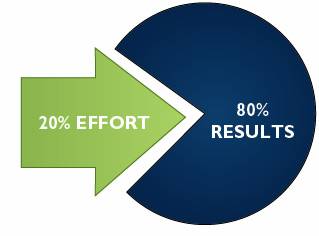
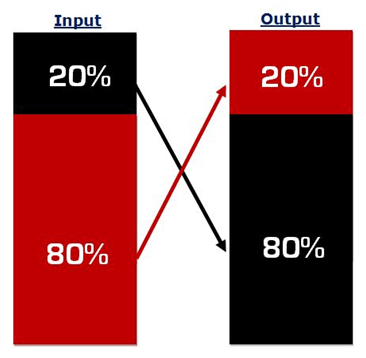
Let us first understand what is 80/20 Rule? It means that 80 percent of your outcomes come from 20 percent of your inputs! It’s also called “law of the vital few” or Pareto principle. This rule applies to almost all the areas of life, even though it’s called 80:20 rule the main idea of this principle is that a large part of outcomes are result of a few number of actions and 80:20 was the best fit for most of the things. A very simple example of this rule is that 80% of the world Wealth is owned by 20% of population. Let us see some example to understand this rule:
- Look back at your exams, 80% of your marks came from the studies you did on 20% of the days 🙂
- If you are coder, you will accept that 80% of the execution time is taken by roughly 20% of the code.
- Even on this blog, 80% of the comments are written by roughly 20% of the readers 🙂
- Also 80% of the total comments are from 20% of the total articles.
- 80% of the recognition you get is for a small amount of work (20%) that you do.
- 80% of sexual satisfaction comes out of 20% of total time spent.
- Most of our worries (80%) are a result of small number of problems (20%).
- 80% of the Assets under management is with 20% Mutual funds.
[ad#link-unit]
 Some Examples from Financial Life
The same 80:20 rule applies to our Financial Life as well…
- 80% of the good returns we get is from 20% of good investments we make or 20% good decisions that we took.
- 80% of the money lost or opportunities lost are result of the 20% small things we didn’t took care of.
- 80% of the money we could have made in Stock markets are due to those 20% of the times we didn’t take risk.
- 80% of the Financial Planning clients are handled by 20% Financial planners (individual or companies) in India.
How to change our way of thinking
There are many small things in our financial life which looks very small but we don’t concentrate on them neither do we appreciate the impact it can have on our financial life. Some of the 20% things which we don’t take care of are:
- Budgeting: A nice article on Budgeting from PV Subramanyam
- Planning for goals by writing it on a piece of paper
- Reviewing our asset allocation and performance of investments every year
- Keeping track of Documents
- Keeping our expectations low or realistic
- Not spending time on increasing knowledge
[ad#big-banner]
These are 20% part which if taken care properly can greatly improve the performance or your returns (at least mental satisfaction) by great deal . We concentrate mostly on things like strategies , “finding best funds” , “finding cheapest plans” , “finding the easiest way to maximize the returns” , but these are 80% part of process which accounts for less than 20% of the success .. Just ask yourself
- How many times have you made money from the best stock tip or best Mutual funds for the year
- If finding the best plan (term plan , ULIP , or any other product) was so easy and clear , why is there so much competition and confusion.
 You have to understand the real goal of financial planning first and then identify the areas you really need to concentrate on .
Here is a 1 hour talk on “Behavioral Finance : Role Of Psychology” from Yale University . Have a look
Comments , please share your views about 80:20 rule . Can you give some other real life example ?
Upcoming Next article : “How to Choose a Financial Planner”

hi,
I am looking for best ULIP plan for My Grandfather his age is 62 yrs . term for 10 yrs
Looking for some pension plan ….
please suggest me….
Rohan
Please dont take any ULIP for grandfather .. the better things would be senior citizen saving account and MIP (Debt) , this would give a better risk adjusted income to him . Dont go with traditional plans .
manish
Hi Manish
A very educative article but lot of people have down to the wire to and commented a lot about using 80 – 20.
All pareto said was related to quality control in manufacturing but now this is being used in all domains. So guys always don’t think 80 – 20, but think that ur small efforts are going to result in big achievements and vice versa 🙂
//Deiva
Deivasigamani
Thanks for the comment , true that little efforts result in the majority part of acheivement , now its upto us that we dont to get that extra 20% by putting another 80% .
manish
80% of marks can be scored by 20% of effort.
But, then, you need 80% of effort to get remaining 20% of marks [Assuming your examiner does not have problem giving 100%!]
NKanani
yes , but depends if u want another 20% or not .. i would rather spent another 80% time as 20% time in 4 different things and get 80% at another 4 places .. so spending 100% total and get 80% at 5 places , rather than spending 100% and getting 100% at one place 🙂
manish
at my age of 54 i m under insured by 40 lacs as per various advises. i have corpus of 10 lacs in various funds,equities and fd. what is the suggestion to get minimum 25000 pm at 60 putting altogether including 15lac retiring benefits?shall i take term insurence, put elss-ulip,pension funds etc?
Ashok
Getting 25000 per month (after tax) can be acheived using around 40-45 lacs . Considering that you have 15 lacs of retiral beniefits , you have 6 yrs in hand and you have to grow 10 lacs into 25 lacs . thats not easy . thats 17% return CAGR . Not that its not possible , but its definately not safe . I would say try to take less risk and settle with 10% return in this age . Invest in couple of Debt oriented Mutual funds + PPF (incase its going to mature by your are retired or you are already retired) and some part in pure equity , this alone can give you around 11-12% , but you can assume 10% to be safe . That will leave you with 32 lacs of retirement lumpsum and close to 18,000 month income , now either you have this choice or take more risk and try for 17% return which can be so risky if things go bad that you will have to settle for lesser income like 12-13k also .
manish
I was watching ET’s Investors Guide. And a viewer has posted some query on how to get Term insurance.The expert listed down some 3-4 points on hows and haves and haves not of it.
I am glad that what ever background work i did prior to taking my term policy, featured in there. And I want to thank Manish for educating me on Term insurance and introducing the split.
So Manish thank you so much.!!
Mukul
I am glad, now its your turn and teach others about it and advocate about term insurance , if they dont understand , bring them here on this blog . it will be mass charity 🙂
ET’s Investor’s Guide ! . is it a show or a Book ? any ecopy ?
Manish
It is weekly programme i think on channel ET.
And yes there are at least 15 new friends of mine who are tuned into your blog. They like it.
I was checking the forums and found that you have Shield policy for yourself. Did you also split it?
Mukul
No man .. I have not split it .The plan of split is such that I need to take one more .
Manish
I liked one point from PV Subramanyam’s blog; Write down the Cash Spending cos cash disappears. Why I like it?
1. Disappears is the right word. Cash really does that.
2. logging your expenditure. This is one age old habit which will stand test of time. And I totally agree it. But there are many who laugh at this habit or ignore it or simply REJECT it.
Log your expenses guys. It ALWAYS helps!
Mukul
Correct , the problem is not less money , its using your money and tracking it and utilizing it in efficient manner . Most of us take care of every thing which comes in our life and in the process many “needs” are compromised for “Wants” . That should not happen 🙂
What do you say ?
Manish
Yes Manish cannot agree any more on this one.
The difference between being Rich and wanting to be Rich; is the will to go extra mile and spend time on money before we spend money itself.
So a not so rich dhirubhai can build/multiply/scale wealth. Cos he started somewhere and persisted.
Think,Revise,Scale,Act…!!
Yep , correct 🙂
Manish
Hey very interesting article. I never knew about this 80:20 rule. Will google it and get some more info.
Also another thing which amazed me was it takes 21 days to form a habit. So if you want to change a habit or form a new one, you have to stick to 21 days rule and it is really difficult, even though 21 days sounds quite easy.
Keep up the good work !
Anu
Thanks for the comment . I do not very much agree with that 21 days rule . I tried it with my gym for 9 months and still its not my habit 🙂 . hehe
Manish
Ah.. this is refreshing one. I recalled my participation on a ‘work-smart’ program and how the instructor introduced this 80/20 rule which applies almost to everything in life. thanks for elaborating its usefulness in financial planning.
.-= Jagbir´s last blog ..Disable ssl ver 2 in apache for pci compliance =-.
Jagbir
Can you give some other example of this 80:20 rule , especially from our domain . What do agree that small things we ignore add up and affect the performance drastically 🙂 ?
Manish
Ya Manish, its true that small things we often forget to give proper attention can cause bigger impacts. some examples of 80/20:
20% of employees are responsible for 80% of a company.
20% percent of customers are responsible for 80% of the revenues.
80% of the profits made in your industry are made by 20% of firms.
20% of the world’s population controlling 82.7% of the world’s income.
We spent 80% of our income in 20% of things (like rent,fee etc.)
We wear our 20% most favoured clothes about 80% of the time.
We spend 80% of the time with 20% of our acquaintances.
some more…
20% of the bugs cause 80% of the crashes in software.
20% of the features cause 80% of the usage in software.
80% crime in country is done by 20% of criminals (in big picture).
80% of work in kitchen is done using 20% of vessels.
Lastly, don’t think the Pareto Principle means only do 80% of the work needed. It may be true that 80% of a bridge is built in the first 20% of the time, but you still need the rest of the bridge in order for it to work. It may be true that 80% of the Mona Lisa was painted in the first 20% of the time, but it wouldn’t be the masterpiece it is without all the details. The Pareto Principle is an observation, not a law of nature.
here’s one fellow stating that 80/20 is not entirely correct: http://blog.davidwurtz.com/why-the-80-20-rule-is-wrong
.-= Jagbir´s last blog ..Disable ssl ver 2 in apache for pci compliance =-.
JaGbir
thanks for the nice list of examples . I agree that rest 80% of the work is important and should be done , but once we complete the first 20% part . The problem is that most of the people ignore 20% part at all .
Manish
Hi
80-20 is now wrong in any sense What it emphasis on that we are more happy/effective to do some task ,some relatioship ,but we used to spend too little with them ( too many tasks , too many relations , too many activities -doing bit of these ,bit of that ,…..)
It emphasis o identify those 20% activities , relationship which gives you maximum happiness ,satisfaction ,achievement & than increase the time spend on those activities ( 3 times say) & you will be very happy ,effective
Hopefully I am able to put my thoughts
But thes source you can find it here
http://www.the8020principle.com/
Regards
Rohit
I feel you wanted to write “80-20 is not wrong” but you wrote “now” 🙂
correct ?
Anyways you have nice points . good work .
Manish
Yes Manish typo error 🙁
Thanks for correction)
“80% of sexual satisfaction comes out of 20% of total time spent .”
You naughty 😉
Pradip
Well .. this is one area I think 80:20 really fails .. the better ratio is 99:1 😉
Manish
That was an interesting article. To understand and think through the applicability, need to read this again. Somehow, I am not convinced completely with this. But again, I may be wrong… let me re-dig this 🙂
.-= Mohan´s last blog ..Decoding Financial Advisers – Part 1 =-.
Mohan
There might be cases when 80:20 does not apply, it may be 90:10 or 95:5 or may be 70:30 .. but the inherent idea remains the same in almost all the areas 🙂
Manish
Liked this 80/20 Pareto principle. So what do you think which side of 82/20 would this post be (in terms of comments).
But anyway I don’t agree totally to 80/20 thing. Take for eg this post- if it falls in top 20% posts which makes 80% of your comments, the other 80% posts have also contributed in its popularity. Similarly in investments its 20% which gives 80% profits is just because you knew that the other 80% was dud or learnt a lesson because of that & then invested in this 20%. So the other 80% has also contributed some way in your profits but probably cannot be quantified.
😀 seems like too much of 80 & 20 in my comments!
.-= Amit Kumar´s last blog ..6 Commonly used Financial Calculators =-.
Amit
Its still early to tell which side it will be . Your reasons are valid , however the rule still applies not matter what the reason is , thats what 80:20 principle is 🙂
Manish
90 trillion – The number of emails sent on the Internet in 2009. and 81% is spam
check this out http://royal.pingdom.com/2010/01/22/internet-2009-in-numbers/
🙂
Cheers
Marshal
Marshall
Great information 🙂
Manish
90 trillion – The number of emails sent on the Internet in 2009. and 81% is spam….
check this out http://royal.pingdom.com/2010/01/22/internet-2009-in-numbers/
🙂
Cheers
Marshal
Hi Manish,
nice to see very informative articles. i need to save 1 lac in next 6-7 months for House. Could you pls tell me where should i invest of 15k montly to get good return with moderate risk.
I am thinking of top debt MF to invest? Please advise.Thank you.
Prashant
Just investing for 6-7 months will not fetch you any decent returns unless you take risk , which is not recommended anyways as this is important goal and you cant risk money ,.. I can think of nothing other than FD’s here .. If you can take some risk , better put money in top debt oriented mutual funds : http://jagoinvestor.dev.diginnovators.site/2009/11/list-of-best-debt-oriented-mutual-funds-for-2009-2010.html
can you take more risk than 10% loosing money ?
Manish